

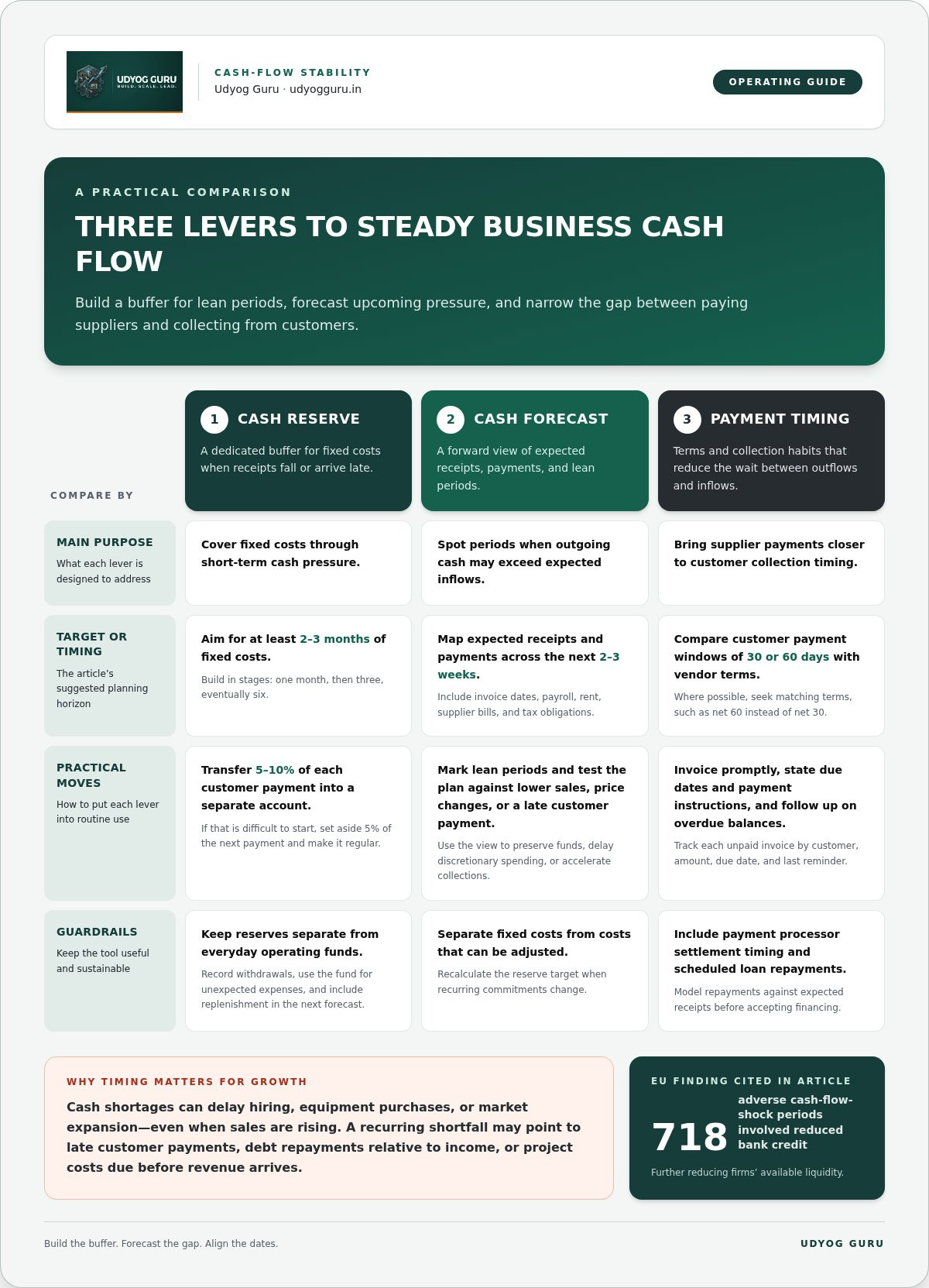
Cash-flow volatility is more than a timing problem: it can limit a business’s ability to grow. To understand how to fix inconsistent cash flow, forecast receipts and payments, build reserves to cover at least two to three months of fixed costs, and negotiate terms that narrow the gap between paying suppliers and collecting from customers. These steps provide a more stable operating base and can reveal whether cash shortages point to a deeper constraint.
Irregular revenue makes everyday decisions harder, from hiring to investing or taking on a larger project. A reserve can absorb short-term pressure, while a forecast helps you spot lean periods early and adjust spending or commitments in time.
This article covers practical ways to reduce volatility: prepare for lean months with cash reserves, align payment terms and collections, and assess how unstable cash flow affects growth. It also explains how to identify the underlying pattern, since a recurring shortfall may stem from late payments, heavy debt repayments, or costs that fall due before revenue arrives.
Key Takeaways
- Set a reserve target of two to three months of fixed costs, then build toward it through regular transfers from incoming payments.
- Reduce timing gaps by invoicing promptly, following up on overdue balances, and seeking vendor terms that align with the 30- or 60-day payment windows offered to customers.
- Cash-flow instability can constrain growth: according to the European Union, 718 adverse cash-flow-shock periods involved reduced bank credit, further reducing firms’ available liquidity.
- Identify the source of recurring shortfalls by examining late customer payments, debt repayments relative to income, and the timing of major project costs.
1. Building cash reserves for lean periods
Cash reserves help cover fixed costs when receipts fall or arrive late. Set a target that covers at least two to three months of fixed costs, then compare it with the cash available. Keep the reserve separate from everyday operating funds so routine spending does not gradually use up the buffer.
Build the reserve through a repeatable transfer rather than relying on occasional surplus. A service business can move 5-10% of each customer payment into a separate bank account. If that feels difficult to implement immediately, set aside 5% of the next payment and establish the transfer as a regular step.
Build the reserve in stages: first aim to cover one month of ongoing expenses, then three months, and eventually six months. Include recurring commitments such as rent, payroll, utilities, and essential supplier costs. Recalculate the target when these commitments change so it reflects the business’s current costs.
A forecast turns the reserve target into a working plan. Map expected receipts and payments across the next 2-3 weeks, including invoice dates, payroll, rent, supplier bills, and tax obligations. Mark periods when outgoing cash exceeds expected inflows. That view shows when to preserve funds, delay discretionary spending, or accelerate collection efforts.
Test your forecast against realistic scenarios, such as lower sales, price changes, or a late customer payment. Note which costs are fixed and which can be adjusted. This helps you tell a temporary timing gap from a reserve target that no longer matches the business’s commitments.
Set clear rules for adding to and drawing from reserves. Record the reason for each withdrawal and include a replenishment step in the next forecast. Use the fund for unexpected expenses, not routine shortfalls. This discipline can ease borrowing pressure in lean periods and make the underlying cash-flow problem clearer.
2. Negotiating payment terms with lenders and vendors
A practical approach to how to fix inconsistent cash flow is to align payment dates across customers, suppliers, and lenders. If customers receive 30 or 60 days to pay, ask vendors for matching terms; where possible, negotiate net 60 instead of net 30. Record agreed dates and amounts, then compare them with expected revenue and scheduled loan repayments.
Short-term financing options for Indian small businesses include an overdraft or another financing solution arranged while the business’s financial position is strong. Costs depend on the lender’s terms, amount used, and repayment structure. An accountant can help assess whether projected receipts can cover repayments without disrupting operating expenses.
Invoice promptly after completing work or supplying goods. State the due date and payment instructions clearly, then follow up on overdue payments. Track each unpaid invoice by customer, amount, due date, and last reminder. Accounts receivable can look healthy while the cash is still unavailable, and payment processor delays can extend the wait. Include settlement timing in your forecast.
Reduce expenses without harming operations by reviewing the budget, renegotiating supplier contracts, and removing overheads that don’t support delivery or revenue. Protect spending required for customer commitments, essential systems, and collections. An accountant can help distinguish avoidable costs from operational necessities.
Loans and credit can bridge a temporary gap, but interest and repayments add future obligations. If late collections or recurring costs are causing the shortfall, borrowing may make it worse. Model repayments against expected receipts before accepting financing. If a payment date is at risk, contact the lender or vendor early to discuss revised timing before it is due.
Use structured cash-flow tracking to view incoming payments, outstanding invoices, and obligations together.
3. Effects of cash flow volatility on business growth
Volatile cash flow can delay growth even when sales are rising. A business may postpone hiring, equipment purchases, or market expansion because cash is needed for payroll and supplier bills. According to the European Union, 718 adverse cash-flow-shock periods involved reduced bank credit, further reducing firms’ available liquidity. This illustrates how a shortfall can narrow access to funds precisely when operations need them.
Growth depends on timing as well as revenue. A company may need to pay for materials and labour before receiving a project’s final payment. Late customer receipts can force management to defer the next project or limit orders, even when expected sales look strong. Before approving expansion, compare planned investment dates with projected collections and committed costs.
In India, GST deadlines must be planned alongside payroll, supplier payments, and other outflows. Delayed customer receipts or funds used elsewhere can leave a business short of cash near an applicable payment date. Add GST obligations to the cash calendar and set aside funds as receipts arrive.
Cash volatility can distort decisions about debt and investment. A business may use credit to cover a temporary gap, then find repayments competing with operating costs. Before taking on a commitment, model how late receipts or lower sales could affect repayment capacity and planned growth spending.
Review the effect on growth to distinguish a timing problem from a structural one. Compare forecast cash with actual receipts, identify delayed projects or investments, and trace each shortfall to collections, costs, or debt payments. If the same constraint repeatedly blocks hiring or delivery, revise the operating plan before making further commitments. Stable liquidity supports execution; recurring gaps can keep viable opportunities out of reach.
4. What causes inconsistent cash flow in small businesses?
Late customer payments create a gap between recorded sales and cash available for operations. A small supplier may deliver goods and issue an invoice, yet need to pay staff before the customer settles. Review receivables by due date and check whether delays stem from disputed invoices, unclear payment instructions, or late approvals.
Debt repayments can strain cash flow when instalments use too much of the cash the business generates. Even steady sales may not prevent a shortfall if loan repayments fall due before major customer receipts arrive. Compare repayment dates with expected collections and assess whether high-interest debt or overlapping obligations are restricting working capital.
Large projects can create uneven cash flow because costs often arrive before project revenue. A contractor may pay for materials and labour during delivery, while customer payments depend on project milestones. Periodic maintenance can also bring substantial costs alongside revenue. Map project costs, milestone invoices, and maintenance needs to uncover timing gaps.
Revenue concentration and seasonal demand make receipts less predictable. A business that relies on one large customer may face a sharp shortfall if that customer delays an order or payment. A seasonal retailer may earn most of its revenue during peak demand, then face quieter trading while rent, payroll, and supplier costs continue. Compare customer receipts and monthly sales patterns to spot dependencies.
Start by diagnosing what is driving each shortfall. Compare bank transactions with invoices, loan schedules, project costs, and recurring commitments. Classify each gap as a collection delay, revenue fluctuation, debt burden, or cost-timing issue. If causes overlap, address their combined effect rather than treating each dip as isolated. This diagnosis shows which process needs adjustment and which commitments are creating recurring pressure.
Udyog Guru: Business X-Ray™ (Tier 1)
Udyog Guru’s Business X-Ray™ (Tier 1) is a structured next step when cash-flow problems point to wider operational weaknesses. Use it to examine how business systems connect, then identify where processes may be affecting financial stability and growth. If the diagnosis shows that broader operational change is needed, the Business Acceleration Engine™ (Tier 2) provides a further transformation framework. For businesses exploring technology and automation within existing workflows, the AI Tech Business Integration Bootcamp (Tier 3) focuses on that integration. These offerings are relevant when reserve-building and payment-term adjustments alone don’t address the underlying system. To discuss a structured review of your business, visit Udyog Guru’s website.
Build cash visibility into everyday decisions
A lasting approach to inconsistent cash flow makes financial visibility part of routine management, not something reserved for a crisis. Assign responsibility for reviewing cash-flow signals, connecting them to operating decisions, and recognizing when recurring problems require a wider systems review. This gives you a clearer basis for deciding what to change next.
When cash pressure appears connected to broader business processes, Udyog Guru’s Business X-Ray™ (Tier 1) offers a structured transformation framework. The Business Acceleration Engine™ (Tier 2) supports broader business transformation, while Workforce X-Ray™ focuses on workforce optimization. These offerings can be relevant when the next step involves examining how operational structure, growth plans, and team performance fit together.
Choose the next step based on the constraint you’ve identified, rather than adding changes without a clear diagnosis. To discuss a structured review, contact Udyog Guru about your business systems. A measured, evidence-led process can help you move forward with greater clarity.
Frequently Asked Questions
How often should businesses update cash flow forecasts?
Update the forecast regularly and whenever a major assumption changes, such as a delayed payment, new order, or unexpected expense. Review near-term receipts and obligations often enough to act before a shortfall reaches the bank balance. For example, revise collection dates as customers confirm payment timing, then compare forecasts with actual transactions to improve future estimates.
What are practical ways to speed up customer payments in India?
Set clear payment terms before work begins, request upfront payment where appropriate, and shorten credit periods when customers agree. For ongoing services, monthly payments can make receipts more predictable. You could also offer a 2% early-payment discount if the margin supports it. Explain the discount and its deadline on the invoice, then assess whether faster collection outweighs the reduced revenue.
How can businesses manage late-paying customers and overdue invoices?
Use a consistent follow-up process: send a courteous reminder after the due date, make a direct payment request, and resolve invoice disputes promptly. Record customer responses and agreed payment dates to make recurring delays visible. For chronically late accounts, weigh the likely recovery against the customer relationship and outstanding balance before pursuing debt collection.
How much cash reserve should a small business keep?
A practical reserve target covers at least two to three months of fixed costs. Calculate it from recurring obligations, not sales: revenue can fluctuate while rent, payroll, and essential services continue. If income is seasonal or concentrated among a few customers, account for those risks when setting the target and build toward broader coverage as the business’s capacity allows.
How should businesses manage seasonal revenue and irregular income?
Plan spending around the full revenue cycle rather than treating a strong sales period as recurring income. Forecast lean periods, schedule discretionary purchases for stronger cash months, and set a consistent owner payday, such as weekly or twice a month. Diversifying across products, services, markets, or customer groups can also reduce reliance on one seasonal source of receipts.
What short-term financing options are available to Indian small businesses, and what are their costs?
Indian small businesses may arrange an overdraft or other financing while their financial position is strong. Costs depend on the lender’s terms, amount used, and repayment structure.


