

Scaling faster than your team and operating systems can absorb is a structural risk, not just a hiring challenge. The Startup Genome Report says 70% of startups fail because they scale too quickly without the right infrastructure in place. The common scaling mistakes to avoid are expanding before demand is tested, hiring without milestones, and adding work faster than teams can absorb it.
Growth can create pressure to hire quickly, launch new initiatives and pursue every opportunity. But when capacity is already stretched, more activity can weaken delivery rather than strengthen the business. Avoid common scaling mistakes by tying each expansion decision to evidence, clear workflows and the people available to execute it.
This article explains how to link hiring to business milestones, prepare teams for changing demands, test the market before a wider rollout, document repeatable workflows and prevent overextension. Use these steps to spot capacity constraints and build a more deliberate path to growth.
Key Takeaways
- Tie each hire to a defined business milestone, required outcomes and the capacity needed to deliver them.
- Prepare teams for growth with role-specific training and clear expectations as responsibilities change.
- Test demand with a focused pilot, then use customer feedback and performance measures to guide expansion.
- Document repeatable workflows and assess whether your systems can support increased volume before scaling.
- Prioritise the initiatives your team can execute well, clarify ownership and delegate decisions to reduce overextension.
1. Aligning hiring with business milestones
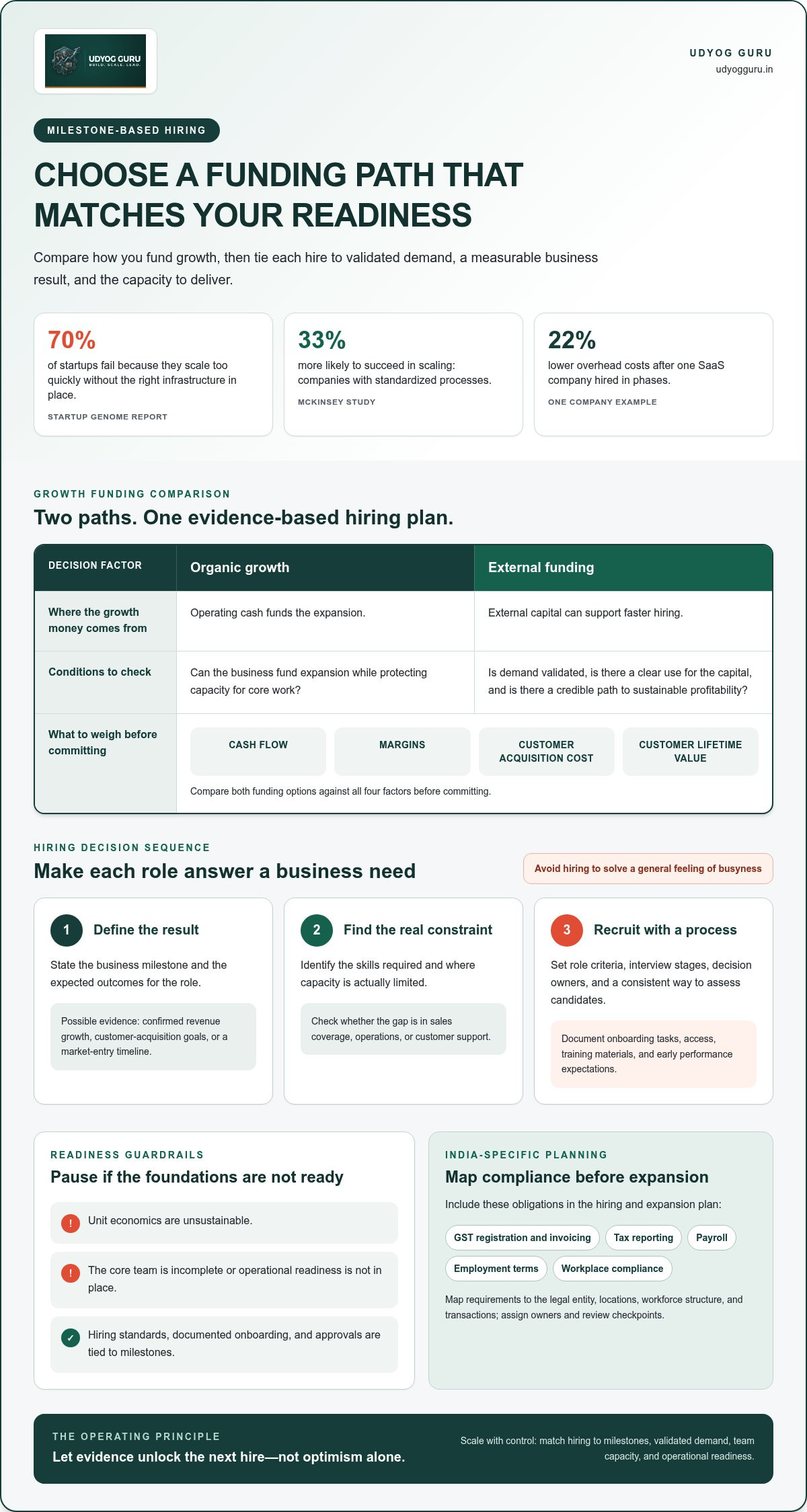
Hiring ahead of demand can add cost without increasing delivery capacity. The Startup Genome Report says 70% of startups fail because they scale too quickly without the right infrastructure in place. Use a milestone-based hiring plan: define the business result, identify the skills required, then connect recruitment to evidence such as confirmed revenue growth, customer-acquisition goals, or a market-entry timeline. This replaces optimistic forecasts with observable triggers.
Before opening a role, define its expected outcomes and the experience needed to achieve them. For example, a company entering a new market should first confirm launch timing, expected customer volume and service requirements. Then identify whether the real constraint is sales coverage, operations or customer support. This prevents hiring to address a general feeling of busyness instead of a measurable capacity gap.
Create a repeatable hiring process before recruitment accelerates. Set role criteria, interview stages, decision owners and a consistent approach to assessing candidates. Document onboarding tasks, access requirements, training materials and early performance expectations. This helps new employees understand how work moves through the business and gives managers a shared standard for reviewing progress. A clear process also makes hiring decisions easier to compare across teams.
Leaders matter at the right stage. A founder may manage early recruitment directly, but rapid growth increases the need for experienced people leaders who can coordinate hiring, onboarding, and performance management. Put those responsibilities in place before several teams recruit independently. The McKinsey study says companies with standardized processes are 33% more likely to succeed in scaling than companies without them. One SaaS company reduced overhead costs by 22% by hiring in phases.
Organic growth suits a business that can fund expansion from operating cash while protecting capacity for core work. External funding may support faster hiring when validated demand, a clear use for the capital and a credible path to sustainable profitability justify the added obligations. Compare both options against cash flow, margins, customer acquisition cost and customer lifetime value before committing.
In India, scaling can affect GST registration and invoicing, tax reporting, payroll, employment terms and workplace compliance. Map these obligations to the business’s legal entity, locations, workforce structure and transactions. Assign owners and review checkpoints before expansion, and include the compliance map in the hiring plan rather than leaving it until recruitment begins.
Avoid scaling when unit economics are unsustainable or the core team is incomplete. Hiring standards, documented onboarding and approvals tied to milestones help leaders scale with control, instead of letting headcount outrun operational readiness.
2. Providing training during rapid growth
Rapid growth changes the work, the risks and the decisions employees must make. Training should cover role-specific capabilities as well as skills for adapting to changing conditions. A sales team may need updated product knowledge, while new managers need practice prioritising work and escalating customer issues. Without this preparation, employees may follow outdated procedures even as customer volume and operational stakes change.
Build training around real workflows, not generic presentations. Identify recurring tasks, decisions, handoffs and exceptions in each role. Then provide practical guidance through demonstrations, checklists, supervised practice and manager feedback. For example, a customer support team can rehearse how to classify urgent requests, route complex cases and communicate delays. Update the material when products, customer expectations or team responsibilities change.
Growth plans need a filter. List active opportunities and compare each with the business’s core mission, available capacity and customer evidence. Choose initiatives the team can execute well, and defer projects that would divide attention across unrelated priorities. This protects culture by making clear which outcomes matter and how employees contribute. Explain why a priority was chosen, who owns it and what work will pause.
Set measurable goals before expanding delivery or adding training. Track growth alongside margins, profitability, customer acquisition cost and customer lifetime value. Add operational indicators that reveal pressure early, such as unresolved support requests, repeat complaints, missed handoffs or rework. Review these measures together: rising sales combined with weakening margins or more complaints points to a capacity problem, not an automatic reason to accelerate.
Customer experience must remain part of the operating plan. HubSpot reports that 88% of customers say the experience a company provides is as important as its products or services. Gather feedback through surveys, reviews, and direct customer conversations, then assign owners to resolve recurring issues. Harvard Business School reports that increasing customer retention by 5% can boost profits by 25-95%. Retention and service quality therefore belong beside acquisition targets, not beneath them.
To scale a small business sustainably in India, set a market-aware plan, protect cash capacity, train teams for changing responsibilities, and expand against measurable demand. A cash reserve sufficient for 3-6 months of operations can help businesses manage expansion pressures. Monitor margins, profitability, customer acquisition cost, customer lifetime value, retention, and service problems together. No single growth metric can reveal whether the operating model is ready.
Translate those measures into a focused review of priorities, team capability, and operating capacity before adding new initiatives. A structured business growth planning approach can help connect training and customer outcomes to execution decisions.
3. Testing the market before scaling
An exciting expansion can still fail if customers don’t need the offer or its delivery model. A lack of clear market need can make it harder for a startup to succeed. Before committing revenue, infrastructure, or team capacity, test the customer problem, target segment, pricing, and delivery assumptions. Market research, customer surveys, and focused discussions can reveal whether interest reflects a real purchasing need.
Define the category, ideal customer profile and route to market. Then compare pricing and packaging with the value customers seek. For example, a service business might test a limited package with existing customers, recording purchase decisions, objections, repeat use and support needs. Distinguish actual demand from polite interest: completed purchases and sustained use are stronger signals than expressions of enthusiasm.
Use a controlled pilot before expanding to new regions or customer groups. A retail startup tested a subscription box with 500 customers; the pilot exposed logistical issues, and addressing them improved profitability by 30% during the full launch. The practical sequence is to choose a narrow audience, define success measures before launch, collect performance data, and adjust the offer or delivery process. Expand only when the pilot supports the next commitment.
A business is ready to scale when it has defined its category, ideal customer profile and routes to market, demonstrated demand and identified a clear path to sustainable profitability. Its operations must also support the proposed volume. If customer interest rests on untested assumptions, extend the pilot rather than treating an optimistic forecast as evidence.
Financial mistakes include projecting revenue from early interest, committing fixed costs before demand is validated, and overlooking cash-flow pressure during expansion. CB Insights states that 29% of startups fail due to cash flow mismanagement. Model expected sales against delivery costs, customer acquisition cost, margins, and payment timing. Preserve a cash reserve sufficient to cover 3-6 months of business operations, and stage spending against measurable results.
For a new product, market or customer segment, set a test budget and decision rule before launch. Review conversion, repeat purchases, fulfilment issues and customer feedback together; revenue alone can hide weak margins or costly service demands. If results miss the target, revise the segment, packaging, price or route to market, then test again. This helps businesses avoid expanding an unproven model across India.
4. Documenting workflows and implementing scalable systems
Scaling exposes process gaps that informal knowledge can conceal. Document how work moves from request to delivery, including handoffs, approvals, exceptions, and ownership. For example, an Indian distributor can map an order from customer enquiry through stock confirmation, invoicing, dispatch, and returns. That record shows where delays occur and which steps depend on one employee’s memory. It also gives new team members a consistent operational reference.
Start with processes that directly affect customers, cash flow or delivery quality. Ask the employee doing each task to record its trigger, required inputs, actions, decision points and completion criteria. Turn that record into a shared document, checklist or playbook colleagues can follow. A returns checklist, for instance, can explain how to log a request, inspect an item and route the case for resolution.
Documentation should diagnose inefficiency, not preserve every existing step unchanged. Review each workflow for duplication, bottlenecks, unnecessary approvals, and tasks that no longer serve customers. The Six Sigma Global Institute says clearly defined and optimized processes can reduce companies’ operational costs by up to 30%. Use process reviews to identify where simplification or automation may improve consistency before transaction volume increases.
Choose systems that support the documented workflow. CRM systems organise customer information, ERPs connect operational functions, and automation platforms handle repeatable tasks. Map handoffs before implementation, such as how a sales order reaches fulfilment and how a delivery issue returns to customer support. Configure tools around the actual process; without clear ownership, software can simply move confusion into a new interface.
Test the full operating chain before scaling it. Check whether people, information, approvals, and tools work together under a higher workload. An e-commerce company reduced order fulfilment errors by 15% after documenting its shipment and returns processes. A comparable business can test a sample order, record where errors occur, and revise instructions before broader rollout. This makes the workflow measurable and exposes gaps between written procedure and daily practice.
Keep documentation current as products, roles and customer expectations change. Assign an owner to each playbook and review it when a process changes or recurring exceptions appear. Remove steps that no longer fit the operation, then train affected teams on the revised sequence. A shared version history helps staff find the current procedure. Review each handoff regularly to confirm it still works as volume grows.
5. Avoiding overextension of teams
Overextension happens when a growth strategy creates more commitments than teams can deliver. Leaders may get caught up in attractive opportunities and divide employees among competing priorities. This is one of the common scaling mistakes to avoid when growth outpaces team capacity. The result can be delayed work, unclear ownership and weaker customer service. Choose initiatives that support the core business, assign accountable owners and pause lower-priority projects.
There is no universal pace for scaling without overextending resources. Increase workload only when teams can maintain quality, meet deadlines and absorb new responsibilities without persistent backlogs. Before approving an expansion, review delivery capacity, unresolved customer issues and employees’ current responsibilities. If core work is already slipping, another initiative can deepen the bottleneck instead of supporting growth.
Gallup data cited on employee workload indicates that overworked employees are 23% more likely to experience burnout. The American Psychological Association reports that 45% of employees attribute workplace stress to heavy workloads. Treat workload as a strategic signal, not solely an individual performance concern. Repeated overtime, rising errors, stalled handoffs, and missed breaks can indicate that capacity needs attention.
Map the work before adding more. List active projects, estimate the people and skills each requires, then compare demand with available capacity. For example, a services firm entering a new market could assign one team lead to protect existing delivery while another group tests the expansion. If both efforts rely on the same specialists, stage the work or drop a lower-value commitment. Treating shared specialist capacity as unlimited is another common scaling mistake to avoid.
Define roles and decision rights so routine work does not queue with the founder. Develop mid-level managers to own delivery, resolve standard issues and escalate exceptions using clear criteria. Give teams shared goals and regular communication so employees understand trade-offs and coordinate across functions. Delegation requires direction, authority and context; leaders must then let managers act within those boundaries.
Cross-train employees on essential tasks so work can continue when someone is unavailable. Contract or interim professionals can also address specific skill or workload gaps during uncertain periods. Match each arrangement to a defined need and clarify ownership before work begins. These options give leaders flexibility without scattering permanent teams across every new opportunity.
Review capacity alongside delivery quality and retention signals. Reassess priorities, redistribute work, and develop managers before pressure becomes normalised. A workforce-capacity assessment can identify where responsibilities and team structure need adjustment; assess your team’s capacity.
Udyog Guru: Business X-Ray™ (Tier 1)
Business X-Ray™ (Tier 1) gives business owners a structured starting point for examining the systems behind growth. Turn to it when hiring, workflows, team capacity, and expansion plans feel disconnected, and you need to identify where operational alignment requires attention.
For workforce-specific concerns, Workforce X-Ray™ focuses on team performance and delegation. Business Acceleration Engine™ (Tier 2) supports the broader business transformation framework, while the AI Tech Business Integration Bootcamp (Tier 3) focuses on embedding AI and modern technology into existing workflows. Each offering addresses a different part of the growth system, so choose according to the issue you need to examine.
To explore how Business X-Ray™ may fit your scaling priorities, visit udyogguru.in.
Make your next growth decision deliberate
A disciplined growth plan accounts for common scaling mistakes to avoid by treating each expansion as a decision point, not an automatic response to rising demand. Before committing, identify the constraint that could undermine the next stage and determine who owns the decision. This creates a clear basis to proceed, adjust the plan, or pause while the business strengthens its foundations.
Udyog Guru’s Business X-Ray™ (Tier 1), Business Acceleration Engine™ (Tier 2), and Workforce X-Ray™ address business and workforce transformation needs through distinct offerings. They can be relevant when growth decisions require a closer examination of business systems, team performance, or the structure supporting execution.
Choose a next step that matches the issue you need to resolve. Contact Udyog Guru to discuss your growth priorities and move forward with greater clarity and control.
Frequently Asked Questions
What are the most common mistakes businesses make when scaling?
Hiring without clear role definitions and expanding before validating demand are common scaling mistakes to avoid. So is treating rising sales as proof that every part of the business is ready for more volume. A business, for example, might add a sales channel without assigning responsibility for returns or customer questions. Link each new commitment to an owner, a customer need and the operational work it creates.
How can businesses maintain product or service quality during rapid growth?
Maintain quality by defining observable delivery standards and reviewing actual work against them. A manufacturer, for example, can inspect samples from each production batch and record recurring defects by type. A professional services firm can review completed work against a checklist. When errors cluster around a task or handoff, correct that point in the workflow and provide targeted guidance before increasing volume.
What hiring and management mistakes commonly occur during business scaling?
Common mistakes include hiring for an undefined need, holding managers accountable without giving them authority, and routing routine decisions through senior leaders. These patterns slow decisions and obscure ownership. Before filling a role, describe the decisions it owns and the results it must deliver. A manager responsible for supplier coordination, for instance, needs clear limits for resolving routine delivery changes without waiting for founder approval.
How can companies avoid scaling operational bottlenecks and inefficient processes?
Trace a real transaction from start to finish, then identify where it waits, gets repeated or needs correction. Automating a broken handoff before clarifying who provides missing information is a common scaling mistake to avoid. For a service request, specify the required intake details, who reviews them and when to escalate. Fix the sequence before adding volume or tools.
What are the risks of expanding into new markets too early?
Entering a market without understanding customer expectations can lead to weak conversion, delivery friction and demands the existing offer cannot meet. Buyers may need different payment options, product information or after-sales support. Assuming the current model transfers unchanged is a common scaling mistake to avoid. Test the offer with a defined customer group and use observed buying behaviour to shape the wider launch.
What GST, tax, labour law, and compliance issues arise when scaling a business in India?
Scaling in India can affect GST registration and invoicing, tax reporting, payroll, employment terms and workplace compliance. Map these obligations to the business’s legal entity, locations, workforce structure and transactions, then assign owners and review checkpoints before expanding.


