

A business that runs with less day-to-day owner involvement is built through deliberate systems, not simply by adding automation. Building a business that runs itself means documenting repeatable work, assigning clear ownership, automating suitable tasks, and creating reliable ways to bring customers back. The owner still monitors performance and handles exceptions, but routine operations no longer depend on constant personal intervention.
Automation can reduce repetitive work, but technology alone won’t fix unclear processes or unpredictable revenue. Customer retention matters just as much: repeat business can make cash flow more dependable and ease the pressure to find every sale from scratch.
This guide explains how to map and document workflows, decide what to automate, delegate responsibilities, and address obstacles that can stall progress. It also covers practical ways to improve cash-flow predictability and build customer experiences that encourage loyalty and repeat purchases. The goal is to make the business less dependent on you, without treating “runs itself” as a promise of zero oversight.
Key Takeaways
- Map recurring work into clear steps, assign ownership, and automate tasks only after the process is documented.
- Identify operational bottlenecks and plan improvements around your goals, available capacity, and the work that still needs human judgement.
- Improve cash-flow predictability by tracking when money comes in and goes out, then aligning expenses and sales activity with those patterns.
- Build repeat business through consistent customer experiences and follow-up processes that make the next purchase easier.
- Assess business models by how repeatable their workflows are and how readily routine tasks can be documented, automated, or delegated.
1. Documenting and automating business processes
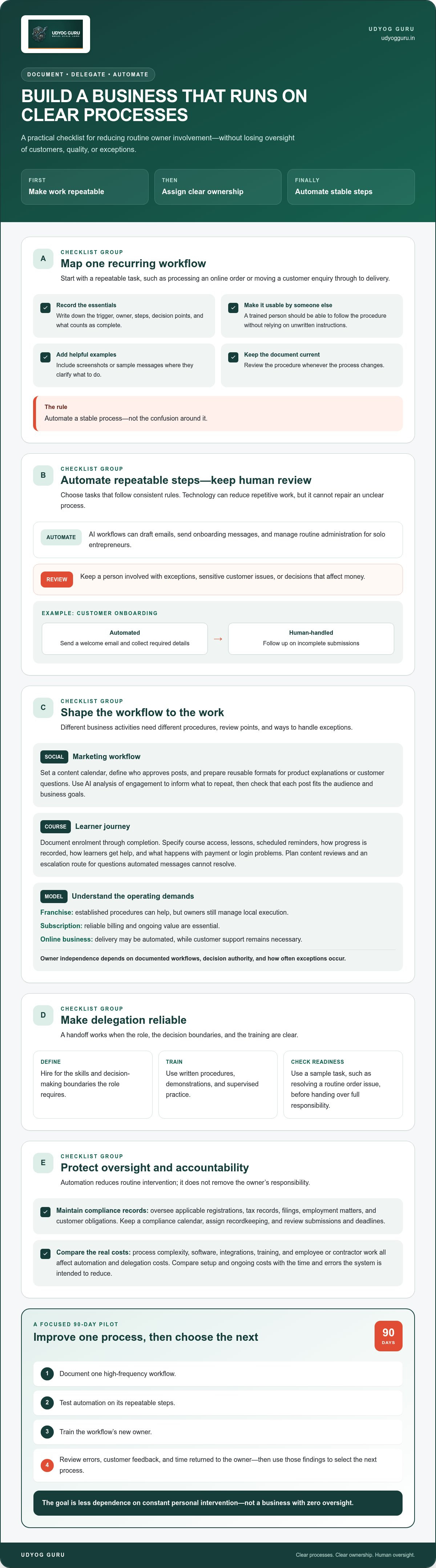
Start by recording how recurring work gets done, from a customer enquiry to final delivery. Choose one workflow, such as processing an online order, and document its trigger, owner, steps, decision points, and completion standard. A useful procedure lets another trained person complete the task without relying on unwritten instructions. Add screenshots or sample messages where they clarify what to do, then review the document whenever the process changes.
Next, identify repetitive steps that follow consistent rules. AI workflows can handle tasks such as drafting emails, sending onboarding messages, and managing routine administration for solo entrepreneurs. Keep a human review step for exceptions, sensitive customer issues, or decisions that affect money. For example, an automated onboarding sequence can send a welcome email and collect required details, while a person handles incomplete submissions. Automate a stable process, not the confusion around it.
Social media marketing also benefits from a documented workflow. Set a content calendar, define who approves posts, and prepare reusable formats for product explanations or customer questions. AI can analyse which posts, hooks, and hashtags drive engagement, helping you decide what to repeat. Treat those findings as input for the next publishing cycle, not a substitute for checking that the content fits your audience and business goals.
For an online course, document the learner journey from enrolment to completion. A platform can provide course access, lessons, and scheduled reminders, reducing repeated manual messages. Specify how learners get help, how progress is recorded, and what happens if a payment or login problem occurs. The course still needs periodic content reviews and a clear escalation route for questions automated messages cannot resolve.
Franchise models may provide established procedures, but owners still manage local execution. Subscription models need reliable billing and ongoing value, while online businesses can automate delivery but still require customer support. Owner independence depends on documented workflows, decision authority, and the frequency of exceptions.
Indian business owners must oversee applicable registrations, tax records, filings, employment matters, and customer obligations. Maintain a compliance calendar, assign recordkeeping, and review submissions and deadlines. Automation does not transfer the owner’s accountability.
Automation and delegation costs depend on process complexity, software, integrations, training, and the amount of work assigned to employees or contractors. Start with a manual-versus-automated task audit, then compare setup and ongoing costs with the time and errors the system is intended to reduce.
Hire for the skills and decision-making boundaries the role requires, then train employees with written procedures, demonstrations, and supervised practice. Use a sample task, such as resolving a routine order issue, to assess readiness before handing over full responsibility.
Over 90 days, document one high-frequency workflow, test automation on its repeatable steps, and train its new owner. Then review errors, customer feedback, and time returned to the owner; use those findings to choose the next process rather than automating everything at once.
Assessing obstacles and planning progress
Progress stalls when the owner treats every operational problem as an isolated event. Diagnose the underlying constraint: unclear authority, inconsistent demand, missing skills, unreliable information, or a process that breaks when exceptions arise. For example, repeated delivery delays may stem from poor inventory handoffs, not too few staff. Record the symptom, its likely cause, and the business outcome affected before choosing a fix.
Businesses designed to need less day-to-day involvement still require upfront work, such as setup, capital, or content creation. Make that workload visible in a progress plan. A new online service, for example, may need course materials prepared before automated enrolment can work. Identify dependencies, assign owners, and protect time for testing. Otherwise, implementation competes with customer delivery and routine operations.
Track performance with a dashboard that connects each goal to a small set of relevant KPIs. A service firm could monitor qualified enquiries, proposal conversion, overdue invoices, and delivery delays, then compare each measure with its target. Give every KPI a clear definition, data owner, and review cadence so employees interpret it consistently.
Use the dashboard to investigate causes, not just outcomes. If overdue invoices rise while completed work remains steady, examine billing timing and follow-up ownership. If enquiries increase but proposals do not, inspect response speed or qualification criteria. Udyog Guru’s Financial Command Dashboard supports financial visibility when the owner needs a consolidated view of business performance.
Automation creates risk when nobody monitors its inputs, exceptions, or failure signals. An outdated customer record can trigger incorrect messages, while a failed integration can interrupt order handling. Assign a named person to review exceptions, document a manual fallback, and test critical workflows after process changes. Automation should reduce routine intervention without removing operational control.
Dependence on one key employee creates another point of failure. If only one person knows how to approve refunds or release orders, their absence can halt the work. Cross-train a second person, document decision limits, and keep current procedures in an accessible shared location. Review access permissions as responsibilities change so continuity does not depend on informal knowledge.
Set priorities against both professional and personal goals before committing resources. If you want fewer interruptions, target routine approvals first. If predictable delivery matters most, address handoffs and capacity planning. Compare each proposed change by its operational effect, implementation effort, and potential disruption. This keeps technology adoption tied to a defined business need.
Use a review cycle to compare expected results with actual performance, then retain, revise, or stop each change. For example, if a new approval rule reduces rework but creates customer delays, adjust its decision boundaries. A structured operational assessment can help identify which constraints deserve attention before further changes are installed.
3. Creating predictable cash flow
Predictable cash flow depends on timing, not just sales volume. Record when customer payments arrive and when expenses leave the account. A business may report completed work while cash remains tied up in unpaid invoices. Map expected receipts against rent, payroll, supplier payments, and other commitments to spot timing gaps before they disrupt operations.
Separate confirmed income from likely sales. A signed project contract, for example, belongs in the committed column, while an unsigned proposal belongs in the pipeline. Build a forecast around expected payment dates, not just invoice totals. If a client pays after delivery, account for that delay against upcoming expenses and plan follow-up before payment becomes overdue.
Review the sales mix for repeatable revenue. A subscription or service retainer can make billing more regular when customers receive continuing value. A one-time project may bring in a larger payment, but its timing depends on new work. Compare the models by payment schedule, delivery workload, renewal patterns, and the resources needed to serve each customer.
Improve collection by making payment steps clear at the point of sale. State the amount due, due date, accepted payment methods, and who is responsible for follow-up. An Indian service business can include clear payment instructions on an invoice, such as a bank transfer or UPI option. Match incoming receipts to invoices so unpaid balances remain visible.
Examine expenses by timing and operational purpose. Supplier contracts, software subscriptions, inventory purchases, and staffing costs affect cash at different points. Renegotiating supplier terms or adjusting order timing may ease pressure without cutting essential capacity. Before changing a contract, consider the effect on service quality, delivery commitments, and the supplier relationship.
Use a rolling forecast to compare expected and actual cash movement. When a large receipt is delayed, update the forecast and identify which planned payments or purchases depend on it. Create a cautious scenario for delayed sales and a stronger one for confirmed repeat orders. These views help owners sequence spending instead of relying on a single optimistic estimate.
Track the drivers behind cash, not just the closing balance. Review proposal conversion, invoice ageing, repeat purchases, refunds, and the time between delivery and payment. If revenue rises while unpaid invoices also grow, investigate collection timing before increasing sales activity. If customers renew but service costs rise, assess whether the offer remains economically sound.
Finally, assign responsibility for maintaining the forecast and recording changes. A small business owner can review upcoming receipts, fixed commitments, and overdue accounts during a regular finance review. Document assumptions behind each estimate, such as expected renewal or supplier payment timing. This makes cash planning an operating routine that can be delegated and improved.
4. Customer retention and repeat business
Repeat business is easier to manage when each customer journey has a clear next step. A design studio, for example, can close a project with a delivery review, maintenance options, and a scheduled follow-up. Record who owns each action and when it should happen. This keeps customer care from depending on the owner’s memory and helps staff deliver a consistent experience across accounts.
Start by identifying why customers return. A grocery business may earn repeat visits through dependable stock and quick issue resolution, while a consultant may rely on useful follow-up after a project. Review customer questions, complaints, cancellations, and repeat orders. These signals show where the experience builds loyalty and where friction drives customers away. Compare feedback with the specific service or product involved.
Build retention into the service process, not just the marketing calendar. After a purchase, send clear instructions, explain support options, and ask whether the customer achieved the intended result. For an online course, a progress reminder can prompt learners to continue, while a support contact handles access problems. Every message should help the customer take a relevant action, rather than simply ask for another purchase.
Use customer segments to make follow-up useful. A salon can distinguish first-time visitors from regular clients and send different reminders based on service history. A business selling consumable products can time replenishment prompts around each customer’s previous purchase pattern. Avoid sending the same offer to everyone: irrelevant messages can weaken trust and increase opt-outs. Make the reason for each message clear.
Make the next purchase simple. Returning customers shouldn’t need to repeat basic details or search old messages for product instructions. Keep purchase history, preferences, and service notes organised in the business’s customer system. A UPI payment option may simplify checkout for customers who prefer digital payment, while clear receipts help both parties track the transaction. Limit customer-record access to employees who need it.
Measure retention through operational indicators, not impressions. Track repeat orders, renewal decisions, customer complaints, cancellations, and time taken to resolve issues. Compare patterns across customer types or products. If a subscription customer cancels after a missed delivery, investigate fulfilment and communication before changing the offer. This diagnosis helps distinguish a service failure from a mismatch in customer expectations.
Close the feedback loop with a defined response. When a customer reports a delayed order, acknowledge the issue, explain the next action, and record the resolution. Share recurring product feedback with the person responsible for delivery or quality. A documented complaint process helps employees respond consistently without escalating every routine case to the owner. Review unresolved complaints so they don’t get lost between handoffs.
Retention supports steadier operations only when repeat demand remains serviceable and economically sound. Review whether returning customers receive the promised value, delivery capacity can meet demand, and recurring work still fits the business’s goals. A well-designed customer journey can encourage loyalty while giving the owner a clearer system to monitor and delegate. Use feedback to refine the experience without adding steps that offer little value.
5. Which business models in India are easiest to automate and delegate?
The easiest business models to systemise have repeatable delivery, clear customer steps, and routine decisions. In India, a digital course business can automate enrolment and lesson access, while a local service firm may delegate bookings and appointment reminders. The owner still handles exceptions, quality control, and decisions requiring judgement.
Subscription businesses can create a recurring service cycle: payment, delivery, support, renewal, and cancellation. A meal-plan provider, for example, can standardise order cut-offs and delivery updates. Delegation works when staff know how to handle missed payments, changed preferences, and delivery problems. Retention depends on continuing value, not billing automation alone.
Online businesses often have fewer physical handoffs. A course creator can use a platform to provide lessons, send reminders, and collect learner questions. An online retailer can standardise order confirmation, packing instructions, and dispatch updates. Product returns, payment issues, and delivery exceptions still need clear ownership and an escalation path.
Franchises may offer established operating procedures, making training and delegation more structured. A franchise owner must still manage local staffing, customer experience, and adherence to the model. Before choosing this structure, examine how much discretion the owner retains and which operating decisions depend on the franchisor’s systems.
Product businesses can automate repeat tasks such as order notifications, stock alerts, and customer follow-up. An Indian seller using UPI payments, for example, can document how staff match receipts to orders. Physical inventory adds work that digital products avoid, including supplier coordination, packing, and delivery tracking. Map these handoffs in the process.
Service businesses differ in how much delivery depends on the owner’s expertise. A cleaning company can standardise checklists and assign teams by location, while a specialist consultancy may rely heavily on the founder’s judgement. To delegate, define service standards, decision limits, and review points. Keep client-specific exceptions visible rather than forcing every case into one script.
Compare potential models by repeatability, exception frequency, customer support needs, and dependence on scarce expertise. Then test one workflow before expanding automation. A training business, for example, could first systemise enrolment and learner reminders, then review completion issues before changing its support process. This diagnostic approach shows whether the model can scale without adding operational confusion.
Choose the model whose recurring work can be documented and transferred, not simply the one with the most software. If your operations need a structured assessment before selecting automation priorities, map your business systems to identify the processes that are ready for delegation.
Udyog Guru: Business X-Ray™ (Tier 1)
Business X-Ray™ (Tier 1) from Udyog Guru is a structured starting point for diagnosing operational constraints that keep a business dependent on its owner. Use it when documented processes, delegation, cash-flow routines, or customer retention efforts still fail to work as a connected system. The assessment helps identify where attention is needed before you decide what to change.
After diagnosis, the Business Acceleration Engine™ (Tier 2) supports business transformation, while the AI Tech Business Integration Bootcamp (Tier 3) focuses on embedding technology and automation into existing workflows. For workforce performance and delegation, Workforce X-Ray™ provides a relevant diagnostic pathway. The appropriate next step depends on the constraint you need to address.
To discuss a structured approach for your business, visit Udyog Guru.
Make your next move a deliberate one
The next stage is not adding more systems; it’s deciding which constraint deserves attention first. Choose a meaningful business outcome, such as reducing owner approvals or making team decisions more consistent, then identify the operational change that supports it. This keeps building a business that runs itself grounded in measurable work, not the idea of removing the owner entirely.
Udyog Guru’s Business X-Ray™ (Tier 1) provides a structured starting point for diagnosing business constraints. The Business Acceleration Engine™ (Tier 2) supports broader business transformation, while Workforce X-Ray™ focuses on workforce performance and delegation. Select a starting point based on whether the primary issue sits in the wider business system or the way work is owned and completed.
Bring a clear view of the decisions, processes, and recurring bottlenecks that currently depend on you. Contact Udyog Guru to get started and identify a practical next step for your business. Sustainable independence is built through disciplined decisions, and your next one can begin now.
Frequently Asked Questions
What does it mean to build a business that runs itself?
It means routine work can continue through clear roles and systems without the owner directing every task. It doesn’t mean the business operates without oversight. For example, a tuition company might let an administrator manage class schedules and student reminders, while the owner reviews enrolment, teaching quality, and unusual complaints. The owner’s role shifts from handling every transaction to monitoring performance and making decisions that need broader judgement.
How do you document and standardize business processes with SOPs?
An SOP turns a recurring task into instructions another trained person can follow. Choose a task, such as preparing a customer proposal, and record its trigger, required information, actions, approval points, and finished output. Add a sample proposal and explain what to do when details are missing. Ask an employee to follow the draft without verbal help, then revise any step that causes confusion or inconsistent results.
What software and automation tools help Indian small businesses run with less owner involvement?
Choose tools to fit the workflow, not the trend. A small retailer could combine an accounting system for invoices, a customer database for enquiry history, and a payment service that supports UPI. A workflow tool can route an order to the person responsible for packing, while shared cloud documents keep current procedures accessible. Start with one handoff, confirm the tool fits existing work, and retain a manual route for exceptions.
How much does it cost to automate and delegate a small business in India?
Costs depend on process complexity, software, integrations, training, and how much work is assigned to employees or contractors. Audit tasks first, then compare setup and ongoing costs with the time and errors the system is meant to reduce.


