

A business owner has stepped out of daily operations when leads are handled, sales are made, and the team delivers the product or service without constant owner involvement. To understand how to remove an owner from daily operations, track your work for seven days, then decide what to delegate, document, or stop doing.
This takes more than hiring people to absorb tasks. If every decision still comes back to you, the workload has only shifted in name. Your team also needs clear responsibilities, documented workflows, and authority to act within defined limits.
Make the transition in stages: assess which work depends on you, plan roles around operational needs and cash flow, and build procedures for consistent execution. Then protect time for strategic responsibilities and focus your oversight on results rather than routine activity.
Key Takeaways
- Map the decisions and interruptions that still depend on you, then assign each to a role, a process or a clear stopping point.
- Sequence hires according to operational pressure and cash flow, adding management capacity as the business can support it.
- Give team leaders defined decision rights and spending boundaries so delegation transfers authority, not just tasks.
- Document recurring workflows and pair each procedure with a practical accountability check.
- Reserve your time for strategy, standards and high-level relationships, using performance measures to oversee execution without micromanaging.
What does it look like when a business owner has removed themselves from the operational aspects of their business?
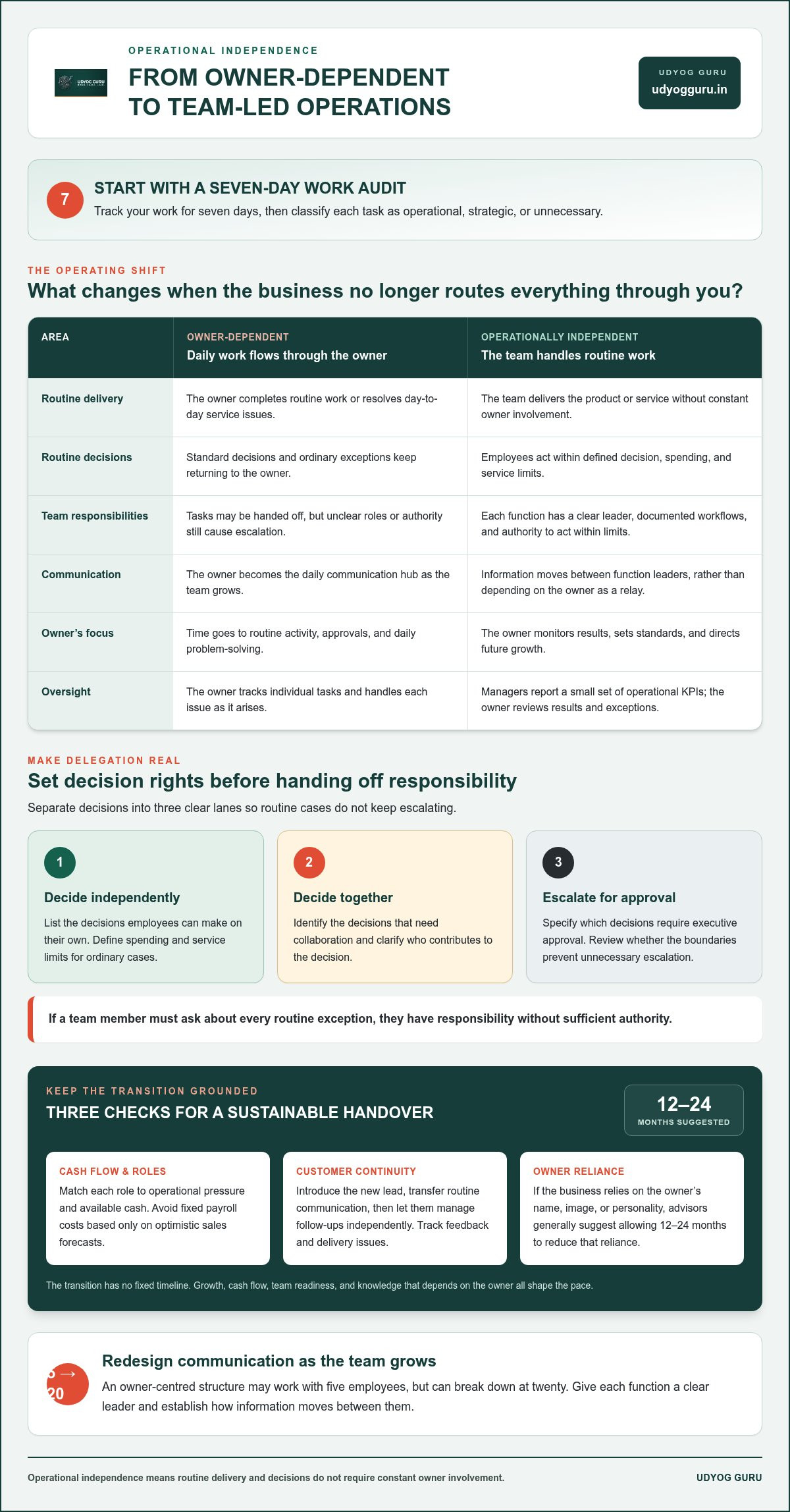
Operational independence means the team handles routine delivery and decisions without routing every issue through the owner. The owner monitors outcomes and directs future growth instead of serving as the daily communication hub.
Shift from Daily Work to Business Oversight
Track your work for seven days, then classify each task as operational, strategic, or unnecessary. Working in the business means completing routine work, resolving daily service issues, or approving standard decisions. Working on it means improving its future through planning, standards, and growth decisions. Identify duties only you can perform, and decide where a manager or documented process can take over.
Set KPIs and Monitor Operations
Choose a small set of operational KPIs tied to delivery, quality, cash collection, or customer response. Assign each measure to a manager, agree on a reporting rhythm, and review exceptions rather than tracking every task. Compare results with agreed targets and discuss the causes of any changes. There is no fixed timeline for stepping back: growth, cash flow, team readiness, and knowledge that depends on you all shape the pace.
- Set clear decision boundaries. List decisions employees can make independently, those that need collaboration, and those requiring executive approval. If a team member must ask you about every routine exception, they have responsibility without sufficient authority. Define spending and service limits, then review whether those boundaries resolve ordinary cases without escalation.
- Redesign communication as the team grows. An owner-centred structure may work with five employees, but can break down at twenty. Give each function a clear leader and establish how information moves between them. Operations management plans, organizes, and revises business practices to improve efficiency and profitability.
- Separate operational continuity from your public-facing Business Profile. In Google Business Profile, review the people and access settings, identify who has owner or manager permissions, and ensure a trusted successor has the access needed to maintain it. Remove your own access only after responsibilities are assigned and the profile can be managed without your account.
- Assess transferability before treating your departure as complete. Transferability measures how well a business can change hands without harming performance; dependence on the owner's image, knowledge, or relationships can make that harder. If the business relies on your name or personality, business brokers or advisors generally suggest allowing at least 12-24 months to reduce that reliance.
- Test continuity by taking a planned break from routine decisions. Have the manager handle normal approvals, customer issues, and team coordination while you review agreed KPIs. Record each escalation and determine whether it stems from missing authority, unclear procedures, or specialized knowledge. Fix those gaps before stepping back further.
Cash flow and growth as factors in the transition
Plan the transition around cash flow, growth demands, and continuity. Use these steps to decide what the business can support now.
- Map each role’s cost against available cash. List the work that must move from you, then estimate staffing and training needs in INR. Compare costs with cash collected, committed expenses, and expected revenue. For example, a growing service business may need delivery leadership before another sales hire. Avoid adding fixed payroll costs based only on optimistic sales forecasts.
- Phase hiring around demonstrated demand. Match each role to a recurring bottleneck, such as delayed customer delivery or missed sales follow-up. Review workload and cash position before adding the next hire. The time it takes to step back depends on business growth and cash flow. A structure that works during stable demand may need adjustment when orders rise or collections slow.
- Protect customer continuity during the handover. Transfer customer relationships in stages: introduce the new lead, let them handle routine communication, then have them manage follow-ups independently. Stay involved in exceptional, high-value sales discussions when your involvement can help close a significant deal. Track customer feedback and delivery issues at each stage, and resolve gaps before reducing your involvement further.
- Reduce dependence on your personal identity deliberately. If customers choose the business because of your name, image, or personality, update public-facing content gradually. Shift website biographies, service descriptions, and marketing materials toward the team, process, and business standards. Business advisors generally suggest allowing 12-24 months to reduce reliance on the owner’s image. This transition can also support transferability, meaning the business can change hands without harming performance.
- Separate operational delegation from ownership transfer. A manager can take over daily decisions without becoming an owner. If you plan to add or remove a business owner, review the applicable agreements and company documents, and consider the legal and tax implications with a business attorney and accountant. For a new partner, put control, profit and loss shares, and management involvement in a signed agreement. Keep communication open among everyone affected.
Use a structured review of hiring needs, cash flow, and delegation to sequence the transition. Business Acceleration Engine™ can support business owners working through that broader growth and operational change.
Delegating operations through progressive hiring
Transfer responsibilities in stages, matching each hire to a recurring operational gap. Pass on knowledge and decision-making authority along with the work, so your involvement decreases without slowing execution.
-
Delegate Specialized Knowledge
Identify tasks that depend on your expertise, then train a capable employee to handle them. Record the steps, explain how to manage exceptions, and have the employee demonstrate the process independently. Check for knowledge gaps in customer delivery, pricing decisions, or supplier coordination. Build a successor before stepping away, especially if you may eventually sell the business.
-
Assign Decision-Making Authority
Define which decisions a team member can make independently, which need collaboration, and which require executive approval. Give leaders clear decision rights and pre-approved micro-budgets for routine choices. For example, a sales manager could resolve a standard customer request without asking your permission. Review results against agreed limits rather than taking back authority whenever a decision differs from your preference.
-
Avoid Common Delegation Mistakes
Transfer authority with responsibility; assigning tasks without decision-making power leaves the workload with you. Avoid stepping away abruptly, which can create confusion, misalignment, and stalled execution. Set a handover sequence, explain reporting lines, and tell employees where to escalate unusual cases. Review early decisions with the manager, then reduce your involvement as the team demonstrates consistent execution.
- Build the hiring sequence around operational pressure. Start with operations staff who can take on recurring delivery work. Add an office all-rounder for marketing, finance, HR, or office functions that need coverage. Hire a salesperson when customer acquisition needs dedicated ownership, then add operations and sales managers as coordination demands grow. A general manager can later connect those functions, while other teams expand when workload justifies it.
- Separate leadership responsibilities and test the handover. Give sales and production distinct leaders, with clear coordination between customer commitments and delivery capacity. An operations manager can coordinate departments and oversee inventory, work-in-process, raw-material acquisition, quality control, materials handling, and maintenance policies. In a granite countertop shop example, two hires freed 40-50 hours of the owner's week and increased total sales capacity. Use a gradual handover, tracking unresolved escalations and whether work continues without your routine input.
Documenting workflows, policies and procedures
Document the company structure and recurring workflows before transferring daily responsibilities. Use these steps to make each process repeatable, measurable, and easier for a manager to oversee.
-
Document Recurring Processes
Choose a recurring workflow, such as client onboarding, invoicing, or weekly reporting, and record each action in sequence. Name the responsible role, required information, expected output, and point where an exception needs escalation. For example, an onboarding process can show who collects client details, prepares the account, and confirms the first delivery. Test the written steps with an employee who didn’t create them.
-
Create Standard Operating Procedures
Turn the tested workflow into a standard operating procedure, or SOP, that employees can follow without relying on your memory. Include its purpose, role ownership, tools, decision boundaries, and a completion checklist. Make instructions specific: an invoicing SOP should state which records support an invoice and who reviews disputed entries. Treat SOPs as an instruction manual for current staff and a future owner.
-
Establish Controls and Reporting Systems
Pair each SOP with an accountability check, such as a metric, checklist submission, or manager review. For invoicing, record completed invoices and unresolved discrepancies; for customer communication, review overdue responses. Where practical, separate task completion from review so one employee doesn’t control every stage of a sensitive process. These checks make unusual activity visible and help managers investigate errors before they become recurring losses.
- Map the company structure to actual work. Write down who owns each function, who covers it when they’re unavailable, and where decisions go next. A company chart should reflect real responsibilities, not just job titles. For example, show whether the sales lead hands a confirmed project to production and who resolves a capacity conflict. Clear reporting lines help employees act without sending every operational question back to you.
- Review documented procedures monthly. Compare each SOP with how work is currently done, then revise steps that no longer match the workflow. Ask the employee doing the task to identify missing instructions, repeated delays, or exceptions without a clear owner. Regular updates keep procedures aligned with changing business practices. Assign a document owner so updates don’t become everyone’s responsibility and nobody’s task.
- Start with workflows that cause frequent interruptions. Document meeting preparation, project management, hiring, and customer communication, along with invoicing and onboarding. For each process, capture its trigger, handoffs, completion signal, and escalation point. A weekly reporting procedure, for instance, can specify which measures the manager submits and which exceptions need discussion. Prioritizing repeatable workflows reduces reliance on informal instructions and gives the team a consistent operating reference.
Defining the owner's strategic responsibilities
After handing off operations, define which work only you should retain. In India, delegation alone doesn’t change your formal role; your duties and liabilities depend on the business’s legal structure and whether you’re also a director, partner, or officer.
- Set the strategic direction. Write down the business vision, priorities, and standards, then translate them into decisions your managers can use. For example, a service business might define which customer segments it serves and the delivery quality it expects. Leave routine scheduling and daily customer follow-up to operational leaders, not your strategic agenda.
- Protect time for planning and research. Block uninterrupted sessions to assess growth, future viability, and research and development. Use them to examine customer needs, changing demand, and opportunities to improve the business model. Limit meetings that don’t require your authority, and set communication boundaries so routine questions reach the responsible manager first.
- Own high-level relationships and partnerships. Retain relationships where your authority or expertise materially affects the business, such as those with strategic partners or key stakeholders. Assign routine account communication to the relevant team member and define when to escalate. You may join a sales meeting to help close a significant deal, but keep this exceptional rather than making it the default sales process.
- Guide managers without taking their work back. Use regular conversations to clarify priorities, remove cross-department obstacles, and support team leaders. Ask each manager to present decisions, risks, and proposed solutions instead of forwarding every operational problem to you. Delegate routine approvals within defined limits and review decision quality, not every action taken.
- Monitor standards through outcomes. Review agreed metrics and investigate meaningful changes in delivery, customer experience, or financial performance. You can observe a product or service being delivered to assess quality, as long as observation doesn’t become a recurring operational task. If the same issue keeps appearing, improve the process or the manager’s authority instead of correcting each instance yourself.
- Clarify your formal position before changing ownership or authority. Separate your responsibilities as an owner from duties attached to being a director, officer, or partner. Review the company’s governing documents and agreements, then assess legal and tax implications with an Indian business attorney and accountant before major ownership changes. Your obligations depend on the entity and your formal capacity, not simply your daily involvement.
Use Business X-Ray™ to map strategic responsibilities and identify where operational decisions still depend on you.
Udyog Guru: Business X-Ray™ (Tier 1)
Business X-Ray™ (Tier 1) gives business owners a structured starting point for examining the systems that keep daily operations dependent on them. Turn to it when you need to diagnose operational bottlenecks and clarify where delegation, workflow changes, or stronger team accountability should begin.
For challenges centred on team performance and delegation, Workforce X-Ray™ and Workforce Acceleration Engine™ address workforce optimisation. Business Acceleration Engine™ (Tier 2) supports broader business transformation, while the AI Tech Business Integration Bootcamp (Tier 3) focuses on embedding technology and automation into existing workflows.
Choose your next step based on the constraint you’ve identified: business systems, workforce performance, or technology integration. Explore Udyog Guru’s offerings at udyogguru.in.
Make Your Next Move Deliberate
The next stage is not simply stepping back. It is designing a business that can make sound decisions without relying on your constant presence. A practical plan for how to remove an owner from daily operations starts with the constraint most limiting progress, whether that is unclear roles, leadership capacity, or disconnected systems.
Use that diagnosis to choose the right support. Business X-Ray™ (Tier 1) helps examine business systems, while Business Acceleration Engine™ (Tier 2) supports broader business transformation. If team performance and delegation are the central issues, Workforce X-Ray™ focuses attention on the workforce. The appropriate starting point depends on where the operating structure is most dependent on you.
Udyog Guru can help you identify the next structural step and develop a clearer path toward owner-independent operations. Contact Udyog Guru to plan your transition. A deliberate transition gives your team room to lead and lets you direct your attention toward the business’s future.
Frequently Asked Questions
How can a business owner delegate daily operations to a manager?
Give the manager ownership of a defined operational area, such as order fulfilment, and authority to resolve routine problems. Agree on what must be escalated, such as a customer complaint involving an unusual commitment. A practical plan for how to remove the owner from daily operations includes reviewing an exception log with the manager and identifying decisions that still depend on you. This shows whether the gap is capability, authority, or missing information.
What steps should an owner take to document and standardize business processes?
Choose a process that varies between employees, then observe someone completing it from start to finish. Record the actual sequence, inputs, handoffs, and evidence of completion. Ask a colleague who wasn’t involved in writing the instructions to follow them, then note where clarification is needed. For example, a customer refund procedure should make approval responsibility and recordkeeping clear. Revise the procedure if the tested steps don’t match practice.
How do you choose and hire an operations manager in India?
Define the outcomes the role must own before evaluating candidates. In an Indian business, these might include coordinating departments, maintaining delivery quality, and managing inventory or supplier handoffs. Use a written scorecard, then ask candidates how they would address a late supplier delivery without disrupting customer commitments. Assess communication and judgment alongside relevant experience. Set reporting lines and decision boundaries before the manager starts.
What are the risks of removing an owner from day-to-day business operations?
A rushed handover can confuse staff, disrupt execution, or weaken customer relationships, particularly when clients rely on the owner personally. Specialized knowledge can also leave with the owner if no one else can do essential work. Before reducing your involvement, test whether the team can handle routine decisions and customer issues. Review escalations and delivery problems; repeated breakdowns point to a continuity gap that needs attention.
How can a small business run without the owner’s daily involvement?
To understand how to remove the owner from daily operations, assign clear ownership of the activities that keep the business running, from handling leads and sales to delivering the product or service. For example, a small firm can route new enquiries to a sales lead and delivery questions to an operations manager, while the owner receives performance updates. Keep the owner available for strategic decisions and exceptional issues, not as the default approver for routine work.
What is the difference between an owner, CEO, and operations manager?
The owner can step back from daily operations and focus on strategy; when a general manager is in place, the owner can focus on the CEO role. An operations manager coordinates departments and plans, organizes, and revises business practices to improve efficiency and profitability.


