

A business diagnosis is only useful when it connects the whole operating picture, from management, finance, operations, marketing and sales to customer feedback and internal processes. The most useful business diagnostic tools for owners include SWOT analysis, personalised audits, competitor assessment and value chain review, each revealing a different part of the system. SMEs can establish a baseline with one tool, then repeat the assessment at least once a year to compare changes over time.
It’s easy to focus on a visible symptom, such as rising costs or flat revenue, and miss the process or strategic gap behind it. A structured diagnosis puts those signals in context before you make decisions.
This guide explains what business diagnostics assess, what each tool can uncover, and how to turn findings into practical priorities. You’ll learn how SWOT and TOWS differ, when a personalised audit adds depth, and how cost and revenue structures fit into a broader view of growth.
Key Takeaways
- Use a business assessment to map the operating system before choosing a growth strategy, then compare repeat assessments to identify what has changed.
- Treat SWOT as a starting point: reliable inputs from customers, internal processes and the competitive environment determine how useful its conclusions will be.
- Choose diagnostic tools by the question they answer, from organisational alignment and value-chain inputs to revenue drivers and cost behaviour.
- Turn findings into actions with TOWS, linking strengths and weaknesses to external opportunities and threats rather than leaving them as observations.
- When a self-assessment surfaces connected operational gaps, a structured diagnostic such as Udyog Guru’s Business X-Ray™ can help organise the next stage of analysis.
Online business assessment for startups and small businesses
An online assessment gives a startup a structured baseline before it commits to a growth plan. Start with one tool, record your answers and evidence, then use the findings to identify the next business question. This avoids a common diagnostic error: adding frameworks before understanding the current operating model. Business diagnostic tools for owners are most useful when they create a clear sequence from assessment to interpretation and action.
The Business Model Canvas helps you check how a company creates and delivers value. Map its customer segments, value proposition, channels, customer relationships, revenue streams, key resources, key activities, partnerships and cost structure. A home-based food business, for example, can compare delivery channels with ingredient costs and repeat-order patterns. The canvas can reveal gaps between the intended customer experience and the resources needed to provide it.
For questions about market value, the CAPE Model can help organise an assessment of the opportunity and the business’s ability to capture value. Apply it to one proposed segment: identify the customer problem, examine alternatives, assess the company’s capability to serve that segment, and test whether the revenue logic supports delivery costs. Treat the findings as a decision aid, not a stand-alone valuation. Compare market assumptions with customer feedback and operating evidence.
An SME business maturity self-assessment can reveal weaknesses in the systems behind day-to-day work. Review strategy, finance, sales, operations, people and data. For each area, note whether the process is informal, documented or consistently measured, and add an example. A sales process that depends on the owner’s memory differs from one with recorded enquiry stages and clear follow-up responsibility. Choose one priority gap rather than attempting a full redesign at once.
Government-supported MSME diagnostic and assessment initiatives exist in India. Their purpose and eligibility can differ, so distinguish a programme-specific assessment from a general online self-assessment before applying.
For SMEs, repeat the same assessment at least once a year. Keep the original answers, evidence and date, then compare each item with the new result. Changes in customer mix, delayed collections or new operating steps may explain a shift in the diagnosis. Comparing results shows whether an earlier action changed the underlying condition, rather than merely changing the score.
To choose business diagnostic tools for owners, define the question and select one framework. Use the Business Model Canvas to examine model coherence, CAPE for market-value questions, and a maturity review for internal capability. Then turn the clearest finding into an action with an owner and a review point. This sequence makes an online assessment useful to a small business, not just a completed form.
SWOT analysis
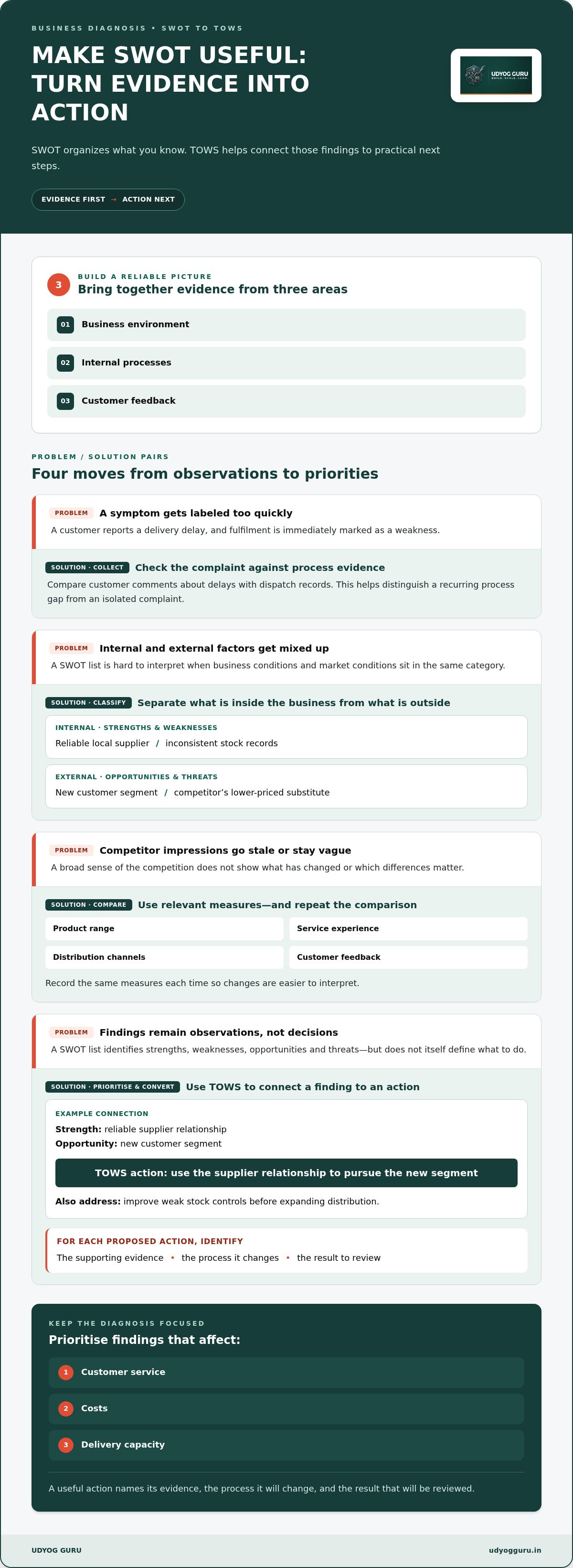
SWOT analysis organises evidence into strengths, weaknesses, opportunities and threats. Strengths and weaknesses describe internal conditions; opportunities and threats describe the external environment. For an Indian retailer, a reliable local supplier may be a strength, while inconsistent stock records may be a weakness. A new customer segment may present an opportunity, while a competitor’s lower-priced substitute may pose a threat.
Use SWOT as a starting point, not a final diagnosis. Its usefulness depends on the quality of the evidence. Gather information from three areas: the business environment, internal processes and customer feedback. For example, compare customer comments about delivery delays with dispatch records before listing fulfilment as a weakness. This helps distinguish a recurring process gap from an isolated complaint.
Competitor analysis adds external evidence to a SWOT assessment. Compare competitors using measures suited to the market, such as product range, service experience, distribution channels and customer feedback. A neighbourhood retailer might assess how nearby shops handle product availability and delivery. Repeat the comparison regularly, because competitor activity and customer preferences can change. Record the same measures each time to make changes easier to interpret.
Inventory management can reveal operational strengths and weaknesses that a broad SWOT may miss. Examine stock records, purchasing decisions and how products move from receipt to sale. Recurring stockouts of a frequently requested item, for example, may point to a forecasting or reorder-process gap. Excess stock that remains unsold can signal a mismatch between purchasing and customer demand. Check observations against stock records and sales patterns before assigning them to a SWOT category.
Turn observations into action with TOWS analysis. While SWOT organises evidence, TOWS helps develop actions and move from research to strategy. A small manufacturer might use a reliable supplier relationship to pursue a new customer segment. It could also address weak stock controls before expanding distribution. Each proposed action should identify the supporting evidence, the process it changes and the result to review.
A practical sequence keeps the analysis usable:
- Collect: Bring together customer feedback, process records, inventory information and competitor observations.
- Classify: Place each evidence-backed finding in the relevant SWOT category.
- Prioritise: Select findings that affect customer service, costs or delivery capacity.
- Convert: Use TOWS to define an action, its owner and the evidence that will show progress.
For business owners whose SWOT findings span several connected systems, a structured business diagnostic tool for owners can help organise the next assessment step. Place each verified observation in the relevant SWOT category, prioritize findings supported by more than one source, and then assign an owner and a review point to each response. Revisit the assessment as conditions change, keeping measures consistent so emerging patterns can inform the next diagnosis and guide practical decisions.
Broad business diagnostics and personalised audits
A broad business diagnosis examines management, finance, operations, marketing and sales together. This matters because weaknesses often cross functions: delayed delivery can affect customer retention, sales forecasts and working capital. Begin with the Business Diagnostics Framework, which progresses from its outer rings towards core strategic planning. Use its sequence to organise the review before choosing individual tools.
Choose tools according to the system under examination. McKinsey’s 7S model assesses organisational alignment across Structure, Systems, Style, Staff, Skills, Strategy and Shared Values. A value chain assessment traces the inputs needed to deliver a product or service to a defined market segment. These tools help identify where responsibilities, capabilities or delivery steps fail to support the strategy.
Business diagnostic tools provide a repeatable structure for collecting answers and highlighting possible gaps. A consultant-led business audit adds tailored investigation, follow-up questions and interpretation of company-specific evidence. For example, an automated questionnaire may flag weak cash-flow controls, while an audit can examine how approval steps and payment timing contribute to the problem.
In India, the cost of popular diagnostic tools depends on their format and scope. A self-assessment, software-based tool and personalised audit have different cost drivers, including features, data integration, number of users and expert review. For a tailored audit, the price depends on the case and is provided after a quote request; scope, data requirements and review depth shape the cost.
Financial diagnostics examine cash flow, revenue sources, cost structure and collection patterns. Operational reviews map workflows, hand-offs and process gaps. Marketing assessments examine customer segments, channels and campaign measures, while strategy tools test whether capabilities and priorities align. A value chain review can connect these areas by tracing resources and activities through to customer delivery.
To run a diagnostic, define the decision first, then select a framework, gather relevant records, assess findings and prioritise actions. Useful inputs include management accounts, sales records, expense categories, customer feedback, workflow documents and role descriptions. Compare records from the same period and note assumptions, so missing data doesn’t lead to a false conclusion.
Automated tools can misread incomplete records, apply generic benchmarks or overlook context such as seasonal demand. Treat their outputs as signals, not decisions; validate a flagged weakness against source records and staff experience. A regular diagnosis can uncover process gaps, risks and growth opportunities, but its value depends on accurate inputs and follow-through.
Apply the Business Diagnostics Framework before using the listed business tools, following the recommended order for the review. Companies should diagnose their business regularly to identify improvement areas, process gaps, risks and growth opportunities. This makes diagnosis a recurring part of business review rather than a one-off exercise. The framework comes first, followed by the listed tools. Regular diagnosis helps companies identify areas for improvement, process gaps, risks and growth opportunities as part of their ongoing review.
Revenue and cost structures
Revenue growth can conceal a weakening business if costs rise faster or cash arrives late. Diagnose the structure by separating revenue streams, direct delivery costs, operating expenses and cash timing. For an Indian business, keep each figure in ₹ and compare records prepared on the same basis. A retailer, for example, should distinguish product sales from delivery charges before assessing which stream contributes more.
Start with a revenue mix analysis. Group sales by product or service, customer segment, channel and geography. Then compare each group’s revenue contribution with the work and resources needed to serve it. A service firm may find that a high-revenue engagement also requires substantial customisation. Revenue concentration analysis can reveal dependence on a small number of customers or offerings, helping owners assess how vulnerable the forecast is to lost demand.
Next, use contribution margin analysis to show what remains after variable costs are deducted from sales. This helps compare offerings with different delivery requirements. Break-even analysis uses fixed costs and contribution margin to identify the sales level at which revenue covers costs. These tools can help test a proposed price, product mix or expansion plan, but their outputs depend on correctly classifying costs.
For a cost diagnosis, split expenses into fixed, variable and semi-variable categories. Rent may remain stable as sales change, while packaging costs often move with order volume. Cost variance analysis compares actual spending with a budget or prior period, then investigates the operational cause. Higher freight spending, for example, could reflect a change in order mix, delivery distance or dispatch process.
Indian business owners should review gross margin, operating margin, current ratio, receivables days and inventory turnover. These ratios help assess profitability, short-term liquidity, collection speed and stock movement. Compare them with the company’s own consistent historical results and genuinely comparable sector benchmarks; business model, product mix and credit terms affect what makes a sound comparison.
Build the review from accounting records, sales invoices, purchase records, payroll and expense categories. Reconcile revenue with cash receipts, since invoiced sales and collected cash answer different questions. Then trace material changes to a specific customer group, product, supplier or process. A monthly management view can reveal movement sooner, while an annual comparison helps assess broader structural shifts.
Convert the diagnosis into a short action sequence:
- Protect: Identify revenue streams with strong contribution and reliable collection.
- Investigate: Trace rising costs to their underlying activity or supplier.
- Test: Model how changes in volume, price or cost mix affect break-even.
- Review: Track the same measures over time and revise decisions when evidence changes.
Which free business health check tools are available in India?
In India, owners can build a free first-pass health check from established frameworks and their own business records. These tools organise evidence; they don’t replace a detailed audit. Start with one assessment method and a focused question, such as whether delayed customer payments are straining cash flow or whether sales depend too heavily on one channel.
SWOT analysis is a practical self-assessment for recording internal strengths and weaknesses alongside external opportunities and threats. A local manufacturer could document reliable supplier relationships as a strength, then test that view against purchase records. Use customer feedback and process evidence to support each point, rather than treating assumptions as findings.
Business Model Canvas helps map how a business creates, delivers and captures value. Review its customer segments, value proposition, channels, relationships, revenue streams, activities, resources, partnerships and cost structure. For example, a home-based food business can compare delivery-channel choices with customer needs and packaging expenses. The canvas is especially useful when the offer or customer mix is changing.
McKinsey’s 7S model provides a structured review of organisational alignment across Structure, Systems, Style, Staff, Skills, Strategy and Shared Values. An owner can use it to assess whether team responsibilities and operating systems support the current strategy. Ansoff Matrix helps frame growth choices: market penetration, market development, product development and diversification. Use it to clarify the type of growth under consideration before testing its assumptions.
A simple spreadsheet can provide a free financial health check when populated with the business’s records. Track revenue by offering, expense categories, customer payment timing and stock movement. A small retailer, for instance, can compare sales records with inventory to identify products that sell slowly or run out. The spreadsheet is only as useful as its source records and consistent categories.
India also has government-supported business diagnostic programmes, but eligibility depends on the specific programme. The stated employee-strength criterion for applying to the programme is at least 100 employees, so owners should distinguish that criterion from general self-assessment frameworks.
Make a useful check repeatable: select one framework, save the completed assessment, record the evidence behind each finding and revisit the same questions at least once a year. Compare changes before adding more tools. If a self-guided review exposes connected gaps across finance, operations and strategy, explore a structured business assessment as a next step.
Udyog Guru: Business X-Ray™ (Tier 1)
Business X-Ray™ (Tier 1) gives owners a structured starting point when self-assessments reveal connected gaps across business functions. Use it when isolated findings, such as unclear priorities or operational weaknesses, need to be considered as part of a broader business transformation framework. If the diagnosis points to execution and growth priorities, Business Acceleration Engine™ (Tier 2) is the next progression. For challenges centred on team performance and delegation, Workforce X-Ray™ provides a workforce-focused option. The right starting point depends on the gap your assessment has surfaced, not on using every tool at once. Bring your key findings into the next discussion and identify which area needs attention first. Contact Udyog Guru to discuss the next step for your business.
Turn the diagnosis into your next operating decision
An assessment becomes valuable when it changes how a business allocates attention. Choose one decision that matters now, such as whether to strengthen execution, clarify team responsibilities or integrate technology into existing workflows. Connect the evidence to a specific operational priority, then review how that priority affects the wider business system. Business diagnostic tools for owners work best when they guide a defined decision rather than create another report.
The right support depends on where the diagnostic points. Udyog Guru offers Business X-Ray™ (Tier 1), Business Acceleration Engine™ (Tier 2) and Workforce X-Ray™. These provide distinct paths for business diagnosis, acceleration and workforce optimisation. When selecting business diagnostic tools for owners, match the assessment finding to the capability that needs attention instead of adding another framework without a clear purpose.
Explore Udyog Guru’s business transformation offerings and identify a practical starting point for your next operating decision. A clear priority gives your team a stronger basis for action and a more disciplined path forward.
Frequently Asked Questions
What is it?
A business diagnosis is a structured examination of how a company operates and where its systems may be misaligned. It connects evidence from areas such as customer delivery, decision-making and financial control, rather than treating each issue in isolation. Repeated owner approval delays, for example, may point to unclear decision rights, not simply a slow workflow. The assessment helps identify which underlying issue deserves attention first.
Why use it?
Use a diagnostic when a recurring business problem has several possible causes and intuition alone can’t distinguish them. If new enquiries rise but completed sales remain flat, the constraint could lie in follow-up, offer fit or the handover process. Mapping the evidence helps narrow the investigation before you commit resources to a change. It also gives the team a shared basis for deciding what to address and how to review progress.
What are the best business diagnostic tools for small business owners?
The most useful tool depends on the decision at hand. A small firm reviewing its overall business systems could consider Business X-Ray™; owners focused on financial control can use the Financial Command Dashboard. For a team-performance question, Workforce X-Ray™ is a relevant option. These tools are not interchangeable: choose according to the problem you need to examine, then use the findings to define a specific next step.


