

Your inbox can reveal a structural problem: being copied on more than five emails a day can be one of the signs your business is too dependent on you. Routine decisions waiting for your approval, undocumented processes, and work that changes when you’re away all point to the same bottleneck. The fix is to clarify decision rights and responsibilities, then build repeatable systems around the work.
If you’ve become the person everyone turns to, that involvement may have helped you build the business. But as activity grows, the same habit can limit how independently your team operates. Here’s how to assess the dependency and reduce it without simply handing off tasks and hoping for the best.
Learn how to delegate authority with clear boundaries, assign ownership and escalation points, and build processes that help routine work move forward without your intervention. You’ll also see how to track whether these changes are easing the bottleneck, so you can lead the business rather than remain its operating system.
Key Takeaways
- Track where work pauses for your approval, then identify the role, next action, and escalation point needed to keep it moving.
- Delegate decisions with defined boundaries, success criteria, and resources, not just tasks.
- Map recurring handoffs and information gaps before deciding whether additional operational leadership is needed.
- Document repeatable processes and clarify who owns exceptions before introducing automation.
- Measure whether changes reduce waiting and manual coordination, then adjust the system based on what the evidence shows.
1. Building a business that can operate when the owner is away
A business cannot operate independently when routine work, customer decisions, or urgent approvals stop without its owner. Look for employees waiting for your answers, customers insisting on dealing only with you, or operations changing as soon as you step away.
One of the clearest signs your business is too dependent on you is being copied on more than five emails a day that require no action from you. This may mean employees, customers, or suppliers are seeking tacit approval or don’t know who has authority. Review a week of messages and mark each one someone else could have handled.
Customer relationships can become concentrated around the owner when clients rely on personal access, undocumented preferences, or decisions only the owner can make. If a renewal, complaint, or revised order waits until you respond, the relationship lacks a reliable second point of contact. Bring a team member into customer meetings and record the account history, commitments, and next action.
Owner dependency also restricts growth when the owner’s capacity limits sales, delivery, or service. If every new project requires your personal review, revenue may depend on how many decisions you can process, rather than on your team’s ability to deliver. Track which opportunities or jobs pause for your input, then identify a recurring decision that could be handled under a clear rule.
To measure dependence, track items waiting for your input, tasks delayed during your absence, and reports assembled manually. Then take a day off midweek without checking in and record what stalls. A useful test is whether you can take a holiday, switch off, and return without a backlog of unresolved routine decisions.
An owner’s illness or sudden unavailability can interrupt customer responses, approvals, and essential handoffs when knowledge and authority sit with one person. Customers may face delays, while employees hesitate because their authority is unclear. Document critical processes and name an owner for each recurring responsibility before an absence occurs.
A practical 30-day plan starts by selecting one recurring process that currently depends on you. Document its steps, assign a responsible role, define decisions that role can make, and state when to escalate. During the remaining days, observe the process in use, note every point that still comes back to you, and revise the instructions or authority. Track waiting items before and after the change; a completed checklist alone doesn’t prove dependency has fallen.
Signing-off authority and delegated decision-making
When every consequential choice returns to the owner, the owner becomes the business’s decision-making bottleneck. A manager may gather information, compare options, and recommend an action, yet work still stops until approval arrives. This can affect pricing exceptions, supplier changes, customer resolutions, and routine spending. The issue isn’t that owners make important decisions, but that the organisation hasn’t established which decisions belong elsewhere.
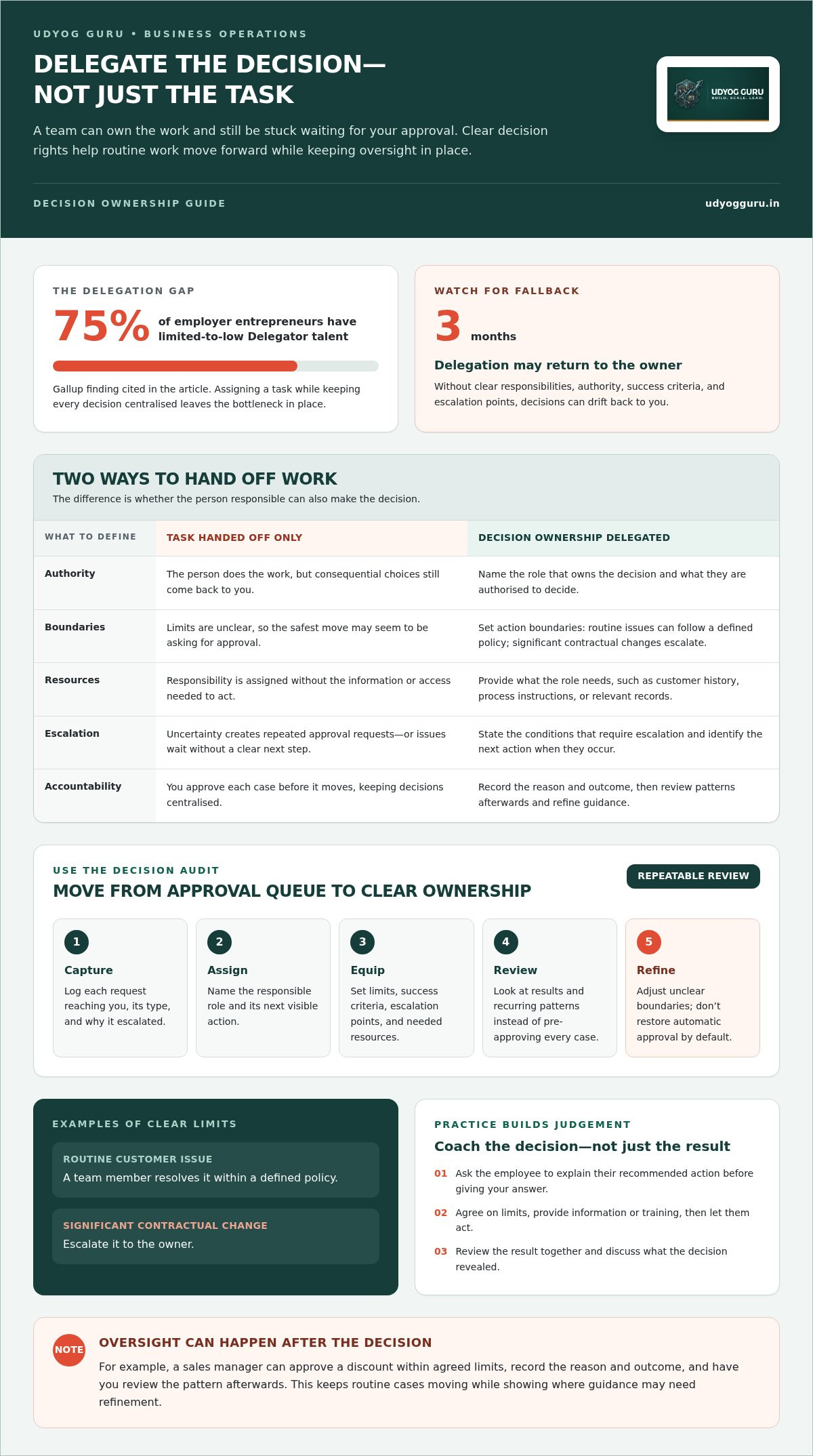
Gallup found that 75% of employer entrepreneurs have limited-to-low Delegator talent. In practice, delegation often stalls when owners assign tasks but retain every decision. An employee may be responsible for resolving a delivery problem, for example, but still lack authority to approve a replacement shipment. The task is delegated; the decision remains centralised.
Separate decisions by risk and reversibility. A team member could resolve a routine customer issue within a defined policy, while a significant contractual change goes to the owner. For each recurring decision, document the intended outcome, action boundaries, and conditions for escalation. Clear boundaries reduce unnecessary approval requests without removing oversight.
Decision ownership also requires accountability. Name the responsible role, describe the next visible action, and state how results will be reviewed. If a sales manager approves a discount within agreed limits, they should record the reason and outcome. You can review patterns afterwards instead of approving every case beforehand. This feedback loop also shows where guidance needs refinement.
Develop managers through controlled practice, not a sudden transfer of responsibility. Ask an employee to explain their recommended action before you offer your answer. Agree on the limits, provide relevant information or training, then let them act. Review the result together and discuss what the decision revealed. Repeated practice builds judgement; reversing every decision teaches the team to wait.
Try a short decision audit. For each request that reaches you, record its type, who could own it, and why it escalated. Then assign a responsible role and define its authority. Provide the resources needed to act, such as customer history, process instructions, or access to relevant records. Revisit unresolved cases and adjust the boundary instead of restoring automatic approval.
Delegation may fall back on the owner within three months if supporting structures aren’t built. Clear responsibilities, authority, success criteria, and escalation points keep decisions with their assigned owners. If approval delays persist across teams, the Business Acceleration Engine™ can support a more structured approach to business operations.
3. Can’t I just hire a COO or an operations person?
Hiring a COO can add leadership capacity, but it won’t automatically remove you as a bottleneck. If the new manager inherits unclear authority, undocumented processes, and decisions that still require your approval, the same delays continue in another role. Before hiring, map recurring handoffs, authority gaps, and missing information. For example, note where a customer issue waits because no manager can approve the proposed resolution.
Separate urgent operational work from important leadership work. A supplier delay may require immediate action, while developing managers, reviewing financial performance, and improving processes need protected attention. If urgent requests consume every available hour, leadership work gets displaced. Record which interruptions recur, who receives them, and what decision they need. This helps show whether the cause is insufficient management capacity or unclear operating rules.
Business owners should deliberately protect time for leadership and planning. Schedule a recurring block to review performance, develop people, and examine process failures. Use that time to ask why the same issue keeps returning to you. Repeated approval requests for customer exceptions, for instance, may point to missing decision boundaries, not a need for another executive.
A new leader also needs a company culture that supports action beyond the owner. If employees expect you to settle every disagreement, a COO can inherit the title without gaining practical authority. Establish which decisions the role owns, what outcomes matter, and when escalation is appropriate. Communicate those boundaries to employees and customers through clear responsibilities, meeting routines, and handoffs.
Leadership accountability requires visible ownership, not simply a reporting line. Assign each recurring operational outcome to a role, define how progress will be reviewed, and make unresolved dependencies visible. For example, an operations lead may own delivery coordination while a department manager owns staffing decisions. If both assume the owner will resolve missed deadlines, the structure creates ambiguity rather than accountability.
Use a diagnostic sequence before deciding to hire. First, list recurring work and where each handoff stalls. Next, identify whether the blockage comes from workload, missing skills, unclear authority, or absent information. Then decide whether an existing manager can own the work once boundaries and procedures are clear. Hire additional leadership when the business has a defined role, decision scope, and outcomes that current capacity cannot support. Specify in the role description what the new leader can decide independently, what requires escalation, and how results will be assessed.
4. Delegation with clear responsibilities and authority
Delegation works when a person receives a defined outcome, authority to act, and a way to account for results. Handing over a task without decision rights often creates a new queue of approval requests. Asking an employee to resolve a customer complaint, for example, is incomplete if they cannot offer an agreed remedy or decide when to escalate.
Choose responsibilities that occur frequently, follow a reasonably predictable process, and don’t require your unique expertise. A recurring customer update, routine quality check, or standard invoice follow-up may be suitable. A sensitive negotiation that depends on your specialist judgement may need to stay with you. Start with one repeatable responsibility, observe the handoff, then expand delegation when the process and decision boundaries work.
Small teams often rely on informal relationships. With three employees, people may understand how the owner prefers work to be done because they communicate daily. As a team grows to 10, 20, or 50 employees, assumptions become less reliable. Record the responsible role, the required outcome, the next action, and the circumstances that require escalation. This makes expectations visible beyond conversations and memory.
Hiring alone doesn’t solve a delegation problem. A new employee or manager cannot take ownership without authority, information, training, and clear success criteria. Before adding a position, identify the work that needs an owner and define what decisions that person can make. If the process remains undocumented, the new hire may depend on you for the same unwritten instructions as everyone else.
Accountability means employees know their responsibilities, can act within agreed boundaries, and report results. Set a review point for each delegated responsibility, such as checking completed customer cases against the agreed service standard. Ask employees what action they recommend before answering. This shifts the exchange from seeking approval to developing judgement, while allowing you to coach when a decision misses its intended outcome.
Use systems to support delegation, not to disguise unclear ownership. Software can create more places to check if responsibilities, triggers, and evidence remain undefined. For a recurring order process, specify who confirms the request, what information makes it complete, and who handles exceptions. Keep instructions accessible and update them when a real exception reveals a gap.
Finally, make communication rules match the new authority. Employees should put you in an email’s “to” line only when they need a specific action from you. Otherwise, they can keep you informed without making you the decision-maker. Clear boundaries protect working relationships, make delegation traceable, and give each role a visible point of accountability.
5. Layer-by-layer systems for reducing dependency
Reduce owner dependency by building operations in layers: clear process, named ownership, reliable information, then appropriate automation. Start with a recurring workflow, such as moving a customer order from enquiry to delivery. Document its trigger, required information, responsible role, next action, and exception path. This lets the team trace the work and keeps your attention available for decisions that genuinely need it.
Small businesses should document processes that frequently stall without the owner. Prioritise sales follow-up, customer onboarding, order fulfilment, billing, service issues, and recurring reporting. For each process, record what starts the work, where authoritative information lives, who completes each handoff, and which exceptions require judgement. A short, usable procedure helps employees act consistently; a document nobody consults changes nothing.
Customer information scattered across email, spreadsheets, and separate operating tools creates friction at handoffs. A sales employee, for example, may record a customer requirement in one place while delivery staff rely on another. Establish the authoritative record and specify who updates it after each change. Then identify missing details before the next role accepts the work. The goal is traceable information, not another system that needs manual checking.
A fractional COO and an AI operating system address different constraints. A fractional COO can help clarify operating ownership, management routines, and process gaps. An AI operating system or automation can support repeatable work once its rules and information inputs are clear. Neither replaces the other: determine whether the blockage needs human leadership judgement, consistent process execution, or both. Keep a manual recovery path for critical operations when changing a control.
Scalable systems make routine work easier to own, measure, and improve as activity grows. Track indicators tied to the coordination problem, such as work waiting for input or reports assembled manually. When a measure worsens, inspect the handoff, responsibility, or information source before adding software. A successful process makes clear who acts next and what evidence confirms completion.
Systemization also supports continuity if ownership or leadership changes. A business that records customer commitments, operating procedures, and decision boundaries makes critical knowledge less dependent on one person. This doesn’t guarantee a particular sale outcome, but it gives a future decision-maker clearer evidence of how operations function. To map the processes, information, and automation opportunities creating owner dependency, start an operating-systems assessment.
Udyog Guru: Business X-Ray™ (Tier 1)
Business X-Ray™ (Tier 1) from Udyog Guru is a structured starting point for examining where owner dependency sits in your business. Turn to it when routine decisions, customer handoffs, or operating processes still rely heavily on your involvement and you need a clearer view of the underlying constraints.
Once those pressure points are visible, the next step depends on the diagnosis. Business Acceleration Engine™ (Tier 2) supports broader business transformation, while Workforce X-Ray™ focuses on workforce optimisation. For owners working to embed AI and modern technology into existing workflows, the AI Tech Business Integration Bootcamp (Tier 3) addresses technology integration. These offerings connect the assessment to practical areas for operational improvement without treating every dependency as the same problem.
If you’re ready to examine where your business relies on you and identify a structured next step, contact Udyog Guru.
Build the next version of the business deliberately
The signs your business is too dependent on you are diagnostic signals, not a verdict on your leadership. Use them to choose one operational change that gives your team more ownership, then see whether decisions move forward without your intervention. Udyog Guru’s diagnosis-first Business X-Ray™ helps identify hidden bottlenecks and priorities for action. Clear roles and repeatable processes give you more room to focus on direction, not just daily approvals.
If you need to identify where that change should begin, Udyog Guru’s Business X-Ray™ (Tier 1) provides a structured starting point. Business Acceleration Engine™ (Tier 2) supports broader transformation, while Workforce X-Ray™ focuses on workforce optimisation. The appropriate next step depends on whether the primary constraint lies in business operations, team structure, or both.
Contact Udyog Guru to discuss a structured way to reduce owner dependency and strengthen how your business operates. A more resilient operating model begins with one clear diagnosis and a deliberate next step.
Frequently Asked Questions
How do I stop being the bottleneck in my business?
Start by identifying decisions that repeatedly return to you, then transfer one decision category with clear limits. For example, let a team lead resolve routine delivery changes while you retain decisions involving unusual customer commitments. Give the lead access to relevant information and review outcomes after action. If the same issue keeps escalating, improve the rule or training instead of automatically taking ownership back.
What is owner dependency?
Owner dependency exists when essential knowledge, customer relationships, approvals, or operating decisions are concentrated in the owner. It becomes visible when a capable employee cannot complete a normal task without asking for personal instructions. If only the owner knows how a key customer handles changes, for example, the business lacks transferable account knowledge. The concern is structural reliance, not an owner’s active involvement in leadership.
Can’t I just hire a COO or an operations person?
Hiring a COO can help when the business needs an accountable leader to coordinate operations, but a title alone won’t transfer authority. Define the role’s outcomes, decision boundaries, information access, and relationship with existing managers before recruitment. For example, specify whether the COO can change delivery priorities or only report delays. If the underlying work remains unclear, the new hire may inherit confusion instead of resolving it.
How Long Does It Take to Get Out of the Business Trap?
Embedding changes to reduce owner dependency across a team typically takes between three and twelve months. The pace depends on how much work relies on undocumented knowledge, how often employees practise decisions, and whether leaders reinforce new responsibilities. A process may change quickly, while customer handoffs and manager judgement require ongoing practice. Measure progress through operating behaviour, such as whether work proceeds consistently without your intervention.
How do I know if I’m the bottleneck or just busy?
You’re busy when your workload is high but colleagues can still make routine progress without waiting for you. You’re a bottleneck when a decision, handoff, or customer response stops specifically because your input is missing. Compare a normal working day with a period when you’re unavailable: note which tasks continue, which stall, and whether the blockage comes from workload, authority, or missing information.
What are the signs a business depends too much on its owner?
Look for repeated workarounds that rely on your memory, customers bypassing their assigned contact to reach you, and managers avoiding decisions they should own. Rework caused by employees following different unwritten versions of the same process is another indicator. These patterns matter more than one difficult day. Check whether the same dependency appears across customer service, delivery, finance, or team coordination.
What happens when a business owner is the only person who can make decisions?
Work queues behind the owner, so one routine choice can delay several connected tasks. Employees may become cautious, customers may wait for answers, and managers may forward problems instead of resolving them. The organisation also loses continuity when you’re unavailable. Map one delayed decision from request to completion to see which teams, customer commitments, or next steps depend on that approval.
How does owner dependence affect business growth and profitability?
Growth becomes harder to absorb when each additional customer, project, or exception increases your personal workload. That constraint can limit the opportunities your team can handle and consume time needed for planning or financial review. Unclear handoffs can also put pressure on profitability through avoidable rework or inconsistent delivery. Examine whether added activity produces repeatable work or simply creates more decisions that depend on you.


