

Growth can expose a service business’s weakest process rather than prove that its model works. Building a scalable service business model means creating repeatable delivery that serves more customers without costs, complexity, or founder workload rising at the same pace. The test is whether the business can handle twice its current volume while maintaining service quality and profitable operations.
It’s reasonable to expect more clients to mean more revenue, but that depends on how work is packaged, assigned, measured, and improved. Without clear workflows, each new engagement can add exceptions and decision-making pressure instead of capacity.
This article explains how repeatable services, documented workflows, performance data, and strategic partnerships support growth. It also covers common mistakes, such as automating processes before they serve the right buyer or increasing demand before delivery capacity and cash flow can support it. The aim is to help you assess whether growth is strengthening the business or simply adding operational strain.
Key Takeaways
- Package expertise into a clear, repeatable core while reserving customization for needs that materially change the outcome.
- Document recurring work so trained team members can deliver it consistently, and identify bottlenecks before they constrain capacity.
- Use financial, operational, and customer evidence to decide what to refine, automate, or strengthen through partnerships.
- Test one part of the model before expanding; if added sales bring more complexity without stronger profit, reassess the design.
Repeatable delivery versus customization
In India, price services in INR according to scope, effort, overhead, and outcome value. Calculate margin by subtracting delivery costs from revenue, then dividing by revenue. Include labour, tools, and acquisition costs in delivery costs.
Balancing Repeatable Delivery and Customization
Repeatable delivery standardizes a service’s core while allowing adjustments for client needs. This balance lets a firm expand without turning every engagement into a new design exercise. For example, a consulting firm can use one assessment framework, then tailor recommendations to each client’s operations. Define which steps stay fixed and which can change. That boundary protects delivery capacity as demand grows.
Customer acquisition should match the service’s repeatable structure. Track customer acquisition cost (CAC) against customer lifetime value (CLV), then assess whether each channel attracts suitable buyers. If referrals bring clients who need extensive, unplanned customization, the sales message may be attracting the wrong demand. A clearly positioned service with a defined scope helps prospects understand the outcome before purchase. Review acquisition and delivery costs together, not as separate measures.
Customer Experience and Retention
Customer experience is the consistency of value across every interaction, from onboarding through delivery and renewal. Retention depends on clients receiving the outcome they expected. Set touchpoints for each service tier: a low-touch subscription might use digital check-ins, while a complex engagement may need scheduled reviews. Use feedback from these interactions to identify friction. Loyalty grows when the service remains dependable and relevant.
Growing the customer base should not weaken service quality. Pilot the service with one customer segment, then review retention, workload, and margin before expanding. A software-enabled onboarding sequence, for example, can guide clients through standard steps while reserving staff time for exceptions. Loyalty programmes or useful renewal incentives can support continued engagement, but they should reinforce a valuable service, not mask delivery problems. Growth starts with a model that retains clients as well as attracting them.
Repeatable workflows and standard operating procedures
Documented processes help team members reproduce core work consistently. As the business scales, this structure reduces reliance on individual memory and reveals where delivery slows.
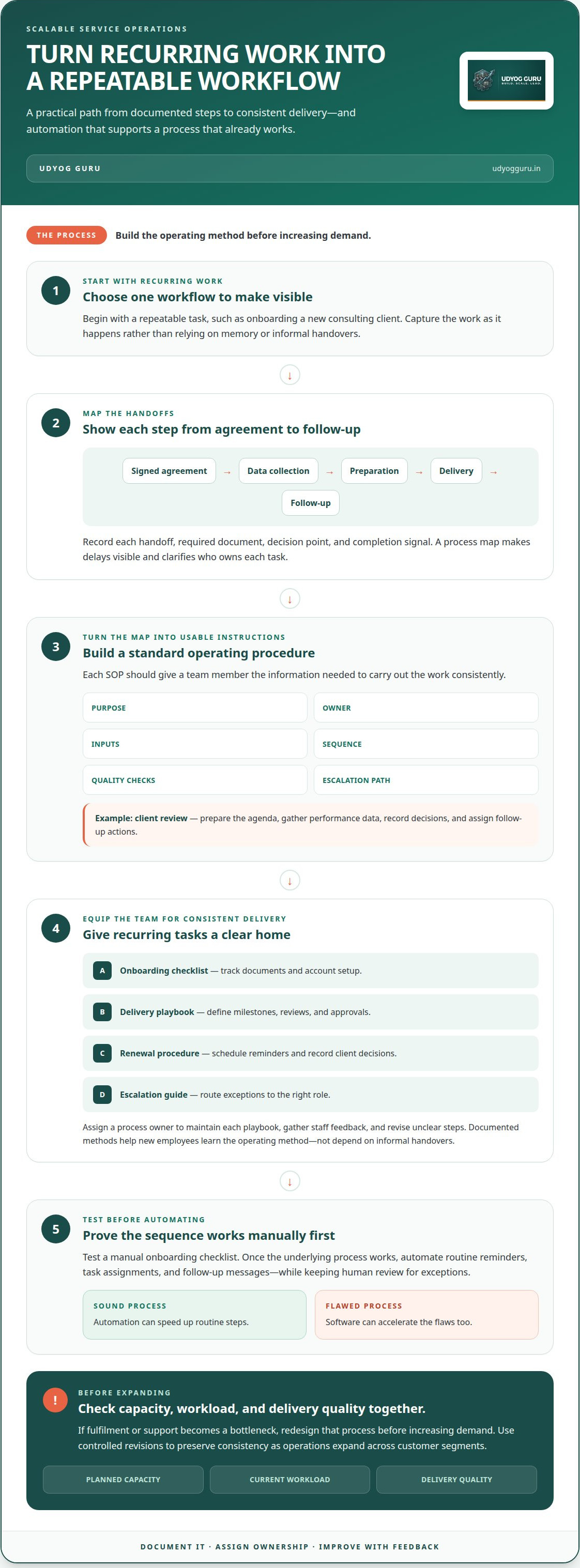
Start with a recurring workflow, such as onboarding a new consulting client. Record each handoff, required document, decision point, and completion signal. A process map can show how a signed agreement moves through data collection, preparation, delivery, and follow-up. This makes delays visible and clarifies who owns each task.
A standard operating procedure (SOP) turns that workflow into usable instructions. Each SOP should identify its purpose, owner, inputs, sequence, quality checks, and escalation path. For a client review, for example, it might specify how staff prepare the agenda, gather performance data, record decisions, and assign follow-up actions.
- Use an onboarding checklist to track documents and account setup.
- Use a delivery playbook to define milestones, reviews, and approvals.
- Use a renewal procedure to schedule reminders and record client decisions.
- Use an escalation guide to route exceptions to the right role.
These tools support hiring by helping new employees learn the operating method rather than rely on informal handovers. Assign a process owner to maintain each playbook, gather staff feedback, and revise unclear steps. Clear ownership also strengthens the working relationship between delivery teams and clients, making responsibilities and response points visible.
Digital tools can automate repetitive reminders, task assignments, and follow-up messages. Automate only after the underlying process works: software can accelerate a flawed sequence just as easily as a sound one. For example, test a manual onboarding checklist first, then automate routine notifications while keeping human review for exceptions.
During a growth strategy review, compare planned capacity with workload and delivery quality. If fulfilment or support becomes a bottleneck, redesign that process before increasing demand. Standardised playbooks make it easier to replicate core operations across customer segments, while controlled revisions preserve consistency as the business expands.
Data-driven decisions and strategic partnerships
Scaling decisions require financial evidence, operational signals, and buyer feedback. A dashboard can bring these inputs together, helping owners identify which growth assumptions merit investment and which need revision.
Start with a specific question, such as whether a marketing channel attracts profitable clients. Compare customer acquisition cost (CAC) with customer lifetime value (CLV), then review churn and revenue growth. If acquisition costs rise while retention weakens, increasing campaign effort may compound losses instead of creating sustainable growth.
Cloud-based finance, marketing, and operations platforms can consolidate records across teams. Data analytics can then reveal patterns in delivery time, employee productivity, operating efficiency, and average revenue per user. For example, compare service-line margins with workload. A popular offer may consume disproportionate effort, while a smaller segment may deliver stronger unit economics.
Choose a compact set of KPIs and assign an owner to each. Review changes together, not in isolation:
- Track CAC, CLV, churn, and revenue growth to assess commercial health.
- Compare operational efficiency and employee productivity to find capacity constraints.
- Use customer feedback, including net promoter score, to investigate experience changes.
- Review unit economics before adding spend, staff, or delivery commitments.
Partnerships can extend reach or capability without requiring the business to build every function internally. A distribution partner may open a new channel; an operational partner may contribute infrastructure or capital. Define responsibilities, customer handoffs, quality measures, and financial terms before work begins. Then assess whether the relationship improves access, delivery, or margin.
Automation can speed up routine reporting, but it cannot fix poor definitions or incomplete records. Standardise what each metric means before connecting systems. The Financial Command Dashboard can support financial visibility by bringing business performance into a decision-focused view. Pair that financial picture with buyer intelligence, then refine the model using feedback from actual delivery. This supports disciplined investment choices and helps distinguish genuine demand from activity that merely looks like growth.
Common mistakes in building a scalable business
Growth can increase revenue while multiplying manual work, service exceptions, and cash demands. Diagnose the operating model before expanding.
Franchising, Licensing, and Direct Expansion
Franchising replicates a service brand and operating format through franchisees; licensing permits the use of defined intellectual property or methods; direct expansion adds company-managed delivery. Each approach distributes control, investment, and operating responsibility differently. Compare the consistency your service requires, what knowledge can be documented, and who will manage local delivery. A process-dependent service may need tighter controls than a standardised digital programme.
A common mistake is pursuing growth before validating the underlying economics. If every new sale requires extra manual work, higher revenue may not improve profit. Test one customer segment or delivery channel first, then compare margins, workload, and retention. Recurring income can support planning, but only when renewals reflect ongoing value. Document exceptions and their causes before assuming the model scales. Repeated custom requests may signal unclear positioning or a service design that needs revision.
In India, GST, tax, and business registration requirements depend on the entity structure, activity, turnover, location, and transaction pattern. Map the applicable registration and filing obligations to those details, and maintain records supporting revenue, expenses, invoices, and tax reporting.
Service businesses with repeatable delivery can scale more readily, including digital training, structured consulting, and ongoing support. Growth depends on clear outcomes, standard delivery, and capacity beyond the founder. No category guarantees success, so examine demand, retention, margins, and delivery effort.
Hiring, Training, and Managing a Growing Team
Team management combines role design, practical training, delegation, and workload review. Hire for the capabilities your documented processes require, then train staff on real delivery tasks. Assign an owner to each client handoff and decision point. Review workload and quality together so managers can redistribute responsibilities before service delays emerge. Empower trained employees to resolve routine issues within defined boundaries.
To diagnose growth constraints and map a more scalable operating model, assess your business systems.
Udyog Guru: Business X-Ray™ (Tier 1)
Udyog Guru’s Business X-Ray™ (Tier 1) helps business owners assess where operations constrain sustainable growth. It is a relevant next step when sales are increasing but delivery, delegation, or financial visibility remains difficult to diagnose. A structured review can help identify which parts of the model need attention before expansion adds further complexity.
For businesses ready to address those findings, the Business Acceleration Engine™ (Tier 2) supports broader transformation. Workforce X-Ray™ focuses on workforce optimisation, while the AI Tech Business Integration Bootcamp (Tier 3) focuses on embedding AI and modern technology into existing workflows.
To discuss which structured business assessment fits your growth priorities, visit udyogguru.in.
Make the Next Growth Decision Deliberate
Choose the next business change by identifying the constraint currently limiting progress. It may be a handoff, a delivery exception, unclear ownership, or a financial signal that needs closer attention. Define what evidence would show the change is working before committing more resources.
This discipline keeps building a scalable service business model focused on operational capacity, not growth for its own sake. Treat each adjustment as a decision to test: set the intended outcome, observe the effect on clients and the team, then keep or revise the approach. This creates a practical way forward without forcing every part of the business to change at once.
If you’re ready to examine your next growth decision, contact Udyog Guru to discuss growth. A clear starting point can help turn operational complexity into focused work. Move forward with a measured plan and build the next stage on stronger foundations.
Frequently Asked Questions
What is a scalable business?
A scalable business can serve more customers and increase revenue without costs rising at the same rate. Its capacity depends on whether work can be distributed beyond the founder while preserving the customer outcome. For example, a specialist firm might train several practitioners to conduct the same assessment using shared criteria. The practical test is whether added demand strengthens the business without creating unmanageable delivery or support needs.
Buyer alignment: Does value survive as volume increases?
Value survives growth when the service continues solving a priority problem for its intended buyer. Compare new customers’ needs with the service’s original purpose, then check whether both groups get useful outcomes. For example, a reporting service designed for small retailers may need different analysis for manufacturers. More enquiries alone don’t prove alignment; look for repeat use, referrals, and customer feedback confirming the service remains relevant.
Economics: Does each additional customer strengthen the model?
Each additional customer strengthens the model when their revenue exceeds the incremental costs of acquisition, delivery, and support while preserving a sound margin. Examine new customer groups separately. For example, a segment that requires extra onboarding or specialist review may contribute less than expected despite higher sales. Track the added work and resources for each service type before treating revenue growth as evidence of healthier economics.
What Does “Scalable” Actually Mean?
“Scalable” means a business can increase output while keeping its operating structure effective. Growth alone isn’t enough: more customers may mean more founder hours without improving capacity. Assess what changes as demand rises, including decisions, delivery time, and support. A scalable design manages these pressures while maintaining service quality and financial performance. The practical question is whether the operation can serve more people without becoming proportionally harder to run.
What is a scalable service business model?
Building a scalable service business model means designing how a firm creates value, delivers it, and earns revenue as customer volume grows. For example, an accounting practice could define a monthly reporting package, specify client inputs, and train staff to deliver it. The model is stronger when customers receive a clear outcome without every engagement requiring a fresh design from the founder.
How do you validate demand for a service business in India?
Building a scalable service business model in India starts with testing a defined service among buyers who face the problem it solves. Interview prospective customers, offer a limited pilot, and record paid uptake, objections, repeat interest, and delivery effort. Compare evidence across customer segments rather than relying on general enthusiasm. Committed purchases and continued use provide stronger demand signals than expressions of interest alone.


