

A crowded to-do list needs a workable schedule, not more hours added to the day. If you're feeling overwhelmed as a business owner, write down your tasks, identify what needs attention today, and spread the rest across the week. Choose three essential tasks for each day, and leave room for delays, urgent work, and a lunch break.
The pressure can feel like a personal failure, but it often points to a practical problem: priorities are unclear, too much work rests with one person, or strategic tasks have no place in the calendar. This guide shows you how to structure your week, set business priorities and goals, and break large projects into manageable starting points. It also covers common causes of owner overwhelm, helping you pinpoint the strain and decide what to change.
Key Takeaways
- Map the full task list onto your week, protect space for urgent work, and keep each day’s commitments manageable.
- Choose a small set of business goals, then use them to distinguish strategic priorities from lower-impact tasks.
- Break a large project into a clear first action so you can begin without needing to solve the entire workload at once.
- Trace persistent pressure to its operational causes, such as carrying tactical work yourself or unclear responsibility across the team.
1. Scheduling tasks across the week
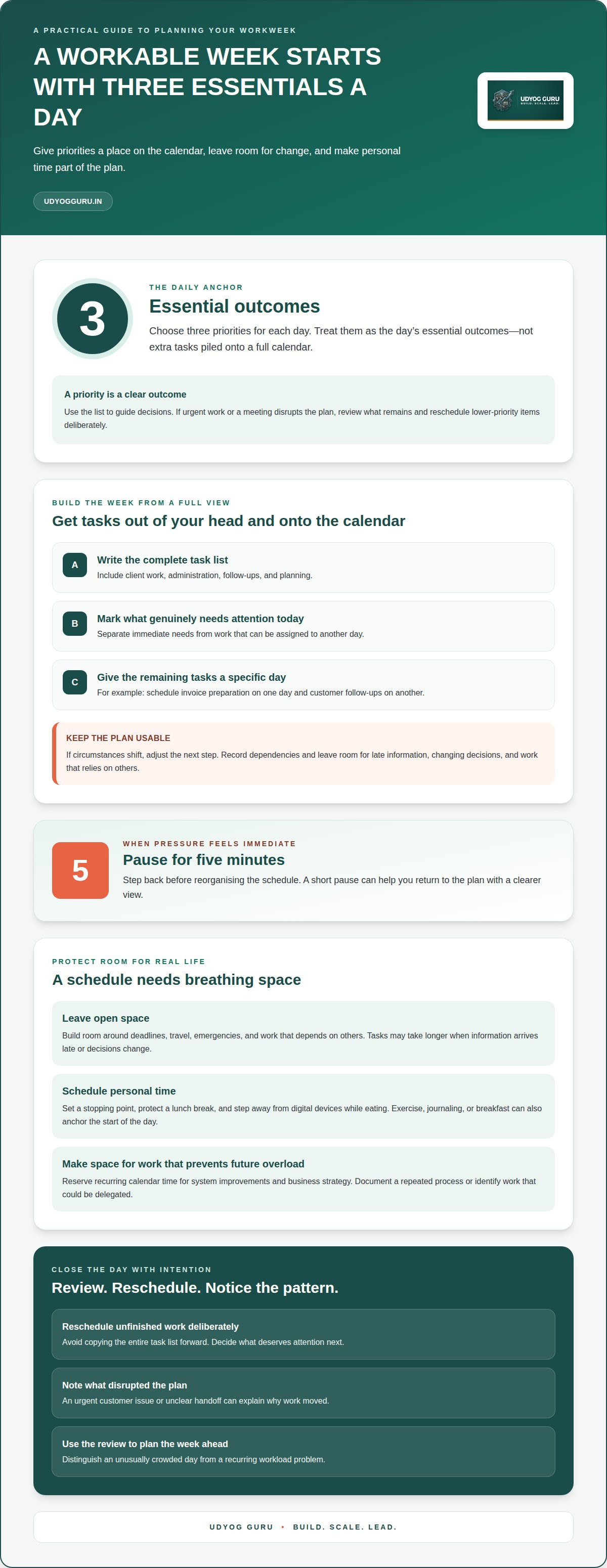
Feeling overwhelmed as a business owner can make every task seem urgent. Start with a complete written list, including client work, administration, follow-ups, and planning. Mark what genuinely needs attention today, then assign the remaining tasks to specific days instead of carrying the whole list in your head. For example, schedule invoice preparation on one day and customer follow-ups on another.
Keep each day realistic by choosing three essential outcomes. These should be the day’s priorities, not extra tasks added to an already full calendar. If a meeting or urgent request disrupts the plan, review the remaining work and reschedule lower-priority items. Use the schedule to guide decisions, not as another standard you must meet perfectly.
Build room for delays and emergencies into the week. Leave open space around deadlines, travel, or work that depends on others. A task may take longer if information arrives late or a decision changes. Don’t assume every person can complete every task exactly when needed. Record dependencies and adjust the next step when circumstances shift.
Work-life balance improves when personal time is part of the schedule. Set a stopping point, protect a lunch break, and step away from digital devices while eating. Exercise, journaling, or breakfast can also anchor the start of your day. If the pressure feels immediate, pause for five minutes before reorganising your schedule.
Use the calendar for work that prevents future overload, not just tasks with immediate deadlines. Reserve a recurring block for system improvements and business strategy, and treat it as scheduled work. For example, document a repeated process or identify tasks that could be delegated. Waiting for spare time often means these improvements never happen.
Review your schedule at the end of each day. Reschedule unfinished tasks deliberately instead of copying the entire list forward. Note what disrupted the plan, such as an urgent customer issue or an unclear handoff. This brief review helps distinguish an unusually crowded day from a recurring workload problem, giving you a clearer basis for planning the week ahead.
2. Setting business priorities and goals
A full calendar can conceal a priority problem. Small administrative tasks can feel easy to finish, so they crowd out work that moves the business forward. Before accepting another request, compare it with your business goals. Ask whether it protects revenue, improves delivery, or advances a defined strategic outcome. If it does none of these, defer it, delegate it, or decline it.
Set three goals for the next 12 months. Keep each goal specific enough to guide decisions, such as improving customer retention, strengthening a key service, or documenting a core process. Then identify the next practical action for each goal. A goal without an action remains an intention, while a goal with a scheduled next step can compete fairly with daily demands.
Use a simple test for incoming work: urgency, consequences, and alignment with your goals. A client issue affecting an immediate delivery may need attention today. A routine report with no near-term decision attached can wait. A request that supports none of your goals should not automatically displace planned work just because it arrived recently.
Delegation works best when the outcome and decision boundaries are clear. Assign the task to a person or role, explain what “complete” means, and specify which decisions they can make independently. For example, a team member could prepare a weekly operations update while you retain approval of major changes. Delegate ownership, not just isolated steps that leave you responsible for every decision.
Declining new demands also protects strategic capacity. Give a clear response, such as offering a later date or explaining which existing commitment would need to move. Review your priorities when new work repeatedly displaces the same goal. That pattern signals a workload or ownership issue, not merely a scheduling error. For a structured perspective on aligning business priorities with operations, explore business systems and priorities.
When small tasks fill the day, larger unfinished work can feel daunting and keep you overwhelmed. Step back from that cycle and focus on progress toward your business vision, rather than letting overwhelm dominate your attention. Declining demands and delegating details, instead of trying to control every task, can ease the pressure too.
3. Starting with a small task to build momentum
When the full workload feels hard to approach, choose one small, visible task. Reply to a client email, file a receipt, or confirm a meeting time. Define what “done” means before starting, so the task has a clear endpoint. Finishing it can create a sense of progress and make the next step easier to identify.
To regain control today, write down the work competing for your attention, then choose one task you can finish promptly. Complete it, record the next action, and use the result to decide what deserves attention next. This creates a practical sequence without requiring you to solve the entire workload at once.
For a larger project, identify the first action that produces a concrete result. “Improve customer onboarding” is too broad to begin; “draft the welcome email” is actionable. If a project task takes more than 60 minutes, split it into smaller tasks. Each part should have a defined output, such as a draft, an approval request, or a completed process step.
Keep the sequence visible. A project board might show “collect customer questions,” “draft answers,” and “review the draft” as separate stages. Finish one stage before opening several unrelated tasks, unless an urgent operational issue requires a change. Visible progress also helps reveal where work is blocked, such as waiting for input or approval.
A small task should be a starting point, not a substitute for important work. After completing it, use that momentum for a meaningful next action. For example, after filing one invoice, consider whether the remaining invoices need a process change or delegated ownership. If small tasks repeatedly consume the day, record the pattern for your workload review.
Use a brief end-of-day note to capture what moved forward and what remains blocked. For each unfinished project, write the next action instead of a vague reminder such as “work on proposal.” This clear handoff lets you resume with a defined step, rather than rebuilding the plan from memory.
4. Common causes of business-owner overwhelm
Overwhelm often signals a workload-design problem, not simply a full calendar. Owners who handle routine delivery, customer queries, and administration have less capacity for strategic decisions. If you occupy every role, identify which responsibilities require your judgement and which follow repeatable steps. Documenting those steps can clarify what a team member could own and where a manager may be needed.
Managing stress starts with locating the pressure point. Track recurring interruptions, delayed decisions, and tasks that return to you after delegation. Set boundaries around work time, take mindful breaks, and clarify role ownership with your team. These actions address operational strain directly, rather than treating every difficult week as an individual productivity failure.
Persistent exhaustion, difficulty concentrating, or withdrawing from usual activities can signal that professional support is appropriate. These signs don’t establish a diagnosis. Seek a qualified mental health professional if they persist or interfere with daily life. In India, business owners can look for support through mental health professionals, counselling services, or hospital mental health departments.
For small-business support in India, identify the practical gap first: registration guidance, credit access, market connections, or skills development. Then look for official government MSME support channels that address that need. For example, an owner seeking help with business processes needs a different service from one seeking finance. Match the type of support to the actual constraint.
Cash-flow pressure can grow when expected receipts and outgoing payments are tracked separately. Keep a forward-looking record of customer invoices, expected payment dates, supplier commitments, and recurring expenses. Follow up on overdue receivables, review spending, and plan major payments against expected inflows. This makes timing gaps visible before they disrupt routine operations.
If financial visibility is a recurring pressure point, explore how the Financial Command Dashboard fits into your business oversight.
When owners handle tactical work themselves, they may have less time for the business’s strategic needs. That can leave important decisions and longer-term improvements waiting. If you occupy every role, consider whether a manager could take ownership of day-to-day responsibilities and ease the strain of carrying the workload alone.
Udyog Guru: Business X-Ray™ (Tier 1)
Udyog Guru’s Business X-Ray™ (Tier 1) is a structured starting point when workload pressure appears connected to how the business operates. It helps examine the business as a system, so you can identify where responsibilities, processes, or priorities may need closer attention. This is useful when weekly scheduling alone hasn’t resolved recurring bottlenecks or when too much operational work continues to depend on you.
Once the underlying constraints are clearer, the Business Acceleration Engine™ (Tier 2) offers a next step for business transformation. If team responsibilities and delegation are central concerns, Workforce X-Ray™ is another relevant offering. The right focus depends on whether the pressure comes primarily from business-wide processes, execution, or workforce structure.
If you’re ready to examine the operational causes of overwhelm, visit Udyog Guru to discuss the next step.
Turn recurring pressure into a clearer operating system
Feeling overwhelmed as a business owner can point to a mismatch between the business’s demands and the way work is structured. Treat recurring pressure as useful diagnostic information: notice which decisions keep returning to you, where responsibilities remain unclear, and which processes rely on memory. These patterns can show where stronger operating systems are needed, rather than simply more personal effort.
The next step is to examine the pattern behind the pressure and decide whether it calls for clearer ownership, improved processes, or a broader operational review. Udyog Guru’s Business X-Ray™ (Tier 1), Business Acceleration Engine™ (Tier 2), and Workforce X-Ray™ support different areas of that work. Choose a structured review when the same constraints continue to affect your capacity to lead.
Contact Udyog Guru today to explore a practical next step. A clearer view of the underlying system can help you move forward with greater control.
Frequently Asked Questions
Why do business owners feel overwhelmed?
Feeling overwhelmed as a business owner often comes from carrying too many unresolved decisions at once. Uncertain customer demand, changing supplier timelines, and competing requests can divide your attention, even when the task list seems manageable. For example, postponing a pricing decision may affect proposals, cash planning, and delivery expectations. Identify the decision creating the most uncertainty, then define the information or action needed to resolve it.


