

Inefficient processes can cost companies up to 30% of annual revenue, turning small delays and duplicated work into a material operating problem. More than 40% of workers say they spend at least a quarter of their workweek on manual, repetitive tasks. Identifying and fixing operational inefficiencies starts by tracing where time, information, and decisions stall, then correcting the process behind the symptoms.
Operational inefficiencies rarely stem from one dramatic failure. Outdated procedures, disconnected tools, unclear handoffs, and unnecessary steps can compound across teams. To identify and fix operational inefficiencies, examine how work actually moves, compare it with the intended workflow, and use evidence such as time-tracking reports, financial statements, and customer-service logs to locate friction. This guide explains how to find the causes and prioritise fixes using relevant KPIs. It also shows when process redesign, clearer delegation, or automation can address the underlying constraint, so improvements strengthen operations instead of shifting work elsewhere.
Key Takeaways
- Trace a workflow from start to finish to expose duplicate steps, unclear ownership, and delays between teams.
- Compare intended procedures with how work is actually completed, then investigate the root cause before changing the process.
- Assess inefficiencies by their effects on service, quality, capacity, and decision-making, not just by visible activity.
- Prioritize fixes by business impact, then monitor relevant KPIs to see whether the change resolves the underlying bottleneck.
Common causes, including outdated processes and disconnected tools
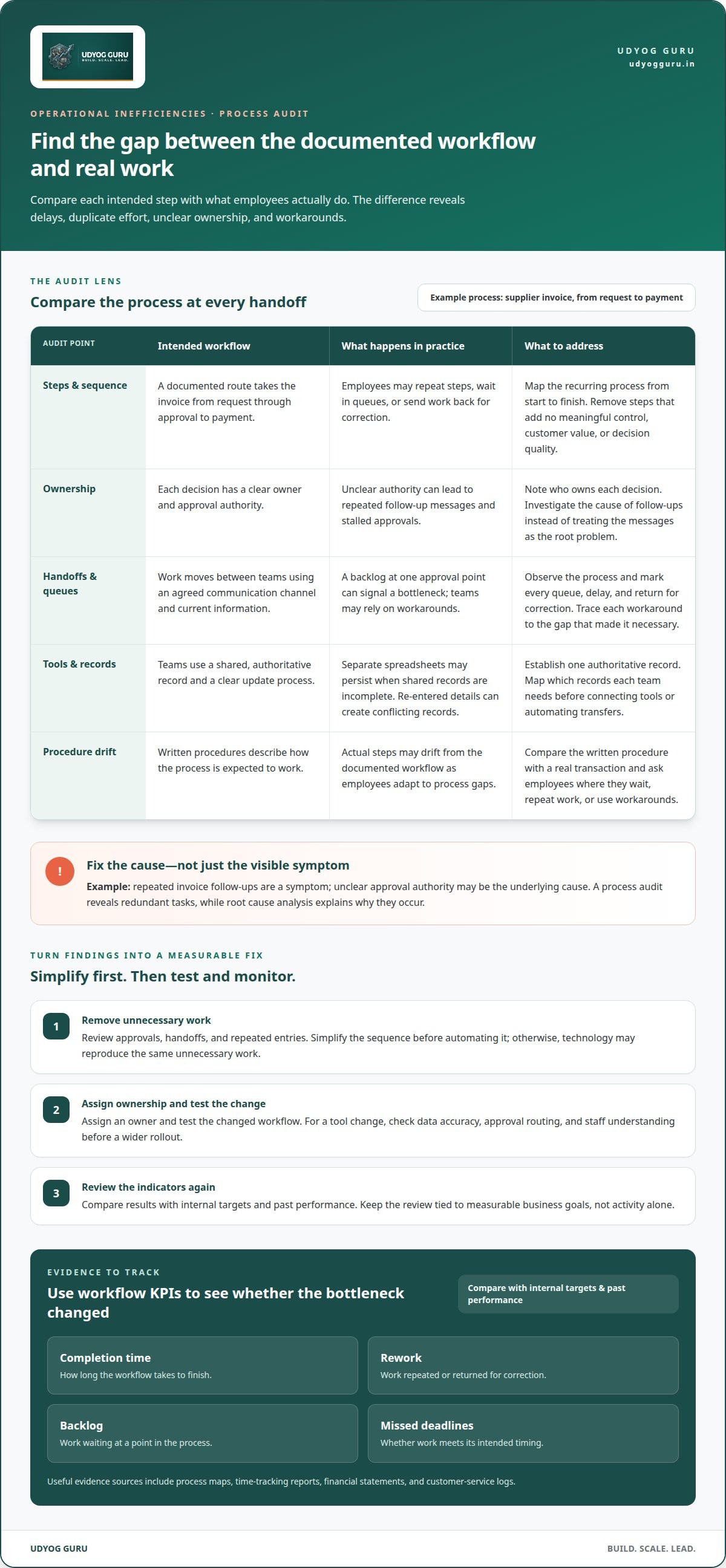
Compare the documented workflow with a real transaction from start to finish. This highlights where outdated steps, disconnected tools, or unclear handoffs interrupt work.
-
Audit Processes and Identify Root Causes
Map one recurring process, such as approving a supplier invoice, from request to payment. Compare each action with the written procedure and note who owns each decision. Ask employees where they wait, repeat work, or rely on a workaround. A process audit reveals redundant tasks; root cause analysis explains why they occur. Distinguish the underlying cause, such as unclear approval authority, from the symptom, such as repeated follow-up messages.
-
Locate Bottlenecks, Drift, and Workarounds
Observe employees completing the process and mark each queue, delay, and return for correction. A backlog at one approval point may signal a bottleneck. Compare actual steps with the intended workflow to spot process drift. For example, employees may keep separate spreadsheets because shared records are incomplete. To identify and fix operational inefficiencies, trace each workaround to the gap that made it necessary.
-
Simplify Processes and Remove Unnecessary Steps
Review every approval, handoff, and repeated entry in the mapped workflow. Remove steps that add no meaningful control, customer value, or decision quality. If staff enter order details in two spreadsheets, establish one authoritative record and a clear update process. Standardise communication channels so teams can find current information. Simplify the sequence before automating it; otherwise, technology may reproduce the same unnecessary work.
- Use process maps, time-tracking reports, financial statements, and customer-service logs to assess operations. Track workflow-related KPIs, such as completion time, rework, backlog, and missed deadlines, against internal targets and past performance. Assign an owner, test the change, and review the indicators again. Keep efforts to identify and fix operational inefficiencies tied to measurable business goals, not activity alone.
What Are Operational Inefficiencies?
Operational inefficiencies are avoidable delays, errors, or duplicated effort within a business process. Manually transferring the same order details between disconnected systems, for example, adds work and can create conflicting records.
- Connect the tools that support a shared workflow. When sales, inventory, and fulfilment records sit in separate systems, teams may re-enter information or miss updates. Connected digital systems can centralise data, automate repetitive tasks, and improve visibility across teams. Before choosing an integration approach, map which records each team needs.
- Automate repetitive tasks only after clarifying the process. Examples include routing a completed form to an approver or transferring standard order details between systems. Automation can reduce manual handling, but automating an unclear workflow can reproduce its errors faster. A Statista figure cited on the page says 52% of businesses report fewer manual errors with automation. For complex workflow technology, structured technology integration can help align tools with existing operations.
- Manage implementation risks by testing a changed workflow with a limited set of transactions first. Check data accuracy, approval routing, and staff understanding before a wider rollout. For example, compare an automated invoice route with the existing approval record, then correct mismatches before expanding the process. Assign an owner to review exceptions and document fallback steps in case a tool fails.
- Measure improvement by comparing a baseline with results after implementation. Choose relevant indicators, such as processing time, error rate, rework volume, or completed orders, and use the same measurement period. To assess return on investment, compare the value of time saved and errors reduced with implementation and operating costs. Record assumptions consistently and review whether the change improves the intended business outcome.
Regular process audits can uncover redundant tasks and outdated practices that slow workflows. Evaluate processes by talking to team members, observing workflows, and identifying gaps between intended and actual steps. The Eisenhower Matrix can help teams prioritise high-impact tasks by sorting them into actionable categories.
A Statista figure cited on the page says 45% of companies have seen improved work quality with automation. A Statista figure cited on the page says 43% of companies report faster processes with automation.
Defining operational inefficiencies and their business impact
Operational inefficiency occurs when a process uses avoidable time or effort without improving the result. Repeated data entry, for example, can delay order fulfilment and increase correction work.
- Measure the gap between work performed and business outcomes. Compare a process’s time, quality, and output with its intended purpose, such as resolving customer requests accurately and promptly. Employees spend approximately 20% of their work time searching for internal information or tracking down colleagues. That lost time can slow decisions and interrupt customer-facing work.
- Connect operational measures to business goals before choosing a fix. If reliable delivery is the priority, track on-time completion and rework rather than counting tasks alone. Misaligned goals create friction: one team may optimise speed while another prioritises approvals, leaving work stuck between them. Define a shared outcome, assign process ownership, and review the measures together.
- Assess how inefficiency affects capacity, service, and quality. Repeated approval loops can delay a customer response, while inconsistent records can lead to incorrect fulfilment. Trace the effect from process step to business result, then identify the gap causing the greatest disruption. This separates a visible symptom, such as a late order, from a recurring process weakness.
- Improve efficiency in India by designing workflows around their intended business results while accounting for applicable labour and data-protection obligations. Before changing work allocation or automating records, document the process, limit access to relevant information, and review the change against the obligations that apply to the business.
- Prioritise improvements using a defined baseline and consistent review method. Record measures such as processing time, error frequency, and completed work before changing a procedure, then compare the same indicators afterward. If a revised handoff aims to reduce order rework, for example, monitor rework alongside completion time so faster processing does not conceal quality problems.
Costs and consequences of inefficient operations
Trace operational costs beyond visible expenditure. A delayed approval can also consume staff time, postpone customer service, and constrain the next stage of work.
- Estimate the full effect of recurring process failures. Inefficient processes can cost companies up to 30% of annual revenue. Treat this as a potential exposure, not an automatic forecast for an individual business. Examine where rework, delays, lost capacity, or errors affect revenue and service, then identify the process behind each consequence.
- Measure the cost of meetings that produce no decisions. Executives report that 67% of meetings fail to achieve their intended outcomes. Review recurring meetings for unclear agendas, unnecessary attendees, and missing next steps. Record decisions and owners; a meeting that ends without either can create another round of coordination.
- Connect operational losses to customer and team outcomes. A bottleneck in order processing, for example, may delay dispatch, prompt customer follow-ups, and divert staff from new orders. Track the chain from delay to consequence using service logs, rework records, and relevant performance indicators. This helps show whether the main issue is capacity, process design, or unclear ownership.
- Estimate the cost of process improvement or automation in India by defining the scope first. The price depends on process complexity, tools involved, integration needs, and implementation requirements; it is provided after a quote request. Compare these factors with the expected operational benefit, such as less rework or faster completion, before choosing an intervention.
- Rank fixes by impact and monitor the result after implementation. Start with the process causing the greatest measurable disruption, then compare its baseline with later performance. If a change reduces delays but increases errors, adjust the workflow rather than declaring success. Use a structured operations assessment to examine where process costs originate and which improvements merit priority.
Udyog Guru: Business X-Ray™ (Tier 1)
Udyog Guru’s Business X-Ray™ (Tier 1) provides a structured starting point when process reviews reveal interconnected operational gaps. Use it to examine where workflows, responsibilities, and business systems need closer assessment before selecting improvement priorities. This is particularly relevant when delays recur across departments, or when local fixes fail to resolve the wider constraint.
For businesses ready to move from diagnosis to broader transformation, the Business Acceleration Engine™ (Tier 2) supports the next stage. Workforce X-Ray™ focuses on workforce optimisation, while the AI Tech Business Integration Bootcamp (Tier 3) focuses on embedding AI and modern technology into existing workflows. The appropriate pathway depends on whether the central issue sits in business operations, workforce performance, or technology integration.
To discuss a structured approach to your operational priorities, contact Udyog Guru or visit udyogguru.in.
Make continuous improvement part of operations
Operational improvement lasts when teams make it part of routine management rather than treating it as a one-time repair. Give employees a clear way to flag friction, record recurring exceptions, and suggest practical changes. Assign an owner to assess each issue, decide what to test, and communicate the revised procedure. This makes identifying and fixing operational inefficiencies an ongoing discipline that adapts as customer needs, workloads, and systems change.
Start with one improvement that supports a defined business priority. Track its effect, record what the team learns, and use that evidence to guide the next adjustment. Keep responsibilities visible so the process remains stable when workloads shift or team members change. The goal is not simply to remove effort, but to direct capacity towards work that advances the business.
Contact Udyog Guru to discuss your operations and determine a structured next step. A measured improvement begins with a clear decision to act.
Frequently Asked Questions
What are operational inefficiencies and common examples?
Operational inefficiencies are avoidable friction that consumes resources without improving results. Examples include maintaining duplicate customer records, correcting invoices because of inconsistent data entry, or routing routine decisions through unnecessary approvals. These issues can emerge between finance, sales, and fulfilment in a growing Indian business. Look for repeated corrections, idle handoffs, and tasks that no longer serve a clear purpose.
How do you identify operational inefficiencies in a business?
Compare employee experience with performance patterns, then investigate where they diverge. Invite staff to share recurring obstacles through confidential surveys or cross-department focus groups; employees may spot friction managers miss. Pair that feedback with measures tied to business goals, such as customer complaint patterns or unfinished work. Review the findings with process owners and distinguish isolated incidents from recurring conditions before assigning a fix.
How can process mapping and root cause analysis reduce inefficiencies?
Process mapping makes responsibilities, decisions, and handoffs visible; root cause analysis tests why a failure occurs. Map a customer refund from request to resolution, for example, noting each team’s input and decision point. If requests repeatedly come back for missing evidence, ask why the evidence is absent and where the requirement becomes unclear. Fixing the source can prevent repeat cases instead of adding another review step.


