

The fastest route to better customer service may be to redesign the process, not ask people to work faster. Business process re-engineering for SMEs means fundamentally restructuring end-to-end workflows to improve customer value, efficiency and responsiveness. Unlike incremental improvement, it examines how work is organised across functions and whether each step still serves a clear purpose.
It’s reasonable to be cautious: changing a workflow can disrupt roles, handoffs and the systems people rely on. Effective redesign starts by understanding how work currently moves, where delays or repeated effort occur, and what customers experience at each stage. Information technology can support a better operating model, but technology alone won’t fix a poorly designed process.
This article explains what BPR involves, how process redesign and information technology can work together, and when a growing Indian SME might consider a fundamental change rather than incremental adjustments. You’ll also see how clearer workflows can support customer satisfaction and help a business respond more effectively as its needs change.
Key Takeaways
- Distinguish fundamental process redesign from ongoing management and incremental improvement to identify the right scale of change.
- Map how work actually moves across teams before choosing technology; automation should support a redesigned workflow, not preserve unnecessary steps.
- Assess redesign through customer value, delays, handoffs and operating effort, then track whether the new process improves responsiveness.
- Use a structured diagnostic to locate operational constraints, then align process, workforce and technology changes with the business’s priorities.
What is business process reengineering (BPR)?
Business process reengineering (BPR) fundamentally redesigns connected workflows to improve customer value, efficiency and operating outcomes. For an SME, it means examining how work crosses roles and functions, then removing steps that no longer support the result.
BPR and Business Process Management
BPR is a radical redesign of how an end-to-end process works, while business process management (BPM) measures, standardizes and improves processes continuously. That distinction matters when existing processes need more than incremental process improvement: BPM may refine an approval path, while BPR may remove redundant approvals and reorganize who completes the work. The approach emerged in the early 1990s, and Michael Hammer and James Champy helped popularise it through their 1993 book, Reengineering the Corporation. For a growing SME, analysis should establish whether a persistent bottleneck needs adjustment or a redesigned workflow.
Intelligent Automation and Process Management
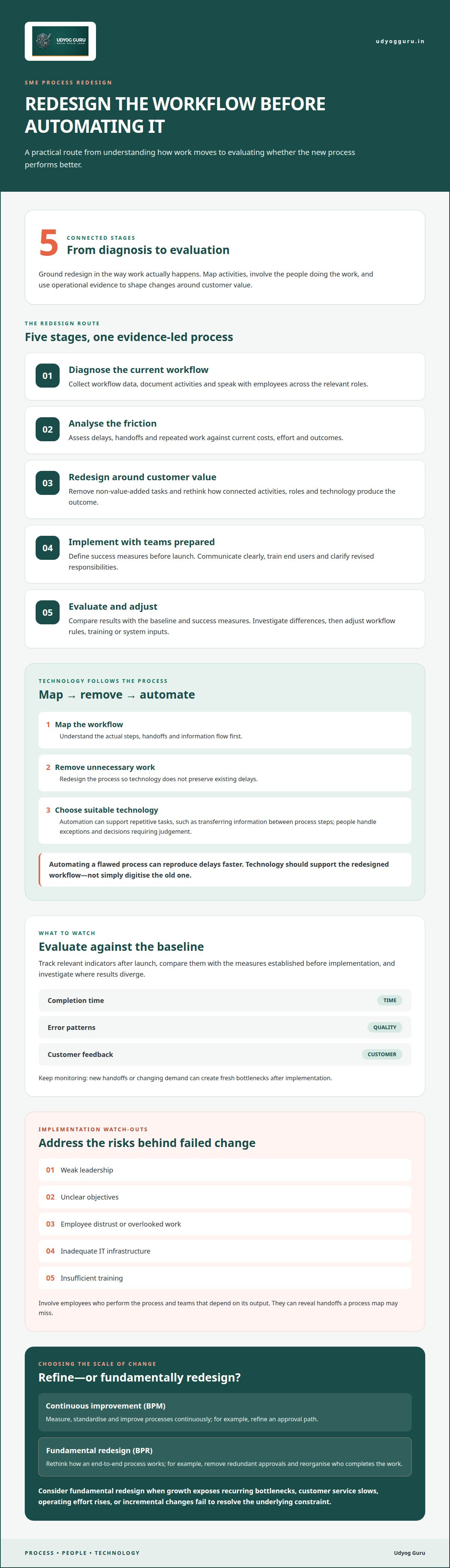
Intelligent automation combines robotic process automation, BPM and artificial intelligence to optimise business processes. BPM provides the process view: it helps teams document workflows, standardise activities and monitor performance. Automation can then handle suitable repetitive tasks, such as transferring information between process steps, while people manage exceptions and decisions requiring judgement. The sequence matters: map the workflow first, remove unnecessary work, then identify tasks technology can support. Automating a flawed process can reproduce delays faster; connecting automation to redesigned steps aligns technology with the intended outcomes.
BPR Benefits and Management Focus
BPR aims to improve customer value by reducing unnecessary steps, cycle time and operating effort, with potential gains in efficiency, productivity, quality and satisfaction. Those outcomes require more than a new workflow diagram. Leaders need to approve the redesign, support its implementation and oversee how teams adopt new responsibilities. Change management includes clear communication and training, so employees understand how revised handoffs affect their work. Suitable IT infrastructure must also support the redesigned process; otherwise, disconnected systems can preserve manual checkpoints. Before implementation, define success measures and monitor results after launch. This keeps redesign tied to observable performance, not technology adoption alone.
Information technology as an enabler of process redesign
Technology supports BPR when it changes how information and decisions move through a workflow. Start with the process, then choose tools that fit its intended outcomes.
Technology for Process Redesign
Information technology enables redesigned workflows by connecting data, automating routine transfers and making process status visible. For example, a shared system can reduce repeated data entry between order handling and fulfilment. Technology should support a new process architecture, not simply digitize existing delays. For Indian SMEs, BPR consulting and implementation costs depend on scope, process complexity, systems and implementation requirements; the price is given after a quote request.
Preparing Teams for Process Change
Prepare teams with clear communication, end-user training and defined responsibilities before implementation. Involve employees who perform the process and teams that depend on its output; they can identify handoffs a process map may miss. Common risks include weak leadership, unclear objectives, employee distrust, inadequate IT infrastructure and insufficient training. Projects can fail when redesign overlooks people’s work or technology cannot support the intended workflow.
BPR Diagnosis and Redesign Stages
BPR moves from diagnosis to analysis, redesign, implementation and evaluation. First, collect workflow data, document activities and speak with employees across relevant roles. Then assess delays, handoffs and repeated work against current costs, effort and outcomes. Redesign the selected process around customer value, and define success measures before implementation. This sequence helps teams remove non-value-added tasks while grounding proposed changes in operational evidence.
Evaluating and Iterating on Processes
Evaluate the new process by comparing its performance with the baseline and success measures established before launch. Track relevant indicators, such as completion time, error patterns or customer feedback, then investigate where results diverge. Adjust workflow rules, training or system inputs based on evidence. Ongoing monitoring matters because new handoffs or changing demand can create fresh bottlenecks after implementation.
SMEs may need fundamental redesign when growth exposes recurring bottlenecks, customer service slows, operating effort rises or incremental changes fail to resolve the underlying process constraint.
A structured transformation framework can connect process diagnosis with implementation priorities through business transformation support.
Business process reengineering definition
Business process reengineering redesigns core work to improve performance, customer value and efficiency. In India, digitisation support is scheme-specific: eligibility and covered activities determine whether a process-improvement project qualifies.
BPR Definition and Goals
Business process reengineering is the fundamental redesign of connected activities, roles and technology to deliver better value. Its goal is not merely to speed up existing tasks, but to rethink how an organisation produces an outcome for customers. That distinction matters when a process remains ineffective despite repeated fixes. A new design may change handoffs, responsibilities and systems together, rather than optimise one isolated task.
Ford Motor Company’s purchasing department provides an industry example: its reengineering project reduced purchasing cycle time by 70%, headcount by 30% and supplier defects by 90%. These figures illustrate the range of outcomes process reengineering can target, not a forecast for every organization. The central thinking is to redesign the system around the intended result, then assess whether the changed process delivers it.
BPR Versus Incremental Improvement
Incremental improvement adjusts parts of a process, while BPR questions its underlying structure. This distinction helps leaders choose a proportionate response: refine a workable approval sequence when small changes address the constraint, or consider fundamental redesign when repeated adjustments leave the same bottleneck intact. Because business process reengineering can affect work across departments, its scope extends beyond one team’s local improvement.
Adoption is most relevant when market demands change, customer outcomes remain weak or existing processes cannot support the organisation’s direction. In those cases, analyse the end-to-end result, not just the performance of individual departments. A redesign can then reconnect responsibilities around the complete customer-facing process.
BPR, Improvement, Automation, and ERP
Business process improvement refines a workflow, automation performs selected tasks, and ERP implementation introduces an integrated enterprise system; BPR redesigns the work itself. For example, installing ERP software without changing redundant approvals may digitise the same constraint. Process reengineering can instead establish what work should change before automation or system implementation is considered.
In India, assess any digitisation or process-improvement subsidy against its stated eligibility, covered activities and expense rules before including it in a project budget. Support for technology adoption does not automatically mean every BPR, automation or ERP expense qualifies. Treat funding as a separate assessment from deciding whether the process needs redesign.
Customer satisfaction and operational agility
Customer satisfaction improves when core business processes remove friction from the customer journey. Operational agility improves when teams can adjust workflows without rebuilding the entire operating model. A well-scoped business process re-engineering for SMEs initiative connects both aims to specific customer and operational outcomes.
Trace one customer request from first contact to completion. For an Indian SME handling product orders, record how staff capture requirements, confirm availability, communicate delivery status and resolve issues. Each handoff can create waiting or repeated information requests. Redesigning the sequence can make ownership clearer and help customers receive consistent updates. The practical test is whether the revised process reduces avoidable effort for customers and staff.
Agility comes from processes that can absorb changes in demand, product mix or customer needs. For example, a service business facing more support requests can use clear routing rules to direct urgent cases to the right team. Defined decision rights help employees respond without sending every exception through a manager. This supports productivity while keeping service standards consistent as work volumes shift. Business process re-engineering for SMEs should preserve the ability to adapt as priorities change.
Measure improvements through indicators tied to customer experience and operating performance, rather than technology use alone. An SME might track:
- Time from customer request to completion.
- Repeated requests for the same information.
- Delays at specific approval or handoff points.
- Customer feedback about clarity and responsiveness.
Review these measures continuously after implementation. If faster processing increases errors, examine the changed steps and adjust the workflow. If customers still wait at one handoff, investigate why. This feedback loop keeps improvements aligned with strategic priorities instead of treating redesign as a one-time exercise. The takeaway: connect each change to a customer outcome, then monitor whether the new design sustains it.
Map your customer-facing workflows to identify where process changes could improve responsiveness and agility.
Udyog Guru: Business X-Ray™ (Tier 1)
Udyog Guru’s Business X-Ray™ (Tier 1) is a structured starting point for examining business operations and identifying where process redesign deserves attention. It can be relevant when recurring bottlenecks, unclear handoffs or operational constraints make it difficult to determine what needs to change first.
Where broader transformation is the next priority, the Business Acceleration Engine™ (Tier 2) supports the wider framework. Workforce X-Ray™ and Workforce Acceleration Engine™ address workforce optimization and delegation, while the AI Tech Business Integration Bootcamp (Tier 3) focuses on embedding technology and automation into existing workflows. The appropriate path depends on whether the central issue lies in processes, workforce structure or technology integration.
Contact Udyog Guru to discuss your business process priorities.
Set the Next Process Priority
Choose one process where delays, rework or unclear ownership affect customers or staff. Define the outcome that matters, identify who owns the work and make the current constraint visible before changing the workflow. This keeps business process re-engineering for SMEs connected to an operational priority, not a technology project in search of a problem.
Use that priority to frame a focused discussion: what is happening now, what must change, and how will the business recognise a better result? Udyog Guru’s Business X-Ray™ (Tier 1), Business Acceleration Engine™ (Tier 2) and Workforce X-Ray™ provide relevant paths for examining business operations and workforce structure.
Contact Udyog Guru about process redesign and take the next step toward a clearer operating model. A well-defined process priority gives your team a practical place to begin.
Frequently Asked Questions
Should I Consider BPR?
Consider BPR when a critical workflow repeatedly misses its intended outcome despite targeted fixes. For example, if a growing distributor’s order process involves repeated stock checks, unclear ownership and delayed dispatch, examine the whole process rather than adjusting one team’s task. BPR is most relevant when the root cause spans roles or systems and leaders can sponsor a redesign, involve affected employees and assess the changes.
What are the 3 R’s in the BPR Project?
A useful shorthand for the 3 R’s is rethink, redesign and retool. Rethink questions why the process exists and what result it should produce. Redesign changes the sequence, responsibilities or decision points. Retool aligns people, systems and skills with the new arrangement. Treat these as a practical memory aid, not a fixed universal standard: BPR frameworks may use different stages or terminology.
What is BPR also known as?
BPR is also called business process redesign or business process reengineering. Both terms describe examining how work is organised and changing the process architecture, rather than simply improving individual tasks. In practice, “redesign” may describe the work itself, while “reengineering” refers to a broader transformation involving roles, technology and operating arrangements. The intended scope matters more than the label.
What is BPR used for?
BPR reshapes a business process that no longer fits its purpose or operating conditions. A manufacturer, for instance, could review how a product defect moves from detection to resolution, clarifying who records the issue, approves corrective work and informs the customer. This end-to-end view can reveal structural causes, such as duplicated decisions or missing ownership, that isolated task changes may leave untouched.
What is the benefit of BPR?
A key benefit of BPR is clearer accountability across work that crosses teams. For example, a service request can have a defined owner from intake through resolution, instead of becoming an untracked handoff between departments. Clear ownership helps managers locate delays, assign decisions to the right role and identify where extra capacity or revised responsibilities could improve the process.
Why is BPR important?
BPR matters because a process designed for an earlier business model can constrain future growth. A company adding products, customer groups or sales channels may find that old approval paths and role boundaries no longer support its needs. Reviewing the process as a connected system helps leaders decide which responsibilities, information flows and decision rules should change to support the organisation’s direction.


