
Is your organization a scalable machine or a collection of manual workarounds that collapse the moment you step away? For many Indian founders, the reality of scaling is less about strategic expansion and more about managing a high-stakes pathology of constant firefighting. You likely recognize the fatigue of being the primary engine for every minor decision, a dependency that creates dangerous operational bottlenecks and obscures real-time financial transparency. It's difficult to maintain momentum when you're trapped in the gears of your own daily operations.
We agree that intuition is no substitute for structural integrity. To transition from a personality-driven company to a systems-led enterprise, you require a rigorous business diagnostic scan. This article provides a clinical framework to identify deep-seated structural flaws and install the predictable growth systems necessary for expansion. We'll preview the architecture of the Business X-Ray™, the methodology for removing founder dependency, and the precise calibration required to implement a Financial Command Dashboard. By the end of this analysis, you'll have a clear blueprint to replace operational chaos with a systematic engine for predictable growth.
Key Takeaways
- Learn to replace intuitive management with a data-driven "Business-as-Science" approach to stabilize your organization's structural integrity.
- Discover how the Business X-Ray™ methodology uncovers hidden inefficiencies through a clinical examination of your internal workflows.
- Identify critical fiscal fractures and restore real-time oversight using the Financial Command Dashboard diagnostic tool.
- Establish a 5-step protocol to ensure your business diagnostic scan leads to a successful installation phase rather than remaining a static report.
- Use your diagnostic blueprint to transition into the Business Acceleration Engine™ for predictable, founder-independent growth.
The Science of the Business Diagnostic Scan: Beyond Intuition
Business management often relies on the intuition of the founder, yet scaling an enterprise requires a shift from subjective guesswork to a clinical evaluation of structural integrity. A business diagnostic scan serves as the technical prerequisite for this transition, moving away from "gut-feel" decisions toward a rigorous "Business-as-Science" methodology. While traditional tools like SWOT analysis are common in organizational development, they frequently fail because they rely on internal perceptions rather than objective data. These legacy frameworks are too shallow to identify deep-seated operational fractures that reside within the company's architecture. High-resolution scanning provides a level of total operational transparency that subjective audits simply can't replicate.
The Limitations of Subjective Business Audits
Subjective audits are prone to "Founder Bias," a condition where the architect of the business becomes blind to their own systemic weaknesses. In the Indian market, where competition is aggressive and margins are often tight, relying on surface-level symptoms like low profit can be fatal. These symptoms often mask root-cause pathogens, such as inefficient protocols or broken communication loops, which remain invisible without high-resolution analysis. A delayed diagnosis in a rapidly scaling market doesn't just stall growth; it accelerates the decay of existing systems, leading to a state of permanent firefighting. When an owner misinterprets a systemic fracture as a temporary cash flow issue, they apply the wrong treatment, further destabilizing the organization.
Defining Operational Clarity in 2026
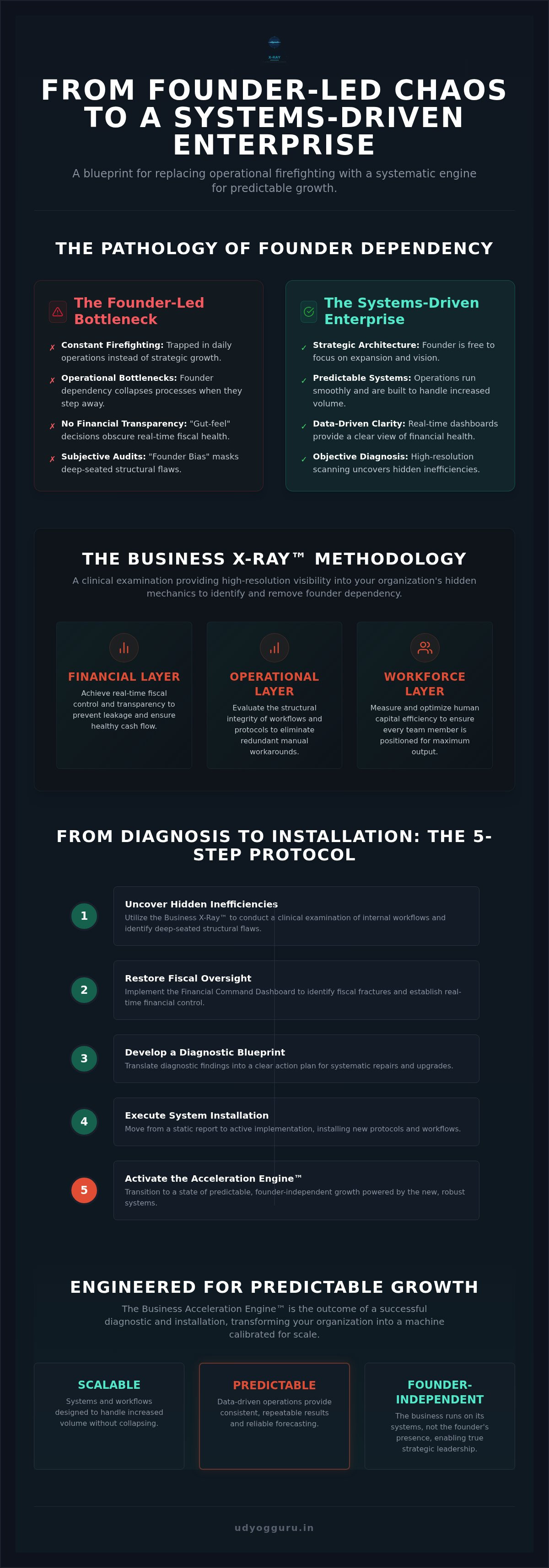
In the current fiscal year, operational clarity isn't just a management goal; it's the ability to visualize every moving part of the business without physical presence. This level of transparency is built upon three distinct pillars that must be examined during any thorough assessment:
- The Financial Layer: Achieving real-time fiscal control and transparency to prevent leakage and ensure healthy cash flow.
- The Operational Layer: Evaluating the structural integrity of workflows and protocols to eliminate redundant manual workarounds.
- The Workforce Layer: Measuring and optimizing human capital efficiency to ensure every team member is positioned for maximum output.
A business diagnostic scan is a clinical procedure for identifying systemic bottlenecks that prevent an organization from reaching its designed capacity. By installing this high-resolution oversight, a founder can finally step back from the gears and assume the role of a strategic architect. This systematic approach ensures that every component of the enterprise machine is calibrated for maximum output and predictable scaling.
Architecting Transparency: The Business X-Ray™ Methodology
The Business X-Ray™ represents a Tier 1 diagnostic protocol designed to provide high-resolution visibility into an organization's hidden mechanics. Unlike generic maturity assessments that rely on qualitative surveys, this methodology functions as a clinical examination of business workflows. It moves beyond simple data collection to create a structural visualization of the company. This process is essential for identifying the degree of Founder Dependency, which often acts as a silent bottleneck within scaling Indian enterprises. By uncovering where the business is tethered to a single individual, the scan provides the necessary evidence to begin the decoupling process.
Conducting a professional business diagnostic scan through the Business X-Ray™ framework allows leaders to see their organization as a machine rather than a series of disconnected tasks. It's about data integrity. If you can't measure the friction in your delivery engine, you can't fix it. To begin this transition toward a systematic architecture, many founders start with a preliminary assessment of their operational health to identify immediate points of failure. The goal is to move from a state of reactive troubleshooting to one of proactive engineering.
The Anatomy of a Business X-Ray™
This protocol analyzes three specific subsystems to ensure the organization is built for scale. First, it examines the sales funnel architecture to verify conversion protocols and identify leakage points in the acquisition cycle. Second, it evaluates the delivery and fulfillment engines to ensure they can handle increased volume without structural collapse. Finally, the scan audits administrative and financial reporting structures to ensure data integrity. This ensures that the Financial Command Dashboard eventually receives accurate, high-fidelity inputs. Without this foundational clarity, any attempt to automate will only accelerate existing inefficiencies.
Workforce X-Ray™: Quantifying Team Performance
The Workforce X-Ray™ functions as a specialized sub-protocol for team optimization and human capital auditing. It moves away from subjective performance reviews and toward quantitative auditing of delegation and accountability loops. By mapping individual and departmental output against specific organizational growth targets, the scan identifies exactly where the human capital engine is misfiring. This diagnostic clarity is vital for enterprises aiming to scale. It highlights which roles are truly productive and which are merely performing "busy work" that doesn't contribute to the bottom line. It's the difference between having a staff and having a high-performance team calibrated for growth.
Diagnostic Parameters: Identifying Structural Fractures
Identifying structural fractures within an organization requires a precise set of diagnostic parameters that go beyond superficial balance sheets. In Indian scaling enterprises, these fractures often manifest as erratic cash flow, delayed fulfillment, or a complete lack of departmental accountability. A thorough business diagnostic scan uncovers the "Firefighting Loop," a systemic pathology where the founder is trapped in daily operations, preventing any form of strategic progression. This loop is usually the result of a significant technology gap; the scan identifies exactly where manual interventions are stalling the organizational engine and preventing the installation of automated protocols. Without this level of forensic detail, growth only serves to widen existing cracks, leading to eventual structural collapse.
The Financial Command Scan
A critical systemic failure in most mid-sized organizations is the absence of real-time reporting. Without high-fidelity data, the CEO is essentially flying blind, making decisions based on financial information that is often weeks or months out of date. The scan evaluates existing cash flow management protocols and profitability tracking systems to ensure they're capable of supporting rapid expansion. We position the Financial Command Dashboard as the central "Command Center" for the CEO. It provides the fiscal control necessary to monitor every rupee flowing through the organization, transforming financial data into a predictive tool rather than a historical record. This allows for precise calibration of acquisition spend and operational overhead, ensuring that capital is deployed where it generates the highest return.
Operational Bottleneck Analysis
Operational excellence is impossible without a clear map of every internal process. During a business diagnostic scan, we specifically look for manual processes that should be phased out in favor of modern tech protocols. These manual workarounds are often "single points of failure" in the organizational chart, where the absence of one specific employee can bring an entire department to a standstill. By identifying these vulnerabilities, the scan provides a roadmap for process mapping. This isn't just about documentation; it's about engineering a system where the workflow is independent of any single individual. Once these bottlenecks are identified, the organization can begin the transition from a fragile, personality-driven model to a robust, systems-led architecture that functions with mechanical precision and total transparency.
From Diagnosis to Installation: The 5-Step Protocol
A business diagnostic scan serves no structural purpose if it remains a static report gathering dust on a digital shelf. It represents the blueprint, but the subsequent "Installation" phase is where the actual organizational repair occurs. Moving from a diagnostic state to an implementation state requires a methodical transition that links scan findings directly to the Business Acceleration Engine™. This sequence ensures that every identified fracture is not just documented but systematically replaced with a robust, scalable architecture. Without this progression, you're merely observing the decay of your enterprise rather than engineering its recovery.
Step 1: Data Acquisition and System Mapping
The process begins with the collection of quantitative data across every department using standardized protocols to ensure high-fidelity inputs. We map existing workflows to identify redundant loops, manual workarounds, and hidden friction points that slow down the delivery engine. This mapping provides a visual representation of the current "as-is" state of your operations. Data acquisition is the foundation of any clinical diagnosis. Without accurate numbers and mapped processes, any attempt at structural change is based on guesswork rather than engineering reality.
Step 2: Identifying Pathogenic Bottlenecks
Once the system is mapped, we pinpoint the exact processes where growth is being throttled. We determine if the bottleneck is a workforce pathogen, a financial leakage, or a technology-related deficit. In the Indian market, these bottlenecks often appear as "single points of failure" where the founder's personal involvement is the only thing keeping a process moving. We prioritize repairs based on their direct impact on the bottom line, ensuring that the most critical fractures are addressed first to stabilize the organization's cash flow and operational integrity.
Step 3: Protocol Design and Technology Integration
In this phase, we draft new Standard Operating Procedures (SOPs) designed to replace broken systems with automated workflows. This is where we plan for deep tech integration, often utilizing the AI Tech Business Integration Bootcamp to upskill the team and install intelligent protocols. We select automation tools that align perfectly with the business architecture identified during the business diagnostic scan. This ensures that the new technology isn't just a layer of digital paint but a core component of a high-performance machine. If you're ready to move from analysis to action, schedule your diagnostic installation roadmap to begin the engineering process.
The final steps involve pilot testing these new protocols within a controlled environment before moving to full-scale deployment. By following this 5-step protocol, the enterprise transitions from a fragile, founder-dependent state into a systematic engine for predictable growth. Each step builds upon the diagnostic data, ensuring the final installation is calibrated for maximum efficiency and scalability.
Engineering Predictable Growth: The Acceleration Engine
The Business Acceleration Engine™ represents the logical progression from diagnostic clarity to operational execution. While the business diagnostic scan provides the technical specifications of your current organizational state, the engine serves as the mechanical power that drives predictable scaling. It uses the scan results as a literal blueprint to construct a machine capable of high-volume output without the structural fractures identified in the previous assessment. By moving into this implementation phase, an enterprise transitions from a state of repair to a state of aggressive, systematic growth.
Installing the Business Acceleration Engine™
This engine functions as a tiered framework designed to drive revenue through a sequence of calibrated subsystems. It effectively removes the founder from the center of every workflow, delegating decision-making to the architecture of the system itself. This shift marks the critical evolution from managing people to managing systems. When an organization manages people, it remains vulnerable to human error and individual fatigue. When it manages systems, it achieves a level of consistency that is independent of any single employee's performance. The engine ensures that every acquisition funnel and fulfillment protocol operates with mechanical precision, providing the stability required for long-term expansion in the Indian market.
AI-Powered Modernization for Founders
To achieve maximum efficiency in 2026, the integration of modern technology is mandatory. The AI Tech Business Integration Bootcamp serves as the Tier 3 implementation phase, where we install intelligent protocols to handle high-output workflows. These AI systems are not mere tools; they are autonomous components of the business architecture that manage repetitive diagnostic and operational tasks with zero latency. This modernization ensures that the data integrity established during the scan is maintained through automated oversight, preventing the re-emergence of previous bottlenecks. It allows the leadership team to focus on high-level strategy while the machine handles the mechanics of growth.
The ultimate vision for a scaling enterprise is a state of total operational health. This is defined by the presence of a Financial Command Dashboard for fiscal control and a Workforce Acceleration Engine™ for human capital optimization. Achieving this level of engineering requires a commitment to the data over intuition. If your organization is currently trapped in a cycle of firefighting and founder dependency, it's time to seek clinical clarity. You can take the first step toward this systematic transformation by initiating a Business X-Ray™ to uncover the hidden fractures stalling your progress.
Transitioning from Friction to Flow
The transition from a founder-dependent struggle to a systems-led enterprise isn't a matter of luck; it's a matter of precise engineering. By utilizing a business diagnostic scan, you move beyond the limitations of "gut-feel" management and into a state of total operational transparency. This clinical analysis identifies specific fractures in your architecture, providing the necessary blueprint to install a Business Acceleration Engine™ that functions independently of your daily presence. We've established that a diagnosis is only as valuable as the subsequent installation of robust, automated protocols.
Udyog Guru's founder has architected high-performance systems for hundreds of Indian enterprises, replacing operational chaos with mechanical precision. Our proprietary Financial Command Dashboard ensures you maintain real-time fiscal control; meanwhile, our tiered programs allow you to select the exact implementation depth your organization requires. You don't have to remain trapped in the gears of your own operations. It's time to calibrate your organization for predictable growth and structural stability. Architect your business for scale with the Business X-Ray™ and begin your journey toward excellence today.
Frequently Asked Questions
What is the primary difference between a business diagnostic scan and a standard audit?
A standard audit is a historical post-mortem of compliance or financial accuracy, whereas a business diagnostic scan is a forward-looking structural assessment. While audits verify what happened, a scan identifies the architectural pathogens preventing future growth. It examines the mechanical integrity of workflows and protocols rather than just looking for accounting errors. This clinical evaluation provides a blueprint for systemic repair and future installation.
How long does a Business X-Ray™ typically take for a scaling SME?
A Business X-Ray™ for a scaling SME typically requires 20 to 40 consulting hours for the initial data collection and analysis phase. The timeframe varies based on organizational complexity and the depth of the existing documentation. A thorough assessment ensures that every operational layer is mapped with high fidelity. This steady, methodical pace is necessary to ensure the final diagnostic report is accurate enough to serve as an implementation roadmap.
Can a diagnostic scan help in removing founder dependency in a family-run business?
Yes, a diagnostic scan is specifically engineered to decouple the personality of the founder from the performance of the organization. In family-run enterprises, this involves mapping informal decision-making loops and replacing them with standardized protocols. By identifying "single points of failure" where the founder's intuition is the only driver, the scan provides the data needed to install a systems-led architecture. This ensures the business remains a sustainable machine regardless of individual involvement.
Is the Financial Command Dashboard included in the diagnostic phase?
The Financial Command Dashboard is positioned as the primary diagnostic tool for fiscal control within the scan's framework. It is used to evaluate real-time reporting capabilities and identify fiscal fractures like cash flow leakage or opaque profitability metrics. While the dashboard is utilized during the diagnosis, its full installation as a permanent command center occurs during the subsequent implementation phase. It serves as the "Command Center" for the CEO to maintain total transparency.
What kind of data is required to perform a comprehensive Workforce X-Ray™?
A comprehensive Workforce X-Ray™ requires quantitative data regarding team output, delegation efficiency, and accountability loops. We collect information such as task completion rates, departmental growth targets, and time spent on manual workarounds. This data allows us to map team performance against organizational objectives. By quantifying the human capital engine, the scan identifies exactly where the workforce is misaligned or where "busy work" is masking a lack of genuine productivity.
How does AI integration fit into the results of a business diagnostic scan?
AI integration is the Tier 3 phase that follows the initial business diagnostic scan results. The scan identifies the specific repetitive and high-output workflows that are most suitable for automation. These findings form the basis for programs like the AI Tech Business Integration Bootcamp. AI is not just a tool; it's a core component of the business architecture used to manage operational tasks with mechanical precision and zero latency.
What happens if the scan identifies bottlenecks that require new technology?
When the scan identifies technology gaps, it provides a specific roadmap for upgrading the business architecture. This includes selecting automation tools that align with the organizational engine rather than applying generic software solutions. If a bottleneck is technology-related, the diagnosis specifies the required protocols to replace manual loops. This ensures that any new tech installation is calibrated to solve a documented structural failure rather than adding unnecessary complexity.
Is a diagnostic scan relevant for service-based businesses as well as manufacturing?
The diagnostic framework is equally relevant for service-based and manufacturing enterprises because both rely on systematic workflows. In manufacturing, the scan might focus on equipment effectiveness and supply chain engines, while in service businesses, it focuses on conversion protocols and fulfillment engines. Every organization is a machine that requires precise calibration. Whether you're producing goods or delivering professional services, structural fractures in delegation and financial control will inevitably stall scaling efforts.


