
If your physical presence is the primary lubricant keeping your company’s gears from seizing, you aren't scaling; you're simply accelerating toward a structural collapse. True scaling a business requires the clinical removal of the founder from the daily operational loop, replacing individual intuition with a calibrated growth engine. It's the difference between a pilot manually fighting the controls and an architect designing a self-correcting flight system.
You likely recognize the symptoms of a founder-dependent system: the persistent bottlenecks, the inconsistent output from a team that lacks clear protocols, and the fog of war created by a lack of real-time financial visibility. It's exhausting to operate as the sole point of failure in an organization that should be supporting you. This article provides the diagnostic framework to transition your organization from a fragile, manual operation into a high-output, self-sustaining machine. You'll master the methodology of structural growth while leveraging the 2026 fiscal landscape, including the $2.5 million Section 179 expensing limits, to fund your expansion.
We'll dissect the structural engineering required to install predictable revenue streams, automate workforce accountability, and implement a command dashboard that delivers data-driven clarity. Prepare to move beyond the chaos and install the systems your business requires to function as a precise instrument of profit.
Key Takeaways
- Learn to differentiate between linear growth and true scaling a business by architecting systems that increase output without a proportional increase in operational friction.
- Discover how to use the Business X-Ray™ protocol to identify and neutralize structural bottlenecks before they compromise your expansion.
- Implement the "Extraction Protocol" to transfer critical operational knowledge from the founder’s head into a systematic Business Acceleration Engine™.
- Transition from subjective management to data-driven performance with the Workforce X-Ray™ to ensure team output remains consistent and accountable.
- Follow a precise 90-day implementation roadmap designed to install a self-sustaining growth machine and achieve operational freedom.
The Science of Scaling: Growth vs. Scalable Architecture
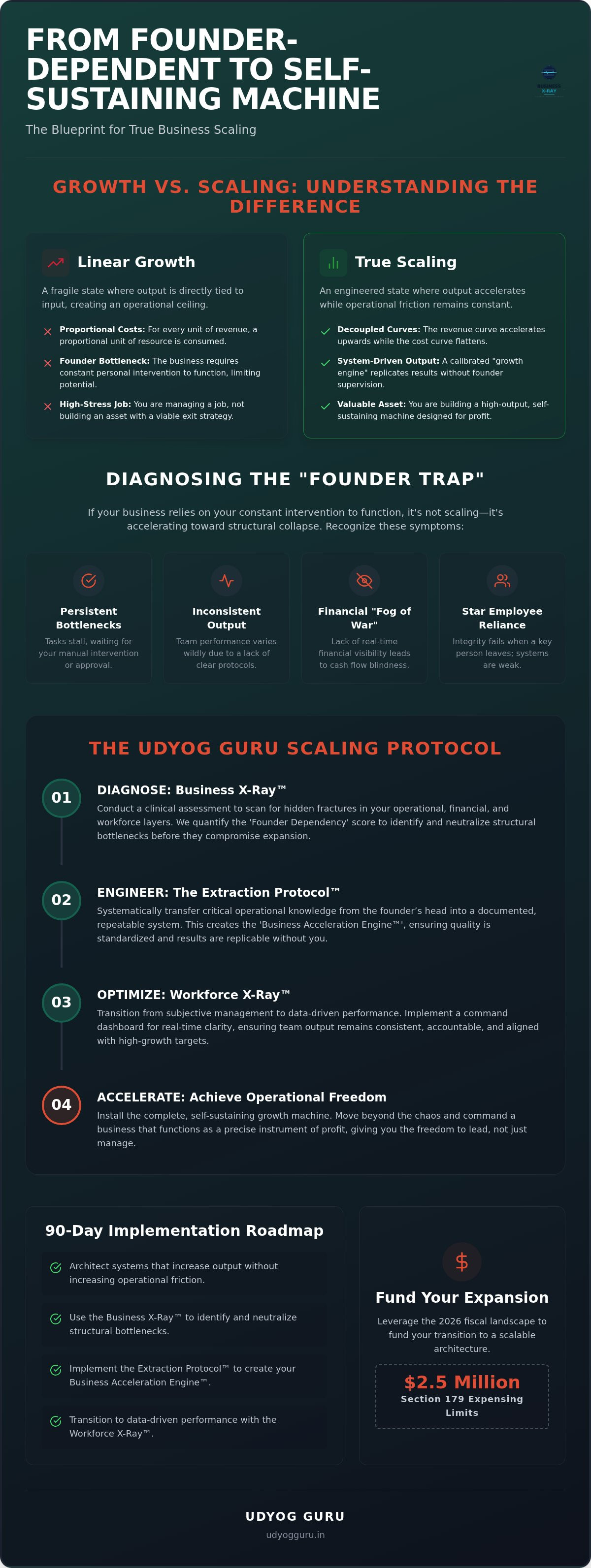
Many entrepreneurs conflate growth with scaling, yet these are distinct physiological states for an organization. Growth is a linear increase in mass; for every unit of revenue gained, a proportional unit of resource, capital, or labor is consumed. The Science of Scaling, however, focuses on the structural ability of a system to handle a growing amount of work by enlarging its margins rather than its overhead. When scaling a business, the objective is to decouple the revenue curve from the cost curve, ensuring that output accelerates while operational friction remains constant.
Without a scalable architecture, growth inevitably triggers the "Founder Trap." This is a state of structural fatigue where the entrepreneur’s personal bandwidth becomes the ultimate bottleneck. As volume increases, the founder must intervene in more decisions, leading to a collapse of both operational quality and personal health. It’s a diagnostic certainty: if your business requires your constant intervention to function, you aren't building an asset; you're managing a high-stress job that lacks a viable exit strategy. Scaling requires a shift from adding mass to increasing the efficiency of the underlying engine.
The Anatomy of a Scalable Business Model
A scalable model is engineered around repeatable, high-margin revenue streams that don't require bespoke manual labor for every delivery. This requires architecting "low-touch" delivery protocols where service quality is standardized through rigorous operating procedures. These protocols act as the DNA of the organization, ensuring that the Business Acceleration Engine™ can replicate results without the founder’s direct supervision. By installing these systems, you transform the business from a collection of talented individuals into a calibrated machine designed for high-output performance.
Why Most Indian SMEs Fail the Scaling Stress Test
Many Indian SMEs fail during expansion because they rely on "star employees" rather than robust systems. When a key individual departs, the structural integrity of the entire department often fails. Furthermore, a lack of a Financial Command Dashboard often leads to cash flow blindness, where a business appears profitable on paper but lacks the liquidity to fund its own growth. Scaling a broken system only accelerates its failure. You must automate your acquisition funnel and stabilize your internal protocols before increasing lead volume, or the resulting pressure will cause a complete operational seizure.
The Diagnostic Phase: Conducting a Business X-Ray™ Before Expansion
Scaling a business that lacks structural integrity is a high-risk maneuver that often results in systemic failure. If your current workflows are fragmented, increasing volume won't solve the problem; it will merely accelerate the rate of collapse. Before any expansion attempt, you must perform a clinical assessment of your organization’s internal architecture. The Business X-Ray™ protocol serves as this diagnostic foundation, scanning for hidden fractures in your operational, financial, and workforce layers that would otherwise remain invisible until the system reaches its breaking point.
A primary metric in this diagnostic phase is the "Founder Dependency" score. We quantify the extent to which critical business functions rely on your personal intervention to proceed. If the score is high, the "Cost of Chaos" manifests as delayed decisions, inconsistent quality, and high attrition. Transitioning to Engineering High-Output Teams requires identifying these dependencies and replacing them with automated protocols. You can begin this process by conducting a Business X-Ray™ to map out the exact points where your presence is currently mandatory.
Scanning for Operational Bottlenecks
Operational efficiency is compromised when "Human Middleware" exists—points where tasks stall because they require manual intervention or subjective approval. We map the flow of a single client order from acquisition through delivery to identify these friction points. A bottleneck is a point where the system capacity is lower than the demand. By isolating these segments, we can install technological solutions that automate the hand-off between departments, ensuring the engine remains in constant motion without human friction.
Financial Diagnosis and Fiscal Control
Many SMEs operate using "Bank Balance Accounting," a reactive method that ignores the complexities of unit economics and future liabilities. Scaling requires a shift toward real-time profitability tracking through a Financial Command Dashboard. This tool allows for data-driven scaling by verifying that every new acquisition is profitable after accounting for variable delivery costs. We audit your financial architecture to ensure that increasing revenue doesn't inadvertently decrease your net margin. Without this fiscal clarity, expansion is merely a path toward a larger, more expensive failure.
Engineering Scalable Systems: Removing Founder Dependency
Scaling a business isn't a hiring exercise; it's a structural migration. Most founders operate as the biological central processing unit of their company, where every critical decision and workflow must pass through their personal cognitive filter. This architecture is inherently limited by human bandwidth. To achieve sustainable growth, you must implement the "Extraction Protocol," a systematic process of moving operational knowledge from your head into the company’s digital architecture. By designing a Business Acceleration Engine™, you transition from a person-led operation to a system-led engine that drives predictable results regardless of who is in the pilot's seat.
This transition is critical as organizations progress through the five stages of small business growth. Moving from the survival stage to the takeoff stage requires a fundamental shift in how authority and information are distributed. You must establish "Operational Clarity" through tiered accountability frameworks that define exactly what high-output performance looks like. This isn't about management by feeling; it's about installing the structural components that allow the organization to function as a precise, self-correcting machine.
Architecting the AI-Integrated Workflow
Modern scaling requires a sophisticated approach to automation. We identify high-frequency, low-complexity tasks that currently consume human labor and subject them to AI intervention. This isn't about custom software development. Instead, our AI Tech Business Integration Bootcamp focuses on using existing, powerful technology stacks to automate customer reporting and internal data synthesis. By treating AI as a teammate rather than just a tool, you can handle increased operational loads without a proportional increase in headcount or payroll expenses.
The 5-Step Protocol for Systematic Delegation
Delegation often fails because it lacks a technical framework. We use a clinical 5-step protocol to ensure that tasks are transferred with zero loss in output quality:
- Step 1: Audit the task for potential elimination or total automation to remove human friction.
- Step 2: Document the operational protocol using a standardized SOP template to create a repeatable blueprint.
- Step 3: Assign the task within the Workforce Acceleration Engine™ to ensure automated accountability.
- Step 4: Establish automated reporting via the Financial Command Dashboard to monitor the task’s impact on profitability.
This systematic approach ensures that every delegated task remains visible and measurable. It removes the need for micro-management and allows the founder to focus on high-level architecture rather than daily maintenance.
Workforce Optimization: Engineering High-Output Teams
Managing a team through intuition is a recipe for operational volatility. When scaling a business, your primary objective is to move from management by feeling to management by metrics. A business surgeon recognizes that subjective performance reviews are often clouded by personal bias, leading to the 56% retention concern reported by organizations in 2026. To stabilize your growth engine, you must implement a Workforce X-Ray™ to conduct a quantitative audit of individual contributions. This diagnostic process identifies where human friction is stalling your output and allows for the installation of a radical accountability culture where the system, not the founder, polices the results.
Engineering a high-output team requires a departure from traditional "trust-based" management. While trust is a commendable trait, in a scaling environment, it's a structural vulnerability. You must design incentive structures that are mathematically aligned with your scalable growth targets. By creating a transparent environment where every contributor’s impact is visible, you ensure that high-performers are recognized through data while bottlenecks are identified and corrected with clinical precision. You can initiate this transition by scheduling a Workforce X-Ray™ diagnostic to assess your current team architecture.
The Workforce Acceleration Engine™
The Workforce Acceleration Engine™ is designed to automate accountability through persistent reporting. Every team member participates in automated daily reporting that feeds directly into your command center. This system tracks "Output per Head" as the primary scaling metric, allowing you to monitor efficiency in real-time. By systemizing the onboarding and training protocols, you reduce the friction associated with new hires. This ensures that as you continue scaling a business, your human capital remains as reliable and predictable as your software stack.
Removing the Emotional Burden of Management
Management by metrics removes the interpersonal conflict that typically plagues growing SMEs. When performance is tracked via data-driven dashboards, the feedback loop becomes objective rather than emotional. This visibility creates "Self-Correcting" teams where members can see their own output relative to benchmarks and adjust their performance without founder intervention. Workforce optimization is the alignment of human talent with mechanical efficiency. This structural shift transforms your workforce from a collection of individuals into a synchronized unit capable of handling exponential load with zero loss in quality.
Implementing the Acceleration Protocol: From Chaos to Control
The transition from operational chaos to systematic control requires a methodical 90-day roadmap for the installation of the Business Acceleration Engine™. When scaling a business, the primary objective is the rigid implementation of structural protocols rather than the pursuit of new product innovation. During this critical window, innovation often introduces unnecessary variables that can destabilize an uncalibrated system. You must prioritize system installation to ensure the organization possesses the structural integrity to handle increased volume without fracturing. This shift redefines the founder’s role from the "Chief Problem Solver" to the "Systems Architect," whose sole focus is the design and maintenance of the growth engine.
The Founder’s New Mandate: Calibrating the Machine
The founder’s new mandate involves a permanent move from working "in the business" to working "on the business" through persistent data monitoring. The Financial Command Dashboard acts as the central telemetry unit, providing the real-time visibility required to spot future trends and mitigate fiscal risks before they cause systemic damage. You should treat scaling a business as a rigorous scientific experiment where you measure current outputs, calibrate the system settings, and repeat the process. This disciplined approach ensures that revenue growth is a predictable result of architecture rather than a product of founder intuition or frantic energy. By leveraging the $2.5 million Section 179 expensing limits available in 2026, you can fund the capital investments required to refine this machine.
Final Diagnostic Check: Is Your Business Scaling-Ready?
Before accelerating your expansion, perform a final diagnostic check to verify that your organization is scaling-ready. This assessment requires a comprehensive checklist of prerequisites, including absolute financial control, the removal of human middleware through automated workflows, and the implementation of workforce accountability engines. If your business still relies on legacy manual operations, the AI Tech Business Integration Bootcamp offers a structured path to modernization without the complexity of custom software development. This ensures your technical infrastructure is capable of supporting high-output demands. Use the following checklist to assess your readiness:
- Verified real-time profitability tracking through a command dashboard.
- Documented SOPs for every high-frequency operational task.
- Automated daily reporting for 100% of the workforce.
- Elimination of all founder-dependent approval bottlenecks.
If your organization fails any of these points, expansion will only lead to a more expensive version of your current chaos. Schedule your Business X-Ray™ today to start your scaling journey.
Finalizing the Blueprint for Exponential Output
The transition from a founder-led operation to a systematic growth engine is a diagnostic necessity for any entrepreneur seeking true operational freedom. By conducting a proprietary Business X-Ray™, you identify the hidden fractures in your architecture that would otherwise lead to a structural collapse during expansion. True scaling a business requires the clinical removal of individual intuition, replacing it with AI-integrated workflows and a calibrated Business Acceleration Engine™ that functions independently of your daily intervention.
You've seen how workforce accountability and real-time financial visibility transform a business from a collection of tasks into a precise instrument of profit. This isn't a motivational exercise; it's a structural migration toward a self-sustaining machine. The roadmap from chaos to control is now clear, and the tools to automate your accountability are within reach. It's time to stop solving problems and start architecting the systems that prevent them from occurring.
Architect Your Growth: Deploy the Business Acceleration Engine™
Your organization is ready for its next phase of evolution. Build with precision and lead with clarity.
Frequently Asked Questions
What is the difference between growing and scaling a business?
Growing a business involves a linear increase in revenue where costs rise proportionally with every new client. Scaling a business is the structural ability to increase output and revenue without a corresponding surge in operational overhead. While growth focuses on adding mass, scaling focuses on increasing efficiency through systemized architecture. It's a clinical distinction between expanding your workload and expanding your margins by decoupling revenue from headcount.
How do I know if my business is ready to scale?
You're ready to scale when your current unit economics are consistently profitable and your operational protocols are documented. A diagnostic scan like a Business X-Ray™ can verify if your system is stable enough to handle increased load. If your physical presence is still required for daily tasks, scaling will only accelerate systemic failure. Pre-requisites include real-time financial visibility and a workforce that operates via automated accountability engines.
Can I scale my business without hiring a large team?
Scaling is entirely possible without significant headcount increases by leveraging technological leverage. By installing a Business Acceleration Engine™, you replace manual labor with automated workflows that handle repetitive administrative and operational tasks. This approach focuses on "Output per Head" as the primary metric. Organizations in 2026 increasingly use AI-integrated protocols to manage higher volumes, allowing a lean team to produce high-output results that previously required dozens of employees.
How does AI help in scaling a traditional small business?
AI functions as a digital teammate that automates high-frequency, low-complexity tasks such as customer reporting and internal data synthesis. In a traditional setting, this means removing "Human Middleware" from the acquisition and delivery funnels. Our AI Tech Business Integration Bootcamp demonstrates how to install these systems without custom software development. This modernization allows legacy operations to operate with the speed and precision of a tech-native enterprise while maintaining their core service quality.
What are the most common mistakes founders make when scaling?
The most frequent error is attempting to scale a broken or chaotic system, which only magnifies existing operational fractures. Founders often hire "star employees" to solve systemic bottlenecks, creating a fragile architecture dependent on individual talent rather than robust protocols. Another critical failure is "cash flow blindness," where revenue grows while net margins shrink due to unmonitored variable costs. These clinical errors result in a structural seizure that stalls expansion.
How can I reduce my business’s dependency on me as the founder?
Reducing dependency requires the clinical extraction of operational knowledge from your head into a standardized company architecture. You must implement a Workforce Acceleration Engine™ to automate accountability and establish clear protocols for every department. By transitioning into the role of a Systems Architect, you focus on calibrating the machine rather than solving individual problems. This shift is monitored through a Financial Command Dashboard, ensuring the business remains profitable without your direct intervention.
What metrics should I track on my CEO dashboard while scaling?
Your command dashboard must prioritize quantitative data over subjective feelings. Key metrics include Output per Head, real-time net profitability per acquisition, and the ratio of Customer Acquisition Cost to Lifetime Value. Additionally, track your "Founder Dependency Score" across core functions to monitor your operational freedom. These data points provide the clinical clarity needed to make informed decisions and ensure that your scaling a business remains structurally sound as complexity increases.
Is scaling possible without significant external investment?
Scaling is achievable by optimizing your internal unit economics and reinvesting operational profits. The "One Big Beautiful Bill Act" of 2025 provides tax incentives like 100% bonus depreciation that help fund capital investments. By engineering a high-efficiency Business Acceleration Engine™, you reduce the need for expensive external debt. This self-funded path requires rigorous fiscal discipline and a command dashboard to ensure every rupee of revenue is deployed with maximum efficiency as you focus on scaling a business.


