

Hours worked alone do not show productivity. To measure employee productivity accurately, divide useful output by the resources needed to produce it, then compare equivalent work over time and consider quality and customer satisfaction. A higher output rate matters only if the work meets the required standard and serves customers well.
Completed tasks and time spent can both be useful, but neither tells the whole story. Work varies in complexity, and speed without quality can lead to rework or harm the customer experience. Reliable measurement starts with clear, role-specific standards, not a single activity metric.
This guide shows how to define productivity for each role, compare like-for-like work, and use past results to establish a practical baseline. It also explains how to include quality and customer satisfaction, then review measures consistently so they reveal meaningful patterns rather than isolated results.
Key Takeaways
- Calculate output against labour hours, then include quality measures such as rework to avoid mistaking activity for useful results.
- Set standards by comparing work with similar complexity, scope, and required quality rather than applying one target to every task.
- Use historical results and a consistent tracking method to identify meaningful trends and calibrate future expectations.
- Pair productivity figures with customer satisfaction to assess whether increased output is also delivering value to customers.
What Are Examples To Measure the Productivity of an Employee?
Start with output divided by input, then define which results count as useful output. The steps below connect labour hours and work quality with employee feedback and remote-work practices.
-
1. Calculate Output Against Hours Worked
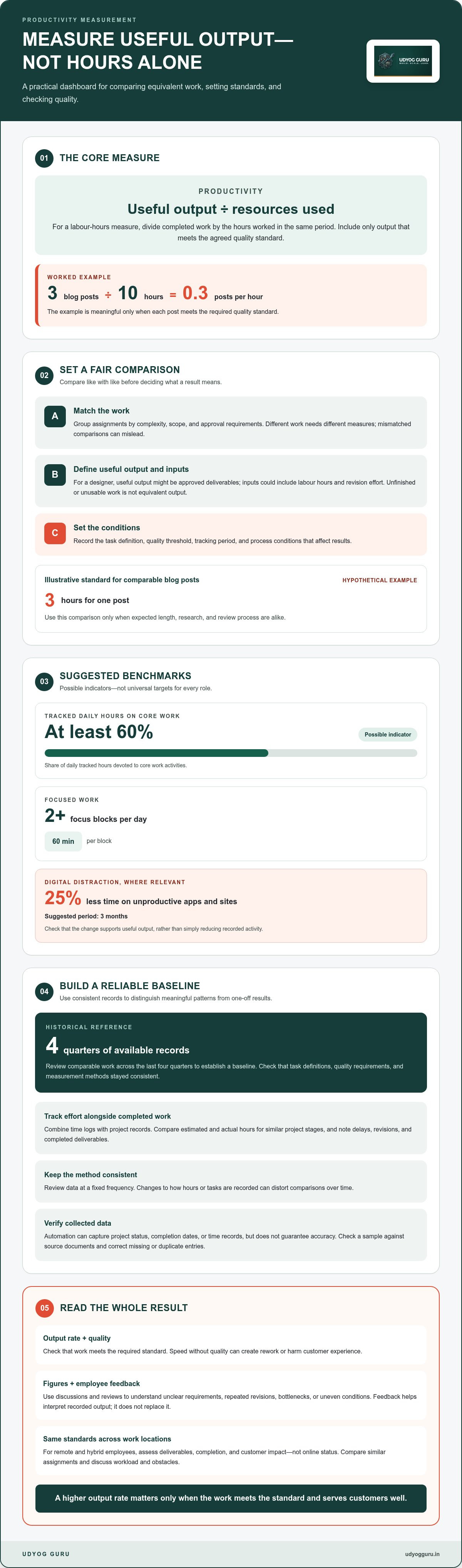
Record completed work and labour hours for the same period, then divide output by hours worked. For example, 3 blog posts completed in 10 hours equals 0.3 posts per hour. Check that each post meets the agreed quality standard; otherwise, faster production can conceal rework rather than improved efficiency. Use the same unit and measurement period when comparing employees doing equivalent work.
-
2. Compare Meaningful Output With Inputs
For each role, define the ratio of total output to total input, including resources that materially support the work. For a designer, meaningful output might be approved deliverables; inputs could include labour hours and revision effort. Productivity measures outputs against inputs, while performance is broader and includes behaviours and contributions to objectives. Don’t count unfinished or unusable work as equivalent output.
-
3. Combine Metrics With Feedback and Reviews
Pair each productivity measure with regular employee discussions and performance reviews. Ask what shaped the result, such as unclear requirements, repeated revisions, or a process bottleneck, and compare the explanation with recorded output and quality. A task count might look strong, for example, while colleague feedback points to avoidable hand-offs. Use feedback to interpret the evidence, not replace it.
-
4. Measure Remote Work Fairly
Apply the same role-specific output and quality standards to remote and hybrid employees, wherever they work. Assess deliverables, completion, and customer impact rather than online status or hours shown on a digital platform. Discuss workload and obstacles in check-ins. Targets that reward volume alone can encourage rushed work or metric gaming. Compare similar assignments and use employee feedback to spot uneven conditions.
Setting productivity standards using comparable work
Set standards using comparable assignments, then define the current baseline and desired result. This connects measurable expectations with the processes and skills behind each outcome.
- Group comparable work. Separate assignments by complexity, scope, and approval requirements before comparing completion times. For example, use a hypothetical standard of 3 hours for one blog post only when the expected length, research, and review process are alike. Different work needs different metrics; otherwise, the comparison produces misleading insights.
- Record the current state. Track results consistently, such as completed deliverables per work period, alongside quality checks. Describe the desired state in observable terms: for example, completing an agreed volume while meeting the same review criteria. Clear expectations give employees a focused target tied to their responsibilities and skills.
- Set a baseline and benchmark. Use existing performance on comparable tasks as the baseline, then decide what improvement would support the team’s goals. Suggested benchmarks include dedicating at least 60% of daily tracked hours to core work activities, or completing two or more 60-minute focus blocks per day. Treat these as possible indicators, not universal standards for every role.
- Specify the measurement conditions. Document the task definition, quality threshold, tracking period, and any process conditions that affect results. A suggested benchmark is reducing time on unproductive apps and sites by 25% over three months. Use it only where digital distraction is relevant, and check whether the change supports useful output rather than simply reducing recorded activity.
For example, structured workforce productivity systems can help align role expectations, work processes, and performance measures.
Using historical data to establish productivity standards
Use past records to establish a baseline and track each measure consistently. Time-tracking or project-management software, or an Excel spreadsheet, can record results. In India, costs depend on user numbers, features, and integrations.
-
Review Historical Productivity Data
Use the last four quarters of available records to establish a baseline for comparable work. Check whether task definitions, quality requirements, and measurement methods remained consistent. If a process changed, separate the results before drawing conclusions. Historical trends show normal variation more clearly and help leaders set standards based on workplace evidence rather than one unusually strong or weak period.
-
Use Time and Project Records
Combine time logs with project records to see how effort relates to completed work. Compare estimated and actual hours for similar project stages, for example, and note delays, revisions, and completed deliverables. Review data at a fixed frequency so discussions can surface changing workloads or process constraints. Keep measures consistent: changes to how hours or tasks are recorded can distort trend comparisons.
-
Automate and Verify Data Collection
Automate routine entries when software can capture project status, completion dates, or time records without repeated manual reporting. Verify a sample against source documents, such as approved deliverables or project logs, and correct missing or duplicate entries. Automation can speed up collection, but it does not guarantee accuracy. Review exceptions and ask employees about unusual results before adjusting standards or assessing profitability.
Customer satisfaction as a productivity measure
Pair customer outcomes with output measures to check whether completed work creates value. A faster process matters only if customers still receive accurate, useful service.
- Choose a customer outcome. Select feedback related to the work, such as whether a support issue was resolved or a deliverable met the customer’s needs. For a service team, review feedback alongside completed cases; for a design team, connect client approval with finished projects. Keep the measure relevant to the role rather than relying on a general sentiment score.
- Track quality signals with output. Compare customer comments, repeat requests, complaints, or accepted deliverables with work completed during the same review period. If a team closes more support cases but gets repeated complaints about unresolved issues, volume alone overstates productivity. Review the cases before attributing the result to individual workers.
- Investigate patterns, not isolated responses. Monitor customer feedback over consistent periods and group it by service, product, or process. Repeated comments about delayed updates, for example, may indicate a hand-off problem rather than low effort by one employee. Discuss the pattern with employees involved, then identify workflow changes that could improve customer experience and delivery.
- Use satisfaction as a balanced measure. Interpret customer feedback alongside completion, quality, and workload records. A positive response can indicate a successful outcome, but it does not prove every task was efficient; a negative response may reflect factors outside an employee’s control. Clarify what each measure can show and use that distinction in performance discussions.
Use workforce productivity systems to align employee measures with customer outcomes and operational processes.
Udyog Guru: Business X-Ray™ (Tier 1)
Udyog Guru’s Business X-Ray™ (Tier 1) is a structured business transformation framework for examining operational systems. Turn to it when productivity measures reveal patterns but the underlying process, role expectations, or workflow needs a broader assessment. It provides a route from isolated figures toward a clearer view of how business operations connect.
If the measurement challenge centres on workforce performance and delegation, Workforce X-Ray™ and Workforce Acceleration Engine™ focus on streamlining team performance and delegation. Business Acceleration Engine™ (Tier 2) supports the broader transformation framework, while the AI Tech Business Integration Bootcamp (Tier 3) focuses on embedding technology and automation into core operations. Contact Udyog Guru to discuss which framework aligns with your operational priorities.
Turn measurement into an operating discipline
Make productivity measurement part of how work is managed, not a standalone reporting exercise. Assign responsibility for maintaining measures, record why they change, and use review discussions to distinguish process barriers from individual performance. This creates a decision trail to guide leaders as priorities, workloads, or customer needs shift.
Asking how to measure employee productivity accurately should lead to better operational decisions, not simply more tracking. Start with one team or workflow, apply standards consistently, and refine the measurement system before extending it across the organisation. Clear measures give managers and employees a shared basis for discussing progress and resolving bottlenecks.
For a structured next step, explore Udyog Guru’s business transformation frameworks. Use the conversation to identify where your operating system needs clearer measurement or stronger alignment. A disciplined approach can turn workforce data into practical decisions and support more focused improvement.
Frequently Asked Questions
What Is Productivity?
Productivity describes useful contribution in relation to resources such as time, tools, and effort. Its meaning depends on the work: a resolved customer issue matters more than a logged support session, while a verified production unit matters more than machine activity alone. Define the intended result first, then identify the resources and quality conditions that explain how it was achieved.
What is the True Definition of Employee Productivity?
Employee productivity is the value of an employee’s work relative to the resources used and the standards for the role. For an accounts specialist, that could mean processing accurate records that support timely decisions, not simply handling many entries. The definition should reflect responsibilities, the results the employee can influence, and the expected quality of their work.
Why is Outcome-based Management Better Than Tracking Activity?
Outcome-based management asks whether work achieved its intended purpose; activity tracking records what someone did along the way. A full calendar of meetings cannot show whether a project decision was made or a client issue resolved. Activity data can help locate delays, but managers need evidence of completed, useful results to assess contribution or adjust team processes.
What are the best ways to measure employee productivity accurately?
Choose a role-specific result, define its completion criteria, and pair it with a quality check. For example, assess a finance role through timely, accurate reports and a customer-support role through resolved cases and customer responses. Discuss exceptions with the employee before changing targets. This helps distinguish a genuine performance pattern from unusual assignments, missing inputs, or process problems.
Which productivity metrics are appropriate for different roles and industries?
Choose metrics based on what each role can influence. A sales team might track qualified opportunities and completed sales; a manufacturing team, accepted units and defects; a software team, delivered features and subsequent issues. In healthcare and other sensitive work, include service quality and process requirements alongside throughput. Avoid comparing roles with different outputs, constraints, and customer impacts.
How do you measure employee output, quality, efficiency, and impact?
Measure output by counting completed deliverables, quality by checking errors or rework, and efficiency by relating accepted results to relevant resources. Assess impact through the result those deliverables support, such as resolving a customer need or producing a usable business report. Keep the measures distinct: a high output count does not prove quality, and a quality score alone does not show broader impact.


