

Trust is not an optional extra in a high-performing workplace; it is part of the operating system. A high-performance work culture aligns people around clear goals, gives them the confidence to speak up and learn, and holds them accountable for meaningful results. Creating a high-performance work culture takes more than asking employees to work harder: leadership behaviour, trust, clear expectations, useful feedback and recognition must reinforce one another.
It is reasonable to expect performance to improve when teams have clear priorities and capable people. But when employees lack trust or do not understand what success looks like, effort can become fragmented and problems may surface too late. This article explains what a high-performance culture means, how its key practices work together and what benefits organisations can expect from a healthier system. It also explores why consistent leadership matters, how feedback and recognition shape daily behaviour, and how to assess whether cultural changes are improving collaboration, accountability and execution.
Key Takeaways
- Build trust through consistent leadership, honest communication and psychological safety so employees can raise concerns and learn from mistakes.
- Align business goals with employees’ development needs to make learning and knowledge-sharing part of everyday work.
- Clarify responsibilities and success measures, then use regular feedback and recognition to reinforce the behaviours teams need.
- Assess culture through signs such as collaboration, accountability and execution, and use workforce-focused systems to identify where performance processes need attention.
Leadership behaviour, trust and psychological safety
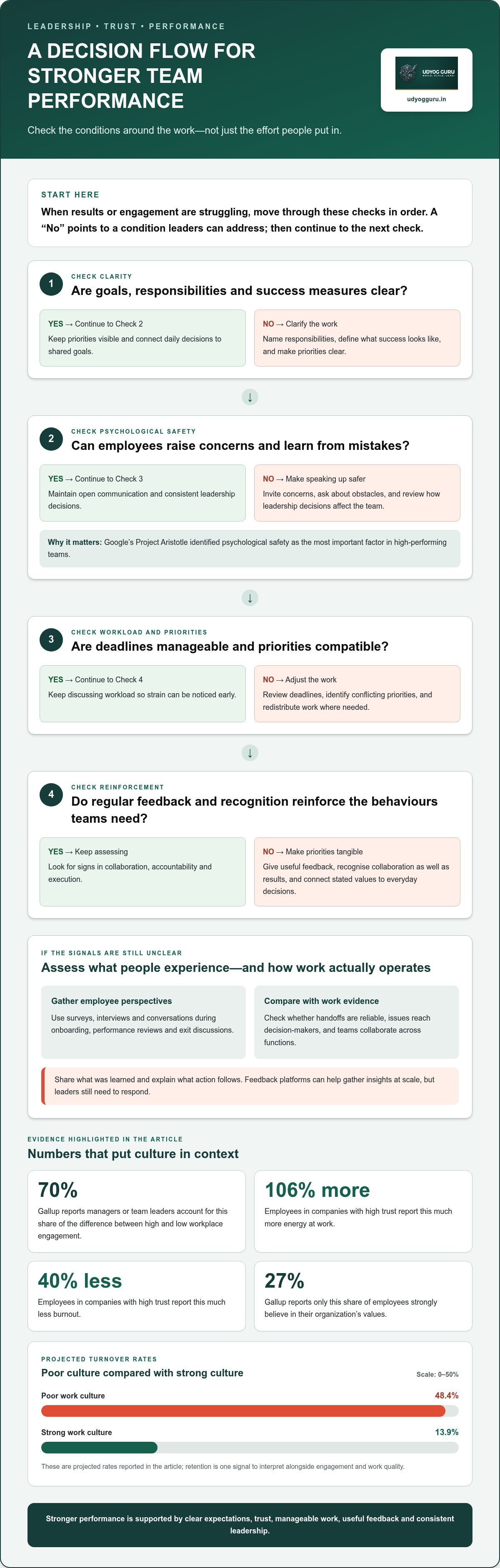
Leadership sets the conditions for trust: employees need clear goals, consistent decisions and room to raise concerns. Google’s Project Aristotle identified psychological safety as the most important factor in high-performing teams.
Supportive Leadership and Career Advancement
Supportive leadership connects employees’ career goals with development opportunities and the skills their roles require. In a development conversation, a manager can ask which responsibilities an employee wants to grow into, then identify relevant learning and practical assignments. This provides a clearer path for advancement without promising a promotion the organisation may not be able to offer. Employees can see how their growth contributes to shared goals and purpose.
Leadership Reflection and Accountability
Leadership reflection means examining how a manager’s decisions and behaviour affect the team, then taking responsibility for the results. For example, after a project delay, a leader can review whether priorities were clear, invite employees to identify obstacles, and adjust the workflow. Gallup reports that managers or team leaders account for 70% of the difference between high and low workplace engagement. That makes leadership behaviour a practical measure in cultural transformation, not a private matter.
Inspiration, Inclusion, and Motivation
Inspirational, inclusive leadership connects employees’ work to a shared purpose while making space for different viewpoints. A manager can explain why a project matters, invite quieter team members to contribute, and recognise collaboration alongside results. Employees in companies with high trust report 106% more energy at work. Inclusion helps motivation become a team resource: people can offer ideas, challenge assumptions respectfully, and see how their contribution supports the organization.
Preventing Burnout While Maintaining Performance
Organizations can prevent burnout while maintaining performance by addressing workload pressure through direct communication and task adjustments. Managers can review deadlines with employees, identify conflicting priorities, and redistribute work where needed, rather than treating extended overload as a performance standard. Employees in companies with high trust report 40% less burnout. Regular conversations help leaders detect strain earlier, protect focus on essential work, and maintain accountability without relying on fear or constant overwork.
What is a high performance culture?
A high-performance culture connects organisational goals with employees’ ability to learn, contribute and improve how work gets done. In practice, creating a high-performance work culture means designing systems that support results while responding to employee needs.
Learning and Development
Learning and development build the capabilities employees need for current responsibilities and future work. Managers can discuss an employee’s goals, identify a skill gap and agree on a practical assignment to develop that skill. For example, an employee interested in project leadership could coordinate a cross-functional task. Mentorship and knowledge-sharing also help teams retain expertise and apply learning to organisational priorities.
Culture Transformation and Retention
Culture transformation changes the daily conditions that influence employees’ experience and decisions to stay. Companies with poor work cultures have a projected turnover rate of 48.4%, while companies with strong work cultures have a projected rate of 13.9%. Leaders can examine exit feedback, workload patterns and development access to locate friction. For leaders creating a high-performance work culture, retention is one signal to interpret alongside engagement and work quality.
Employee Feedback and Culture Assessment
Assessing culture means combining employee perspectives with evidence of how work actually operates. Gather feedback through surveys, interviews and conversations during onboarding, performance reviews and exit discussions. Then compare responses with observable examples: are handoffs reliable, do issues reach decision-makers, and can teams collaborate across functions? Employee feedback platforms can help gather insights at scale, but leaders still need to share what they learned and explain what action follows.
Workplace Rules and High-Performance Examples in India
Indian employers should align workplace policies with applicable requirements on wages, working time, leave, safety and workplace conduct. Relevant obligations depend on the establishment and its circumstances, so translate applicable rules into clear internal procedures. Reliance Industries provides an example of a company with a stated ambition to extend 5G access across India; that ambition alone does not establish its internal work culture.
When feedback and workflow evidence reveal broader system gaps, a structured business assessment can help identify where processes and responsibilities need attention.
Clear expectations, feedback and recognition
Managers improve performance and engagement by defining success, giving regular feedback, and recognising behaviours that support shared goals. Gallup reports that only 27% of employees strongly believe in their organization’s values, so leaders need to connect stated priorities with everyday decisions.
For a multifunctional team, start with a clear mission and named responsibilities. An initial face-to-face project meeting can improve understanding of goals and how work is shared, according to Chalmers University of Technology. For example, a product launch team can agree who owns customer research, design approval and delivery coordination. That structure reduces duplicated effort and gives each function a common measure of success.
Translate the organisation’s vision into expectations employees can act on. Department priorities should support company strategy, while role descriptions clarify expected outcomes and decision-making authority. Choose performance measures that reflect the work, such as delivery quality, customer issues resolved or progress against a project milestone. Review these measures openly. If a target encourages individual competition at the expense of collaboration, revise it to recognise team contribution and productivity.
Feedback works best as an ongoing operating practice, not an annual event. Managers can use brief one-to-one check-ins to discuss progress, obstacles and the next action. Employees are 3.6 times more motivated to do outstanding work when their manager gives daily feedback. Recognition should reinforce useful behaviours as well as results: acknowledge an employee who shares expertise, resolves a handoff problem or helps a colleague meet a deadline.
Keep expectations reciprocal. Ask employees which ones remain unclear, then adjust the roadmap or explain the reasoning. In career discussions, connect performance feedback to a skill the employee wants to develop. This makes recognition specific, supports commitment and helps teams understand how their work advances the organisation’s purpose.
Characteristics and benefits of high-performance culture
A high-performance culture combines shared goals, effective execution, employee engagement and continuous learning. Its value is visible in outcomes, not slogans: business units in the top quartile for employee engagement have 23% higher profitability than units in the bottom quartile. The key takeaway is alignment. Employees need authority, skills and information that let them contribute to organizational priorities.
Productivity improves when work has clear ownership and fewer avoidable handoffs. For example, a service team can map each customer request from intake to resolution, then identify where delays or duplicated tasks occur. Assigning decisions to the level closest to the work can reduce bottlenecks. Leaders can measure execution through quality, completed work and recurring issues, rather than treating hours worked as the result.
Adaptability is another defining characteristic. When customer needs or market conditions shift, teams that share information and question outdated processes can respond without waiting for every decision to move up the chain. To assess this, review a recent challenge: did employees identify the change early, propose options and apply what they learned? This sequence connects continuous improvement with organisational agility.
Strong cultures also turn talent and ideas into coordinated action. Teams can invite input from different functions before making a decision, assign an owner and record the reasoning behind the chosen approach. This makes collaboration observable and helps employees understand how their contributions affect outcomes. Innovation depends not just on generating ideas, but also on testing useful ones and sharing lessons across teams.
Assess cultural performance through a balanced set of indicators: engagement, productivity, quality, retention and progress against business goals. Review them together, because a short-term output increase may conceal rising errors or reduced collaboration. Compare results with employee experience and workflow evidence, then target the system causing the gap. Map your workforce performance gaps to identify where clearer responsibilities or stronger processes could support sustained performance.
Udyog Guru: Business X-Ray™ (Tier 1)
Udyog Guru’s Business X-Ray™ (Tier 1) provides a structured starting point for examining how business systems support performance. Consider it when unclear processes, responsibilities or workflows are limiting the culture you want to build. For workforce-specific challenges, Workforce X-Ray™ focuses on team performance and delegation. If the priority is broader business transformation, Business Acceleration Engine™ (Tier 2) offers a further structured system; the AI Tech Business Integration Bootcamp (Tier 3) focuses on embedding technology and automation into operations.
Choose the option that matches the problem: workforce alignment, business-wide systems or technology integration. A focused diagnosis connects cultural goals with operational processes, rather than treating performance as a standalone initiative.
Contact Udyog Guru or visit udyogguru.in to discuss your next step.
Make the Next Improvement Deliberate
A stronger workplace culture develops through deliberate choices, not a single announcement. Start with one operational friction point employees experience directly, such as unclear handoffs or delayed decisions. Identify what needs to change, who owns the adjustment and how the team will recognise progress. This gives creating a high-performance work culture a practical starting point, instead of turning it into a broad initiative without a clear owner.
Treat the change as a test: explain its purpose, invite employee observations and review what the new approach reveals. If the process improves, build on it; if it creates new obstacles, refine the design. This disciplined cycle helps leaders turn intent into daily practice while keeping employees involved in the outcome.
Where culture challenges reflect wider business or workforce systems, Udyog Guru’s assessment and acceleration offerings can help clarify the next focus. Contact Udyog Guru to discuss workplace culture and identify a practical next step for your organization.
Frequently Asked Questions
Step Two: Design, What Needs to Change?
Good design identifies the gap between the workplace you want and how work currently functions. Map recurring obstacles, decision rights, required information and employee experience before choosing an intervention. For example, repeated approval delays may point to unclear authority rather than low effort. Define the intended change, assign an owner and decide what evidence will show whether the new arrangement works.
What Does High Performance Look Like?
High performance is visible in reliable results and the behaviours that produce them. A team meets its commitments, makes trade-offs explicit and flags dependencies before they disrupt delivery. For example, a service team might record recurring reasons requests remain unresolved and use them to improve its process. The test is whether people can sustain quality while adapting their work to changing priorities.
What Does This Look Like in Practice?
In a finance team, a high-performing close process makes responsibilities and unresolved items visible to everyone involved. If a report depends on missing inputs, the owner identifies the dependency early and records the decision needed to resolve it. The team can then address the process gap instead of relying on last-minute individual effort. Each cycle provides clearer information for the next.
What Defines a High-Performance Work Culture?
A high-performance work culture consists of shared norms and operating conditions that help people deliver important outcomes consistently. Its real character emerges in routine decisions: how priorities are assigned, how concerns are handled and whether employees can improve a flawed process. Compare stated values with these everyday choices. When they conflict, employees experience the choices as the organisation’s actual culture.
What Are the Key Elements of a High-Performance Workplace?
Key elements include a clear purpose, defined roles, decision-making authority, reliable information and systems that support focused work. These components need to fit together. For instance, assigning ownership without access to necessary data creates responsibility without the means to act. Check whether employees can identify the intended outcome, find the information they need and resolve routine issues at the appropriate level.
How Can Leaders Create a High-Performance Work Culture Step by Step?
Leaders can make change manageable by taking it step by step: identify a business outcome, examine the conditions affecting it, involve the employees concerned, and redesign the relevant responsibilities or workflow. Communicate what will change and what will stay the same. Observe how the new arrangement works, gather specific examples of friction and refine the design before extending it to other teams.


