

A founder’s most valuable task is not always the one they should keep. Effective delegation techniques for founders begin with handing off work that has a clear outcome, repeatable steps, and one accountable owner, while retaining decisions that require the founder’s authority or carry unusually high consequences. Match each task to someone with relevant skills, then set the expected result, decision boundaries, and review points before work begins.
It’s easy to hold on to work because explaining it seems slower than doing it, or because the first handover may not match your approach. But delegation is more than transferring a task: it means setting someone up to deliver it responsibly.
This article explains how to assess tasks, match them to team members, and set checkpoints without micromanaging. Practical examples across product, operations, and agency work show what to hand off, what to retain, and how to structure the transition.
Key Takeaways
- Match delegated work to a person’s skills, interests, and capacity rather than choosing whoever seems least busy.
- Set clear outcomes, decision boundaries, resources, and checkpoints so the team can act without constant oversight.
- Prioritise repeatable, well-defined tasks for handover; retain work that depends on your unique authority or judgment.
- Apply delegation differently across product, operations, and agency workflows by assigning clear ownership and review points.
1. Matching delegated work to team members' skills and interests
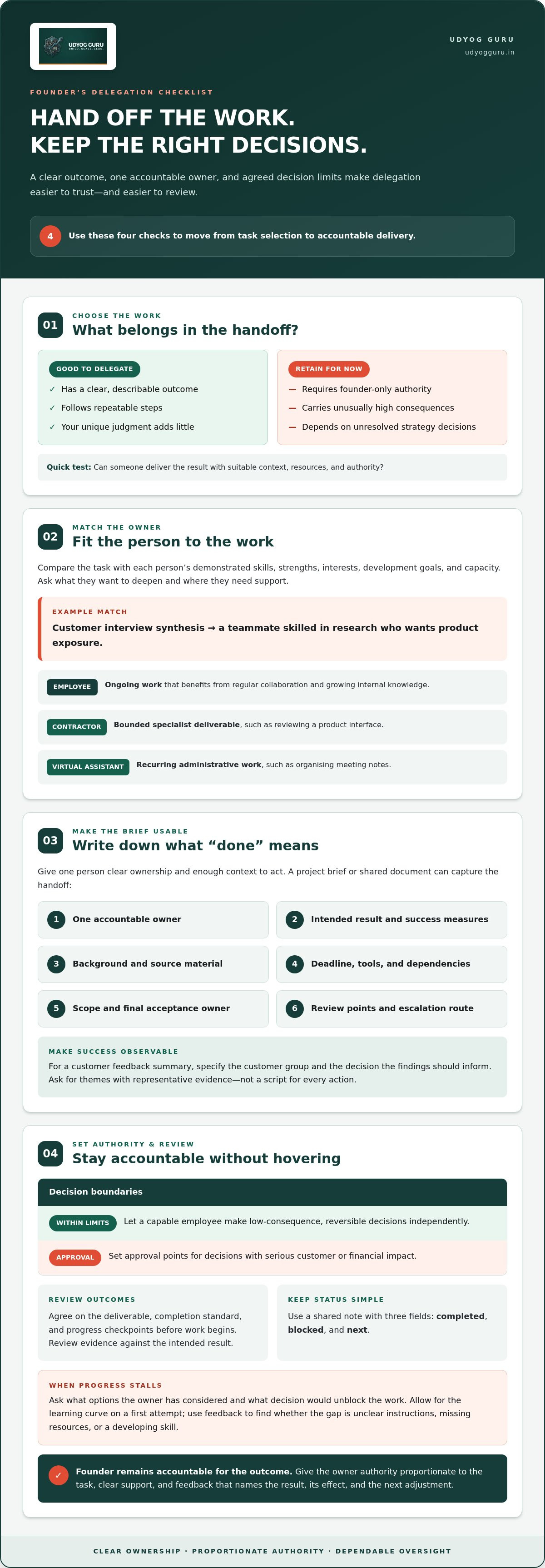
Start with a task inventory, then compare each task with team members’ demonstrated skills, strengths, interests, and development goals. In a one-to-one meeting, ask what work they want to deepen their skills in and where they need support. For example, assign customer interview synthesis to someone skilled in research who wants product exposure. This connects an operational need with a capability the person can develop.
In a small or remote startup team, assign a defined outcome to one owner rather than dividing unclear responsibility among several people. A founder might ask a detail-oriented teammate to prepare release notes, explain the intended audience, and agree on a review point. This gives the employee room to complete the work without micromanagement. For distributed teams, record decisions, responsibilities, and open questions in a shared workspace so colleagues can act across schedules.
Choose an employee for ongoing work that depends on regular collaboration and growing internal knowledge. A contractor may suit a bounded specialist deliverable, such as reviewing a product interface; a virtual assistant may be a better fit for recurring administrative tasks, such as organising meeting notes. Compare the work’s continuity, expertise requirements, and coordination needs before choosing. This is an operational fit, separate from assessing the applicable engagement terms.
Use a shared task board to record the owner, expected outcome, due date, status, and next checkpoint. Pair it with a project brief or shared document containing context and resources. For a product task, that might include customer feedback and acceptance criteria. These tools make progress visible without repeated status messages or constant monitoring.
Match autonomy to the consequences of a decision. Let a capable employee make low-consequence, reversible decisions within agreed limits, and set approval points for decisions with serious customer or financial impact. When someone is learning a task, provide a sample, explain the quality standard, and review an early milestone. The founder remains accountable for the result, while the team member gets authority proportionate to the task and support when questions arise.
2. Avoiding micromanagement
Set oversight around agreed results, not every action. Before work begins, agree on the deliverable, completion standard, and progress checkpoints. For a supplier handover, review a draft at an agreed milestone instead of requesting updates after every email. A shared status note with three fields, completed, blocked, and next, provides visibility while leaving the team member responsible for how the work is done.
At each checkpoint, review evidence against the agreed outcome. If progress stalls, ask what options the employee has considered and what decision would unblock the work. A task a manager completes in 30 minutes may take an employee a full hour the first time. Allow for that learning curve, then use feedback to identify whether the gap came from unclear instructions, missing resources, or a skill still developing.
Accountability requires authority as well as ownership. Define which decisions the team member can make independently, which need approval, and which require escalation. For example, a project owner might adjust a draft’s layout but seek approval before changing a customer commitment. Record these boundaries in the project brief. The founder remains responsible for the outcome, while the owner gains confidence by making decisions within the agreed scope.
Common delegation mistakes include assigning work without clarifying its importance, authority, or support, then intervening repeatedly when uncertainty arises. This can create rework, delay decisions, and make responsibility feel like a burden. Prevent these problems by setting a clear escalation route and scheduled follow-ups before work starts.
Make feedback specific: describe the result, explain its effect, and agree on the next adjustment. If a report omits a key customer issue, show where it belongs and update the review criteria. The European Commission associates authoritarian management with lower levels of delegation and information transfer. A structured review replaces constant control with clear expectations, useful feedback, and dependable oversight.
3. How do I decide which tasks to delegate?
Choose work another person can complete with suitable context, resources, and authority. Effective delegation techniques for founders begin with reviewing recurring tasks and identifying where your judgment adds little. For example, if you repeatedly format internal updates, document the expected structure and hand over preparation. Retain work tied to unresolved strategy or founder-only authority until the necessary decisions are clear.
Write a brief that names one accountable owner, the intended result, relevant background, deadline, and success measures. Include links to source material, required tools, and dependencies that could block progress. For a customer feedback summary, specify which customer group to cover and what decision the findings should inform. These effective delegation techniques for founders make the purpose and ownership clear before work begins.
Define success with observable criteria, not a script for every action. For example, ask for a summary that groups customer issues by theme and includes representative evidence. State what falls outside the assignment and who accepts the final deliverable. The employee can choose a suitable method, while the founder has a clear basis for evaluating the result.
Set a realistic deadline by mapping dependencies and review time. If a launch summary depends on final product details, specify who will provide them and how to raise a delay. Clarify how the task ranks against existing commitments so urgent work isn’t displaced without discussion. An interim milestone can reveal a blocker before the final deadline.
Before assigning work, ask whether the outcome is clear and whether the owner has the skills, authority, and resources to deliver it. If the objective is unsettled, resolve the decision first. If the work can be taught and its risks are controlled, assign an owner and agree on acceptance criteria. A concise brief defines the destination without dictating every step.
4. Founder delegation examples in product, operations, and agencies
Delegation should follow the work system, not the founder’s job title. In a product team, assign someone to synthesise support tickets into recurring themes. Provide the tickets, customer segment, and decision context. Ask for a concise findings summary, not a predetermined product decision. The founder can use the evidence to set priorities while the employee develops product judgment.
For a feature release, a founder might delegate test coordination to a team member familiar with the release process. Define the user journeys to test, how to record defects, and who should receive urgent findings. The owner can organise the test sequence and report blockers. The founder retains decisions about scope changes, keeping strategic trade-offs aligned with company priorities.
In operations, hand over a repeatable process such as preparing a weekly cash-collection status report. Give the owner access to relevant records, define the fields, and explain how to flag overdue items. At Mosaic Tech, departments set weekly goals and review them in weekly stand-up meetings before tasks are delegated. The practical lesson is to connect assignments to visible departmental priorities.
For an agency, delegate campaign reporting to an account team member who understands the client brief. Share the approved objectives, source data, reporting format, and delivery date. Ask the owner to highlight performance changes and open questions rather than prescribe every sentence. The founder can review client-sensitive recommendations while someone else handles data assembly and report structure.
Across these examples, separate execution from decisions that require founder authority. Assign one owner to each deliverable, identify contributors, and set a review point that reflects the work’s risk. Product research, recurring operations, and agency reporting each need different context, but all need a visible result. This structure supports reliable handovers without making the founder an approval point for every action.
Udyog Guru: Business X-Ray™ (Tier 1)
Udyog Guru’s Business X-Ray™ (Tier 1) helps founders examine how business operations function and identify structural bottlenecks affecting delegation. It’s a relevant next step when tasks keep returning to the founder, ownership is unclear, or team handovers expose gaps across workflows.
Once the operational picture is clearer, the Workforce X-Ray™ can address workforce optimization, while the Business Acceleration Engine™ (Tier 2) supports broader business transformation. The right focus depends on whether the main constraint sits in team performance, operating systems, or the way work moves through the business. This creates a structured path from diagnosis to action rather than adding delegation rules without understanding the underlying process.
For a closer assessment of delegation and operational structure, contact Udyog Guru.
Build delegation into the operating system
Make delegation a repeatable operating practice, not a one-off response to a crowded calendar. Choose a workflow that regularly depends on your attention, then document where ownership shifts, decisions stall, or information gets lost. Use what you learn to refine the process before expanding delegation to other areas. Each handover then becomes useful evidence of how work moves through the business.
The effective delegation techniques for founders become more valuable when they are supported by clear operating structures. If you need to diagnose bottlenecks or align workforce responsibilities with business priorities, Udyog Guru’s Business X-Ray™ (Tier 1), Business Acceleration Engine™ (Tier 2), and Workforce X-Ray™ are relevant pathways for that work.
Contact Udyog Guru today to discuss the operational structure you want to strengthen. A well-designed handover gives your team room to take ownership while allowing you to focus on the decisions that move the business forward.
Frequently Asked Questions
What Is Delegation and Why Is It Important?
Delegation gives another person responsibility for a defined piece of work while the founder remains accountable for the overall result. It helps a startup distribute execution, develop team capability, and reserve founder attention for decisions that shape the business. For example, asking a team member to prepare a customer feedback digest lets the founder focus on deciding which product issues deserve attention.
How do I decide which tasks to delegate?
Choose work another person can complete with the available context, resources, and authority. Review upcoming work and flag recurring tasks where your involvement adds little judgment. For example, if you repeatedly format internal updates, document the expected structure and hand over preparation. Retain tasks that depend on unresolved strategy or founder-only authority until those decisions are clear.
What are the 5 steps of delegation?
The five steps are to identify the task, choose the right person, define the assignment, provide resources and support, then follow up with feedback. For example, a founder can assign a customer interview summary, explain its intended use, share the interview notes, and review the completed synthesis. Use that review to clarify expectations for similar assignments.
What is effective delegation?
Effective delegation gives a capable person ownership of a defined result, with enough authority and support to deliver it. It is not simply shifting work away from the founder. For example, asking a team member to handle routine customer queries works better when they know which responses they can send independently and which situations they must escalate.
When should I not delegate a task?
Keep a task with the founder when its objective is unresolved, its consequences are difficult to reverse, or it relies on authority only the founder holds. A sensitive partnership decision, for example, may need founder involvement if it changes company commitments. If part of the work is routine, delegate the preparation and retain the final decision. This separates execution from judgment without blurring accountability.
What tasks should startup founders delegate first?
Start with repeatable tasks that take attention but don’t require founder-only judgment. Examples include organising meeting notes, compiling customer questions, preparing routine status updates, or coordinating a documented testing process. Choose one task with a clear input and output, then note where the handover needs better documentation. This gives you a practical starting point without restructuring the whole team at once.


