

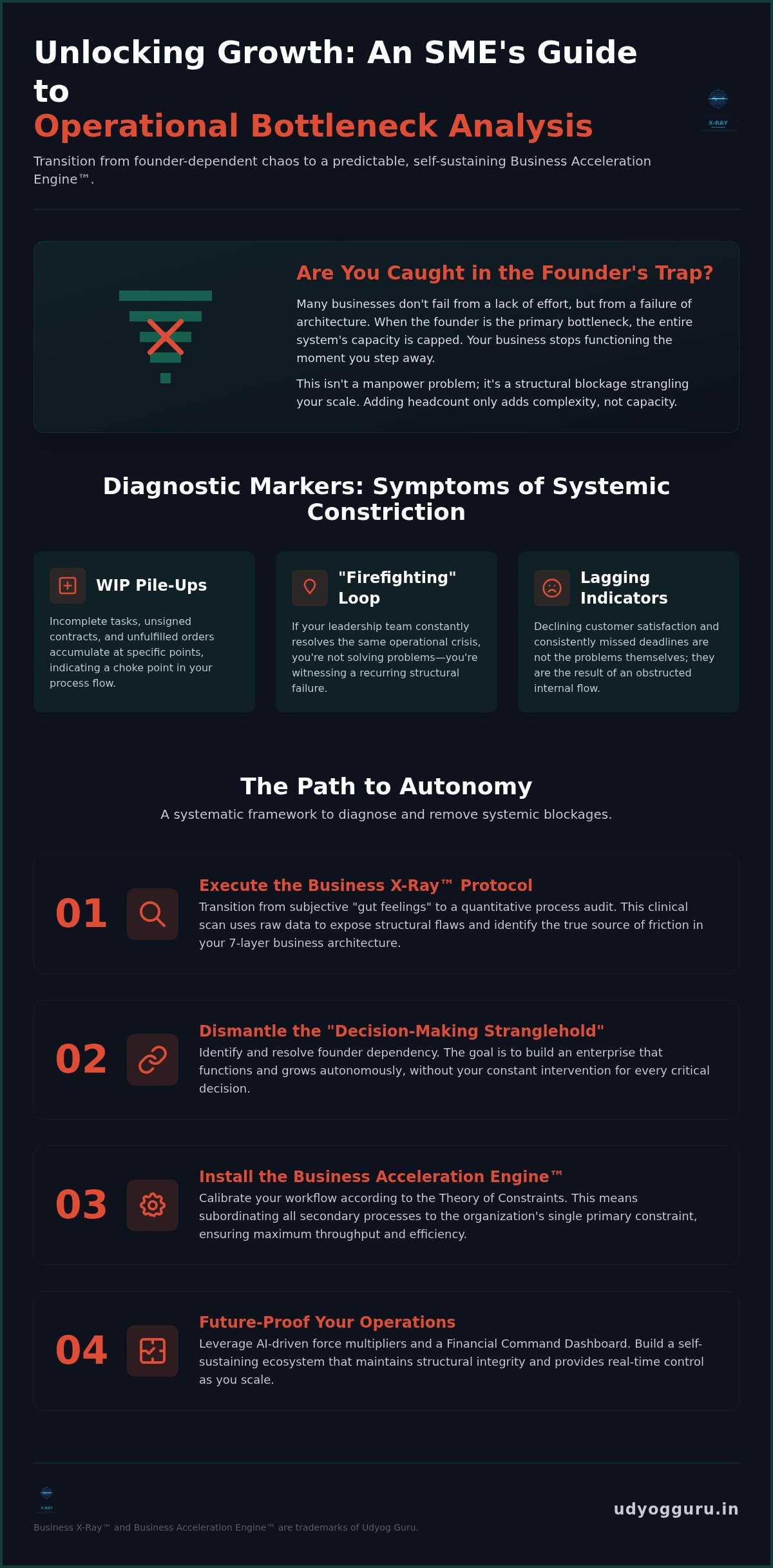
Why does your business stop functioning the moment you step away from your desk? For many Indian SMEs, the inability to scale isn't a lack of effort but a failure of architecture. When you're trapped in a cycle of chronic firefighting, the issue isn't your team's work ethic; it's a fundamental blockage in your system's flow. Conducting a rigorous operational bottleneck analysis is the only way to move beyond the 'Founder's Trap' and identify the precise structural friction points that are strangling your scale. Without this clinical diagnostic, you're merely treating symptoms while the underlying pathology remains unaddressed.
You likely feel that more manpower is the solution, yet you've realized that adding headcount often adds more complexity rather than capacity. This article delivers the diagnostic framework required to identify, analyze, and remove the systemic blockages constricting your revenue. We'll examine how to perform a Business X-Ray™ to scan your operations for hidden inefficiencies and install a Financial Command Dashboard for real-time control. You'll learn to transition from founder-dependent chaos to an autonomous Business Acceleration Engine™ that facilitates predictable growth. We'll map the logical progression from operational repair to a calibrated, self-sustaining machine.
Key Takeaways
- Learn to differentiate between temporary operational hiccups and chronic architectural constraints that limit your organization’s total throughput.
- Execute a clinical operational bottleneck analysis using the Business X-Ray™ protocol to transition from subjective observation to a quantitative process audit.
- Identify and dismantle the "Decision-Making Stranglehold" to resolve founder dependency and allow the enterprise to function without your constant intervention.
- Install the Business Acceleration Engine™ to calibrate your workflow and subordinate all secondary processes to the organization’s primary systemic constraint.
- Leverage AI-driven force multipliers and a Financial Command Dashboard to build a self-sustaining ecosystem that maintains structural integrity as you scale.
The Anatomy of Operational Bottlenecks: A Diagnostic Overview
An operational bottleneck is not merely a delay; it's a structural failure in your business architecture that dictates the maximum speed of your entire organization. In a clinical sense, a production bottleneck is the specific point of systemic constriction where the demand on a resource exceeds its capacity, effectively capping the output of the entire enterprise. Performing a rigorous operational bottleneck analysis allows you to distinguish between transient operational "hiccups," such as a one-time staff absence, and chronic architectural blockages that persist regardless of how much capital or labor you inject into the system.
This diagnostic approach is rooted in the Theory of Constraints, which posits that any complex system is only as strong as its weakest link. In the context of an Indian SME, this means that increasing efficiency in non-bottleneck departments is a mathematical waste of resources. If your sales engine produces 100 leads but your delivery team can only process 20, optimizing sales further only increases internal pressure without improving revenue. Identifying and widening the primary bottleneck is the only path to achieving a non-linear ROI on your management effort. You don't need to fix everything; you only need to fix the one thing holding everything else back.
Symptoms of Systemic Constriction
Systemic constriction manifests through visible patterns that many founders mistake for the unavoidable friction of growth. You can identify these through three primary diagnostic markers. First, look for Work-in-Progress (WIP) pile-ups. These are inventories of incomplete tasks, unsigned contracts, or unfulfilled orders that accumulate at specific departmental junctions. Second, observe the "Firefighting Loop." If your leadership team is resolving the same operational crisis every week, you aren't solving problems; you're witnessing a structural failure. Finally, track declining customer satisfaction and missed deadlines. These aren't the problems themselves; they're the lagging indicators that your internal flow is obstructed.
The Financial Impact of Unresolved Blockages
The cost of an unaddressed bottleneck is rarely found on a standard P&L statement. It exists as "Opportunity Cost," which is the revenue your business is physically incapable of capturing because of restricted throughput. Beyond lost revenue, an ignored operational bottleneck analysis leads to significant payroll waste. When one department is stalled, the downstream teams are often paid to wait, creating "hidden" overhead that erodes your margins. In the Indian market, where operational costs are rising, these inefficiencies result in a direct correlation between systemic friction and shrinking profit percentages. A business with a blocked engine can't scale; it can only grow more expensive to operate.
The Business X-Ray™ Protocol: A Systematic Methodology for Analysis
The Business X-Ray™ protocol represents a critical shift from subjective observation to a rigorous, Tier 1 diagnostic scan of your organization's internal mechanics. While many Indian founders rely on gut feeling to identify friction, a scientific operational bottleneck analysis demands raw, unfiltered data to expose the structural flaws that intuition often overlooks. This methodology functions as a clinical pre-surgery requirement; you cannot attempt to scale or re-engineer a system until you have achieved total diagnostic transparency. By stripping away the emotional narrative of being "busy," the Business X-Ray™ exposes the cold reality of your throughput capacity and the 7-layer architecture of your enterprise.
Quantitative auditing replaces vague complaints of delays with specific metrics like cycle time and lead time variability. In the Indian SME landscape, where resources are often stretched thin, knowing exactly where ₹1 of investment yields the highest return is vital for survival. This audit does not just look at what people are doing; it measures the friction of the system itself. It uncovers the "hidden factory" of rework and manual interventions that founders often accept as a normal cost of doing business. Without this data, any attempt at improvement is merely a shot in the dark that may inadvertently create new problems elsewhere.
Mapping the Operational Architecture
The first stage of the protocol involves visualizing the end-to-end acquisition and delivery funnel to expose the underlying architecture. We identify every specific hand-off point where a task moves between departments or individuals, as these junctions are frequently the sites of systemic failure. A Process Map serves as the definitive blueprint of your business logic, documenting how value is actually created rather than how you imagine it happens. This visualization is critical for managing workflow bottlenecks that occur when departmental silos fail to synchronize their output, leading to internal stagnation.
Identifying High-Resistance Nodes
Once the architecture is mapped, we conduct time-motion studies to pinpoint high-resistance nodes where tasks sit for the longest duration. We analyze the ratio of resource utilization against actual output at each junction to determine if a node is genuinely under-resourced or simply inefficiently structured. A critical diagnostic priority is flagging nodes where a single individual holds exclusive "tribal knowledge," as this creates a catastrophic point of failure. If you are ready to move beyond guesswork and obtain a 62-point diagnostic report, you can begin your own Business X-Ray™ to quantify these hidden risks before they destabilize your scaling efforts.
Founder Dependency: The Invisible Primary Bottleneck in Scaling Enterprises
The most pervasive constraint revealed during a clinical operational bottleneck analysis is frequently the founder themselves. This phenomenon, categorized as the "Decision-Making Stranglehold," occurs when every minor operational approval, from ₹5,000 vendor disbursements to final client deliverables, must pass through the owner’s desk for verification. While founders often justify this constant intervention as essential "quality control," it's actually a diagnostic marker of systemic immaturity. By positioning yourself as the ultimate filter for all tasks, you've inadvertently capped your enterprise’s capacity at the physical limit of your personal bandwidth. An organization cannot outgrow the 24 hours available to its owner; scaling therefore requires the total detachment of organizational performance from your daily presence through a framework of Operational Clarity.
Workforce X-Ray™: Auditing Team Output vs. Capacity
Breaking this cycle of dependency requires a Workforce X-Ray™ to conduct a rigorous audit of team output against their actual capacity. This diagnostic scan identifies under-leveraged team members who possess the technical capability but lack the structural permission or protocol to execute independently. Many Indian SMEs suffer from "Functional Gaps" where the workforce remains stagnant simply because they lack the specific blueprints to act without explicit verbal instruction. It's critical to distinguish between a "people problem" and a "systemic instruction problem." If a competent employee fails to deliver consistent results, the diagnosis usually reveals a failure in the architectural protocols, not the individual’s inherent ability.
Architecting Automated Delegation Protocols
The transition from a "Manager" to a "Systems Architect" involves replacing erratic verbal instructions with architected delegation protocols. You must abandon the "command and control" model, which consumes your daily energy, and install self-regulating accountability loops that function autonomously. These protocols ensure that quality standards are maintained through predefined triggers and checkpoints that do not require founder intervention. By installing these standardized operational protocols, you calibrate the business to function as a predictable machine. Removing yourself as the primary engine of progress allows your operational bottleneck analysis to finally focus on external market acquisition rather than internal firefighting. This structural reconfiguration is the foundational step in transforming a founder-dependent operation into a scalable, high-throughput enterprise.
Installing the Business Acceleration Engine™: Protocols for Removal
Once the Business X-Ray™ has mapped the structural flaws, you must move to the Tier 2 implementation phase: the Business Acceleration Engine™. This isn't about suggesting minor improvements or providing temporary motivation; it's about the clinical installation of new workflows designed to eliminate friction at its source. A key methodology here is "subordinating" the entire system to the identified constraint. If your delivery department is the bottleneck, your sales and marketing must be calibrated to match its throughput, preventing the internal chaos of over-commitment. By aligning the organization's rhythm to its most restrictive node, you stabilize the machine before attempting to accelerate it. The objective is to build a predictable engine that generates growth regardless of market volatility or individual performance fluctuations.
In the Indian market, where economic shifts can be sudden, a business that relies on a calibrated system rather than a founder's frantic energy is the only one that survives long-term. This phase transitions your business from a collection of people doing tasks to an integrated architecture capable of high-volume throughput. You're no longer hoping for growth; you're engineering it through structural integrity.
Process Re-Engineering and Standardization
We simplify complex, erratic workflows into repeatable, documented protocols that remove the need for constant supervision. This stage involves the aggressive elimination of redundant steps identified during the initial operational bottleneck analysis. You aren't just writing guides. You're architecting the DNA of your enterprise. Standard Operating Procedures (SOPs) serve as the essential DNA of a scalable business, establishing the repeatable protocols necessary for autonomous operation. By stripping away the 'unwritten rules' of your office, you create a system that can be operated by any trained team member, effectively removing the reliance on specialized individuals.
Resource Re-Allocation for Maximum Throughput
Widening the neck of the bottle requires the strategic re-allocation of capital and talent to the point of highest resistance. In many Indian SMEs, high-performing staff are often wasted on non-critical tasks while the primary bottleneck remains under-resourced. This creates a massive imbalance. We implement cross-training protocols to ensure no single point of failure (SPOF) exists within the architecture. This ensures the system maintains flow even during staff turnover. Finally, we optimize your acquisition funnel to ensure it perfectly matches your delivery engine’s capacity, preventing the financial waste of unfillable leads. If you're ready to stop firefighting and start building a predictable growth machine, you can install the Business Acceleration Engine™ to recalibrate your operations for maximum throughput.
Future-Proofing Through AI Integration and Financial Command
Future-proofing an enterprise requires moving beyond mere structural repair toward technological orchestration. Once the initial operational bottleneck analysis has cleared existing obstructions, you must install the digital scaffolding required to support rapid, high-volume growth. Artificial Intelligence serves as a critical force multiplier in this phase, specifically designed to prevent the recurrence of bottlenecks in administrative and communication protocols. By integrating these automated systems, you ensure that as your acquisition volume increases, your operational capacity scales proportionally without requiring a linear increase in headcount. The AI Tech Business Integration Bootcamp functions as the implementation vehicle for this modernization, providing the custom architecture needed to transition from manual intervention to automated workflow execution.
Research indicates that organizations utilizing AI to enhance operational excellence can expect a productivity increase between 25% and 55% depending on the level of automation. This isn't about replacing human talent; it's about calibrating the business machine to handle repetitive, data-heavy tasks with clinical precision. Technology acts as the structural frame that holds the business together during the high-pressure environment of rapid scaling, ensuring that the engine doesn't seize under its own weight.
AI Tech Integration for High-Output Workflows
The modernization of an Indian SME involves the aggressive automation of repetitive administrative and communication protocols that traditionally consume founder bandwidth. We use AI to provide real-time diagnostic data on workflow health, allowing you to identify potential friction points before they manifest as chronic blockages. Your workforce must be trained to operate alongside these AI Acceleration Engines, shifting their focus from manual data entry to strategic system management. This integration ensures that the "Decision-Making Stranglehold" identified in earlier diagnostic phases is permanently dismantled through automated logic gates and pre-approved protocol triggers.
The Financial Command Dashboard: Real-Time Monitoring
The final layer of a scalable architecture is the installation of the Financial Command Dashboard. This system integrates your financial metrics with real-time operational throughput data, establishing a centralized "Founder’s Command Center" for data-driven control. Total transparency is the only defense against "Bottleneck Drift," a phenomenon where inefficiencies slowly re-emerge as the business enters new markets or adds complex product lines. By monitoring the correlation between ₹1 of expenditure and the resulting system output in real-time, you maintain absolute control over your profit margins. This dashboard ensures that your operational bottleneck analysis is no longer a one-time event but a continuous, automated process that safeguards the structural integrity of your enterprise.
Architecting a Frictionless Scaling Engine
Scaling an Indian SME from a collection of manual tasks into a self-sustaining machine requires more than just incremental effort; it demands a total structural recalibration. By shifting your focus from temporary firefighting to a rigorous operational bottleneck analysis, you dismantle the invisible barriers that cap your enterprise's throughput. We've established that identifying the "Decision-Making Stranglehold" and installing the Business Acceleration Engine™ are the primary steps toward achieving autonomous growth. This systematic approach replaces founder intuition with raw data, ensuring that your architecture remains resilient against market volatility.
Leveraging our proprietary Business X-Ray™ Framework and a national track record in SME transformation, we provide the clinical precision necessary for this architectural transition. Our expertise in AI-driven business integration allows you to install the digital scaffolding and financial command systems required to future-proof your operations. You don't have to remain the primary engine of your company's progress. If you're ready to obtain total diagnostic transparency and begin your systemic repair, Request Your Business X-Ray™ Diagnostic Scan Today. Your business is a machine; it's time to calibrate it for peak performance.
Frequently Asked Questions
What is the most common operational bottleneck in a growing SME?
The most prevalent constraint is the "Decision-Making Stranglehold," where the founder remains the primary filter for every operational choice. This creates a systemic ceiling because the organization's throughput is limited by the owner's personal bandwidth. In the Indian SME context, this often manifests as a lack of delegated protocols, forcing the founder into a cycle of chronic firefighting that prevents any meaningful transition toward high-level strategic scaling or autonomous operation.
How do I conduct a bottleneck analysis without disrupting daily operations?
You can execute a rigorous operational bottleneck analysis by utilizing passive data collection and the Business X-Ray™ diagnostic framework. This clinical approach scans your existing acquisition and delivery funnels without requiring a total operational shutdown. By auditing raw data points like cycle times and hand-off delays, you identify structural friction points remotely. This allows you to map the internal architecture and pinpoint inefficiencies while your team maintains their standard daily output.
Is my business too small for a formal Business X-Ray™ diagnostic?
No business is too small for structural transparency; in fact, installing scalable systems early prevents the "Founder's Trap." Even an enterprise with a small team needs a clear blueprint to avoid the chaos that accompanies rapid growth. The Business X-Ray™ provides a 62-point diagnostic report that is essential for any founder aiming to transition from a person-driven operation to a system-driven engine, regardless of their current headcount or turnover.
Can software alone solve my operational bottlenecks?
Software functions as the scaffolding of your business, but it cannot fix a fundamentally broken process. Without established operational protocols, new technology often just automates existing inefficiencies, leading to faster failures. You must first perform an operational bottleneck analysis to re-engineer your workflows. Only after the architecture is calibrated should you integrate AI and software tools to act as force multipliers for your newly standardized, high-throughput delivery engine.
How often should a business conduct an operational bottleneck analysis?
A systemic scan should be conducted quarterly or whenever the business reaches a new revenue tier that puts pressure on existing capacity. As you scale, new constraints naturally emerge at different departmental junctions. Regular diagnostic auditing ensures that "Bottleneck Drift" doesn't occur, allowing you to maintain structural integrity. This proactive frequency keeps your Business Acceleration Engine™ calibrated and ensures that your financial margins don't erode due to hidden operational friction.
What is the difference between a bottleneck and a lack of resources?
A lack of resources is a capacity issue, whereas a bottleneck is a structural constriction that limits the utility of all other resources. If you have a narrow neck in a bottle, pouring in more water doesn't increase the flow; it only creates a spill. Similarly, adding headcount to a department that is blocked by a systemic protocol failure only increases your payroll waste without improving your organization's total throughput or revenue.
How long does it take to see results after implementing a Business Acceleration Engine™?
The installation of a Business Acceleration Engine™ typically yields measurable improvements in operational flow within 60 days. This period allows for the full deployment of 7 modules and 8 weekly calibration sessions required to stabilize new workflows. While some efficiencies are visible immediately after the initial scan, the transition to a truly autonomous, engine-driven business requires this structured implementation timeline to ensure that the new protocols are deeply integrated into your workforce.
What are the first signs that a founder has become a bottleneck?
The primary diagnostic marker is "Operational Stagnation" during the founder's absence. If deadlines are missed or decision-making halts the moment you step away from your desk, you have become a structural constraint. Other lagging indicators include a permanent backlog of approvals on your desk and a team that lacks the protocol to resolve minor crises without your intervention. These signs indicate that your personal bandwidth has become the absolute maximum capacity of the business.


