

For a growing business, organizational design connects team and role structures to business strategy, so responsibilities, decisions and information flow support the work the company needs to do. The right design is more than an org chart: it aligns processes and workforce capabilities with business goals. What worked with a small team can create bottlenecks as the company grows, making organizational design for growing businesses essential to linking workforce decisions with performance.
Growth can bring new layers, specialist roles and coordination demands. But adding structure without a clear purpose can create confusion instead of capacity. This article explains how functional, divisional, flat and hybrid structures work, how to assess whether a design still fits, and how to plan changes that support execution. It also explores how role clarity, decision rights and workforce alignment affect customer delivery and business objectives.
Key Takeaways
- Align roles, decision rights and information flows with business priorities to make accountability clearer as the company grows.
- Combine functional stability with matrix or team-based coordination when work requires specialists to support shared priorities.
- Plan structural changes around leadership alignment, clear communication and ongoing monitoring so implementation can respond to operational blockers.
- Connect workforce capabilities and delegation to the outcomes the business needs, then assess whether the current design supports them.
What is organizational structure?
Organizational structure defines roles, reporting lines and information flows across a business. Organizational design aligns these elements with strategy, processes and workforce capabilities.
In India, employment requirements for wages, working hours, social security and workplace safety can shape responsibilities and reporting. Since requirements vary by establishment and workforce, assign clear ownership for compliance and escalation.
Structure and Strategic Alignment
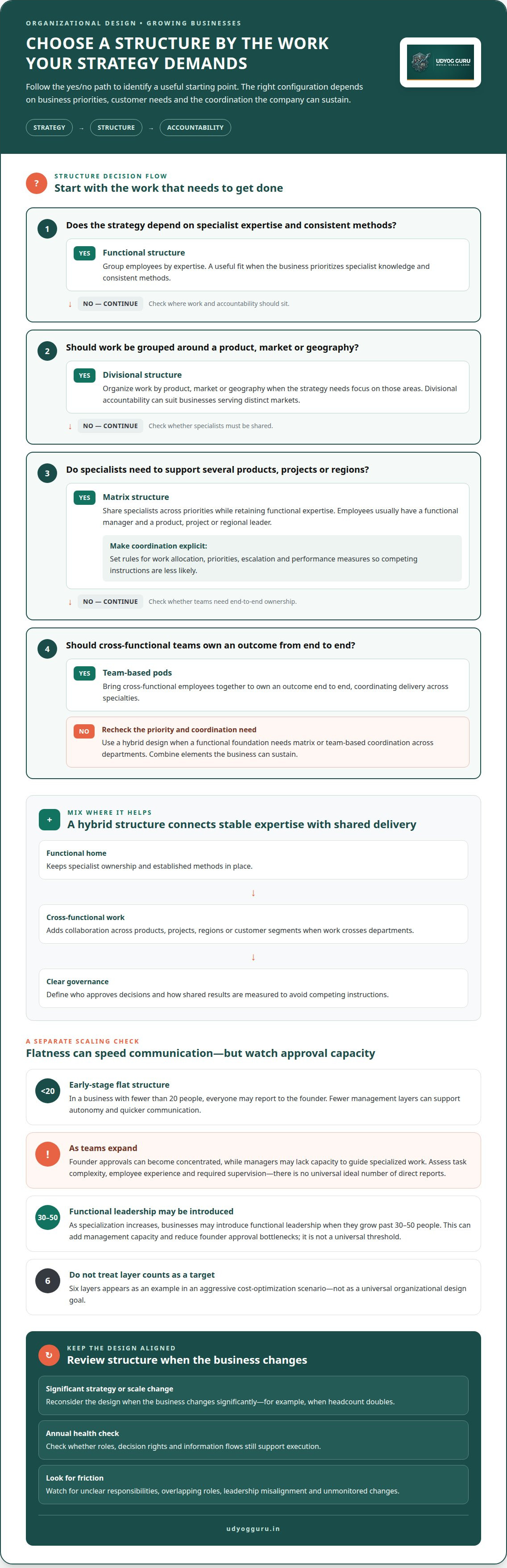
Structure is the arrangement of departments, roles and authority used to deliver a company’s strategic purpose. A functional structure groups employees by expertise, which can suit a business prioritising specialist knowledge and consistent methods. A divisional design groups work by product, market or geography. Choose according to where the strategy requires focus: expertise, customer segments or local delivery. A 20-person company and a 200,000-person company face different design challenges.
Decision-Making and Accountability
Decision-making and accountability depend on who has authority, who provides input and who owns each result. Span of control, the number of employees reporting to a manager, affects supervision and escalation, but there is no universal ideal. Routine, automated work, for example, can support a wider span than specialised work that needs frequent guidance. Define decision rights alongside reporting lines so employees know who approves, executes and resolves exceptions.
Teams and Roles Around Strategic Goals
Redesigning teams and roles means assigning work and capabilities around the outcomes that matter to strategy. If customer delivery is a priority, map the process from enquiry to fulfilment, then identify hand-offs and ownership gaps between departments. A process map shows how tasks connect and depend on one another. Use it to clarify role boundaries, place critical capabilities where they affect results, and reduce duplicated work without leaving gaps in service.
Delegation and Leadership Team Building
Delegation transfers defined decisions and outcomes from a founder to accountable leaders. Start by grouping recurring responsibilities, such as sales, operations and finance, then assign each area an owner with clear authority and escalation boundaries. As specialization increases, businesses may introduce functional leadership when they grow past 30-50 people. This creates management capacity, reduces founder approval bottlenecks and gives employees a direct route for decisions. Review responsibilities as strategy and scale change.
Hybrid organizational structures
For Indian startups and growing SMEs, a functional foundation can establish specialist ownership, with matrix or team-based arrangements added when work crosses departments. The right mix depends on business priorities, customer needs and the coordination the company can sustain.
Roles, Reporting, and Decision Authority
An organizational structure establishes roles, reporting relationships and decision authority. A hybrid design combines stable functional teams with flexible collaboration across products, projects or regions. Its components include structure, roles, processes, governance, incentives and metrics. For example, a sales department can retain functional reporting while employees join a cross-functional team serving a key customer segment. Define who approves decisions and how shared results are measured to support alignment without creating competing instructions.
Matrix Structures and Coordination
A matrix structure gives an employee dual reporting lines, usually to a functional manager and a product, project or regional leader. This lets businesses share specialists across priorities, such as assigning finance expertise to several product launches while retaining a finance function. It also requires coordination: managers must clarify priorities, resolve conflicting requests and agree on performance measures. Set rules for work allocation and escalation, or employees may be unsure whose direction takes precedence.
Flat Structures and Scaling Limits
A flat structure reduces management layers, giving employees greater autonomy and enabling quicker communication. In an early-stage business with fewer than 20 people, everyone may report to the founder. As teams expand, that arrangement can concentrate approvals and leave managers without enough capacity to guide specialised work. There’s no standard number of direct reports for every manager. Assess task complexity, employee experience and required supervision; an aggressive cost-optimisation scenario may flatten an organisation to six layers, but that isn’t a universal target.
Comparing Structures for Growing Businesses
Functional structures group expertise, while divisional designs organise work by product, market or geography. Matrix structures share specialists across priorities, and team-based pods bring cross-functional employees together to own an outcome end to end. A manufacturer focused on consistent operations may favour functional ownership, while a business serving distinct markets may benefit from divisional accountability. Choose the configuration that supports strategic priorities, combining elements where teams need coordinated delivery.
Change management and implementation planning
Redesign when strategy or scale changes significantly, such as when headcount doubles, and conduct an annual health check. Common risks include unclear responsibilities, overlapping roles, leadership misalignment and failing to monitor changes after implementation.
Agility and Market Responsiveness
Agility means adapting roles, decisions and processes as market conditions shift. Changing customer needs, for example, may call for moving specialists closer to delivery teams. Identify where approval delays or hand-offs obstruct responses, then adjust authority and workflows. This keeps responsibilities aligned with current priorities without making every market shift a reason for a full restructure.
Organizational Culture During Change
Organizational culture shapes how employees interpret and adopt new responsibilities. Visible executive sponsorship gives managers a consistent message when explaining changes to roles or reporting lines. Align leaders before implementation so teams understand expected behaviours and decision routes. For example, if a functional team starts supporting a cross-functional programme, its leaders should clarify how priorities are set and conflicts resolved.
Planning for Growth and Change
Growth planning defines a future-state structure to support strategic goals over a one-to-three-year horizon. Start with business priorities, then assess roles, processes and decision paths against the capabilities required. Review business documents and financials, and gather input from critical stakeholders once you have an initial hypothesis. This grounds the design in business needs instead of letting individual preferences dictate the structure.
Redesign Timing and Restructuring Risks
Review the structure when evidence shows it no longer supports strategy or scale. Doubling headcount, for example, may warrant a fundamental review. Risks rise when leaders announce new roles before clarifying decision rights, or give too little attention to culture and communication. Set clear responsibilities, communicate changes through aligned leaders, then monitor outcomes and adjust when blockers emerge.
Connecting workforce design to business performance
Workforce design connects people, capabilities and decision rights to the operational results a business needs. A study involving more than 350 companies examined 76 organizational practices. Organizations with highly mature design were 2.3 times more likely to exceed financial targets. The relationship shows why structure should be assessed against outcomes, not treated as an isolated chart.
Start with a defined business priority, such as improving customer retention or accelerating product launches. Identify the capabilities and roles that directly affect it, then trace how work moves between employees. For a product launch, clarify who owns customer research, development, approvals and delivery. This can reveal whether hand-offs, unclear authority or missing expertise are getting in the way.
Performance also depends on information and decision rights. In companies analysed for strong strategy execution, these factors had about twice the effect of organizational structure or motivators. Give teams access to the information they need to make decisions, and define who can approve, allocate resources or resolve exceptions. Track operational indicators alongside strategic outcomes to distinguish capacity problems from process failures.
Workforce design must also support adaptability and innovation. Organizations with highly mature design were 30 times more likely to adapt well to change and 5.3 times more likely to be a great place to work. These findings are associations, not a promise of results. Use scenario modelling to compare structural options through strategic alignment, span assumptions and cost implications. Then monitor whether roles and workflows support engagement, learning and delivery.
When unclear ownership or delegation is limiting performance, a structured workforce assessment can identify where responsibilities and capabilities need adjustment. Map workforce design to business performance through an assessment of roles, accountability and execution priorities.
Udyog Guru: Business X-Ray™ (Tier 1)
Business X-Ray™ (Tier 1) is Udyog Guru’s structured starting point for examining business transformation needs. Turn to it when growth has exposed gaps between strategy, operational systems and workforce decisions, and you need a clearer basis for the next change. The Business Acceleration Engine™ (Tier 2) extends this framework, while Workforce X-Ray™ focuses on workforce optimization, team performance and delegation. For businesses embedding AI and modern technology into existing workflows, the AI Tech Business Integration Bootcamp (Tier 3) addresses that operational transition.
The appropriate starting point depends on whether the core issue lies in the wider business system, workforce design or technology integration. Contact Udyog Guru to discuss your organizational design needs.
Make the next design decision with purpose
Start by identifying the structural constraint that most directly limits execution. It may be unclear ownership, delayed decisions, fragmented information or a capability gap. Use that constraint as a diagnostic starting point, then link any proposed change to a defined business outcome. This keeps organizational design for growing businesses focused on improving the work, rather than changing for its own sake.
A structured assessment can help clarify where business systems and workforce decisions need attention. Udyog Guru’s Business X-Ray™ (Tier 1), Business Acceleration Engine™ (Tier 2) and Workforce X-Ray™ address business transformation and workforce optimization. The appropriate focus depends on the operational issue you need to resolve.
Discuss your organizational design priorities with Udyog Guru and establish a clear basis for your next decision. A sound design gives growth a stronger operating foundation.
Frequently Asked Questions
What is organizational design?
Organizational design is the coordinated arrangement of people, work, authority and management systems to deliver a company’s purpose. It goes beyond reporting lines to include how tasks connect, how results are measured and how incentives shape behaviour. For example, a service firm can organise its workflow around timely customer resolution, with hand-offs and measures supporting that outcome across sales and delivery.
What is organizational design for a growing business?
Organizational design for growing businesses adapts responsibilities, capabilities and operating systems as company demands change. A small online retailer, for example, may start with one team managing orders, support and inventory. As demand grows, it can separate those responsibilities while defining how inventory issues reach customer support and purchasing. The design should increase capacity without making routine work dependent on the founder.
How should a business define roles, reporting lines, and decision rights as it scales?
Define each role by its expected outputs, recurring decisions and boundaries with adjacent roles. For a delayed customer order, specify who investigates stock, who updates the customer and who can approve a remedy. Record reporting relationships separately from decision authority, since a manager may provide guidance without owning every operational choice. A shared register of responsibilities and decisions helps employees handle routine cases consistently.
What are the steps to design and implement an organizational structure?
Use a sequence that links the proposed structure to actual work, then tests how it operates:
- Set the business outcomes the design must support.
- Map core workflows, hand-offs and capability gaps.
- Assign role ownership, reporting relationships and decision boundaries.
- Communicate the changes, implement them and monitor operational blockers.
For example, mapping a delayed-order workflow can show whether the problem lies in ownership, approval authority or access to information, helping guide a targeted adjustment.


