
What if the primary obstacle to your company’s expansion isn't a lack of effort, but the very energy you're using to keep it alive? Most founders mistake frantic firefighting for leadership, yet this approach ensures the organization remains tethered to their personal capacity. To break this cycle, you must implement a rigorous business growth framework that functions like a high-performance engine rather than a series of manual interventions. Scaling isn't a creative art form; it's a clinical engineering process that requires precise calibration of your operational architecture.
You've likely felt the weight of a business that can't survive a single day without your direct input. It's exhausting to manage a team that lacks accountability or to fly blind without real-time financial transparency. This article provides the exact diagnostic and architectural protocols needed to install a systems-led infrastructure. You'll learn how to transition from operational chaos to a predictable revenue engine using a scientific approach. We'll examine the deployment of a Business X-Ray™ to identify structural weaknesses, the installation of a Financial Command Dashboard for clinical clarity, and the implementation of automated workforce protocols to ensure your enterprise scales independently of your daily presence.
Key Takeaways
- Transition from manual exertion to a systematic business growth framework that treats organizational expansion as a measurable engineering challenge rather than a creative endeavor.
- Utilize the Business X-Ray™ to conduct a clinical scan of your operations, identifying the specific structural gaps that must be repaired before scaling begins.
- Install the Business Acceleration Engine™ to replace founder-led sales efforts with an automated, predictable revenue generation protocol.
- Modernize your organizational architecture by integrating workforce protocols and AI automation through the AI Tech Business Integration Bootcamp to eliminate manual bottlenecks.
- Establish total fiscal transparency with the Financial Command Dashboard, providing the real-time data visualization required for objective, data-driven decision-making.
The Architecture of Scalability: Why Growth Requires a Scientific Framework
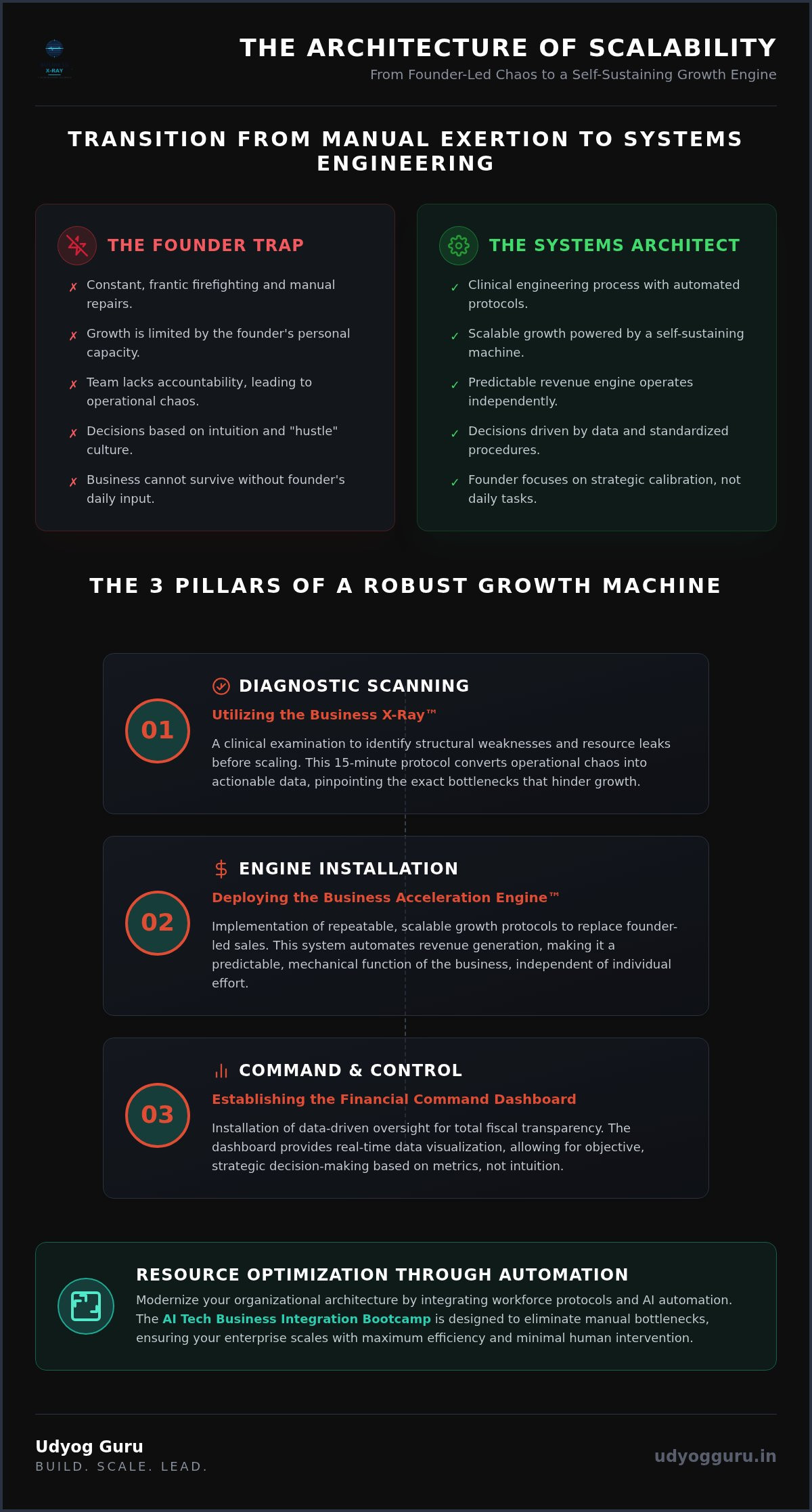
Many entrepreneurs view expansion as a byproduct of increased effort or aggressive sales targets. This is a fundamental misunderstanding of enterprise dynamics. A true business growth framework isn't a collection of ambitious goals; it's a structural blueprint that defines how an organization functions without the constant intervention of its founder. Most SMEs remain stagnant because they rely on hustle-based growth, which is inherently limited by the founder’s personal bandwidth. This "Founder Trap" occurs when the business is an extension of an individual's will rather than a self-sustaining machine. To scale effectively, you must transition from being a visionary leader to acting as a Systems Architect who prioritizes structural integrity over temporary momentum.
From Firefighting to Operational Engineering
Operational chaos is a diagnostic symptom of a missing or broken architecture. When a founder spends their day firefighting, they're essentially performing manual repairs on a machine that should be automated. Growth often exacerbates these flaws. If your operational protocols are weak, increasing sales only accelerates the rate of internal collapse. Scientific implementation replaces intuitive management with standardized procedures. It's about moving away from reactive survival and toward a state of operational engineering where every outcome is the result of a deliberate process, not a heroic individual effort.
The Three Pillars of a Robust Growth Machine
Building a scalable enterprise requires a tiered approach to system installation. Without these three pillars, growth remains erratic and unsustainable:
- Diagnostic Scanning: This involves a clinical examination of the current state of the enterprise. Before you can install new systems, you must identify where the existing architecture is leaking resources or failing to hold pressure.
- Engine Installation: Once the diagnosis is complete, you implement repeatable, scalable growth protocols. This is where you replace manual labor with the Business Acceleration Engine™, ensuring that revenue generation becomes a predictable, mechanical function.
- Command and Control: The final stage is establishing data-driven oversight. A founder needs clinical clarity on business health through a Financial Command Dashboard, allowing for strategic calibration based on real-time metrics rather than emotional intuition.
By treating your company as a logical puzzle of process and logic, you remove the volatility that plagues most small and medium enterprises. This shift in perspective is the first step in installing a resilient business growth framework that survives the transition from founder-dependency to enterprise-level operations.
The Diagnostic Phase: Utilizing the Business X-Ray™ to Identify Operational Gaps
A growth strategy implemented without a prior diagnostic scan is organizational malpractice. Most enterprise leaders attempt to scale based on subjective intuition or vague "feelings" regarding where operational friction exists. This approach is unscientific and carries a high risk of systemic failure. Within a robust business growth framework, the diagnostic phase serves as the clinical foundation for all subsequent interventions. The Business X-Ray™ provides an objective visualization of organizational health, moving beyond surface-level symptoms to identify the root causes of stagnation. It's a precise calibration tool designed to reveal the hidden cracks in your operational architecture before they become catastrophic under the pressure of expansion.
We utilize a 15-minute diagnostic protocol to quantify operational friction across the entire enterprise. This process isn't about gathering opinions; it's about converting qualitative chaos into actionable data points. By measuring the integrity of your current systems, we can map out exactly where the infrastructure is likely to fail as volume increases. This initial scan ensures that every resource allocated toward growth is directed at a verified bottleneck rather than a perceived problem. It replaces the "hit or miss" nature of traditional management with a disciplined, data-driven methodology.
Mapping the DNA of Your Business Operations
Analyzing workflow efficiency requires a detached, analytical lens that evaluates how tasks move across departments without founder intervention. Any point where a process requires the founder's specific input is a leakage point in the organizational architecture. By deploying the Workforce X-Ray™, we audit team performance and accountability through a lens of systematic output rather than individual effort. This scan reveals whether your human capital is accelerating your scaling efforts or acting as a primary inhibitor. It provides the clinical clarity needed to determine if your team is capable of supporting a systems-led organization or if their current protocols require a total structural overhaul.
The Outcome of a Comprehensive Business Scan
The result of this comprehensive scan is a prioritized roadmap for structural repairs and system installations. This roadmap eliminates guesswork in resource allocation and capital investment, ensuring that the business machine is primed for high-performance output. Instead of broad, ineffective changes, you receive a clinical prescription for specific repairs. This transition from hope-based management to data-driven oversight is what separates stagnant SMEs from scalable enterprises. The Business X-Ray™ is a mandatory diagnostic prerequisite for the successful installation of the Business Acceleration Engine™.
The Business Acceleration Engine™: Protocols for Driving Predictable Revenue
Once the diagnostic phase has identified the structural gaps in your organization, the next stage in a robust business growth framework is the installation of the Business Acceleration Engine™. This isn't a collection of marketing tips, but a mechanical replacement for founder-led operations. It functions as the core mechanism that converts organizational potential into predictable revenue by removing the volatility of human intuition. For an enterprise to scale, it must transition from manual effort to automated revenue generation, where every outcome is the result of a deliberate, engineered protocol rather than a heroic individual performance.
Architecting a business that operates independently of the founder’s presence requires a shift from "doing" to "designing." When the revenue engine is properly installed, the organization functions with clinical precision. It ensures that quality remains consistent even as volume increases, preventing the systemic collapse that often occurs when SMEs attempt to scale without a verified structural blueprint.
Step-by-Step Engine Installation
The installation of this engine begins with standardizing high-value tasks through rigorous documentation. Every critical function, from lead acquisition to service delivery, must be distilled into a Standard Operating Procedure (SOP) that eliminates ambiguity. We then implement automated delegation systems to streamline workforce output, ensuring that tasks move through the organization without manual friction. Central to this pillar is the Workforce Acceleration Engine™, a framework for high-performance team management that establishes clinical accountability. This system ensures that every team member understands their specific role within the machine and is held to a measurable standard of performance.
Calibrating for High-Speed Scaling
Scaling at high velocity requires precise calibration of the "critical path," which is the sequence of stages that directly impacts revenue growth. You must remove every friction point that slows this progression. A common failure in rapid expansion is the imbalance between acquisition speed and fulfillment capacity. If your acquisition protocols outpace your fulfillment architecture, the system will eventually fail under the weight of its own success. We focus on building repeatable cycles that function like clockwork. This predictability allows the founder to exit the daily firefighting cycle, moving into a role of strategic oversight. By balancing these internal forces, the business growth framework creates a predictable growth machine that can handle increased load without sacrificing structural integrity.
Resource Optimization: Integrating Workforce Protocols and AI Automation
Scaling an enterprise in the current economic climate requires more than just efficient human labor. It demands the integration of technology as a primary structural component. Traditional manual processes have become the most significant inhibitors of scalability in 2026, as they lack the speed and consistency required for high-volume operations. Within a scientific business growth framework, resource optimization is achieved by shifting from human-only workflows to AI-augmented operational excellence. This transition isn't about replacing your workforce, but about installing a force-multiplier that allows your existing team to produce at an exponential rate.
By treating technology as a fundamental architectural layer, you remove the bottlenecks associated with human error and manual fatigue. This level of optimization is what allows an enterprise to maintain structural integrity while scaling at high velocity. It ensures that the organization remains agile and responsive, capable of handling increased complexity without a loss in operational quality.
Engineering High-Output Teams
Constructing a high-output team requires a move away from subjective management and toward clinical accountability. By using data-driven performance tracking, you ensure that every member of the organization is operating at peak efficiency. Automated delegation systems are essential for reducing founder cognitive load, allowing tasks to be routed based on predefined protocols rather than manual oversight. Managing remote or distributed teams requires even greater precision. You must establish rigorous communication and reporting protocols that provide real-time visibility into productivity, regardless of geographical location. This systematic approach ensures that your workforce functions as a synchronized unit rather than a collection of independent actors.
The AI Tech Business Integration Protocol
The AI Tech Business Integration Bootcamp serves as a Tier 3 modernization protocol designed to embed artificial intelligence into your business architecture. The process begins by identifying repetitive operational tasks that are ripe for automation, such as lead qualification, data synchronization, or basic customer fulfillment. Unlike traditional software development that requires high-cost custom builds, this protocol focuses on integrating existing AI tools into a cohesive tech-stack. This stack acts as a force-multiplier, significantly increasing the output capacity of your workforce without a corresponding increase in overhead. To begin this modernization process, you can enroll in the AI Tech Business Integration Bootcamp to calibrate your organization for the next level of efficiency.
The Command Center: Establishing Control with the Financial Command Dashboard
The installation of a robust business growth framework is incomplete without a centralized mechanism for fiscal oversight. The Financial Command Dashboard serves as the final, critical component in this architectural transformation, providing a real-time visualization of organizational health. It allows the founder to move from the erratic management of people to the clinical management of systems. When you have total transparency into your fiscal data, you're no longer guessing about the efficacy of your operations. You're observing the machine's performance through a lens of absolute clarity, ensuring every component of the business growth framework is functioning at peak efficiency.
High-level scalability requires that KPIs correlate directly with business valuation and profit. If your current data is scattered across multiple platforms or buried in manual logs, you lack the structural integrity needed for aggressive expansion. This dashboard consolidates vital metrics into a single, authoritative source of truth. It transforms the founder’s role from a participant in daily chaos to a Systems Architect who monitors the organization’s vital signs from a position of detached, analytical control.
Designing Your CEO Dashboard
A functional CEO dashboard must prioritize metrics that drive long-term sustainability. You don't need more data; you need the right data. Essential metrics like cash flow, profitability, customer acquisition costs, and churn rates must be visible at a glance. We eliminate the spreadsheet nightmare by installing automated reporting systems that pull data directly from your operational engines. This allows for a 5-minute daily protocol where you scan the health of the entire enterprise. It's a diagnostic habit that ensures any mechanical failure in the business is identified and repaired before it impacts the bottom line.
Data-Driven Decision Making for Founders
Decision-making in a systems-led organization is never based on emotional intuition. It relies on historical data and trend analysis to predict future growth trajectories with clinical precision. When you have objective financial evidence, you can make aggressive scaling decisions with calm confidence. You'll know exactly when the Business Acceleration Engine™ requires more fuel and when it needs calibration. This level of operational and fiscal clarity provides a peace of mind that's impossible to achieve through manual hustle. It's the final step in your transition from a founder-dependent business to a scalable, systems-driven enterprise that thrives on logic and data.
Transitioning to a Systems-Led Organization
The shift from founder-dependent chaos to a scalable enterprise is a deliberate engineering feat. It requires moving beyond manual effort and embracing a rigorous business growth framework that prioritizes structural integrity over temporary momentum. By conducting a clinical scan with the Business X-Ray™, you identify the precise operational gaps that inhibit expansion. Once diagnosed, the installation of the Business Acceleration Engine™ and the Financial Command Dashboard provides the predictable revenue and fiscal transparency necessary for national-scale implementation. This methodical approach ensures your organization functions as a self-sustaining machine rather than an extension of your personal capacity.
Our national-scale implementation expertise allows for the seamless integration of these advanced protocols into your existing architecture. You can finally exit the cycle of firefighting and enter a phase of data-driven strategic oversight. The path to a predictable, systems-driven future begins with an objective assessment of your current health. Begin your diagnostic journey with the Business X-Ray™ today. Your organization is a puzzle of logic and process; it's time to solve it with clinical precision and architectural confidence.
Frequently Asked Questions
What is the primary difference between a growth strategy and a business growth framework?
A growth strategy defines your market objectives and competitive positioning, whereas a business growth framework provides the structural architecture required to execute those goals. Strategy is the conceptual "what," but the framework is the mechanical "how." It functions as a comprehensive blueprint that standardizes operations, ensuring that expansion is a result of systematic design rather than erratic manual effort or temporary market trends.
How does the Business X-Ray™ identify operational bottlenecks in a scaling SME?
The Business X-Ray™ identifies operational bottlenecks by conducting a clinical scan of departmental workflows to detect leakage points. It converts qualitative friction into actionable data points, revealing where current systems lack the structural integrity to handle increased volume. This diagnostic protocol ensures that interventions are targeted at verified structural weaknesses, preventing the organization from collapsing under the weight of rapid expansion or inefficient resource allocation.
Can a business growth framework be implemented without the founder being present?
Implementation is specifically engineered to function independently of the founder’s daily presence. The primary objective of the business growth framework is the removal of founder-dependency through the installation of automated protocols and standardized systems. Once the operational architecture is calibrated, the enterprise operates as a self-sustaining machine. This allows the founder to transition from a manual operator to a Systems Architect focused on high-level strategic oversight.
What role does AI integration play in the Business Acceleration Engine™?
AI integration serves as a mechanical force-multiplier within the Business Acceleration Engine™. It automates repetitive operational tasks, such as lead qualification and data synchronization, which traditionally act as inhibitors to scaling. By embedding technology into the core architecture, the organization achieves a level of consistency and speed that manual labor can't match. This modernization protocol ensures the revenue engine remains efficient even during periods of high-velocity growth.
How much time does it typically take to install a Financial Command Dashboard?
Installation of the Financial Command Dashboard follows a methodical sequence that replaces manual reporting with automated data visualization. While the specific timeline depends on the complexity of your existing tech-stack, the focus is on rapid deployment of real-time fiscal transparency. The protocol prioritizes the consolidation of fragmented data sources into a single authoritative source of truth, allowing you to monitor organizational health with a five-minute daily diagnostic routine.
Is the AI Tech Business Integration Bootcamp suitable for non-technical business owners?
The AI Tech Business Integration Bootcamp is designed specifically for business owners who prioritize operational results over technical coding. It focuses on the architectural integration of existing AI tools rather than custom software development. Participants learn to build a tech-stack that serves as a force-multiplier for their workforce. This Tier 3 protocol ensures that non-technical leaders can successfully modernize their organizations without requiring a background in computer science.
What are the key performance indicators (KPIs) every growth framework must track?
A mature framework must track specific metrics that correlate directly with enterprise valuation and structural health. Essential KPIs include cash flow, net profitability, customer acquisition cost, and churn rate. These data points provide the clinical evidence required for objective decision-making. By monitoring these metrics through a centralized dashboard, the founder maintains absolute fiscal clarity, ensuring that every scaling decision is supported by real-time organizational performance data.
How does workforce optimization prevent founder burnout during rapid scaling?
Workforce optimization prevents burnout by replacing manual management with automated delegation and data-driven performance tracking. When you install the Workforce Acceleration Engine™, you'll reduce the founder’s cognitive load by ensuring team accountability is enforced through systems rather than personal intervention. This systematic approach allows the founder to exit the firefighting cycle, shifting their focus toward strategic calibration while the organizational machine handles daily execution with precision.


