

What if your financial results show the symptoms, but not the process causing them? A business performance audit can trace underperformance across operations, workforce systems and financial controls to reveal where results are being constrained. Without that evidence, teams may rely on scattered reports or founder intuition, and recommendations can lose momentum without clear ownership.
A useful review should do more than identify problems. It should explain what the evidence means, which issues to prioritise and who is responsible for acting on each finding. This guide shows how to scope an audit around business objectives, assess connected systems and turn findings into an improvement plan with owners and review points.
Diagnosis also needs to connect to implementation. Udyog Guru’s Business X-Ray™ provides a structured diagnostic starting point, while the Business Acceleration Engine™ supports the implementation-focused next step. Together, they help connect financial visibility, workforce performance and operating processes to corrective action, giving your business a clearer basis for control as it grows.
Key Takeaways
- A business performance audit examines how resources, processes and controls support objectives, beyond what financial statements alone can show.
- Keep the review bounded: define the question, gather relevant evidence, test performance and document findings.
- Separate observed variances from their operational causes and wider business consequences before deciding what to change.
- Turn validated findings into actions with accountable owners, clear next steps and review dates.
- Business X-Ray™ provides a diagnostic starting point, while Business Acceleration Engine™ focuses on implementation.
What a Business Performance Audit Examines Beyond the Numbers
A business performance audit is a systematic review of whether an organisation’s resources, processes and controls support its objectives. It traces how work moves through the business, what that work produces and whether managers have reliable evidence to assess performance. The focus is not only whether revenue or costs changed, but how the systems behind those results are functioning. The broader concept of a Performance Audit also considers whether activities achieve their intended purpose and use resources effectively.
This differs from a financial-statement audit, which examines whether financial statements are presented fairly under the applicable accounting framework. A compliance review tests whether specified requirements are being met. An informal management check may flag concerns, but it can rely on anecdotes or limited reporting. Performance analysis connects operational evidence to objectives, helping decision-makers understand what changed and which business conditions may explain it.
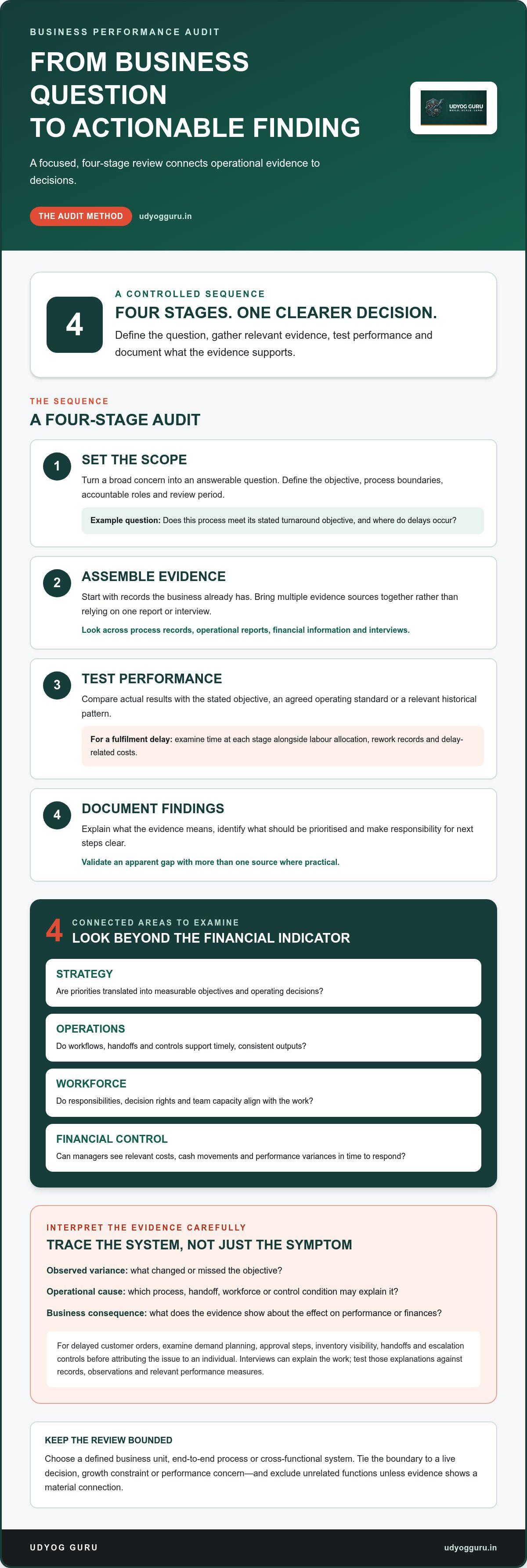
The focus is the system, not an individual. If customer orders are delayed, for example, examine demand planning, approval steps, inventory visibility, handoffs and escalation controls before attributing the problem to a person. Interviews can explain how work is performed, but test findings against records, process observations and relevant performance measures. This helps distinguish a recurring system weakness from an opinion or one-off event.
A practical scope map covers four connected areas:
- Strategy: Are priorities translated into measurable objectives and operating decisions?
- Operations: Do workflows, handoffs and controls support timely, consistent outputs?
- Workforce: Are responsibilities, decision rights and team capacity aligned with the work?
- Financial control: Can managers see relevant costs, cash movements and performance variances in time to respond?
This map helps prevent a narrow financial indicator from obscuring a process, workforce or control issue that may contribute to it.
What questions should a business performance audit answer?
Start with the decision the review needs to inform. Ask whether activities produce the intended outputs and outcomes, where time, capacity or resources are not supporting priority objectives, and whether managers can detect material deviations early enough to act. For instance, if a delivery target is being missed, compare planned and actual cycle times, locate delays between stages, and check whether reporting reveals the delay before it affects customers. Make each question specific enough to guide evidence collection.
Which parts of the business belong in scope?
Choose a defined business unit, end-to-end process or cross-functional system instead of trying to review everything at once. Map the relevant owners, handoffs, controls and reporting inputs from start to finish. A scope focused on order fulfilment might include sales commitments, inventory checks, dispatch and customer updates. Exclude unrelated functions unless evidence shows a material connection.
Then tie the boundary to a live decision, growth constraint or performance concern. State the period under review, the objectives being tested and what falls outside scope. A clear boundary keeps the diagnosis focused on evidence that can inform a decision, rather than producing an unstructured catalogue of observations.
How to Conduct a Business Performance Audit: A Four-Stage Method
A useful audit follows a controlled sequence: define the question, assemble evidence, test performance and document findings. Each stage narrows the gap between an operational concern and a decision. Before collecting information, identify the process or unit under review, the objectives being tested and a relevant review period. A defined period makes comparisons more meaningful and prevents the exercise from expanding into an unrestricted review of the entire business.
Stage one and two: Set the scope and assemble evidence
Turn the concern into an answerable question. Instead of asking why performance is poor, ask whether a defined process meets its stated turnaround objective and where delays occur. Record the objective, process boundaries, accountable roles, key handoffs and review period. Then gather existing records before requesting new reporting or interviews. This limits disruption and shows what the business can already measure.
Use evidence sources together, not in isolation. Process records can reveal queues or repeated rework; operational reports show volumes, timing and service levels; financial information can indicate cost or revenue implications; and interviews explain how the documented process works in practice. A diagnostic scan framework can help organise these connected dimensions, particularly when operations, workforce capacity and financial visibility intersect.
Stage three and four: Test performance and report findings
Compare actual results with the stated objective, an agreed operating standard or a relevant historical pattern. For example, if fulfilment takes longer than planned, examine processing time at each stage alongside labour allocation, rework records and costs associated with delays. Connect operational evidence to financial consequences without assuming one automatically explains the other. Where practical, validate an apparent gap using more than one source. A report and an interview that point to the same handoff issue provide a stronger basis for action than either alone.
Document each finding in a consistent format so decision-makers can distinguish evidence from interpretation:
- Condition: What the records or observations show.
- Objective: The target, standard or historical pattern used for comparison.
- Implication: The operational effect and, where evidence supports it, the financial effect.
- Likely cause: The process or control factor supported by the evidence, with uncertainties stated.
- Decision required: The next action or investigation needed, and the role responsible for it.
Keep conclusions proportionate to the evidence. If cost data is incomplete, report the operational variance and identify what information is needed to assess its financial impact instead of estimating an unsupported figure. This makes a business performance audit a decision tool, not merely a collection of observations. For a deeper look at structuring a diagnosis, use the business diagnostic scan framework. To connect diagnosis with implementation, explore Udyog Guru’s business transformation systems.
How to Interpret Audit Findings Without Mistaking Symptoms for Causes
An audit finding is not automatically an explanation. Separate three layers: the variance is what differs from the objective or baseline; the operational cause is the process, decision or control condition that may explain the difference; and the business consequence is the effect on capacity, cost, customer outcomes or another priority. Keeping these layers distinct prevents a visible metric from being treated as proof of its own cause.
For example, rising order delays are a symptom. Records may show that orders wait for inventory confirmation, while the wider consequence could include extra handling or delayed invoicing. Those consequences also need evidence. Compare performance with the organisation’s objectives, agreed service standards or relevant historical patterns. External benchmarks can provide context, but differences in scale, customer mix, process design or measurement definitions can make direct comparisons misleading.
How can an audit distinguish a root cause from a symptom?
Trace the workflow from inputs through handoffs and decisions to outputs. Check whether the pattern recurs across periods, teams or related processes, and look for a mechanism that plausibly links the suspected cause to the variance. If delays appear only in one team or after a specific approval step, that narrows the investigation. Record explanations that have not been tested as hypotheses, not established causes.
Use a compact evidence map to keep interpretation disciplined:
Symptom: Orders exceed the planned fulfilment time.
Evidence: Process timestamps show repeated waiting before inventory confirmation.
Possible cause: Stock information may not be available when the order reaches the confirmation step.
Follow-up test: Compare stock-record timing with order timestamps and observe the handoff across more than one operating period.
This structure makes clear what is known, what is inferred and what would strengthen or disprove the explanation.
How should conflicting or incomplete evidence be handled?
Identify records that are missing, delayed, inconsistent or defined differently across teams. Cross-check reports against process observations and the people responsible for the work, then state the confidence level and limitations. If sources conflict, investigate differences in timing, definitions or data capture before recommending a consequential change. A qualified conclusion is more useful than false certainty.
Prioritise findings using four considerations: likely business impact, urgency, evidence strength and the organisation’s capacity to respond. A high-impact issue supported by corroborating evidence may warrant immediate action; a plausible but weakly supported explanation may call for a focused test first. Capacity matters because an action that cannot be owned or sustained is unlikely to resolve the underlying condition. This ranking turns analysis into a defensible decision sequence without treating every variance as equally important.
Turn Business Performance Audit Findings Into an Improvement System
A validated finding has operational value only when it changes how work is controlled. Convert each finding into an action record that names the accountable owner, next step, review date and evidence that will show whether the response is working. The owner should be able to influence the process, not simply be held responsible for an outcome outside their control. This makes follow-through visible and keeps recommendations from remaining isolated in a report.
Separate the response into three time horizons. Containment limits an immediate issue, such as introducing a manual check while investigating a recurring handoff error. Process redesign addresses the workflow condition contributing to the issue, such as clarifying approval steps. System change establishes a durable operating control, such as a recurring exception review with a named decision-maker. Containment can reduce immediate exposure, but it should not be mistaken for a permanent fix.
How do you prioritize corrective actions?
Rank actions by likely business impact, urgency, dependencies and implementation effort. Address control gaps that could create material exposure before lower-impact refinements. Also check whether one system-level change could resolve findings that appear across several teams. If a constrained workflow is driving repeated delays, operational bottleneck analysis can help focus the response on the restriction instead of adding disconnected initiatives around it.
Make dependencies explicit. If a process redesign requires clearer role ownership or more reliable financial reporting, sequence those enabling actions before measuring the redesign’s full effect. A short action register can capture the finding, priority, owner, next step, dependency and review date. At each review, record whether the action is on track, blocked, completed or needs revision. This creates an operating control, not just a project list.
How do you keep improvements measurable over time?
For each action, record a baseline and select a small set of indicators: outcome measures showing whether the business objective is improving, and process measures showing whether the new control is being followed. Define the data source, review cadence and decision threshold in advance. A business performance metrics reference can inform indicator selection without turning the audit into a catalogue of measures.
For example, if a handoff redesign targets delayed orders, track the fulfilment outcome alongside a process indicator, such as the time orders wait at that handoff. Review both on the agreed date. If the process indicator improves but the outcome does not, investigate dependencies or other causes rather than declaring success prematurely. If the action is not being followed, examine whether ownership, capacity or the control itself needs adjustment.
A business performance audit becomes a repeatable improvement system when findings lead to accountable action, measured review and operating controls. To connect business diagnosis with structured implementation, explore Udyog Guru’s business transformation systems.
How Udyog Guru Connects Business Performance Diagnosis With Implementation
A business performance audit creates a basis for improvement, but the findings document is only a diagnostic output. Udyog Guru connects assessment with implementation through a defined pathway: identify relevant business-system gaps, select priorities tied to current objectives, then translate those priorities into operating actions. This keeps the work focused on improving how the system functions, with a route from findings to follow-through.
What does a structured diagnostic-to-implementation path involve?
The process begins with a defined business question and a structured assessment of the systems connected to it. Business X-Ray™ is Udyog Guru’s Tier 1 diagnostic offering, used to identify business-system gaps. Its findings help clarify which operating conditions need attention and where action should begin. Business Acceleration Engine™ is the Tier 2 offering focused on implementation, connecting selected priorities to practical changes instead of leaving them in a findings document.
The sequence matters. A diagnostic scan is a starting point, not a substitute for implementation. First establish the question and assess the relevant systems. Then use the evidence to determine which gaps are material and what changes should address them. If an action depends on work being performed consistently across people or teams, it may require a repeatable operating process, not just a one-time instruction. The business process systematization guide can help frame that transition from audit action to a defined, repeatable process.
For example, if an audit identifies inconsistent follow-up across a sales process, the next step is not simply to remind staff to follow up. Identify where the handoff breaks down, clarify the required steps and responsibilities, and establish how the process will be monitored. The implementation priority should address the diagnosed gap and provide a basis for reviewing whether the process is being followed.
When do workforce and financial systems belong in the audit?
Include workforce systems when evidence shows they affect the performance question. Workforce X-Ray™ is relevant when findings concern team performance, role clarity or delegation. Workforce Acceleration Engine™ supports workforce implementation. These systems bring people and responsibilities into the diagnosis and improvement path, especially when decisions or tasks are not moving clearly between roles.
Financial visibility also belongs in scope when owners need clearer insight into financial performance and control. The Financial Command Dashboard supports that visibility, helping connect financial information with the operating conditions under review. Financial and operational evidence can then be considered together: a process variance may have a cost implication, while financial reporting can help owners monitor relevant control points. Keep the scope tied to the decision at hand instead of expanding into unrelated measures.
Where relevant, diagnosis, workforce systems, financial visibility and implementation create a coordinated improvement path. The objective is not to deploy every system in every review. Match the evidence to the response, focus attention on the gaps that matter and establish processes that can be monitored as the business grows.
Make Your Next Performance Review Actionable
Start by choosing one business question that matters to current decisions and deciding how the answer will shape action. A business performance audit is most useful when its evidence informs a system change, with responsibility and follow-up built into the way work is managed. Treat the review as the start of a stronger operating discipline, not a one-time inspection.
Udyog Guru connects diagnosis with implementation through Business X-Ray™ (Tier 1) and Business Acceleration Engine™ (Tier 2). For businesses strengthening financial visibility and control, the Financial Command Dashboard supports that part of the system. Choose a starting point based on the gap your review identifies and the decisions you need to make next.
Explore Udyog Guru’s business transformation systems to build a structured path from diagnosis to action. With clear evidence and accountable follow-through, your business can approach its next stage of growth with greater visibility and control.
Frequently Asked Questions
Is a business performance audit the same as a financial audit?
No. A financial audit focuses on financial statements and whether they are fairly presented under the applicable accounting framework. A business performance audit examines how the organisation’s activities and systems contribute to its objectives. The two can inform each other: financial records may reveal a cost variance, while operational evidence can help explain the activity behind it. Neither review should be treated as a substitute for the other.
How often should a business conduct a performance audit?
There is no single frequency that suits every business. Set a review cadence based on how quickly processes change, how important the decision is and how often reliable data becomes available. A stable process may need less frequent in-depth review than a rapidly changing workflow. Reassess sooner after a major system change, persistent performance deviation or shift in business priorities, rather than waiting for a calendar date.
Who should participate in a business performance audit?
Include a decision-maker who can set the scope and act on findings, the process owner, relevant employees who perform the work and someone able to interpret the data. For a cash-flow visibility concern, participants might include leadership, finance and the roles responsible for invoicing or collections. Keep participation proportionate to the review. People should contribute evidence and process knowledge, not be treated as targets of a blame exercise.
Can a small business conduct its own performance audit?
Yes. A small business can review a clearly bounded process using records it already maintains, such as order logs, service tickets, schedules or expense reports. Write down the question, comparison criteria and review period before examining results. Because a small team may assess its own work, invite someone not directly responsible for the process to challenge assumptions and check that conclusions follow from the evidence.
What should a business performance audit report include?
A useful report identifies the decision the review supports, the boundaries and period examined, the criteria used and the evidence reviewed. It should distinguish verified observations from interpretations, note data gaps or limitations, and explain why each issue matters to the business. Include an action register with accountable roles and follow-up dates, as well as supporting references that allow another reader to trace how a conclusion was reached.
Does a performance audit guarantee improved business results?
No. An audit can clarify performance gaps and inform decisions, but it cannot guarantee that a corrective action will work or be implemented. Results depend on factors such as management decisions, available capacity, external conditions and whether the response addresses the underlying issue. Treat recommendations as actions to test and review: define what evidence would indicate progress, then adjust the response if the expected change does not appear.
How is a business performance audit different from a health check?
The terms can overlap, and “health check” has no single standard meaning across businesses. It often refers to a broad, quick scan of general condition, while an audit usually has a defined question, scope, evidence base and comparison criteria. For example, a health check might flag weak order fulfilment; a performance audit would examine the chosen workflow and supporting records to establish what needs investigation.


