

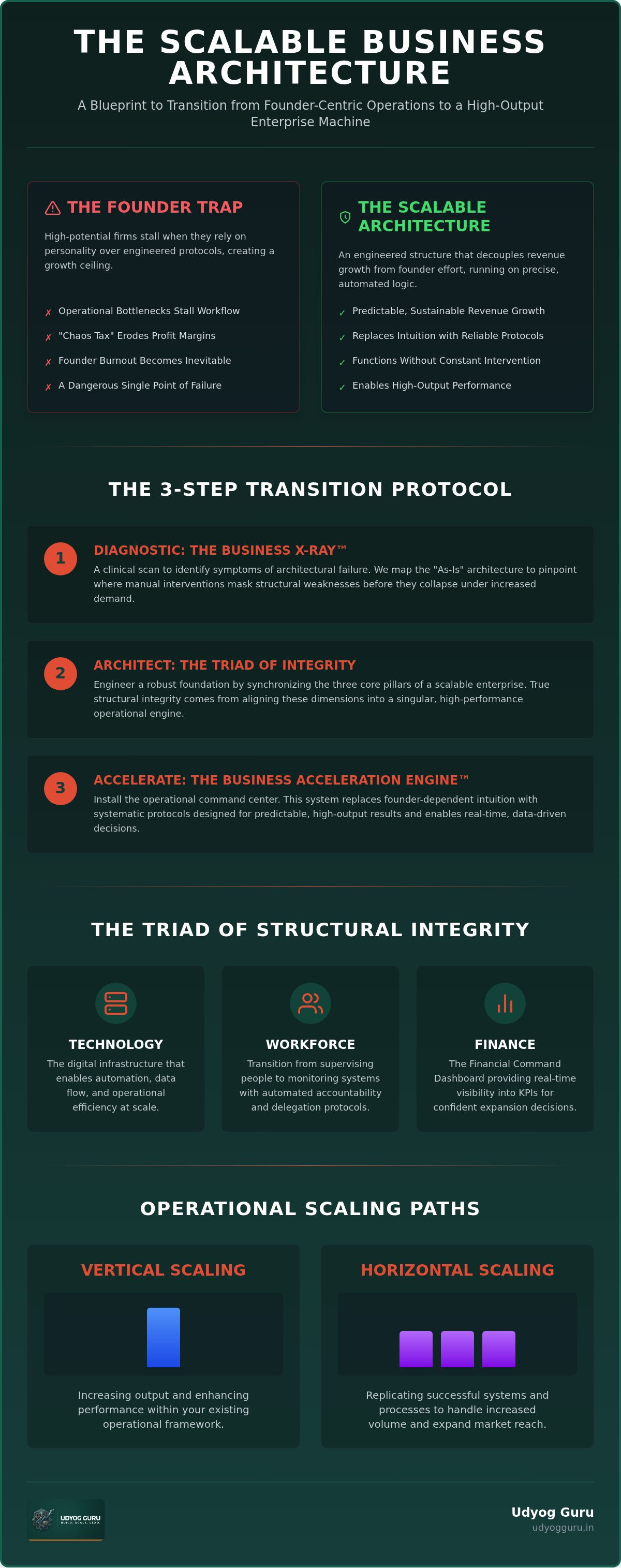
The most significant threat to your organization’s expansion in 2026 is not market volatility, but the structural fragility of founder-dependent operations. You likely feel the daily friction of operational bottlenecks where your personal intervention remains the only mechanism preventing systemic failure. It's a common diagnostic finding among growing firms: high-potential enterprises stalling because they lack a scalable business architecture capable of functioning without constant manual override. Relying on personality rather than engineered protocols creates a growth ceiling that no amount of founder effort can pierce.
This analysis provides the professional blueprint to transition your firm from a chaotic, founder-centric model into a high-output enterprise machine. You'll learn how to replace inconsistent team performance with predictable revenue growth by installing sustainable growth protocols. We will analyze the essential components of a modern command center, from the initial Business X-Ray™ diagnostic to the installation of a Business Acceleration Engine™. By the end of this guide, you'll understand how to achieve operational clarity and build a business that runs on precise, automated logic rather than intuition.
Key Takeaways
- Learn how to engineer a scalable business architecture that decouples revenue growth from founder effort by implementing modular, repeatable protocols.
- Identify the critical interdependence between technology, workforce, and finance to ensure your organizational machine maintains structural integrity during rapid expansion.
- Differentiate between vertical and horizontal operational scaling to determine the most efficient path for increasing output without compounding complexity.
- Master the implementation protocol, beginning with a diagnostic scan to expose architectural fractures before installing the Financial Command Dashboard for real-time visibility.
- Discover how the Business Acceleration Engine™ replaces founder-dependent intuition with a systematic protocol designed for predictable, high-output results.
Beyond Tactical Firefighting: The Diagnostic Need for Scalable Architecture
In the high-velocity environment of 2026, many SMEs remain trapped in a cycle of reactive management. They mistake increased activity for progress, yet their profit margins stagnate. True scalable business architecture is the structural engineering of an organization to ensure that as output increases, complexity and costs don't rise at the same rate. Without this foundation, growth becomes a liability rather than an asset. Tactical firefighting might solve immediate crises, but it fails to address the underlying infrastructure that supports long-term expansion.
Most businesses suffer from "Founder Trapped" syndrome, where every critical decision and operational pivot relies on a single individual's intuition. This creates a dangerous single point of failure. When the founder’s bandwidth is exhausted, the business stops growing. Transitioning from organic, personality-driven growth to engineered expansion is no longer a luxury; it's a survival requirement. Identifying structural fractures requires a business diagnostic scan to expose the hidden bottlenecks that prevent high-output performance.
The Business X-Ray™: Scanning for Operational Fragility
A clinical diagnosis must precede any attempt at scaling business systems. The Business X-Ray™ identifies symptoms of architectural failure, such as declining quality control and acute employee burnout. By mapping the "As-Is" architecture, we pinpoint where manual interventions mask structural weaknesses. This allows us to identify non-scalable processes that require immediate calibration before they collapse under increased enterprise demand, ensuring that every protocol is primed for modular growth.
The Scalability Ceiling: Why SMEs Plateau Without Structural Change
Every business eventually hits a scalability ceiling where personality-driven management fails to support enterprise-level volume. At this stage, the "chaos tax" erodes profit margins through communication redundancies and operational errors. In 2026 markets, operational opacity is a significant risk factor. Data silos prevent confident expansion decisions, forcing a permanent plateau. Overcoming this requires scalable business architecture that replaces founder intuition with disciplined, repeatable protocols that function independently of the founder's daily presence.
The Triad of Structural Integrity: Technology, Workforce, and Finance
Engineering a robust scalable business architecture requires more than a modular codebase or a new project management tool; it necessitates a synchronized triad of technology, workforce, and finance. While many organizations focus exclusively on software, true structural integrity comes from aligning these three dimensions into a singular operational engine. Relying on tech alone is a common failure point in a scaling a business strategy. If one pillar is weak, the entire structure risks collapse under the weight of increased market demand. It's about building a sustainable machine, not just purchasing a digital utility.
Workforce Architecture: From Delegation to Automated Accountability
The transition from a founder-led team to a self-correcting organization begins with the Workforce X-Ray™. This diagnostic tool audits team performance and alignment to identify human friction points that slow down the machine. By installing a Workforce Acceleration Engine™, we move from "supervising people" to "monitoring systems." We design protocols for automated delegation that remove the founder from the feedback loop. This ensures predictable team output that doesn't fluctuate based on individual moods or manual oversight, creating a workforce that functions as a high-output component of the larger scalable business architecture.
Financial Command Dashboard: The Architecture’s Control Center
The Financial Command Dashboard acts as the CPU of any scalable enterprise. It provides real-time visibility into essential metrics like customer acquisition cost (CAC), lifetime value (LTV), and burn rates. Without this level of fiscal transparency, expansion decisions are mere guesses based on outdated spreadsheets. A scalable architecture uses this real-time data to calibrate growth speed and ensure the business remains solvent while accelerating. If you can't see your fiscal health in a live environment, you aren't in control; you're just a passenger in a machine you don't understand.
AI Tech Integration: Modernizing the Operational Blueprint
Modernizing the blueprint in 2026 means moving beyond basic software toward AI-driven workflow automation. The AI Tech Business Integration Bootcamp protocols help eliminate repetitive manual tasks that drain executive resources. This allows the tech stack to grow horizontally, adding capacity without increasing maintenance overhead. Business owners seeking this level of precision often start with a Business X-Ray™ to map their current structural capacity. By building a tech stack that functions as connective tissue, you ensure that every digital tool contributes directly to the enterprise’s bottom-line efficiency.
Comparative Analysis: Vertical vs. Horizontal Operational Scaling
In the clinical assessment of enterprise growth, we must distinguish between vertical and horizontal scaling. Vertical scaling, often termed "scaling up," focuses on increasing the power of a single operational unit. In most SMEs, this unit is the founder. They attempt to handle more volume by increasing their personal working hours or refining their individual intuition. This approach is fundamentally non-scalable. Horizontal scaling, or "scaling out," involves adding discrete, identical modules to the organizational structure to handle rising demand. For an organization to survive the competitive pressures of 2026, it must transition to a scalable business architecture that prioritizes modularity over individual heroics. This shift requires the installation of a business growth framework designed for scientific replication rather than organic, erratic expansion.
The Limitations of Vertical Management
Vertical management creates a critical single point of failure. When an organization's capacity is tethered to a founder's bandwidth, it inevitably hits a growth ceiling. We identify this as the "Founder Bottleneck," a diagnostic symptom where the central executive becomes the primary operational constraint. In this model, every new client or project adds a direct burden to the founder, leading to diminishing returns on effort. Working harder is a linear solution to an exponential problem. It's a fragile architecture that lacks the structural integrity to support enterprise-level volume, eventually resulting in missed deadlines and a visible decline in service quality.
Designing Horizontal Operational Modules
The solution lies in engineering horizontal operational modules that function as plug-and-play departments. These units are built on Standard Operating Procedures (SOPs), which act as the mechanical blueprints for the organization. By defining exact protocols for every task, you ensure that team output remains consistent regardless of who is operating the module. This is the core of a scalable business architecture. The Business Acceleration Engine™ provides the necessary protocols to drive this modular growth, allowing the business to add identical service units or sales units as demand dictates. This method ensures that the cost of adding new capacity remains predictable and that the organization's complexity stays manageable, even as its market footprint expands.
Implementation Protocol: Transitioning to a Founder-Independent Architecture
Transitioning to a founder-independent organization isn't a single event; it's a systematic engineering project. It requires a tiered implementation protocol that moves the enterprise from individual intuition to structural predictability. This sequence ensures that the foundation is stable before we accelerate growth. To achieve a truly scalable business architecture, we follow a five-step installation logic:
- Step 1: Diagnostic Scan. We conduct a comprehensive Business X-Ray™ to map existing architectural fractures and identify where the current structure is under stress.
- Step 2: Visibility Installation. We install the Financial Command Dashboard to provide immediate operational visibility, ensuring every subsequent decision is backed by real-time fiscal data.
- Step 3: Protocol Development. We transform manual, erratic tasks into automated workflows by documenting exact operational blueprints.
- Step 4: Workforce Alignment. We re-engineer roles based on high-output protocols, ensuring team members are aligned with the machine’s requirements rather than personal preferences.
- Step 5: System Calibration. We implement continuous monitoring and AI-driven optimization to refine the machine's performance in real-time.
Removing Founder Dependency: The "Business Surgeon" Approach
To eliminate operational bottlenecks, you must identify "Critical Founder Points" (CFPs). These are specific nodes in your process where the system stalls without your personal intervention. A "Business Surgeon" approach involves excising these dependencies and installing systematic replacements. It requires a psychological shift from being an "Operator" to becoming a "Systems Architect." By establishing a chain of command that operates on data triggers rather than personal permission, you ensure the organization functions at peak capacity even in your absence.
AI-Driven Workflow Installation
The final phase of modernizing your blueprint involves installing an AI-driven automation layer. We prioritize high-frequency, low-complexity tasks for AI integration to free up human capital for high-value strategic work. Protocols from the AI Tech Business Integration Bootcamp help identify these automation opportunities across disparate business modules. We maintain a "low-code" tech architecture to ensure maximum agility, allowing the system to be recalibrated without extensive custom software development. This ensures your scalable business architecture remains responsive to market shifts throughout 2026.
If your current structure feels fragile under the weight of expansion, you should schedule a Business X-Ray™ to begin your diagnostic transition.
The Udyog Guru Methodology: Installing the Business Acceleration Engine™
Udyog Guru serves as the Systems Architect for the modern Indian SME, providing the rigorous engineering required to survive the operational volatility of 2026. We don't offer generic motivational coaching; we install a scalable business architecture that functions with mechanical precision. The Business Acceleration Engine™ is our proprietary protocol used to drive predictable, high-output growth. By treating your business as a solvable puzzle of logic and process, we replace erratic founder intuition with a calibrated operational machine that achieves total clarity and financial control.
The Tiered Transformation Roadmap
Our methodology follows a strict sequence of installation to ensure the foundation remains stable as we accelerate. This tiered approach prevents the structural collapse often seen in unengineered growth. The roadmap consists of three distinct phases:
- Phase 1: Diagnosis. We begin with a clinical examination using the Business X-Ray™ and Workforce X-Ray™. These tools map the current structural state and identify fractures before they cause systemic failure.
- Phase 2: Installation. We deploy the Business Acceleration Engine™ alongside the Financial Command Dashboard. This provides the enterprise with its central "CPU" for real-time fiscal control and operational visibility.
- Phase 3: Optimization. We implement the AI Tech Business Integration Bootcamp protocols. This phase automates high-frequency manual workflows, ensuring the system grows horizontally without increasing maintenance friction.
Securing Your Enterprise Legacy
Architectural integrity isn't just about daily efficiency; it's the primary driver of business valuation and exit readiness. An organization that runs on protocols rather than personality is significantly more attractive to investors because its results are repeatable and predictable. When your business functions as a well-oiled machine, you gain the peace of mind necessary to focus on high-level strategy rather than tactical firefighting. In 2026, the directive for any serious SME owner is clear. You must transition from the role of a frantic operator to a disciplined architect. By installing a scalable business architecture, you secure a legacy that is built to last, independent of your daily manual intervention.
Engineering Your Enterprise for 2026 and Beyond
The transition from a founder-led organization to a protocol-driven enterprise is a scientific necessity for survival in 2026. By engineering a robust scalable business architecture, you replace manual intervention with automated systems that maintain structural integrity during rapid expansion. We've analyzed how horizontal scaling and the triad of technology, workforce, and finance create a self-correcting machine. This shift allows you to move from tactical firefighting to strategic oversight, ensuring your business remains a high-value asset rather than a personal job.
Udyog Guru provides the national expertise and proprietary tools required to execute this transformation with clinical precision. Our tiered methodology, featuring the proprietary Business X-Ray™ diagnostic system and the Financial Command Dashboard, ensures you maintain real-time control over every operational node. You don't have to navigate this diagnostic project alone. Secure your enterprise legacy by installing the infrastructure needed for predictable, high-output growth. Begin your diagnostic journey with the Business X-Ray™ at Udyog Guru and build a machine that's engineered to scale.
Frequently Asked Questions
What is the primary difference between a business model and a scalable business architecture?
A business model defines the conceptual framework for how your organization creates and captures value. In contrast, scalable business architecture is the structural engineering that allows that value to be delivered at scale without operational collapse. While the model identifies the "what," the architecture provides the "how" through modular protocols. It functions as the mechanical blueprint that ensures your organization can handle 10x volume without a proportional increase in founder effort.
How do I know if my current business architecture is failing?
Symptoms of architectural fragility include chronic operational bottlenecks, declining service quality during peak demand, and acute founder burnout. If your personal intervention is required to resolve daily tasks or if team output fluctuates based on individual moods, your structure is failing. These fractures indicate that your growth is tethered to personality rather than predictable protocols. A Business X-Ray™ can diagnose these invisible points of failure before they lead to systemic collapse.
Can a service-based business implement a scalable architecture, or is it only for products?
Service-based enterprises absolutely require a scalable architecture to decouple revenue from billable hours. In these organizations, the "product" is the protocol itself. By modularizing service delivery through Standard Operating Procedures, you ensure consistent quality regardless of which team member handles the client. This transition allows service firms to scale horizontally, adding new service units to meet demand without exhausting the founder’s capacity or compromising the organization's reputation.
How much does it cost to install a Business Acceleration Engine™ protocol?
The investment required to install a Business Acceleration Engine™ protocol depends on the complexity of your current operational infrastructure and the diagnostic findings of your initial Business X-Ray™. We don't provide generic pricing because every installation is a precision engineering project tailored to specific structural needs. You should consult with a Systems Architect to determine the scope of repair and installation required to achieve your desired growth outcomes for 2026.
Will AI integration replace my workforce in a scalable architecture?
AI integration in a scalable business architecture is designed to augment human capacity, not eliminate it. We use AI to automate high-frequency, low-complexity tasks that currently drain your team’s executive resources. This realignment allows your workforce to focus on high-value strategic functions that AI cannot replicate. The goal is to build a high-output machine where human intelligence and automated protocols work in synchronized harmony to drive enterprise growth.
How long does the transition to a founder-independent architecture typically take?
The timeline for transitioning to a founder-independent architecture varies based on the volume of existing structural fractures. A typical phased implementation, moving from the initial diagnostic scan to the full installation of acceleration engines, often spans several months. This methodical pace ensures that each new protocol is calibrated and stable before the next layer is added. It's a progressive walkthrough of a blueprint rather than an overnight software switch.
Is a scalable architecture necessary for a small business with fewer than 10 employees?
Structural engineering is critical for small teams because they lack the resource redundancy of larger firms. Installing scalable protocols early prevents the "Founder Trapped" syndrome from taking root as you grow. If you don't build a modular foundation with five employees, you'll face exponential chaos when you reach twenty. Early adoption of a structured architecture ensures that every new hire is a plug-and-play component of an already efficient machine.
How does the Financial Command Dashboard differ from standard accounting software?
Standard accounting software records historical data, while the Financial Command Dashboard functions as a real-time operational CPU. It synthesizes fiscal data with performance metrics to provide a live view of your organization’s health. Instead of looking at last month's profit and loss statement, you monitor customer acquisition costs and burn rates as they happen. This transparency allows for data-driven expansion decisions rather than guesses based on outdated financial reports.


