
An AI business integration workshop should start by diagnosing a workflow, not by recommending a technology. A tool can be capable and still fail to solve the operational problem that matters. If you’re unsure which processes are suitable for AI, whether the necessary data is available, or how employees will use a new system, address those questions before choosing a tool.
A useful workshop turns operational needs into decisions and practical next steps, rather than leaving you with a list of interesting ideas. This guide explains what to assess, what a workshop should cover, and how to judge whether its recommendations are ready for further testing. You’ll learn how to compare opportunities by business value and feasibility, examine workflow and data requirements, account for employee adoption, and define priorities, ownership, and measures of success. For businesses looking for a structured path from diagnosis to integration, Udyog Guru’s AI Tech Business Integration Bootcamp focuses on embedding technology into existing workflows without custom software development.
Key Takeaways
- Use an ai business integration workshop to connect operational needs to suitable AI-enabled workflows, not simply to showcase tools.
- Map a real process step by step, then identify friction points, data requirements, and a measurable outcome before considering solutions.
- Evaluate tools alongside data sensitivity, access controls, human review, and clear ownership.
- Prepare participants with a specific workflow and relevant process information so discussion stays grounded in day-to-day operations.
- Turn the strongest opportunity into a bounded pilot with a named owner, success measure, human-check process, and review point.
What an AI Business Integration Workshop Should Actually Deliver
An ai business integration workshop examines business needs, identifies where AI-enabled workflows may help, and turns promising opportunities into prioritised decisions and next steps. It should begin with how work currently moves through the business, not with a preferred tool or a list of AI features.
This distinction matters. A product demonstration shows what a specific tool can do, while an introductory presentation explains general AI concepts. Neither necessarily determines whether a particular process is suitable. A useful workshop examines the work itself, identifies friction, and considers whether AI could address it within the organisation’s operational and data constraints.
Business process management offers a useful foundation for examining how processes are discovered, analysed, measured, and improved. The principles behind Diagnose Workflows help keep discussion focused on the sequence of work before considering automation.
Look for outputs that make the decision process clear: a prioritised set of use cases, a named owner or responsible role for each leading opportunity, unanswered questions about data and workflow fit, and a defined next-step decision. For example, a team might assess whether routine invoice classification is suitable for a test. It could record what information is available, where a person needs to review the result, and what must be investigated before proceeding. These are planning outputs, not evidence that implementation is complete.
Who benefits from an AI integration workshop?
Owners and operations leaders may benefit when repetitive work takes up staff time or a process breaks across disconnected systems and teams. A workshop can also help departments compare AI tools using shared criteria instead of individual preferences. Technical expertise can clarify feasibility, but people who understand the process are essential. They can identify exceptions, hand-offs, and the consequences of an incorrect result.
Workshop, training, or implementation: what is the difference?
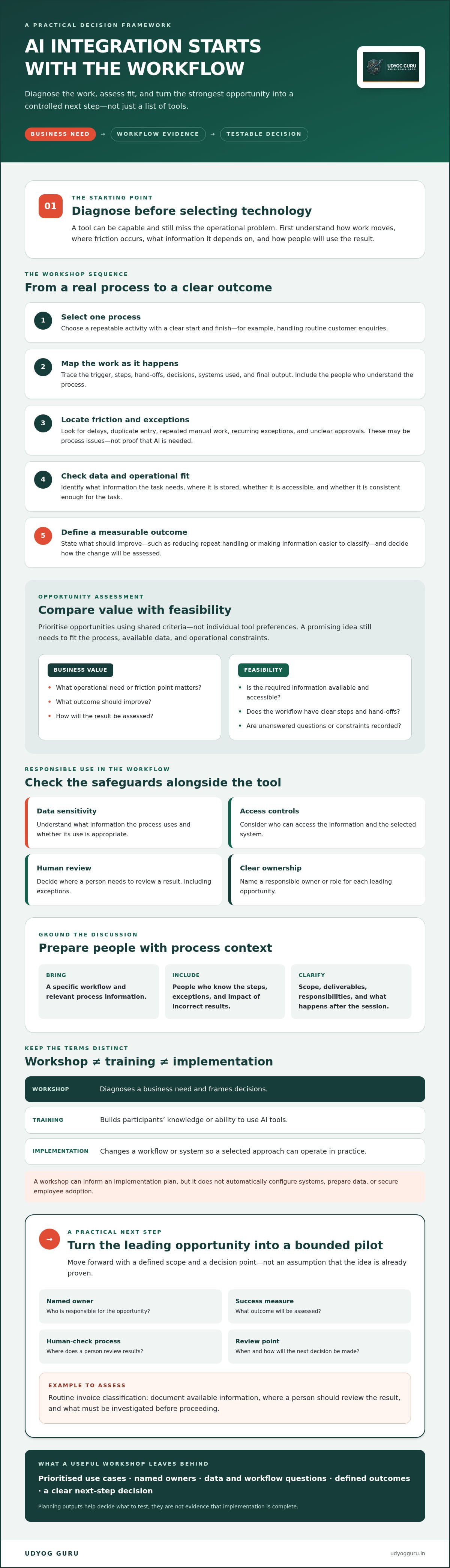
A workshop diagnoses a business need and frames decisions. Training builds participants’ knowledge or ability to use AI tools. Implementation changes a workflow or system so a selected approach can operate in practice. These activities may form a sequence, but they are not interchangeable. Before committing, ask the provider to specify the scope, deliverables, responsibilities, and what happens after the session. A workshop can inform an implementation plan, but it does not automatically configure systems, prepare data, or secure employee adoption.
For owners seeking a structured next step beyond diagnosis, Udyog Guru’s AI Tech Business Integration Bootcamp focuses on embedding technology and automation into existing workflows without custom software development. Ask about the programme’s format and deliverables to determine whether they match your needs.
Diagnose Workflows Before Choosing AI Use Cases
Start with work that happens frequently and follows a recognisable sequence, not with a tool you want to deploy. A process may be slow because of unclear approvals, missing information, or repeated hand-offs rather than a lack of AI. Identify these process issues separately from technology limitations before proposing automation.
Workflow diagnosis should come before AI tool selection because technology can only address the task it is given, not the underlying process defects. In an ai business integration workshop, use this sequence to identify where a solution could fit:
- Select one process. Choose a repeatable activity with a clear start and finish, such as handling routine customer enquiries.
- Map the steps. Record the trigger, hand-offs, decisions, systems used, and final output.
- Locate friction. Look for delays, duplicate entry, recurring exceptions, and avoidable manual repetition. These may point to operational bottlenecks, but do not prove that AI is needed.
- Assess the data. Check what information the process depends on, where it is stored, whether it is accessible, and whether it is consistent enough for the task.
- Define the outcome. State what should improve, such as reducing repeat handling or making information easier to classify, and decide how to assess the change.
Map the current process and its friction points
Trace one real workflow from beginning to end. For a customer enquiry, record how the request arrives, who reviews it, what information must be gathered, how it is routed, and what response closes the process. Ask staff where work waits, where details are entered twice, and which exceptions require judgement. A slow process may need clearer ownership or simpler steps rather than automation.
Test use cases for feasibility and business value
Compare candidate uses against four factors: expected usefulness, process stability, data availability, and the need for human review. Generative AI may assist with drafting or summarising; workflow automation may move information between existing steps; rules-based automation may suit consistent decisions with explicit conditions. Treat these as options to test, not assumptions about what will work. Florida International University’s guide discusses AI applications such as operational efficiency and process optimisation. Use that context to turn workshop findings into controlled AI implementation.
Record projected benefits as hypotheses. For example, a team might expect automated classification to reduce manual sorting, then check that expectation against real cases before expanding use. If you’re considering guided integration after diagnosing a workflow, review the AI Tech Business Integration Bootcamp, which focuses on embedding technology and automation into existing workflows without custom software development.
How to Evaluate Workshop Methods, Tools, and Governance
Evaluate a workshop method by asking what decision it helps your team make. A tool-led demonstration can be useful when you need to understand a specific feature or test whether it supports a known task. A workflow-led exercise is more useful when the problem, process, or best-fit technology is still uncertain. A strong ai business integration workshop explains the purpose of each activity instead of presenting a product showcase as a diagnosis.
Use the comparison below to check whether the workshop connects its activities to accountable decisions:
| Method | Purpose and inputs | Expected output | Risks to assess | Decision owner |
|---|---|---|---|---|
| Tool-led demonstration | Explore a specific capability using a defined task or sample input. | Initial view of task fit and questions for further testing. | A polished demo may not reflect real data, exceptions, or workflow constraints. | Process owner, with relevant technical input. |
| Workflow-led exercise | Examine process steps, friction points, data sources, and desired outcomes. | Prioritised opportunity and readiness questions. | Incomplete process information can produce weak recommendations. | Business or operations owner. |
| Approach comparison | Compare generative AI, rules-based automation, and existing software features against the task. | A reasoned option for further assessment, not a guarantee of results. | Integration effort and ongoing human oversight may be underestimated. | Business owner, informed by technical and risk reviewers. |
What should a workshop ask about data and risk?
Identify the data sources involved, known quality gaps, who can access them, and what information should not be shared with a proposed tool. Then decide how a person will check outputs before they affect a customer interaction or business decision. Governance needs depend on the organisation, data, and use case. Record legal, security, or compliance questions for review by qualified advisers rather than assuming a general workshop resolves them.
How can teams compare AI approaches responsibly?
Match the approach to the work. Generative AI may suit tasks involving drafting or summarising; rules-based automation may fit stable processes with explicit conditions; existing software features may address a need without adding another system. Ask what integration is required and what human oversight will remain. Treat accuracy, savings, and productivity projections as hypotheses until a suitable pilot tests them under real operating conditions.
Record the selected option, unresolved risks, responsible decision owner, and evidence needed for the next review in an AI implementation roadmap. This creates a clear link between workshop discussion and a controlled decision, without suggesting that the workshop itself completes implementation.
Plan an AI Business Integration Workshop Step by Step
A productive ai business integration workshop needs a defined decision, people who understand the process, and evidence from actual work. Use the following sequence to keep discussion focused and finish with a documented next-step plan, rather than an untested promise of results.
- Set the objective. Agree on the decision the workshop must enable, such as whether to test AI support for a specific workflow or first address a data-readiness issue.
- Select participants. Include the process owner and people who perform or oversee the work. Add technical or risk expertise where the use case requires it.
- Prepare one real workflow. Bring a process map or clear account of the steps, examples of routine cases, recurring exceptions, and relevant process information.
- Diagnose the process. Examine where work pauses, repeats, or requires judgement. Check available baseline measures, if any, and note gaps instead of filling them with assumptions.
- Prioritise and document. Compare candidate use cases, assign an owner to each leading option, and record the evidence or review required before action.
Prepare the right people, process, and evidence
Keep preparation proportionate. A team assessing enquiry handling could bring representative requests, current routing steps, examples of exceptions, and any available information about response or rework. Participants should agree in advance on the decision the session needs to support. That makes it less likely the discussion will stay at the level of general AI concepts without resolving an operational question.
Prioritise use cases and document decisions
Use a simple scorecard to compare options consistently. Qualitative ratings such as high, medium, or low can reveal trade-offs, provided the team records its reasoning.
| Criterion | Diagnostic question |
|---|---|
| Business relevance | Does the use case address a defined operational need? |
| Feasibility | Are the workflow and required information sufficiently understood? |
| Risk | What data, review, or governance questions remain? |
| Ownership | Is a responsible person available to lead validation? |
Close by recording the selected opportunity, assumptions, unresolved questions, owner, and proposed validation step. Separate options that are ready for an initial experiment from those that need further data or governance review. This gives the business a practical basis for improving the process and deciding what should happen next.
For a structured programme focused on embedding technology and automation into existing workflows, explore Udyog Guru’s AI Tech Business Integration Bootcamp.
Turn Workshop Findings into Controlled AI Implementation
A workshop finding becomes useful when someone can test it safely and judge the result. Move one prioritised use case into a bounded pilot: define the workflow and users in scope, specify what the AI-enabled approach may and may not do, and set conditions for pausing or changing the test. Expand to other processes only when the evidence supports that decision.
Controlled pilots turn AI assumptions into evidence, giving businesses a firmer basis for deciding whether to adjust, stop, or scale an approach. Before testing begins, document four controls:
- Owner: Name the person responsible for coordinating the pilot and resolving issues.
- Success measure: Choose a small set of workflow-specific measures, such as output quality, completion time, exception frequency, or staff effort.
- Human check: Specify who reviews outputs, what they check, and when a result must be corrected or escalated.
- Review point: Set a date or defined checkpoint to assess evidence and decide whether to continue, revise, or stop.
Measure whether an AI workflow is working
If a baseline is available, record it before the pilot so the team can compare like with like. For a test involving classification of incoming requests, for example, track classification quality, cases needing correction, time to complete the task, and reviewer workload. Choose only measures relevant to the process. A faster step may not be a better outcome if errors or extra checks increase.
Review results alongside user experience and exceptions, not just the headline measure. Interpret findings carefully because outcomes depend on the workflow, data quality, implementation, and measurement method. A pilot provides evidence about the conditions tested, not a guarantee that the same result will apply to other teams or processes.
When does a structured integration programme make sense?
A structured programme may suit owners who have identified a relevant workflow and need guidance on integrating technology into existing operations. Udyog Guru’s AI Tech Business Integration Bootcamp focuses on embedding technology and automation into existing workflows, with an aim to automate repetitive tasks without custom software development. Before deciding whether it fits, clarify the programme’s format, delivery, and participant deliverables.
If that scope aligns with your needs, review the AI Tech Business Integration Bootcamp as a possible next step from diagnosis toward practical integration. Confirm what guidance and outputs are included, who is responsible for implementation, and what your team must provide. The right programme should match the business’s readiness and workflow, not create an obligation to pursue every idea raised during an ai business integration workshop.
Make Your Next AI Decision Evidence-Led
A useful ai business integration workshop starts with the work itself, identifies where AI may fit, and turns promising use cases into controlled next steps. Workflow diagnosis helps distinguish process issues from technology opportunities. Clear ownership, human review, and measurable criteria make it possible to assess a pilot before deciding whether to expand it.
If your business needs a structured path from workflow assessment to integration, Udyog Guru’s Tier 3 AI Tech Business Integration Bootcamp focuses on embedding technology into existing workflows and automating repetitive tasks without custom software development. Review the programme’s scope and deliverables to decide whether it aligns with your operational needs.
Explore Udyog Guru’s AI Tech Business Integration Bootcamp to consider a practical next step toward well-governed AI adoption.
Frequently Asked Questions
What is an AI business integration workshop?
An AI business integration workshop is a structured session for examining business workflows, identifying suitable AI opportunities, and deciding what to validate next. It should begin with operational needs rather than a catalogue of tools. Formats and deliverables vary, so check whether the session includes workflow diagnosis, use-case prioritisation, governance questions, and a documented follow-up plan. A workshop guides decisions; it does not automatically implement a solution.
Who should attend an AI integration workshop?
Include the business owner or decision-maker, the person responsible for the selected process, and employees who understand its daily steps and exceptions. Technical or data expertise can also help if the workflow depends on existing systems or information sources. Keep the group focused enough to make decisions, but broad enough to reflect how the process operates. Without input from people doing the work, important hand-offs and exceptions may be missed.
What should an AI business integration workshop include?
A practical workshop should set a clear objective, examine a real workflow, identify friction and data needs, compare possible AI approaches, and prioritise use cases. It should also address risks, human review, ownership, and validation. Before committing, ask what participants will leave with. Useful outputs may include a documented shortlist of opportunities, readiness questions, assigned responsibilities, and next steps. Be cautious if the agenda focuses mainly on tool demonstrations without examining your process.
How do I choose an AI use case for my business?
Start with a repeatable process that has a clear owner and an observable outcome. Document its steps, inputs, exceptions, and current friction before considering technology. Then assess whether relevant data is available, whether a person can review outputs, and whether the likely operational value justifies a test. Treat projected benefits as assumptions, not results. A bounded experiment can help establish whether the approach works under actual workflow conditions before you expand it.
Is a workshop the same as AI training or implementation?
No. A workshop typically examines business needs and helps prioritise decisions. Training builds participants’ knowledge or skills, while implementation changes systems or operating processes. Providers may combine these activities, but the terms are not interchangeable. Before booking, confirm the agenda, delivery scope, participant responsibilities, and what support, if any, follows the session. This helps match your expectations to what the provider includes, rather than assuming a planning discussion will also install a solution.
Can a business integrate AI without custom software development?
Some workflows may use existing tools, built-in automation features, or configurable services, while others may need technical changes. Fit depends on the process, systems, data, and required controls. Udyog Guru’s AI Tech Business Integration Bootcamp focuses on embedding technology into existing workflows and automating repetitive tasks without custom software development. Check whether the programme’s scope and deliverables suit your requirements, since the same integration approach will not fit every workflow.
How do you measure the results of an AI integration workshop?
Measure changes tied to the selected workflow, such as completion time, error frequency, exceptions, or human review requirements. Record an available baseline before testing and define the measurement period and review method in advance. A workshop itself does not guarantee business results. Assess pilot evidence against the original objective, then decide whether to revise, stop, or expand the approach. Consider quality and staff experience alongside speed so that improvement in one measure does not obscure new problems elsewhere.


