

What if rising revenue still left you uncertain about cash, margins, or the next decision? That gap may mean your financial reporting isn’t yet giving you a usable control system. For CEOs, ceo financial control systems should do more than collect figures. They should reveal changes early, connect them to accountable owners, and prompt timely action.
Financial reports should clarify the business. But when they arrive late, measures lack clear ownership, or review and escalation routines are undefined, growth can obscure operational risk rather than resolve it. A dashboard alone won’t fix those conditions. Control depends on measures, processes, people, and decisions working together.
This practical framework for 2026 explains how to establish that structure: choose decision-relevant indicators, assign responsibility, set review rhythms and escalation rules, and improve data quality as the business grows. It also explains where a tool such as Udyog Guru’s Financial Command Dashboard may fit, without replacing accounting or management judgment. The aim is a reliable view of financial health that helps you see what is changing and decide who should act.
Key Takeaways
- Effective ceo financial control systems connect reliable records to useful measures, review routines, and accountable follow-up.
- Trace the five system layers from source records to action logs, with clear responsibility at each handoff.
- Assess reports and dashboards by whether they support a defined decision, not simply by how much financial information they display.
- Build controls in sequence: diagnose current records, define what matters, assign owners, establish reviews, and improve the process.
- Consider how the Financial Command Dashboard may fit within a wider financial-control approach, without treating it as a substitute for accounting or management judgment.
What CEO Financial Control Systems Actually Control
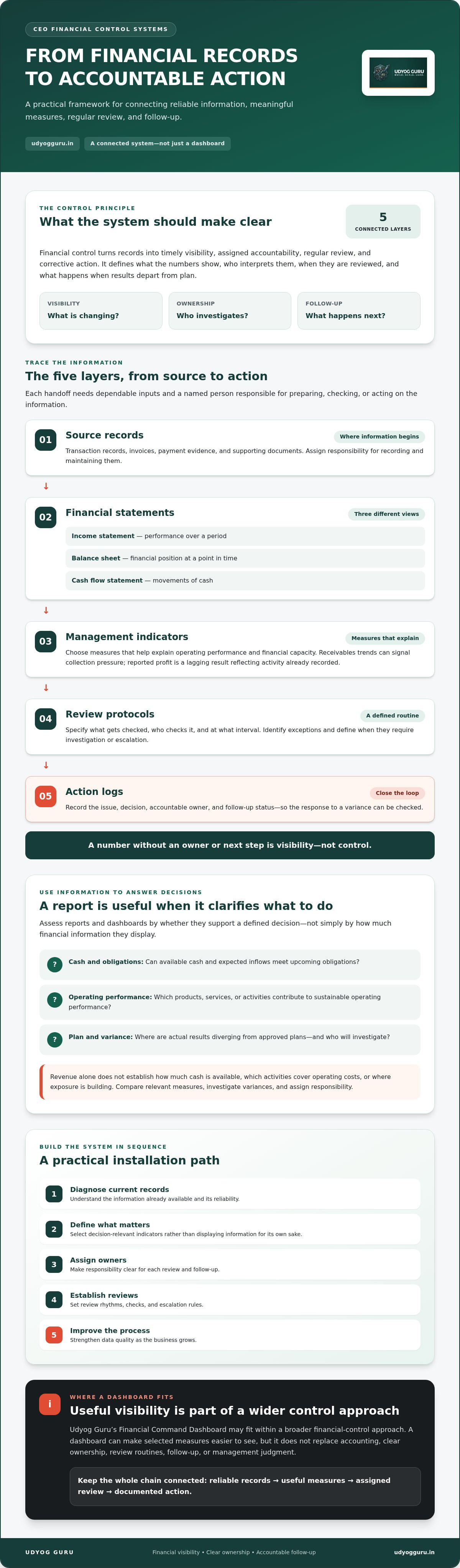
Definition: CEO financial control systems are connected routines that turn financial records into timely visibility, assigned accountability, regular review, and corrective action. They establish not only what the numbers show, but who interprets them, when they are reviewed, and what happens when results depart from plan.
This is broader than bookkeeping, which records and classifies transactions, and annual reporting, which presents financial information for a defined period. A dashboard can make selected measures easier to see, but viewing it without an owner, review routine, or follow-up decision is not management control. The wider idea of an internal control framework also helps distinguish reliable information from the processes that use it to support organisational objectives.
Revenue alone is an incomplete signal. A business may record sales while customer payments are still outstanding, so reported growth doesn’t establish how much cash is available for upcoming obligations. Revenue also doesn’t show, by itself, which activities cover their operating costs or where financial exposure is building. A useful control routine compares relevant measures, identifies variances, and assigns someone to investigate them.
What questions should a CEO financial control system answer?
At minimum, it should help decision-makers establish whether available cash and expected inflows can meet upcoming obligations, which products, services, or activities contribute to sustainable operating performance, and where actual results are diverging from approved plans. For each variance, define the next step: determine its cause, name the person responsible for investigating it, and decide whether action or escalation is required.
Who needs financial control beyond the CEO?
Different roles need different levels of detail. A founder may need a concise view of cash, performance, and material risks. A finance lead, where one exists, may examine the underlying records and explain variances. Operational managers need measures relevant to the areas they influence, along with clear limits on the decisions they can make.
The CEO shouldn’t become the sole control point. Assign each review and follow-up to a named role, even if one person in a small or medium-sized business handles several responsibilities. For example, a manager responsible for an operating area can investigate an unfavourable variance and bring its cause and proposed response to the appropriate review. The structure can remain lean: clear ownership, dependable information, and a defined route for decisions matter more than having a dedicated finance department.
The Five Layers of an Effective CEO Financial Control System
Effective ceo financial control systems connect the origin of a number to the decision it should inform. Each layer needs reliable inputs and a named person responsible for preparing, checking, or acting on the information. Without those links, errors can travel forward unnoticed, and useful signals can arrive without a clear response.
- Source records: Transaction records, invoices, payment evidence, and other supporting documents establish where financial information begins. Assign responsibility for recording and maintaining them.
- Financial statements: The income statement shows performance over a period; the balance sheet presents the business’s financial position at a point in time; and the cash flow statement tracks cash movements. Each answers a different management question.
- Management indicators: Select measures that help explain operating performance and financial capacity. Receivables trends can signal collection pressure, while reported profit is a lagging result that reflects activity already recorded.
- Review protocols: Define what gets checked, by whom, and at what interval. The routine should identify exceptions and establish when they require investigation or escalation.
- Action logs: Record the issue, decision, accountable owner, and follow-up status. This closes the loop between identifying a variance and checking whether the response occurred.
Reliable financial controls require meaningful measures and assigned responses. A number without an owner or next step is visibility, not control.
Which financial statements and operating signals belong in the system?
Use the statements together rather than treating any one as a complete diagnosis. The income statement helps assess whether operations generated a profit or loss over a period. The balance sheet helps examine what the business owns and owes at a specific date. The cash flow statement helps explain how cash moved. Working capital adds a practical view of short-term operating capacity by focusing attention on timing across items such as receivables, inventory, and payables.
Choose additional indicators according to the business model and decisions at hand. A service business and a product business may need different operating signals. Neither should adopt a metric simply because it appears on a standard dashboard. Set thresholds using the organisation’s own plans, obligations, and risk tolerance, rather than relying on generic industry benchmarks.
How do ownership and review protocols make controls usable?
For each measure, document a preparer, reviewer, decision owner, and review interval. The same person may hold multiple roles in a small business, but the responsibilities should remain explicit. Record checks for reconciliations, approvals, exceptions, and action follow-up so that a missed check or unresolved variance has a clear escalation path.
For organisations assessing how diagnostics and implementation can support stronger routines, Udyog Guru’s systems implementation approach may be relevant.
Why Financial Reports and Dashboards Alone Do Not Give CEOs Control
Visibility is necessary, but it doesn’t create control by itself. A report can summarise activity, and a dashboard can display selected measures, yet neither establishes whether the data is dependable, who must investigate an exception, or what decision follows. Without those steps, a polished view can create confidence without giving leaders a reliable basis for action.
| Tool | Purpose | Owner and cadence | Expected outcome |
|---|---|---|---|
| Report | Record or summarise financial activity | Prepared by an assigned person at a defined reporting interval | Information for review |
| Dashboard | Display selected measures for visibility | Maintained and checked according to the data source and update cycle | A view that may highlight changes or exceptions |
| Control system | Connect measures to review, decisions, and follow-up | Named preparer, reviewer, and decision owner, with an agreed cadence | Investigation, response, and documented follow-through |
Three defects can undermine the signal. Stale data may hide a developing issue; unclear definitions can make people compare figures that don’t mean the same thing; and unassigned exceptions can leave a variance visible but unattended. A tool cannot guarantee financial accuracy. Data needs appropriate checks, consistent definitions, and human interpretation before it informs a management decision.
What can a dashboard show, and what must a CEO still decide?
A dashboard may organise information for easier review, but leaders still need to validate what the figures represent, interpret changes in context, prioritise important issues, and choose a response. Its usefulness depends on sound underlying data, stable definitions, and an update frequency suited to the decision. Udyog Guru’s Financial Command Dashboard is a named offering. Confirm its specific data sources and capabilities rather than assuming them.
How can a growing business keep controls proportionate?
Start with essential transaction checks, clear approvals, and a dependable process for identifying and resolving exceptions. Add deeper analysis or automation when transaction volume, delegation, or decision risk makes manual routines insufficient. Controls should grow with the operating system, not precede a diagnosed need. A business diagnostic scan framework can help readers consider broader operational diagnosis alongside financial visibility.
How to Install CEO Financial Control Systems in a Practical Sequence
Install ceo financial control systems around decisions the business needs to make, not around a software purchase. Start with the records already available, identify where information fails to support a decision, then build a small review cycle before extending the process across teams. Each step should produce a usable output:
- Diagnose: Map a priority decision to the information it requires, the records currently used, the people responsible, and any reporting delays. Output: a short list of control gaps and their causes.
- Define: Select decision-relevant measures and document what each means, where its data comes from, and how it will be checked. Output: a consistent measure definition and source record for each priority decision.
- Assign: Name who prepares the information, reviews it, owns the resulting decision, and records follow-up. Output: clear responsibility at each handoff.
- Review: Run a pilot cycle with a limited set of measures and participants. Check whether information arrives on time, exceptions are understood, and actions are completed. Output: a tested review protocol and action log.
- Improve: Correct weak definitions, delayed inputs, or unclear escalation paths before extending the process. Output: a refined routine ready to scale where needed.
How should a CEO diagnose current financial control gaps?
Begin with a decision that matters to the business, such as whether to commit to a planned expense or investigate an unexpected variance. Trace the required information back to its source, then note who prepares it, who checks it, when it becomes available, and what happens if it is incomplete. Look for recurring reconciliation issues, missing reports, and exceptions that remain unresolved. If a financial delay points to an operational cause, use an operational bottleneck diagnosis to examine where the process is slowing down.
How should the review cadence and escalation rules be established?
Set review frequency according to the urgency of the decision, transaction patterns, and how quickly dependable information is available. A review is useful only if its inputs are ready and someone can act on the findings. Document who investigates a variance, who approves a response, how the decision is recorded, and who confirms closure. Set escalation thresholds for the company’s own operating context, and validate them with the responsible finance professional rather than adopting generic benchmarks.
Keep the pilot narrow enough to inspect closely, but complete enough to test the full path from source information to follow-up. Once roles and routines work reliably, extend them to other decisions. To learn more about a structured diagnostic and implementation approach, review Udyog Guru’s business systems programs.
How Udyog Guru Can Support a More Systematic Financial Control Approach
A financial control framework identifies the routines a business needs. Implementation starts by diagnosing which parts are missing, unclear, or disconnected from decisions. Udyog Guru provides structured business diagnostic and systems implementation programs. Its Business X-Ray™ and Business Acceleration Engine™ are part of that broader approach to identifying operational gaps and implementing systems. This can help a company examine its financial visibility and operating routines before deciding what to prioritise, rather than treating a dashboard or software purchase as the entire solution.
The diagnostic step matters because the same symptom can have different causes. A delayed decision may stem from late source information, unclear responsibility for preparing a report, inconsistent review practices, or a missing escalation route. Identifying the underlying gap helps leaders sequence improvements around their actual operating needs.
Where does the Financial Command Dashboard fit in the control architecture?
The Financial Command Dashboard is a named Udyog Guru offering that may form part of a broader approach to financial visibility. Consider its role alongside source information, review routines, and management decisions, not as a replacement for them. Before assessing fit, confirm which data sources, measures, integrations, and reporting capabilities it supports. A dashboard doesn’t replace accounting expertise, validation of financial information, or the CEO’s responsibility to interpret results and decide what action to take.
The distinction is structural: a tool can present information, while the wider control approach defines who checks it, how often it is reviewed, and how a decision is followed through. Those responsibilities should remain clear regardless of the technology used.
What should a CEO prepare before exploring implementation support?
Gather the materials and routines that show how financial information currently moves through the business. A concise preparation set can include:
- Current financial reports and the records used to prepare them.
- Recurring review practices, including who attends and what decisions are made.
- Role assignments for preparing, checking, interpreting, and acting on information.
- Known control gaps, such as delayed reporting, repeated reconciliation issues, or unresolved exceptions.
- Decisions that lack timely or trusted financial information.
This evidence gives a diagnostic process a clearer starting point and helps distinguish urgent gaps from improvements that can wait. It also supports a proportionate discussion about priorities, responsibilities, and the systems needed to put them into practice.
If your business is assessing how to strengthen its ceo financial control systems, you can review Udyog Guru’s business systems approach and consider whether structured support fits your company’s situation.
Build Financial Control Around the Decisions Ahead
Strong ceo financial control systems connect dependable information with clear ownership and timely follow-through. The practical test isn’t how much data a business can display. It is whether leaders can spot a meaningful change, determine who should investigate it, and make a considered decision.
Start with the information your most important decisions require, then strengthen the routines that prepare, review, and act on it. Keep controls proportionate to your business, and refine them as responsibilities and operating complexity grow. Technology can support visibility, but it works within a wider system of sound records, defined measures, and management judgment.
Udyog Guru brings business diagnostic and implementation programs together, and offers the Financial Command Dashboard as one part of a broader approach. A clear diagnosis can help you identify what your company needs before deciding how to strengthen its financial control routines.
Frequently Asked Questions
What is a CEO financial control system?
A CEO financial control system links financial information to regular reviews, clear ownership, and corrective action. It helps leaders understand what the figures indicate, who should investigate an exception, and how the response is tracked. Bookkeeping records and classifies transactions, providing an essential foundation, but it doesn’t establish management review or action by itself. The control system connects those records to decisions and follow-through.
Why does a CEO need financial controls if the business already has an accountant?
An accountant can help maintain or interpret accurate financial records, while management oversight connects those records to ongoing business decisions. A CEO still needs to understand relevant changes, assign responsibility for investigating them, and decide when action is needed. How these responsibilities are divided depends on the company’s size, structure, and accounting arrangements. The aim isn’t to duplicate accounting work, but to make sure useful financial information reaches the right decision-makers.
Which financial reports should a CEO review regularly?
Consider the income statement, balance sheet, and cash flow statement together. The income statement summarises performance over a period, the balance sheet shows financial position at a particular date, and the cash flow statement tracks cash movement. Select additional reports according to the decisions leaders need to make, such as investigating a change in costs or assessing cash availability. Confirm that each report uses dependable information and consistent definitions before relying on it.
How often should a CEO review business finances?
There isn’t one review schedule that suits every business. Set the cadence according to cash needs, transaction patterns, how quickly reliable reports can be prepared, and the risks attached to delayed decisions. A time-sensitive cash decision may call for more frequent visibility than a measure used for longer-term planning. Define when information is prepared and reviewed, then adjust the routine if reports arrive too late or emerging exceptions remain unnoticed.
Can a dashboard replace a financial control system?
No. A dashboard can make selected information easier to view, but it doesn’t automatically confirm that the underlying data is accurate or consistently defined. It also doesn’t assign someone to investigate an exception, approve a response, or check that follow-up is complete. Treat a dashboard as one possible visibility tool within a wider control system. Its value depends on reliable inputs, appropriate review routines, and management decisions.
What should a small business do first to improve financial control?
Start by mapping one important business decision to the information needed to make it. Identify the current source records, who prepares and checks the information, how long reporting takes, and which exceptions remain unresolved. This diagnosis can reveal whether the gap involves missing records, unclear ownership, or delayed review. Use what the business already has before selecting new tools, then prioritise improvements that address the identified decision gap.
How can a CEO identify gaps in financial controls?
Trace an important decision from the source data through review, approval, action, and documented closure. At each step, ask who is responsible, what check is performed, and what happens when information is late or a result differs from expectations. Repeated reconciliation issues, unclear approvals, and open exceptions can indicate weaknesses in the process. For technical accounting questions, seek review from a qualified accounting professional rather than relying on a management process alone.
To explore structured support for diagnosing and implementing business systems, contact Udyog Guru through its business systems approach.


