

A report that doesn’t change a decision is an inventory of numbers, not a management system. Effective data driven business management connects evidence to a specific choice, assigns responsibility for the next action, and checks whether the action changed the outcome.
Spreadsheets and dashboards can show what happened, but not necessarily what to do next. When teams track activity without connecting it to business outcomes, managers must fill the gaps with instinct or incomplete information. The issue isn’t always a lack of data. Often, it’s the missing process between measurement and action.
This article explains how to build that process. You’ll learn how to choose evidence for a decision, check whether the data is reliable, and establish a review cycle with clear ownership and follow-through. It also shows how to connect operational indicators with financial performance, so findings across the business contribute to a coherent view. The result is a practical framework for more consistent decisions and stronger accountability, without adding another disconnected report.
Key Takeaways
- Use data to guide, explain, and review decisions, while keeping human judgment in the process.
- Match evidence to the decision, then check that the data is complete, consistent, timely, and clearly owned.
- Interpret metrics in context: leading indicators can inform action, while lagging indicators show what has already happened.
- Make data driven business management repeatable with a review cycle that defines the question, assigns an action owner, and sets a follow-up point.
- Use diagnostic findings to identify structural gaps before setting priorities for wider operational change.
What Data-Driven Business Management Means, and What It Does Not
Business records become useful when they help managers answer a defined question, explain the reasoning behind a choice, and assess what happened after action was taken. Data-driven business management is the disciplined use of relevant evidence to guide, explain, and review business decisions, while keeping people accountable for the judgment and action involved.
This doesn’t mean replacing experience with spreadsheets. Experience helps managers frame questions and interpret evidence; records help test whether an explanation fits what happened. The aim is a traceable decision process, not a larger pile of reports.
Disconnected reports can hide how work moves between functions. A sales report may show orders booked, a delivery log may record dispatch delays, and a financial statement may show the resulting cash position. Without a shared question and clear ownership, managers see separate outcomes but can miss where performance changed, who can act, or what contributed to the problem. Foundational practices such as data quality and governance are covered in Data management.
How evidence changes a management decision
Start with the decision, then select evidence that can inform it. “Improve operations” is too broad to test. Asking whether dispatch delays cluster around a particular process gives the team a more focused investigation.
Hypothetical example: recurring delivery delays
- Observed fact: Dispatch records show that orders repeatedly leave later than scheduled.
- Interpretation: The pattern may point to a bottleneck before dispatch.
- Assumption to test: Staff may be waiting for order details or stock confirmation.
- Decision: The manager reviews hand-offs, assigns an owner to test a revised confirmation step, and checks whether dispatch timing changes.
The records reveal a pattern, not its cause. Investigate the process before treating an interpretation as fact or making a permanent change.
Common misconceptions about managing by data
Misconception: better decisions require new software. Useful evidence can come from existing sales records, delivery logs, customer-service notes, or financial statements. First check whether those records are relevant and dependable. Technology alone cannot fix a poorly framed question or incomplete source data.
Misconception: data removes human responsibility. It doesn’t. Evidence informs judgment, but managers remain responsible for weighing context, considering operational constraints, and explaining the decision. Accountability means recording who will act and what outcome will be reviewed, not attributing the choice to a metric.
Misconception: a dashboard is the management system. A dashboard or analytics tool can organise information, but it doesn’t decide which issue matters, interpret conflicting signals, or assign follow-through. The management system is the sequence of question, evidence, judgment, action, and review. Tools support that sequence; they don’t replace it.
Build a Reliable Evidence Base Before Drawing Business Conclusions
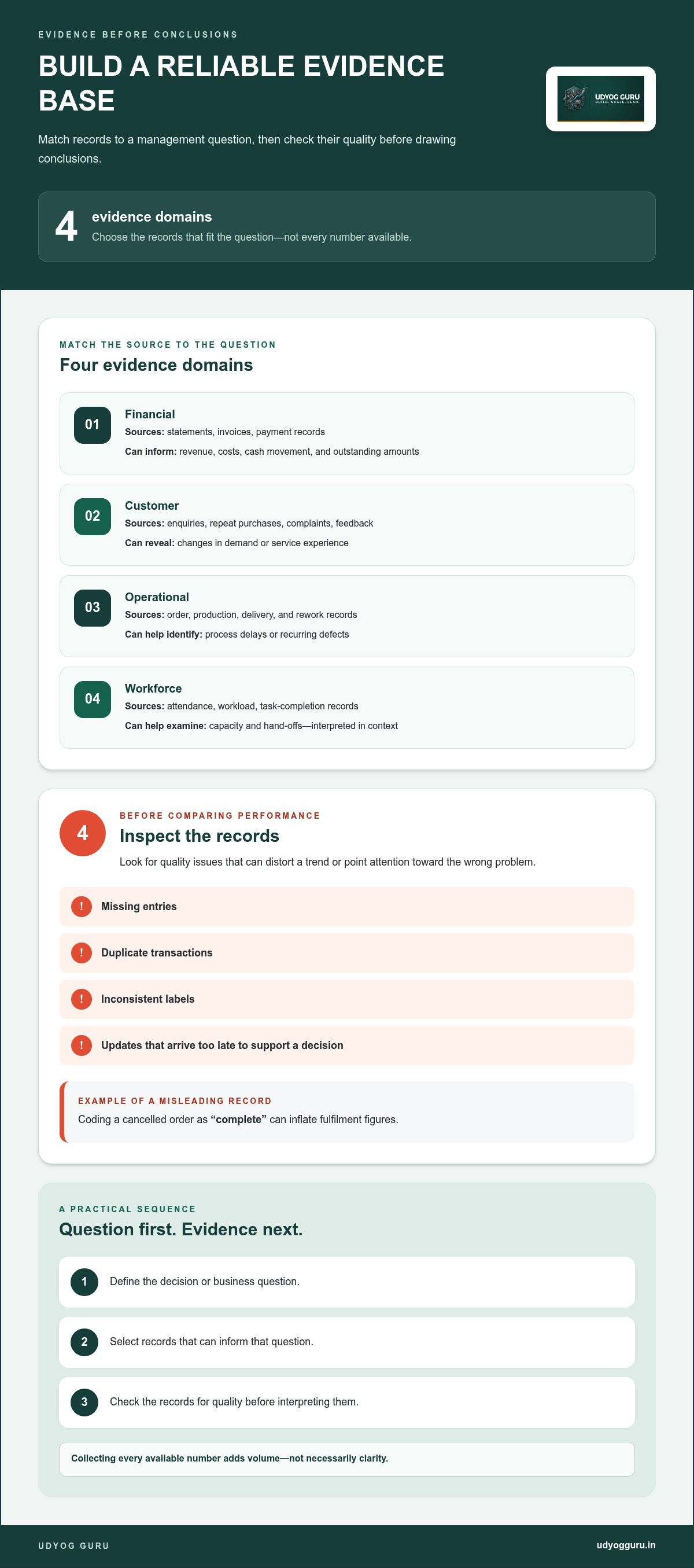
A conclusion is only as dependable as the records behind it. Before comparing performance or changing a process, identify the decision under review and choose evidence that can inform it. Collecting every available number adds volume, not necessarily clarity.
Unreliable inputs produce unreliable conclusions, even when the analysis looks precise. Missing transactions, shifting definitions, or records updated at different times can distort a trend and draw attention to the wrong operational issue. Check the evidence before interpreting it.
Match each source to a management question
Translate the decision into a question first. If you need to know whether sales growth is converting into cash, financial statements and payment records are more relevant than a general activity count. If the concern is delayed fulfilment, delivery logs and order records can help locate where the process slows. Choose sources that fit the question.
Sort evidence by what it can help assess:
- Financial: Statements, invoices, and payment records can inform questions about revenue, costs, cash movement, and outstanding amounts.
- Customer: Enquiries, repeat purchases, complaints, and feedback can reveal changes in demand or service experience.
- Operational: Order, production, delivery, and rework records can help identify process delays or recurring defects.
- Workforce: Attendance, workload, and task-completion records can help managers examine capacity and hand-offs, provided they are interpreted in context.
For a deeper method of selecting measures that reflect business outcomes, see this business performance metrics guide. A metric is useful only when its definition and source fit the decision being examined.
Check data quality and interpretation limits
Inspect records before comparing them. Look for missing entries, duplicate transactions, inconsistent labels, and updates that arrive too late to support a decision. For example, coding a cancelled order as “complete” can inflate fulfilment figures. Different spellings of the same category can also split one pattern across several labels.
For each measure, record four controls: the source system or document, the person responsible for maintaining it, the reporting period, and the exact definition. Define terms such as “completed order” or “customer complaint” before comparing teams or months. Keep periods and cut-off dates consistent. Comparing fully updated records for one month with records that are still being updated for another can create a false impression of change.
Good data quality doesn’t remove uncertainty. A relationship between two measures may be coincidental, and a small sample may not represent the wider pattern. Treat these as limits on interpretation, and investigate further before claiming cause or applying a broad fix. In data driven business management, disciplined diagnosis helps protect decisions from false precision.
When evidence points to structural gaps across functions, Business X-Ray™ provides a diagnostic framework to examine the business before setting implementation priorities.
Turn Business Data into Decisions Without Mistaking Metrics for Answers
A metric describes what has been measured; it doesn’t explain why a result changed or what management should do. Interpretation requires context: the process behind the number, the period covered, and the customer or business conditions surrounding it. In data driven business management, metrics are signals to investigate, not verdicts.
Leading indicators can inform action before an outcome is complete. For example, enquiry response time may help a team spot a potential issue in its sales process. Lagging indicators, such as completed sales or repeat purchases, show outcomes that have already occurred. Using both can help managers act early and then check whether the expected result follows.
Interpret trends in context
Compare like with like. Review consistent time periods and relevant business segments, such as product categories or customer groups, instead of relying only on an overall average. Before attributing a change to a team or process, check whether seasonality, a process change, or an unusual event may have affected the result.
If delays recur across a workflow, investigate where work accumulates before assigning a cause. This operational bottleneck analysis can help structure the investigation. The metric indicates where to look; operational evidence and customer context help explain the pattern.
| Decision stage | Example | Management use | Risk of misreading |
|---|---|---|---|
| Evidence | Repeat purchases declined in one customer segment. | Identify where the change occurred. | Assuming the decline applies to every customer. |
| Interpretation | The decline coincides with a change in service process. | Investigate whether the change is relevant. | Treating timing as proof of cause. |
| Decision | Review the process with affected customers and staff. | Gather context before making a broader change. | Changing the entire process based on limited evidence. |
| Risk review | Track the same segment using the same measure. | Assess whether the decision altered the signal. | Comparing inconsistent periods or definitions. |
Choose between action, further analysis, and monitoring
Evidence doesn’t always call for immediate intervention. Match the response to the strength of the pattern and the consequence of being wrong:
- Act when evidence is relevant and the step is reversible. Define what result would support continuing or changing the action.
- Analyse further when uncertainty remains high or the decision could materially affect customers, finances, or operations. Seek a second source or examine the pattern by segment.
- Monitor when a change is isolated and no consistent pattern has emerged. Set a review point instead of reacting to one observation.
Evidence-based management doesn’t require managers to ignore experience. Experience can suggest plausible explanations, while customer feedback may reveal issues a summary metric misses. The discipline is to test those insights against evidence, distinguish what is known from what is inferred, and retain responsibility for the final decision.
Install a Repeatable Data-Driven Management Review Cycle
A review creates value when it turns a finding into owned action and checks what happened next. Without that final step, teams may revisit the same issue without learning whether their decisions changed the operating condition.
A reliable management cycle turns a clear question and relevant evidence into an owned decision, a defined action, and a scheduled review of the result. This makes data driven business management repeatable: managers can see what was decided, who is responsible, and what evidence will inform the next decision.
- Define the question. State the decision in terms that can be answered. For example, ask whether a hand-off process contributes to missed dispatch commitments, rather than asking generally how to improve operations.
- Inspect the evidence. Choose records relevant to the question, check their limits, and note the period covered. Separate confirmed observations from explanations that still need testing.
- Decide. Record the response and why it fits the evidence, uncertainty, and operating context. If the evidence is inconclusive, specify what information is needed before committing to a change.
- Assign the action. Name one accountable owner, set a deadline, and state the expected signal of progress. For instance, a dispatch lead may own a revised hand-off check, with fewer orders missing scheduled dispatch as the signal to review.
- Review. Set a follow-up point that gives the action time to take effect and produces relevant evidence. Compare the observed signal with the expectation, then decide whether to retain, revise, or stop the action.
Convert findings into accountable actions
Document each decision in a compact action record: the finding, action, accountable person or role, deadline, expected outcome, and review date. Define the evidence that would indicate progress before implementation begins. This prevents teams from changing the success measure after results appear and clarifies which process step is changing. A business process systematization framework can help connect review decisions to documented operating procedures.
Set the review frequency according to the pace and risk of the process. A fast-moving operational issue may need an earlier check than a decision whose effects emerge gradually. Review often enough to detect meaningful change, but not so often that normal variation triggers unnecessary adjustments.
Review outcomes and refine the system
At follow-up, compare the outcome with the expected signal without assuming the action caused every change. Note other process changes or operating conditions that may have influenced the result. Retain the action when evidence and context support it, revise it when the signal is mixed, or stop it when it isn’t suitable. Record the reasoning so the next review can build on what the team learned.
For a structured approach to management diagnosis and implementation, explore Udyog Guru’s systematic business frameworks.
Scale Data-Driven Business Management into an Operating System
Informal reviews can work when decisions stay within one team. They become less reliable when sales, delivery, workforce capacity, and cash flow affect one another. A change in order volume, for example, may affect workload, dispatch performance, and the timing of customer payments. If each function reviews a separate report on a different schedule, managers may see local results without understanding the wider effect.
At this stage, data driven business management needs an operating structure: shared definitions, connected review responsibilities, and a clear path from diagnosis to implementation. The aim isn’t to track every activity. It’s to make evidence for important cross-functional decisions visible and interpretable.
Connect management evidence across business functions
Operational, workforce, and financial signals answer different questions, but their meaning may depend on one another. Delivery records can show whether fulfilment is slowing; workforce information can help assess available capacity; financial records can show how operational changes relate to cash movement. Reviewing these views together helps managers investigate trade-offs instead of optimising one function at another’s expense.
For instance, faster order processing may look positive until managers check whether rework or customer complaints also changed. The important question is how the process performs across relevant outcomes, not whether one isolated measure improved. A scaling a business framework can provide broader context for aligning operating structures with growth.
Udyog Guru’s Financial Command Dashboard supports financial control and operational clarity. Use it as a source of financial visibility within the decision system, not as a substitute for understanding how business functions interact.
Move from diagnosis to structured implementation
When evidence reveals a recurring gap, diagnose the system before choosing a fix. The pattern may point to unclear process ownership, a weak hand-off, limited visibility, or another structural issue. Treating the first visible symptom as the root cause can lead to an implementation that misses the underlying constraint.
Udyog Guru’s Business X-Ray™ is a diagnostic system, and the Business Acceleration Engine™ provides an implementation framework. This diagnosis-before-implementation sequence connects findings to priorities, helping changes address identified business needs rather than assumptions. When technology integration is a defined requirement, the AI Tech Business Integration Bootcamp focuses on integrating technology into existing workflows.
To move from disconnected reviews toward structured diagnosis and implementation, explore Udyog Guru’s business transformation systems.
Make Your Next Management Decision More Deliberate
The next step isn’t to measure more. Choose one consequential decision that currently relies on fragmented information, then identify what evidence would clarify the choice and how to assess the outcome. That gives data driven business management a practical starting point: decisions become traceable, responsibilities visible, and learning cumulative.
When the challenge extends beyond one decision, Udyog Guru’s Business X-Ray™ supports diagnosis, while the Business Acceleration Engine™ provides an implementation framework. The Financial Command Dashboard supports financial control as part of broader management visibility. Identify the structural need first, then align implementation to it. A focused starting point can reveal where information, authority, or process design breaks down, without pushing for broad change before the evidence supports it.
Explore Udyog Guru’s structured business transformation systems to identify a disciplined next step for your business. Better management doesn’t require perfect information; it requires a clear question and the resolve to act on evidence. Build from there.
Frequently Asked Questions
Is data-driven business management suitable for a small business?
Yes. A small business can start with records it already maintains, such as daily sales, stock purchases, or customer enquiries. For example, an owner deciding what to reorder can compare recent sales with current stock before committing cash to inventory. The goal isn’t to copy a large company’s reporting structure. Make one recurring decision more consistent, then expand the approach when it provides useful operational clarity.
Can a business make data-driven decisions when its records are incomplete?
Yes, if the decision accounts for the uncertainty. For a low-risk choice, an owner might use available records alongside direct observation, then limit the action until more evidence is available. For a decision with substantial financial or customer impact, identify which records are missing and whether another source can fill the gap. Mark conclusions based on incomplete information as provisional, rather than presenting them as established facts.
Do business owners need special software to manage using data?
No. A spreadsheet or well-maintained set of existing records may be enough for a straightforward decision, such as checking which services generate repeat enquiries. Keep the format simple enough for staff to update correctly, and make the source of each entry clear. Consider dedicated analytics software only when manual consolidation creates a real obstacle, such as conflicting versions or delays that prevent timely decisions.
Does data-driven management mean intuition should be ignored?
No. Experience can help an owner notice a change before it appears in a monthly report, especially when customer conversations or staff observations reveal friction. Treat that signal as a reason to investigate, not as proof. If customers mention confusion about a service step, for example, review the relevant enquiries and speak with the team handling it. Combining operational evidence with informed judgment produces a more defensible decision.
How can a business prevent teams from collecting data that nobody uses?
Give each measure a clear management purpose: name the decision it informs and the person who will use it. If a weekly count of unprocessed enquiries has no owner and doesn’t inform a sales or service decision, stop collecting it or redefine its purpose. Review the measures whenever priorities change. This keeps reporting focused on information that supports actual choices, rather than activity collected simply because it is easy to count.
Can artificial intelligence make business management data-driven automatically?
No. AI may help organise records or surface patterns, but it can’t ensure that source information reflects the business accurately or that a suggested action fits the context. If a tool groups customer feedback, for example, a manager should inspect sample comments and check whether the categories make sense before changing a service process. Define who reviews AI-generated findings, what evidence supports action, and where human approval is needed for consequential decisions.


