

Growth doesn’t create operational chaos; it exposes gaps that were manageable at a smaller scale. If routine approvals still return to you, work quality depends on who handles it, and each new hire adds coordination, you don’t need more complexity. You need to systematize business for growth by aligning recurring work, decision rights, and performance signals in one operating system.
You already know consistency matters. The challenge is building enough structure to make work easier to delegate without burying the business in procedures, meetings, or software. Effective systems clarify how work gets done, who can make which decisions, and when managers need to intervene.
This article shows how to build those foundations: identify the operational gaps, standardize high-frequency workflows, set clear ownership and decision boundaries, and establish visibility that supports deliberate growth. The progression is diagnosis first, then repeatable execution, a framework reflected in Udyog Guru’s Business X-Ray™ and Business Acceleration Engine™ systems.
Key Takeaways
- To systematize business for growth, connect workflows, decision rights, accountability, and performance information instead of treating each as a separate fix.
- Prioritize recurring work by frequency, business impact, failure risk, and how much it depends on the owner.
- Use a focused implementation sequence: select one constraint, map the work, assign ownership, test the process, and review what needs adjustment.
- Keep the first system narrow enough to test while protecting day-to-day delivery.
- See how Business X-Ray™ diagnosis and Business Acceleration Engine™ implementation, alongside workforce systems, relate to operational clarity and delegation.
What Does It Mean to Systematize a Business for Growth?
To systematize a business for growth is to make recurring work, ownership, decisions, and feedback repeatable, so execution doesn't depend on one person's memory or constant intervention. A system connects these elements: a task has a clear trigger, an owner understands the expected result, decision limits are defined, and feedback shows whether the work is performing as intended.
Systematization is the design of repeatable operating conditions that allow a business to grow without making every result depend on the founder. It doesn't mean removing judgement from work. It means clarifying what should happen routinely, who is accountable, and which exceptions need escalation. The underlying Business Process is more than a sequence of tasks: it includes the people, handoffs, decisions, and information needed to produce an outcome consistently.
This is why an operating system is not simply a folder of procedures or a set of software tools. A document can describe a task, and an app can record it, but neither ensures that someone owns the result or that problems reach the right decision-maker. A functioning operating system links guidance to daily work and uses feedback to identify where the design needs adjustment.
How Can You Tell When Growth Is Outpacing Your Operating Model?
Look for patterns rather than isolated errors. A single missed handoff may be an exception; repeated delays at the same approval point suggest a structural bottleneck. Duplicated work, inconsistent customer experiences, and routine questions escalating to the owner are also signals that responsibilities or decision boundaries are unclear.
As volume rises, these gaps multiply: more requests pass through the same unclear handoff, and more employees need answers from the same decision-maker. The visible symptom may be a late delivery or rework, but the underlying weakness may be an operating model that relies on informal knowledge.
Does Systematization Mean More Rules and Paperwork?
No. A useful system reduces ambiguity by specifying the action, accountable owner, decision limits, and conditions that require an exception. Documentation earns its place only when it helps people perform work, make decisions, or correct a recurring failure. Length is not a measure of control; clarity is.
For example, a routine customer enquiry can have a clear owner, a standard response path, and a defined point for escalation when the request falls outside agreed limits. That concise guidance supports consistent handling without scripting every conversation or creating paperwork no one uses.
The Operating Architecture Behind a Systematized Business
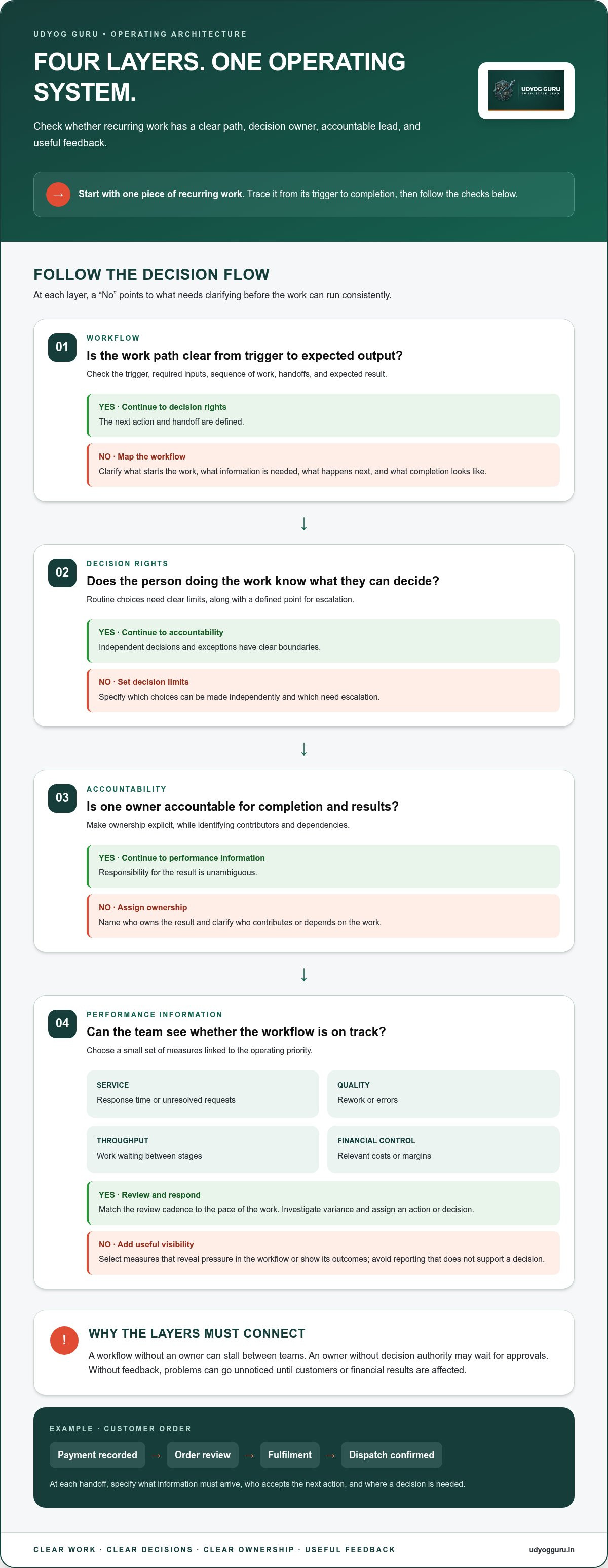
A business operating system has four connected layers: workflow, decision rights, accountability, and performance information. Each layer answers a different operational question: What happens next? Who can decide? Who owns the result? How will the team know whether the work is on track?
- Workflow: Defines the trigger, required inputs, sequence of work, handoffs, and expected output.
- Decision rights: Clarifies which choices employees can make independently and which require escalation.
- Accountability: Assigns ownership for completion and results, while identifying contributors and dependencies.
- Performance information: Shows whether the workflow is producing the required service, quality, throughput, or financial result.
These layers depend on one another. A workflow without an owner can stall between teams. An owner without decision authority may wait for approvals. And without feedback, managers may not discover that a handoff is creating delays until customers or financial results are affected. Aligned operating layers turn individual effort into repeatable execution, with clear responsibility and timely feedback at every handoff.
How Do Workflows and Decision Rights Fit Together?
Trace a piece of work from its trigger to completion. For example, a customer order may begin when payment is recorded, move from order review to fulfilment, and end when dispatch is confirmed. At each handoff, specify what information must arrive, who accepts the next action, and where a decision is needed. Then set decision limits, such as which routine order changes a team member can approve and which exceptions need a manager. A RACI matrix can help clarify who is responsible, accountable, consulted, and informed, but the essential requirement is unambiguous ownership.
This design prevents a common failure: installing a task-management tool while leaving approval authority undefined. The tool may display a pending task, but it cannot determine whether the employee has authority to resolve it. Technology can support the operating logic; it cannot replace it.
What Should Teams Measure to Keep Systems on Track?
Choose a small set of measures linked to the operating priority. For service, monitor response time or unresolved requests; for quality, track rework or errors; for throughput, examine work waiting between stages; for financial control, review relevant costs or margins. Leading signals, such as a growing queue or rising rework, indicate pressure inside the workflow. Lagging outcomes, such as customer complaints or reduced margin, show the effects after they have accumulated.
Set a review cadence that matches the pace of the work. The purpose isn't to produce more reports; it's to identify a variance, determine its cause, and assign an action or decision. Without a review and an owner for follow-up, measurement becomes passive reporting rather than operational control. A financial view, such as Udyog Guru’s Financial Command Dashboard, can complement workflow information by connecting operating activity with business performance. For businesses assessing how diagnosis and implementation can work together, Udyog Guru’s business systems provide a relevant starting point.
What Should You Systematize First for Sustainable Growth?
Start with work that happens repeatedly and has a meaningful effect on customers, delivery, quality, or cash flow. The objective isn't to document every activity. It's to identify which recurring workflow creates the greatest constraint when volume rises, then address the cause rather than treating each delay or error as a separate incident.
Compare potential workflows using four diagnostic criteria:
| Criterion | Diagnostic question | Suitable first action |
|---|---|---|
| Frequency | Does this work recur often enough that small inefficiencies accumulate? | Standardize the routine steps and handoffs. |
| Business impact | Does it affect customer experience, delivery, quality, or financial priorities? | Clarify the expected result and how it will be checked. |
| Failure risk | Do errors or omissions create rework, delays, or avoidable service problems? | Define required inputs, checkpoints, and exception handling. |
| Owner dependence | Does progress stop when one person is unavailable or must approve routine work? | Assign an owner and define decision boundaries. |
Use the criteria together, not as isolated scores. A frequent task with little business impact may be a lower priority than a less common handoff that repeatedly delays delivery. Where the constraint is difficult to locate, a structured operational bottleneck diagnostic protocol can help direct attention to the point where work accumulates or decisions stall.
Which Business Processes Offer the Highest Leverage?
Prioritize processes that combine repeat frequency with visible consequences: customer onboarding that produces inconsistent experiences, order fulfilment that creates recurring delays, or approvals that keep work dependent on one individual. Examine customer impact, rework, waiting time, and concentration of knowledge. These signals help distinguish a process that merely feels inconvenient from one that restricts delivery or makes growth harder to manage.
Should You Document, Delegate, or Automate the Work?
Choose the intervention that addresses the diagnosed weakness. Document when execution varies and people need a shared reference. Delegate when ownership is concentrated and a manager or team member can act within clear limits. Consider automation only after the workflow and its exception rules are stable enough to repeat; otherwise, automation can reproduce confusion faster.
These are different interventions, not competing labels for the same fix. A recurring customer update may first need a standard message and owner; routine approval can then move to that owner within defined boundaries. Automation may be appropriate later if the steps are predictable. To systematize business for growth, correct the operating constraint before adding tools or documenting work that doesn't need control.
How to Systematize Your Business: A Practical Implementation Sequence
Build the operating change in a controlled sequence, beginning with a real constraint rather than an idealized process. A narrow pilot lets the team test new responsibilities and handoffs under normal conditions while protecting core delivery. This makes it easier to see whether the design works before extending it to other workflows.
- Select one constraint. Choose a recurring issue that affects delivery, quality, customer experience, or management capacity. Define the specific problem the change should address, such as work waiting for an avoidable approval or repeated rework at a handoff. Keep the initial scope contained to one workflow or team.
- Map how the work happens now. Trace the workflow from its trigger to completion, including actual handoffs, decisions, delays, and exceptions. Record the current method, not just the intended one. This reveals where informal knowledge or workarounds are compensating for a process gap.
- Assign ownership and boundaries. Name the person accountable for the workflow and clarify who completes each stage. Set out which decisions the owner can make independently, what information must pass between roles, and which exceptions need escalation. Explain why the change is being made and what will remain each employee’s responsibility.
- Test the proposed method. Put the revised steps into use on a limited basis without changing unrelated work. Let affected employees know where to find the guidance, how to report an unclear handoff, and whom to contact if an exception affects delivery. Record what happens, including cases the design doesn't cover.
- Review and adjust. Compare actual performance with the intended service, quality, or efficiency measure. Look for recurring delays, confusion, or unnecessary steps. Correct the design before expanding it, then communicate any changes so the team is working from the same operating method.
How Do You Pilot a New Operating System Without Disrupting Work?
Select one repeatable workflow with visible impact and a clearly named process owner. Test the proposed steps during normal operating conditions, while keeping existing delivery responsibilities in view. Record exceptions as evidence, not as automatic reasons to abandon the design. Ask the people doing the work where instructions, inputs, or handoffs remain unclear, then refine those points before broader adoption.
How Should You Review and Improve the System?
Set a review cadence that reflects how often the workflow runs and the consequences of failure. Compare results with the intended measure, then decide whether the cause is unclear guidance, an ownership gap, an impractical decision limit, or a change in operating conditions. Revise only where evidence supports it, and make the updated method visible to everyone affected.
A structured business diagnostic scan can help clarify which operating constraint to address before implementation begins. To systematize business for growth with a diagnosis-led approach, explore Udyog Guru’s business transformation programs.
How Udyog Guru Helps Turn Business Systems Into Growth Capacity
Building operating discipline requires two connected capabilities: identifying which parts of the business need attention and translating those priorities into practical systems. Udyog Guru’s Business X-Ray™ and Business Acceleration Engine™ support this progression, moving from diagnosis toward structured implementation without treating growth as a guaranteed result. The focus is on making the operating model clearer, so leaders can address gaps in execution, team responsibility, and management visibility.
From Business Diagnosis to an Installed Growth System
Business X-Ray™ provides a diagnostic starting point for examining operating gaps and priorities across the business. This helps distinguish a high-impact constraint from a surface-level symptom, such as repeated delays that may stem from unclear ownership or an approval bottleneck. Business Acceleration Engine™ then provides an implementation system for translating priorities into structured business systems, so identified changes can be put into practice and reviewed. For a closer look at the process-level principles involved, explore this business process systematization framework.
The value of this sequence is its logic: diagnosis informs what to address, and implementation focuses attention on how the operating model should change. Without that connection, businesses can adopt tools or introduce procedures that don't resolve the underlying constraint. A systematized approach instead ties operational priorities to defined ways of working, ownership, and review.
Where Workforce, Financial Control, and AI Fit
Business systems depend on people knowing their roles and having appropriate authority to carry out the work. Workforce X-Ray™ and Workforce Acceleration Engine™ relate to workforce analysis and implementation, supporting clearer consideration of team performance, delegation, and execution. These tools fit into the broader operating structure: role clarity matters most when responsibilities connect to real workflows and decision boundaries.
Financial visibility adds another management input. The Financial Command Dashboard supports visibility and financial control, helping leaders use financial information when assessing business activity and making decisions. It informs management; it doesn't guarantee growth or replace judgement about priorities, capacity, and risk.
Technology belongs in the same architecture, but it should follow operating logic rather than substitute for it. The AI Tech Business Integration Bootcamp is focused on embedding technology into existing workflows. That distinction matters: AI can support defined work, but unclear responsibilities or inconsistent process design still require operational attention.
If you're assessing how to systematize business for growth, consider beginning with diagnosis and a defined implementation priority. Explore Udyog Guru’s business transformation systems as a considered next step in building more deliberate operating capacity.
Build the Next Stage on Clear Operating Priorities
The next step doesn’t need to be a full-scale redesign. Choose one operational question that matters now: where is growth creating friction, and what would help the team handle that work with greater clarity? A focused answer gives you a practical starting point and keeps system changes connected to the needs of the business.
For leaders ready to systematize business for growth, Udyog Guru’s Business X-Ray™ diagnostic system and Business Acceleration Engine™ implementation system provide a structured path from identifying priorities to putting systems into practice. Workforce and financial-control tools can also inform how responsibilities and business visibility fit into that operating design.
Explore Udyog Guru’s business transformation systems to consider a structured next step for your business. Start with the operating question that matters most, then build forward with purpose and confidence.
Frequently Asked Questions
Can a small business systematize its operations without hiring more people?
Yes. A small business can systematize existing work by clarifying who handles each recurring task, reducing duplicate effort, and removing steps that don't contribute to the result. For example, a shared customer enquiry log can prevent two people from following up on the same request. Start with available capacity, though: if the workload consistently exceeds what the team can deliver, process changes alone won't replace the need for additional capacity.
How long does it take to systematize a business?
There isn't one reliable timeline for every business. The scope of the work, number of people involved, complexity of handoffs, and time needed to test and refine the new method all affect the pace. A focused change to one recurring task can be assessed sooner than a redesign involving several teams. Define what “working” means before implementation, then judge progress against that evidence rather than an arbitrary deadline.
Can you systematize a business while its strategy is still changing?
Yes, provided you distinguish stable operations from choices that are still under review. A business can clarify how it handles current customer requests or records work without locking in a long-term market strategy. Keep changeable assumptions easy to update, and set a review point after strategic decisions shift. This allows the team to reduce avoidable confusion while preserving flexibility where the business direction remains unsettled.
How do you prevent business systems from becoming bureaucracy?
Require each procedure, approval, or form to serve a defined purpose, such as preventing a material error or ensuring a necessary handoff. If a step doesn't improve control, decision quality, or delivery, reconsider it. A practical test is whether an employee can use the guidance to complete work or resolve a routine question more effectively. Remove outdated instructions when responsibilities or operating conditions change.
Do business systems need software to work?
No. A system can begin with a clearly maintained checklist, shared document, or simple tracking sheet. For example, a small team might record unresolved customer requests in one shared place before investing in a dedicated platform. Software becomes more useful when multiple people need coordinated access, reliable records, or repeatable alerts. Choose a tool to support a defined operating need, not to create the operating method for you.
How often should a growing business review its operating systems?
Review frequency should reflect how often the work occurs and how costly a failure would be. A workflow used daily may need regular checks of exceptions or backlogs, while a less frequent process can be reviewed at its natural completion points. Reassess sooner after a change in team responsibilities, customer requirements, or business volume. Use the review to identify whether the system still supports the intended result.
What is the difference between systematizing and automating a business?
Systematizing defines how work should operate, including its purpose, responsibilities, and handling of exceptions. Automating uses technology to perform or coordinate selected steps. A business might first establish how an invoice is checked and approved, then automate a routine reminder for overdue information. The first decision is operational; the second is technological. Automation is most dependable when the underlying work is sufficiently clear and repeatable.


