

The more important the work, the less safe it is to delegate by task volume alone. If routine decisions keep returning to you for approval, the issue may not be your team’s willingness; it may be a missing operating design. A practical delegation framework for business owners assigns work according to business impact and operational risk, then defines who owns each outcome and which decisions they can make.
You need to preserve visibility and quality without reclaiming every decision. This guide shows you how to identify suitable work to delegate, set decision boundaries, clarify accountability, and choose review measures that surface problems without creating approval bottlenecks.
You’ll also learn how to distinguish work to hand off from responsibilities that should remain with you, and how workforce diagnostics can reveal gaps in ownership and capacity. Udyog Guru’s Workforce X-Ray™ helps identify workforce and ownership gaps, while the Workforce Acceleration Engine™ supports implementation. Together, these systems help you build an operating model around clear ownership, defined decision rights, and reliable visibility.
Key Takeaways
- A delegation framework for business owners replaces ad hoc task lists with a repeatable method for assigning work, authority, and accountability.
- Assess delegation candidates through recurrence, business impact, process clarity, team capability, and decision risk, rather than relying on a universal score.
- Define an accountable owner, expected outcome, decision authority, and escalation trigger so responsibility is clear without micromanagement.
- Use the select, prepare, transfer, monitor, and recalibrate cycle to test delegation and improve the operating model over time.
- Workforce X-Ray™ helps identify ownership gaps, while the Workforce Acceleration Engine™ supports implementation.
Why business owners need a delegation framework, not another task list
A task list records what needs doing. It does not establish who owns the result, what decisions they can make, or when you should step in. A delegation framework for business owners is a repeatable method for assigning work, authority, and accountability so routine operations can move forward without routing every decision through you.
Consider an employee asked to prepare a weekly report who still needs approval for every data correction, format change, or follow-up. The task has moved, but ownership has not. Genuine delegation defines the expected outcome and gives the responsible person bounded authority to achieve it. The management principle of aligning authority with responsibility is also discussed in Delegation in Management.
What should a delegation framework solve?
The framework should identify recurring work that consumes your attention but does not require owner-level judgment. It should also specify which decisions stay with you and which move to a role, along with clear limits and escalation conditions. For example, an operations lead might resolve routine scheduling conflicts independently while referring decisions that materially affect customer commitments or business priorities.
The objective is not to remove you from every decision. It is to reserve your attention for decisions that genuinely require it, while making routine work reliable and accountable elsewhere.
Why does delegation fail when the owner stays the operating system?
When processes exist only in your memory, employees have to reconstruct them by asking repeated questions. Two people may complete the same task differently because the required sequence, quality standard, or exception path was never made explicit. You then become the reference manual, quality checker, and approval point, even when capable employees are available.
Approval bottlenecks create another failure mode. A team member may know how to prepare a client update or coordinate a routine purchase, yet pause because the decision boundary is unclear. Work waits, you receive more interruptions, and responsibility remains concentrated at the top. This is a structural constraint, not simply a time-management problem. For a deeper diagnostic view, see operational bottleneck analysis.
A useful framework makes the operating rules visible: the outcome to deliver, the role accountable for it, the decisions that role can make, and the conditions that require escalation. That structure gives you oversight without requiring involvement in every execution step. Next, assess which work is suitable for delegation and what risks or capabilities should shape that decision.
The five inputs that determine what a business owner should delegate
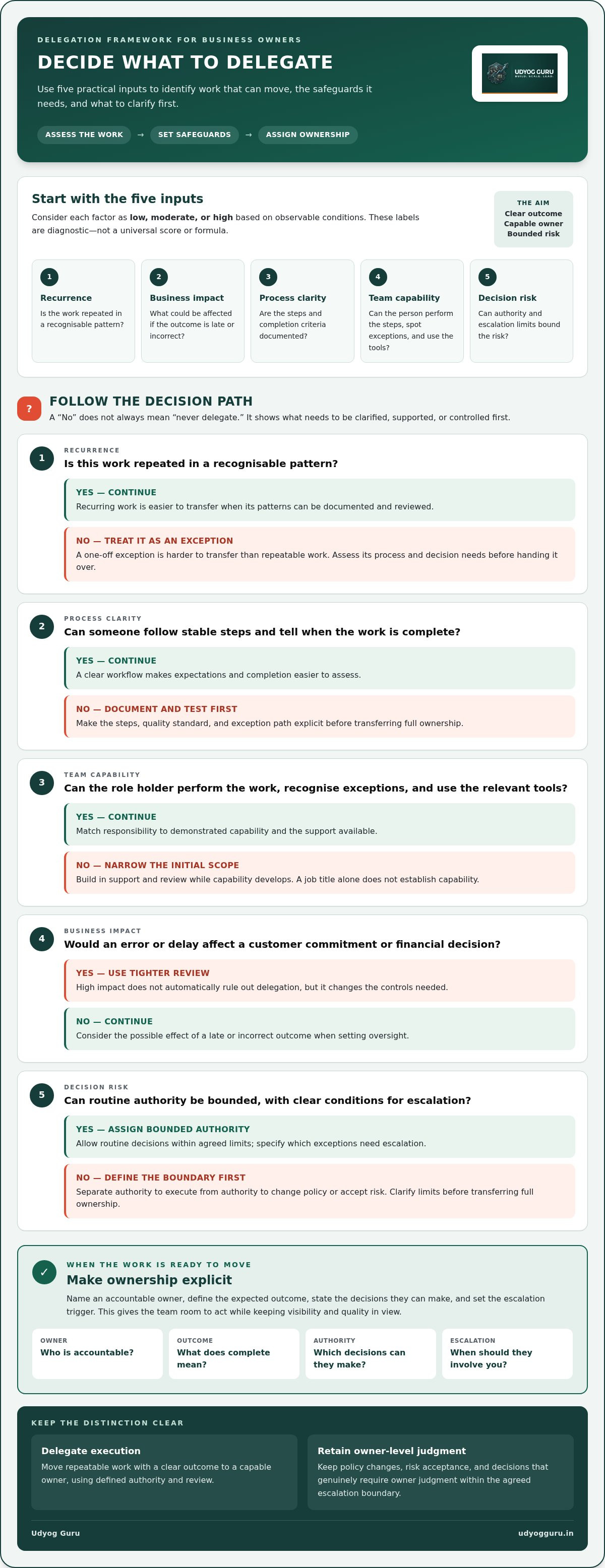
Not every time-consuming task is a good delegation candidate. A useful delegation framework for business owners evaluates the work across five inputs: recurrence, business impact, process clarity, team capability, and decision risk. Consider each as low, moderate, or high based on observable conditions. These are diagnostic labels, not a universal score or formula. Their purpose is to show what can move, what needs safeguards, and what should be redesigned first.
A delegation candidate is repeatable work with a clear outcome, a capable owner, and risks that can be bounded through defined authority and escalation.
How do repeatability, impact, and process clarity change the decision?
Start with recurrence. Work performed regularly is easier to transfer than a one-off exception because its patterns can be documented and reviewed. Then assess business impact: an error in a routine internal update may be easy to correct, while an error affecting a customer commitment or financial decision may require tighter review. High impact does not automatically rule out delegation, but it does change the controls you need.
Finally, examine process clarity. Can someone follow stable steps and tell when the work is complete? If not, document and test the workflow before transferring full ownership. For example, recurring invoice preparation may be suitable for delegation when the required information, checks, and completion standard are clear. Unwritten approval rules or frequent exceptions signal that the process needs attention first.
How should capability and decision risk shape delegation?
Match responsibility to the role holder’s demonstrated capability and the support available to them. Capability is not simply a job title. Assess whether the person can perform the steps, recognise exceptions, and use the relevant tools. If experience or support is limited, narrow the initial scope and build in review while capability develops.
Separate authority to execute from authority to change policy or accept risk. A team member may be authorised to resolve routine customer issues within agreed limits, while policy exceptions or unusual commitments require escalation. This boundary protects the business without routing every standard decision back to you. For broader role and capacity context, see the workforce optimization framework.
- Recurrence: Is the work repeated in a recognisable pattern?
- Business impact: What could be affected if the outcome is late or incorrect?
- Process clarity: Are the steps and completion criteria documented?
- Team capability: Can the role holder deliver the outcome with available support?
- Decision risk: Which choices can they make, and which require escalation?
Use these inputs to decide whether to delegate now, add controls, develop capability, or clarify the process first. If workforce roles and ownership need a structured diagnostic, explore Udyog Guru’s workforce systems.
How to assign ownership, authority, and accountability without micromanaging
A delegation agreement turns an assigned task into clear ownership. It identifies four elements: the accountable owner responsible for the result, the expected outcome that defines success, the decision authority available to deliver it, and the escalation trigger that signals when you need to be involved. Without all four, employees may be held responsible for outcomes they cannot control.
Compare a task hand-off with genuine ownership:
| Element | Task assignment | Genuine ownership |
|---|---|---|
| Accountable owner | “Please handle the client update.” | A named role owns preparing and sending the update. |
| Expected outcome | The action is described, but success is unclear. | The update meets an agreed quality standard and deadline. |
| Decision authority | Routine choices still return to you. | The role can make defined decisions independently. |
| Escalation trigger | There is no clear point to raise an issue. | Material risks, missed commitments, or scope changes are escalated. |
What belongs in a delegation agreement?
Record the outcome, quality standard, deadline, available resources, and reporting cadence. Specify which decisions the role can make independently and which require escalation. Define evidence of completion, such as a sent update recorded in the agreed system, so you and the employee share the same test for success. These details make the delegation framework for business owners operational rather than open to interpretation.
How can owners set controls without reclaiming the work?
Set review points according to business impact and decision risk, not constant availability. Reviews should examine outcomes, progress against agreed measures, and exceptions rather than prescribe every action. If a material commitment is at risk, intervene at the agreed trigger; otherwise, let the role holder execute within the boundaries.
When results fall short, separate coaching from takeover. Clarify what failed, correct the process or capability gap, and adjust the boundary if needed. Taking back the work may resolve one instance, but it leaves the ownership design unchanged.
When responsibilities overlap or accountability remains unclear, Workforce X-Ray™ helps examine workforce ownership gaps. To understand how Udyog Guru’s workforce diagnostic can support clearer roles and responsibilities, explore the workforce systems.
A five-stage delegation cycle for testing and improving the framework
Test delegation as an operating change, not a one-time hand-off. A controlled pilot lets you see how a responsibility performs within defined boundaries before expanding its scope. In practice, delegation is a monitored transfer of decision rights and outcomes, with evidence guiding the next adjustment.
- Select: Choose a recurring responsibility with a defined outcome and manageable risk.
- Prepare: Clarify the process, role ownership, authority limits, support, and escalation conditions.
- Transfer: Move responsibility to the role holder and confirm their understanding of the expected result.
- Monitor: Review performance and exceptions at an agreed cadence, using consistent measures.
- Recalibrate: Adjust the process, support, scope, or decision boundaries based on what the pilot reveals.
For example, you could pilot responsibility for a recurring internal report with one role before transferring additional reporting work. The purpose is not to prescribe every action. It is to test whether the outcome, authority, and review controls work together in practice. This feedback loop keeps a delegation framework for business owners adaptable as processes and roles change.
What should owners measure after transferring work?
Establish a baseline and use the same review period and definitions throughout the pilot. Track completion reliability, rework, escalation frequency, and how often you intervene. Don’t set arbitrary benchmark targets. First compare performance with the process’s own starting point and agreed standards.
Patterns matter more than isolated events. Repeated escalations may indicate unclear authority. Persistent rework may point to process ambiguity, capability gaps, or an outcome standard that needs clarification. Frequent intervention from you can signal that the transfer was incomplete or its boundaries are too narrow.
When should a delegated responsibility be redesigned?
Reassess when the work’s scope changes, errors recur, or the role lacks the authority needed to deliver the expected result. Diagnose before reversing the hand-off: unclear steps call for better process documentation, capability gaps may need support, and excessive exposure may require narrower decision rights. If workflow clarity is the constraint, see business process systematization.
Use the pilot findings to decide whether to stabilise the current arrangement, revise its controls, or expand ownership to related work. Udyog Guru’s workforce systems support a structured approach to workforce implementation.
How Udyog Guru can help owners install a measurable delegation system
A delegation framework for business owners becomes operational when its responsibilities, decision boundaries, and review measures fit the workforce and the wider business system. Before changing roles or transferring more work, identify where ownership is unclear, capacity is misaligned, or hand-offs repeatedly return to you. Diagnosing these conditions helps address structural causes rather than treating the problem as an individual failure.
When does a workforce diagnostic make sense?
A workforce diagnostic is useful when you cannot see who owns recurring outcomes, whether roles have capacity for additional responsibility, or why work repeatedly stalls between people. Udyog Guru’s Workforce X-Ray™ helps examine workforce and ownership gaps. Use its findings to inform decisions about the operating structure, rather than to label employees or assume a predetermined result.
If delegation problems appear alongside broader operating constraints, Business X-Ray™ provides a wider business diagnostic. This distinction matters: a hand-off problem may stem from unclear workforce ownership, or it may sit within a larger operational issue that affects multiple functions.
What does a structured implementation pathway address?
Diagnosis identifies where the system needs attention; implementation translates those findings into operating changes. Udyog Guru’s Workforce Acceleration Engine™ provides a workforce implementation pathway. In a delegation context, the focus is on establishing clearer responsibilities, operating expectations, and review measures so roles and outcomes can be managed through a defined system.
For example, if a recurring hand-off has no clear accountable role, implementation should address ownership and the expectations attached to it. If decisions keep returning to you, clarify the authority boundary and escalation conditions. If work varies because the procedure is unclear, address the process itself. The specific response depends on the diagnosed constraint; the aim is a more visible operating structure, not a guaranteed performance gain.
Use Workforce X-Ray™ when role ownership, capacity, or recurring hand-offs are difficult to see. If the findings point to a wider business constraint, Business X-Ray™ provides a broader diagnostic route. Explore Udyog Guru’s Workforce X-Ray™ and Workforce Acceleration Engine™ to move from workforce diagnosis to implementation.
Build delegation into the way your business operates
A reliable delegation system starts by selecting work according to recurrence, impact, process clarity, team capability, and decision risk. It then gives each responsibility a clear owner, expected outcome, decision boundary, and escalation trigger. Together, these elements make a delegation framework for business owners a practical operating structure, not merely a list of tasks to hand off.
Improve the system through controlled transfers and consistent reviews. Track completion reliability, rework, escalations, and owner intervention, then adjust the process, support, or authority when the evidence points to a gap. The aim is to maintain visibility while allowing capable people to own outcomes within defined limits.
Udyog Guru’s Workforce X-Ray™ helps diagnose workforce gaps, and the Workforce Acceleration Engine™ supports implementation. Explore Udyog Guru’s workforce diagnostic and implementation systems to take a structured next step. With clear ownership and measured review, your business can build operations that rely on sound systems, not constant owner intervention.
Frequently Asked Questions
What is a delegation framework for business owners?
A delegation framework for business owners is a repeatable system for selecting work, assigning an accountable owner and decision authority, defining the outcome, and reviewing exceptions. Unlike a task list, it governs who can decide, what responsibility they hold, and when an issue returns to you. Assigning report preparation is only a task; ownership also clarifies quality criteria, authority to resolve routine gaps, and escalation conditions.
How do I know which tasks to delegate first?
Assess each task by recurrence, process clarity, business impact, team capability, and decision risk. Start with work that happens regularly, follows clear steps, has observable completion criteria, and fits the role holder’s demonstrated capability. If the process is unclear, document it before transferring full ownership. High-impact or higher-risk work may still be delegated, but it needs more preparation, tighter boundaries, or additional review.
How can I delegate without losing control of my business?
Maintain operational visibility without personally approving every action. Agree on the expected outcome, define the decisions the role can make independently, and set exception thresholds for issues such as material risk or a threatened commitment. Schedule reviews that examine progress, outcomes, and exceptions at a cadence suited to the work. This gives you oversight while allowing the responsible person to execute within clear limits.
What should a delegation plan include?
A delegation plan should name the accountable role and specify the outcome, quality standard, authority limits, available resources, deadline, reporting cadence, and escalation conditions. It should also define what evidence confirms completion, such as a completed record or delivered output. These elements reduce ambiguity: the employee knows what they own and can decide, while you have a consistent basis for reviewing whether the agreed result was achieved.
Why does delegation fail in small businesses?
Delegation often fails because processes are unclear, responsibility exceeds a person’s capability or authority, feedback is inconsistent, or you re-enter execution before the role can operate independently. These are structural conditions, not automatic evidence of employee failure. Diagnose where the hand-off breaks down: the remedy may be clearer workflow documentation, capability support, narrower responsibility, or decision boundaries that match the role.
How do I measure whether delegation is working?
Track completion reliability, rework, escalation frequency, and your own intervention against an initial baseline, using consistent definitions and review periods. Interpret these measures together: fewer escalations may indicate clear authority, but it could also mean risks are going unreported. Look for recurring patterns and investigate their causes before changing the arrangement. Avoid universal targets; assess performance against the agreed outcome, quality standard, and risk controls.
When should a business owner delegate a decision instead of just a task?
Delegate decision authority when the desired outcome, decision boundaries, escalation triggers, and role holder’s capability are clear. For example, a role may handle routine scheduling choices independently while referring changes that affect wider commitments. This allows the person to own an outcome rather than wait for approval at each step. Keep strategic choices and exceptional decisions with you when they exceed the agreed authority or risk limits.


