

What if a recurring bottleneck in your business comes not from a lack of effort, but from a workforce system that leaves people unsure what they own and when to escalate? A workforce management framework makes those gaps visible by connecting business priorities with team capacity, roles, workflows, and measures.
When responsibilities are unclear, workload is hard to assess, or hiring and process changes happen without a shared rationale, decisions often return to the owner and performance becomes difficult to evaluate consistently. These are structural issues, not reasons to add layers of bureaucracy. They call for clear operating rules and a repeatable way to review how work gets done.
This article explains what a practical framework should include and how to put it into practice. You’ll learn to align workforce decisions with measurable priorities, clarify accountability and workload, and establish a review cycle that reveals operational gaps. We’ll move from diagnosis to implementation, including how tools such as Workforce X-Ray™ can help assess the current system and guide next steps.
Key Takeaways
- Use a workforce management framework to connect business outcomes with the people, responsibilities, and workflows needed to deliver them.
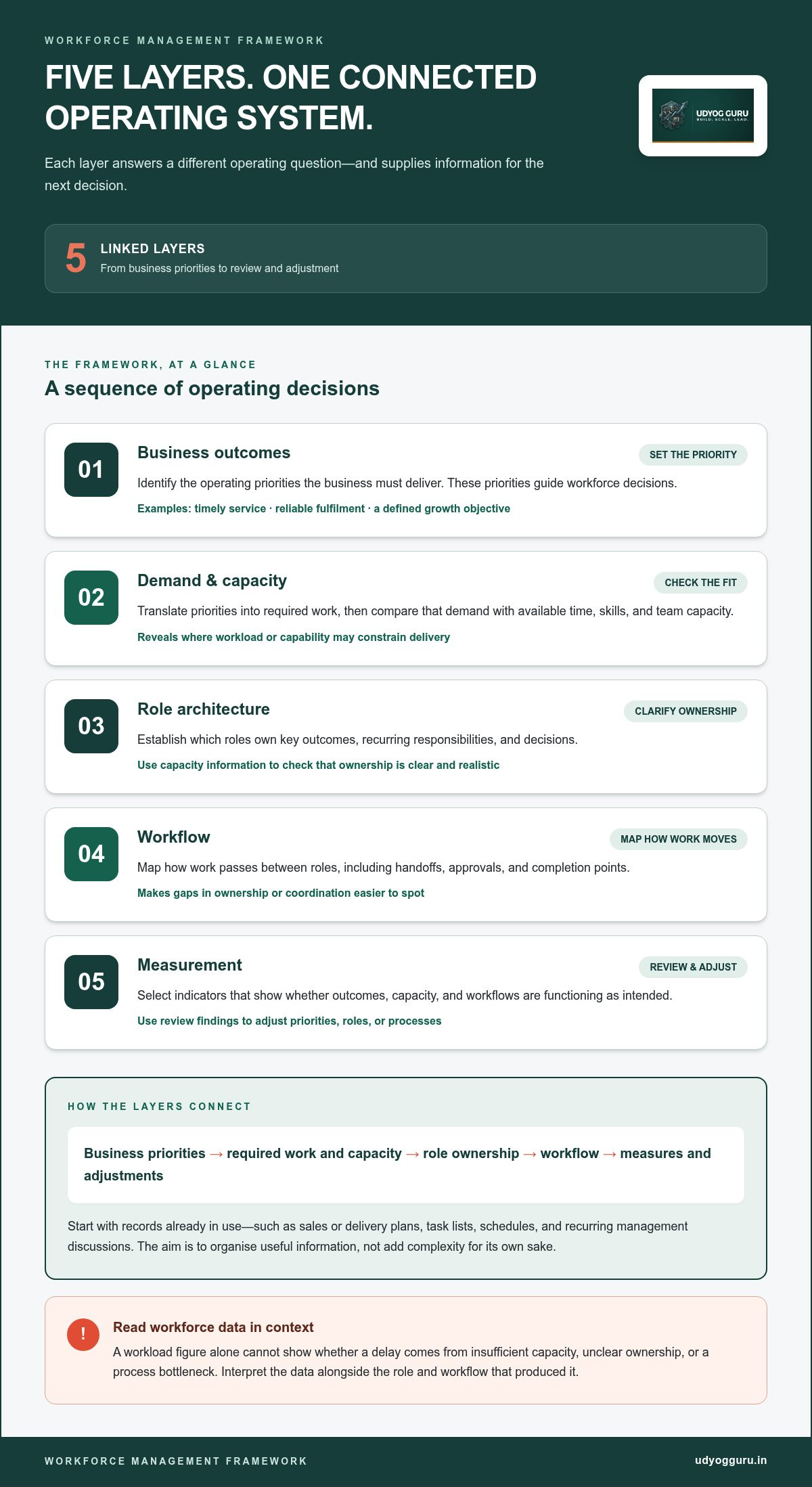
- Assess five linked layers: business outcomes, demand and capacity, role architecture, workflow, and measurement.
- Choose measures that inform decisions; avoid tracking activity without a clear operational purpose.
- Implement the system through six stages, each with an accountable owner, a defined output, and a decision gate.
- Use Workforce X-Ray™ to support workforce diagnosis and Workforce Acceleration Engine™ as an implementation pathway.
What Is a Workforce Management Framework, and What Should It Solve?
A workforce management framework is a repeatable operating system that links business goals to the work required, the people responsible for it, and the way results are reviewed. It makes workforce decisions traceable: priorities define the work, work informs capacity and role requirements, and measures show whether the arrangement is functioning. The framework covers workforce planning, role clarity, delegation, workflows, workload, and accountability.
In brief: workforce management is the system for organising and improving how people deliver business priorities; day-to-day supervision guides employees through particular tasks. Supervision is one management activity, not the whole operating discipline. For a broader overview of the field and its components, see Workforce Management on Wikipedia.
The key is integration. Hiring, appraisals, training, and scheduling can each be useful, but when handled in isolation they may not resolve who owns a result, whether capacity matches demand, or how a workflow should change. A workforce management framework connects those decisions. For example, it ties a hiring need to a business priority and an observed capacity gap rather than treating it as a standalone request.
How Is Workforce Management Different from Workforce Planning?
Workforce planning forecasts the people and capabilities a business may need, and when it may need them. It informs decisions about capacity, skills, roles, and timing, but it does not by itself define how work is assigned, delegated, completed, or reviewed. Workforce management is broader: it uses planning as an input, then establishes the operating conditions that turn available capacity into accountable work. It is not simply HR administration, because it focuses on how the workforce supports business operations.
Which Business Problems Does a Workforce Framework Address?
Unclear ownership creates predictable friction. Two employees may duplicate a task, a decision may stall because no one knows who has authority, or a routine issue may be escalated to the owner. A framework makes responsibilities and decision rights explicit, reducing ambiguity without requiring another approval layer for every action.
It can also expose workload imbalances. If one person carries several urgent responsibilities while another role has capacity, priority work may be delayed and handoffs may become unreliable. Consider a small services business where client follow-up, delivery coordination, and invoicing are shared across a small team. If ownership is undefined, follow-up may be missed while the owner fields questions about routine delivery steps. Mapping the work, assigning accountable roles, and reviewing workload against priorities helps identify the operating gap and guide a practical adjustment.
The Five Layers of a Workforce Management Framework
A practical workforce management framework works as a connected sequence, not a collection of separate charts or HR activities. Each layer answers a different operating question and supplies information for the next decision. Start with records you already use, such as sales or delivery plans, task lists, schedules, and recurring management discussions. The aim is to organise useful information, not add complexity for its own sake.
- Business outcomes: Identify the operating priorities the business must deliver, such as timely service, reliable fulfilment, or a defined growth objective. These priorities guide workforce decisions.
- Demand and capacity: Translate priorities into the work required, then compare that demand with available time, skills, and team capacity. This reveals where workload or capability may constrain delivery.
- Role architecture: Establish which roles own key outcomes, recurring responsibilities, and decisions. Use capacity information to check whether ownership is realistic and clear.
- Workflow: Map how work moves between roles, including handoffs, approvals, and completion points. The process can expose gaps in ownership or coordination.
- Measurement: Select indicators that show whether outcomes, capacity, and workflows are functioning as intended. Use review findings to adjust priorities, roles, or processes.
Workforce data becomes useful only when interpreted in the context of the role and workflow that produced it. A workload figure alone cannot show whether a delay comes from insufficient capacity, unclear ownership, or a process bottleneck.
Translate Business Priorities into Workforce Requirements
Begin with a short set of operating priorities, not a generic headcount target. For each priority, identify the work required, the capabilities needed, who should own the outcome, and the capacity required to deliver it. Separate immediate delivery needs from future capability needs. For example, meeting current service commitments may require clearer task ownership, while future expansion may require new skills or a different role structure.
Connect Roles, Workflows, and Accountability
Describe roles through outcomes and decision rights people can apply to recurring work: who completes a task, who approves an exception, and who is accountable for the result. Then map handoffs and approval points across the team. If a recurring delivery issue needs the owner’s intervention, examine the workflow and authority boundaries before adding another check-in. Clear operating rules reduce reliance on informal escalation.
Choose Measures That Explain Performance
Balance outcome, capacity, quality, and workflow measures. A team might review completion against agreed priorities, workload distribution, rework, and delays at handoff points. For each measure, define what it means, who maintains it, how often it is reviewed, and what decision it should inform. Keep team-level indicators distinct from individual evaluation: an overall delay can point to a process constraint without establishing the cause of one person’s performance.
When the current picture is difficult to assemble, Udyog Guru’s workforce diagnosis and implementation system can help connect these layers to practical operating decisions.
Does a Workforce Management Framework Create Bureaucracy or Surveillance?
It can, if it adds records and checks without improving an operating decision. A useful workforce management framework does the opposite: it makes responsibilities, capacity constraints, and process failures easier to diagnose, while keeping information proportionate to the decision at hand.
Workforce visibility explains how work is progressing; employee surveillance tracks people without a clear operational purpose. A team-level view of unresolved work, for example, can help a manager identify a bottleneck. Recording every action or measuring time without a defined decision in mind creates activity data, not necessarily better management.
Governance helps maintain that distinction. Set out what information is collected, who can access it, how it will be interpreted, and which decisions it may inform. Give managers enough context to understand the role, workload, and workflow behind a measure. Limit access to people who need the information for an identified responsibility, and review whether each measure remains useful as work changes.
When Does Process Become Unnecessary Bureaucracy?
Look for duplicate reports, approvals that add no quality or accountability safeguard, and dashboards nobody uses to make a decision. These are signs that a process may be recording activity rather than controlling an operational risk. Remove steps that do not protect quality, accountability, or compliance. Keep documentation proportionate to the work and team: a recurring handoff may need a clear owner and completion condition, not a lengthy procedure.
A practical test is to ask what decision each step supports. If a report never changes priorities, capacity allocation, or process design, simplify or retire it. If an approval exists only because responsibility is unclear, define decision rights instead of adding another checkpoint. The aim is not fewer controls at any cost; it is controls that address a real failure mode.
How Can Workforce Measurement Remain Fair and Useful?
Explain each measure before using it: its purpose, what it can and cannot show, who reviews it, and how it may guide action. Start with operational diagnosis. If a team misses a service milestone, examine workload, dependencies, role expectations, and workflow conditions before drawing conclusions about an individual. A measure can flag where to investigate; it rarely explains the cause by itself.
Interpret quantitative indicators alongside role context, work quality, and informed manager observation. A high task count, for instance, says little about complexity, rework, or whether the work supported the intended priority. Separate team-level indicators, which help assess operating conditions, from individual performance evaluation, which requires relevant evidence and context. This keeps measurement useful for improvement without turning routine work into indiscriminate monitoring.
How to Implement a Workforce Management Framework in Six Steps
Build the system around a real operating need, then test whether it improves decisions before extending it. A workforce management framework does not need a new platform to get started. Begin with existing schedules, task records, role descriptions, and management discussions, and pilot the method on one important workflow, such as client onboarding or order fulfilment.
- Diagnose. Record current priorities, recurring work, role responsibilities, capacity constraints, and unresolved handoffs. The business leader or designated manager owns this baseline. First agree on which issue needs investigation.
- Prioritise. Select the operating outcome the pilot should support and define what better performance would look like. The leader responsible for that outcome is accountable. Proceed when the priority is clear enough to guide trade-offs.
- Map work. Document the workflow from start to completion, including handoffs, approvals, and recurring exceptions. The process owner validates the map. Confirm that it reflects actual work, not only the intended procedure.
- Assign ownership. Clarify role outcomes, decision rights, and escalation conditions. The accountable manager confirms who owns each result. Move forward when routine decisions have a clear path and do not depend on informal intervention.
- Install measures. Choose a small set of outcome, capacity, quality, or workflow indicators. A named measure owner defines the data source and review purpose. Use a measure only if it can inform a specific management decision.
- Review. Compare results with the baseline, identify causes, and agree on corrective action. The business or process owner leads the review. Expand the framework when the pilot produces usable evidence and the workflow is stable enough to repeat.
Establish a Workforce Baseline Before Changing Roles
Separate observed evidence from assumptions that still need testing. For example, record repeated delayed handoffs as evidence, but treat “the team needs another role” as a hypothesis until workload and process conditions are examined. This baseline helps leaders investigate operational bottlenecks in business and consider relevant workforce optimization strategies without changing roles prematurely.
Install Ownership, Review Cadence, and Corrective Action
Assign decision ownership for workforce priorities, role changes, and recurring workflow issues. Set review frequency according to how quickly the work changes and how soon a problem needs intervention, rather than imposing one interval on every team. After each review, document the action, owner, due date, and evidence that will show whether the adjustment worked.
Use Automation Only After the Operating Logic Is Clear
Consider automation for repetitive, rules-based tasks only after responsibilities and workflow steps are stable. Define who reviews outputs and how exceptions are handled before automating a workforce-related process. If technology adoption is part of the next stage, an AI roadmap for SMEs can help frame the questions to resolve before implementation.
For structured workforce diagnosis and implementation, explore Udyog Guru’s workforce systems.
How Udyog Guru Turns Workforce Diagnosis into an Operating System
A workforce management framework becomes useful when diagnosis leads to deliberate changes in how work is owned, coordinated, and reviewed. Udyog Guru connects these stages through Workforce X-Ray™ for workforce diagnosis and Workforce Acceleration Engine™ for implementation. Workforce X-Ray™ helps establish where the operating structure needs attention; Workforce Acceleration Engine™ provides an implementation pathway for workforce improvement.
The distinction matters. A diagnosis should inform decisions, not become a report that sits apart from daily operations. Findings need to be translated into priorities that fit the business’s objectives and operating constraints, then supported by clear ownership and ongoing review. This keeps workforce improvement connected to the way the business runs.
From Workforce Diagnosis to Prioritised System Changes
A diagnostic perspective can help examine where role clarity, capacity, delegation, or workflow coordination may be limiting operations. The point is not to assume that every issue requires a new role or process. Instead, identify the underlying constraint, distinguish evidence from assumptions, and decide which change is most relevant to current priorities.
Prioritisation is a management decision. Assess a proposed change against the business need it addresses, the people and capacity available to carry it out, and the operational dependencies it may affect. For example, if routine decisions repeatedly reach the owner, the first adjustment may be to clarify decision ownership rather than redesign several roles at once. Broader business diagnosis can also put workforce findings in context by connecting team structure to wider operating priorities.
Build Workforce Improvements into Ongoing Operations
Implementation is not complete when responsibilities are written down. The change must become part of normal management routines: people need to understand who owns the work, managers need a way to review whether the workflow is functioning, and recurring issues need a route to resolution. Workforce Acceleration Engine™ is Udyog Guru’s implementation system for workforce improvement, supporting the shift from diagnosis towards an operating system.
This connection matters for business owners who want the organisation to function with less dependence on informal intervention. Clearer ownership and repeatable review make it easier to identify whether a problem sits in capacity, workflow, or decision rights. They also give managers a basis for corrective action instead of relying on isolated escalations or ad hoc process changes.
The objective is a workforce structure that supports business priorities and can be reviewed as those priorities or operating conditions change. Diagnosis identifies areas to address; prioritised changes establish what to adjust; ownership and operational review help keep those changes active in day-to-day work. Explore Udyog Guru’s workforce systems to understand its diagnostic and implementation approach.
Make the Next Workforce Decision Deliberate
The next step is not to redesign every role or process at once. Select one workforce issue that affects a current business priority, identify what evidence would clarify it, and decide who will own the next action. That creates a practical starting point for improving the system without adding process for its own sake.
A workforce management framework becomes more valuable when it supports consistent decisions through change. Udyog Guru’s Workforce X-Ray™ provides a diagnostic starting point, while Workforce Acceleration Engine™ supports implementation. Together, they offer a structured route from understanding workforce conditions to embedding improvements in operations.
Explore Udyog Guru’s workforce systems to see how diagnosis and implementation can support clearer ownership and more scalable operations. Start with the decision your business needs to make next, and build from there.
Frequently Asked Questions
Is a workforce management framework the same as an HR policy?
No. An HR policy sets rules for a specific employment matter, while a workforce management framework helps leaders make connected decisions about how work is organised and delivered. For example, a leave policy can explain how leave requests are handled, but it will not determine how a team redistributes time-sensitive work during an absence. The policy guides consistent practice; the framework clarifies operational ownership and how decisions affect delivery.
Can a workforce management framework work for a small business?
Yes. A small business can use a workforce management framework without creating a dedicated HR function or adopting complex software. Start with a shared record of current responsibilities and decisions that repeatedly need the owner’s input. Keep it usable: name who maintains it, update it when work changes, and remove fields nobody uses. The purpose is to make coordination less dependent on memory, not to produce more documentation.
Who should own a workforce management framework?
A leader with authority to connect business priorities to team decisions should sponsor it. That person can delegate routine updates to team leads, but decision rights need to remain explicit. For example, a team lead might flag a recurring workload conflict, while a senior leader decides whether priorities or resources should change. A short decision log can help prevent the same unresolved issue from circulating between managers.
How often should a workforce management framework be reviewed?
Review it when a change could affect delivery, rather than relying only on a fixed calendar date. A new service, a shift in customer demand, or a change in team structure may require earlier attention. Routine reviews can then check whether previous decisions still fit current conditions. If a review produces no decision, action, or useful learning over time, reconsider its frequency or agenda.
Does workforce management include payroll and attendance?
Payroll and attendance can supply useful operational information, but they do not define the full scope of workforce management. For instance, attendance patterns may help a manager understand whether a particular shift has enough coverage; they do not explain whether work is assigned clearly or handoffs are functioning. Include administrative information only when it helps answer a relevant workforce question, and keep access and interpretation aligned with that purpose.
How should a workforce framework adapt to seasonal changes in demand?
Use seasonal planning as a set of working assumptions, then compare them with actual demand as the period unfolds. A business handling higher order volumes during a festive period, for example, can identify which tasks are likely to increase, which skills those tasks require, and where coordination may need adjustment. Name who monitors the signals and who can approve a change, so the team can respond without treating a forecast as certain.


