

What if fluctuating revenue is not primarily a marketing problem, but a systems problem? Leads rise and fall without a clear cause, growth initiatives stall during execution, and the owner cannot see team performance or cash position clearly. In that situation, adding another tactic may only increase complexity. Predictable business growth systems address the connections beneath those symptoms: how demand is diagnosed, work is delivered, responsibilities are owned, and financial results are monitored.
Growth will always involve uncertainty, but uncertainty does not have to mean operating without reliable signals or repeating the same reactive fixes. A structured approach helps you identify where inconsistency begins and connect priorities to processes that teams can measure and manage.
This practical framework for 2026 explains how to diagnose operational constraints, turn growth priorities into repeatable workflows with accountable owners, and establish financial visibility that supports better decisions. You’ll see how customer acquisition, workforce execution, and financial feedback work as one operating system, and how to adapt that system as the business changes. No system can guarantee an outcome, but it can make performance easier to understand and manage.
Key Takeaways
- Predictable business growth systems connect demand, delivery, workforce execution, and financial visibility so decisions reflect the whole operation.
- Trace handoffs between sales commitments, delivery capacity, team responsibilities, and cash flow to locate where growth activity loses momentum.
- No operating system can guarantee revenue, but consistent measures and review routines can make performance easier to understand and manage.
- Start with a focused implementation sequence: diagnose the constraint, prioritize a change, document the process, assign ownership, and review results.
- Explore how diagnosis, implementation, workforce systems, technology integration, and financial visibility can support a more connected operating framework.
What makes a business growth system predictable, and what does not?
Growth activity can be constant while results remain difficult to explain. A business may run campaigns, follow up with prospects, and serve customers, yet still struggle to understand why one period performs differently from another or whether a successful process can be repeated. The gap is often not a lack of activity, but a lack of connection between actions and outcomes.
Predictable business growth systems link processes, measures, responsibilities, and review routines across the operation. They make the path from attracting a prospect to delivering work and collecting revenue visible enough to assess. A tactic is one action within the system; a campaign is a time-limited initiative; software is a tool that may support a process. None is a complete system on its own. People need to know how each part fits, who owns it, and how its performance will be reviewed.
A founder’s personal routine can produce results, but it is fragile if decisions, follow-ups, or customer handovers depend on that person’s memory. A system makes essential steps clear and repeatable for the team, while leaving room to adjust when evidence shows a process is not working.
Which parts of growth can a business system influence?
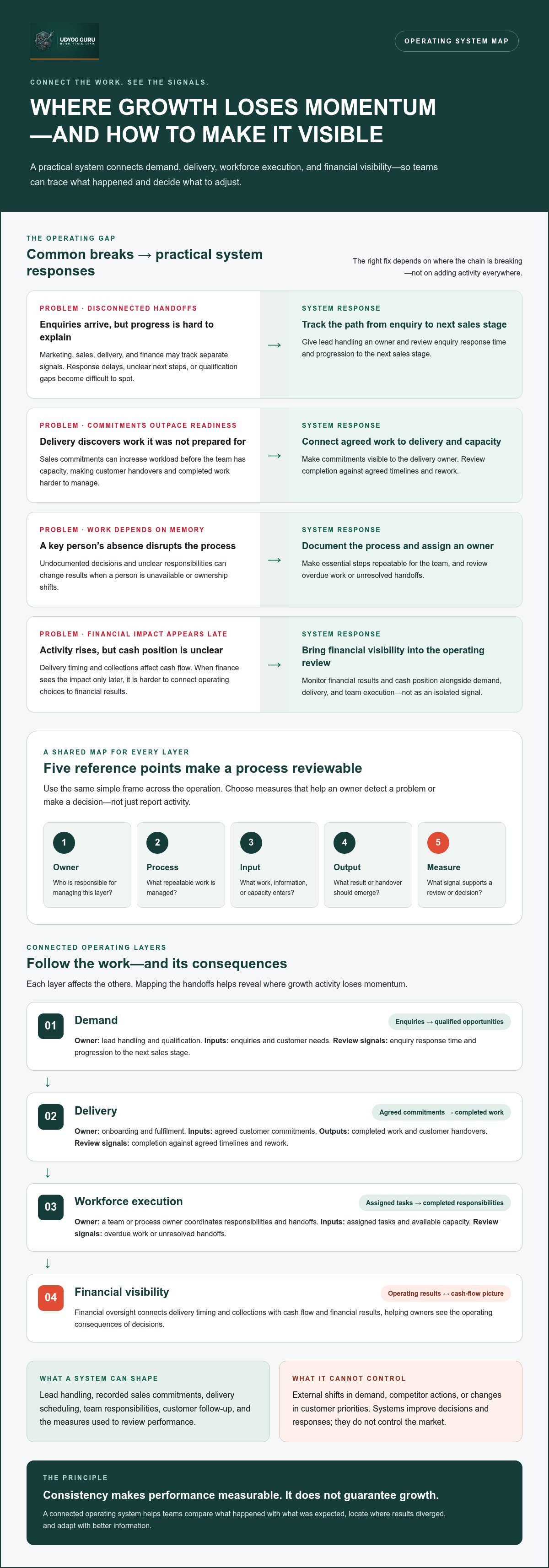
Management can shape operating inputs: how qualified enquiries are handled, how sales commitments are recorded, how delivery work is scheduled, and how customers are followed up with. It cannot control external conditions such as shifts in demand, competitor actions, or changes in customer priorities. The distinction matters: systems improve the quality of decisions and responses, not control over the market.
For example, if enquiries arrive but few progress to a proposal, tracking each handoff can help reveal whether response delays, qualification criteria, or unclear next steps are contributing. A strategic initiative for expanding revenue may be described as a Growth Platform; the operating system provides the processes and measures needed to execute and assess that initiative.
Consistency makes performance measurable; it does not guarantee growth. Repeatable acquisition, delivery, and follow-up processes help owners compare what happened with what was expected, identify where results diverged, and plan the next adjustment with better information.
Why do growth efforts become inconsistent?
Inconsistency often appears at the handoffs. Marketing may count enquiries, sales may track conversations separately, delivery may discover commitments it was not prepared for, and finance may see the impact only after costs or cash-flow pressures emerge. Without shared measures and a common review rhythm, cause and effect are difficult to trace. A stronger campaign can increase workload without improving completed sales or financial performance.
Undocumented decisions create another weak point. If one employee knows how to qualify a lead or resolve a delivery issue, results may change when that person is unavailable or responsibilities shift. The right fix depends on the diagnosis: one business may need clearer follow-up, while another needs better capacity planning or financial visibility. Applying the same process everywhere treats different constraints as if they were identical.
A sound system starts by identifying the specific break in the operating chain, then making that process observable and assigning ownership. The goal is not uniformity for its own sake. It is enough structure to explain performance, learn from variation, and adapt without rebuilding the whole business around every new tactic.
How a predictable business growth system connects the whole operation
Growth becomes easier to manage when customer demand, delivery work, team execution, and financial information are treated as connected parts of one operating system. A change in one layer affects the others. More sales commitments, for example, can increase delivery workload before the team has capacity, while the timing of delivery and collections can affect cash flow. Tracking each function in isolation hides these handoffs; mapping them makes the operating consequences easier to see.
A practical system map gives every layer five reference points: its owner, process, input, output, and review measure. Choose measures that help owners detect a problem or make a decision, rather than simply report activity.
- Demand: The owner manages lead handling and qualification. Inputs are enquiries and customer needs; outputs are qualified opportunities. Review measures might include enquiry response time and progression to the next sales stage.
- Delivery: The delivery owner manages onboarding and fulfilment. Inputs are agreed customer commitments; outputs are completed work and customer handovers. Review measures can include completion against agreed timelines and rework.
- Workforce execution: A team or process owner coordinates responsibilities and handoffs. Inputs are assigned tasks and available capacity; outputs are completed responsibilities. Review measures can include overdue work or unresolved handoffs.
- Financial visibility: The person responsible for financial oversight connects operating activity with financial reporting. Inputs include sales, delivery costs, and collection information; outputs are a clearer view of financial position. Review measures can include cash flow, receivables, and margin.
The right measures depend on the business. The map should show how work moves, where information is recorded, and who acts when a result falls outside expectations.
Connect customer demand to delivery capacity
The customer journey begins with a need, then moves through enquiry handling, qualification, sales, onboarding, and fulfilment. Each stage should pass usable information to the next: what the customer requires, what was promised, when delivery is expected, and who is responsible. If sales records commitments inconsistently, delivery may have to resolve avoidable gaps after work has already begun.
A growth plan must account for the team’s ability to fulfil the work, not just its capacity to generate interest. Demand without delivery capacity can create operational strain instead of sustainable progress.
Connect workforce ownership to financial visibility
Clear roles make execution easier to monitor because the team can identify who owns a task, decision, or handoff. Financial reporting helps owners assess the effects of those operating decisions, including whether increased workload is translating into completed work, collections, and a sound financial position. Udyog Guru’s Financial Command Dashboard supports financial visibility and control as part of this wider operating picture.
For businesses assessing how diagnosis, implementation, people, and financial feedback fit together, Explore Udyog Guru’s business transformation systems.
Can business growth systems make revenue predictable? Limits, measures, and trade-offs
No operating system can guarantee demand, revenue, or conditions outside management’s control. Customer priorities change, competitors adjust their offers, and external events can affect buying decisions. A well-designed system has a narrower purpose: it makes operating activity and results easier to observe, so owners can plan with clearer assumptions and respond sooner when evidence changes.
That distinction separates predictable business growth systems from promises of fixed outcomes. A forecast is a decision tool, not a commitment. It depends on assumptions about factors such as enquiry volume, conversion, delivery capacity, and collection timing. If those assumptions change, update the forecast rather than treating it as a guaranteed result.
The operating approach also shapes what an owner can learn:
| Approach | What it looks like | What the owner can see |
|---|---|---|
| Reactive activity | Actions change in response to immediate pressure, with little consistent tracking. | Activity is visible, but causes and effects are difficult to compare. |
| Isolated optimization | One function, such as lead generation, is improved without examining its handoffs. | Local performance may improve, while delivery or cash-flow effects remain unclear. |
| Connected system management | Processes, owners, measures, and review routines link across functions. | Deviations can be traced and decisions can account for wider operating effects. |
Connection does not remove trade-offs. Increasing demand may require more delivery capacity; speeding up work may affect quality; and investing in a process change may have financial effects that take time to assess. The system helps make these choices visible, but it does not make them automatically.
What should owners measure to improve predictability?
Choose a small set of measures tied to current priorities, process performance, and financial visibility. Leading indicators show activity that may influence later results, such as qualified enquiries received, follow-ups completed, or delivery steps finished on schedule. Lagging outcomes, including revenue, show what has already happened. Reading both helps distinguish a weak result from an earlier process issue.
Define each measure precisely, assign an owner, and set a regular review cadence. For example, agree on what counts as a qualified enquiry and when a follow-up is recorded as complete. Establish a business-specific baseline before setting targets; a universal benchmark may not reflect the company’s sales cycle, capacity, or operating model.
When should a growth system be adjusted?
When a measure moves off course, investigate before changing tactics. Check whether the cause may sit in the process, team capacity, customer response, or quality of the recorded data. Compare observations collected consistently over time to distinguish a recurring pattern from a temporary variation.
Then test a focused adjustment. Changing one variable at a time, such as the follow-up step while keeping the qualification process stable, makes cause and effect easier to interpret. Record the change and review the same measures again. If results remain unclear, reassess the diagnosis instead of layering on more activity.
How to implement predictable business growth systems in practical stages
Implementation works best as a controlled sequence, not a business-wide redesign. Start with one process that affects a meaningful growth objective, record how it currently performs, and install only enough structure to test a better approach. This keeps the work manageable and makes it easier to learn whether a change is useful before expanding it.
- Diagnose: Map the growth objective against current processes, recurring bottlenecks, and available information. Identify where work slows, ownership becomes unclear, or results are difficult to trace.
- Prioritize: Select one constraint based on its effect on customer experience, delivery, team capacity, or financial control. Avoid choosing a problem solely because it is visible or easy to fix.
- Document: Describe the current workflow and define the intended steps, handoffs, and output. Record a baseline using the same measure and method you plan to use after the change.
- Assign ownership: Name the role responsible for each key action and define where exceptions should go. Ownership means accountability for moving the process forward, not necessarily completing every task personally.
- Review: Compare later observations with the baseline at a consistent cadence. Note what changed and what else may have influenced the result; a comparison can inform a decision without proving that one adjustment caused every difference.
Start with diagnosis and select one constraint
Begin with a defined objective, such as improving the handoff from a sale to delivery. Map the steps involved, recurring delays, who participates, and what information is missing. Then assess which constraint has the clearest operational consequence. Udyog Guru’s Business X-Ray™ is its Tier 1 diagnostic offering, designed to identify operational gaps before implementation.
Install ownership, workflow, and review routines
For the selected process, document its trigger, responsible role, expected output, and escalation point. Keep the process record concise enough for the team to follow and specific enough to expose a missed handoff. Set a review routine to examine exceptions, identify breakdowns, and assign corrective action. Udyog Guru’s Business Acceleration Engine™ is its Tier 2 implementation offering.
For related practical guidance, use a business diagnostic scan framework to structure the assessment and a business process systematization guide to support process documentation.
Expand only after the first system is observable
Before extending the method to other functions, check whether the team follows the documented process and whether its measures provide useful visibility. If execution varies, clarify responsibilities rather than assuming software will resolve ownership. Where team roles and execution need deeper attention, explore workforce optimization strategies. Expand the system only when its operation and review routine are clear enough to inform the next decision.
To structure diagnosis and implementation around your business’s operating needs, explore Udyog Guru’s business systems.
How Udyog Guru structures a system for more manageable business growth
Predictable business growth systems require more than a defined sales process. They depend on an operating structure that connects diagnosis, implementation, team execution, and financial visibility. Udyog Guru’s offerings address these stages, helping business owners focus on the specific gap they need to address rather than treating growth as a single marketing problem.
The sequence matters. Diagnosis helps locate operating gaps before processes are installed. Workforce systems address how responsibilities are carried out, while financial visibility helps owners assess the position and effects of operating decisions. Technology can support a defined workflow, but it cannot replace clear process design or ownership.
Match the support to the system’s current stage
Start by identifying whether the primary need is understanding the current operation, implementing processes, or clarifying how work gets done across the team. Business X-Ray™ is Udyog Guru’s Tier 1 diagnostic scan for identifying operational gaps. Business Acceleration Engine™ is its Tier 2 system implementation program, for translating diagnosis into installed processes.
Workforce needs call for a related but distinct lens. Workforce X-Ray™ focuses on workforce diagnosis, while Workforce Acceleration Engine™ addresses workforce execution systems. These offerings connect people’s responsibilities to the processes they carry out, helping owners examine whether roles, handoffs, and operating expectations support the intended workflow.
Use financial visibility and technology with operational purpose
Financial visibility completes the feedback loop. The Financial Command Dashboard supports financial visibility and control, giving owners a clearer basis for reviewing the financial position alongside operational activity. It is most useful as part of a management system in which information informs decisions, not as a substitute for defining what the business needs to monitor or who acts on that information.
Technology has a similarly specific role. If a diagnosed workflow would benefit from technology or automation, the AI Tech Business Integration Bootcamp focuses on integrating those tools into existing workflows. Let the operational need guide the decision: first clarify the process and its owner, then consider where technology can support execution. A dashboard cannot resolve unclear responsibilities, and automation cannot repair a process that has not been defined.
- Operational gap: Use diagnosis to locate where work or information breaks down.
- Process implementation: Translate the priority into repeatable workflows and operating routines.
- Workforce execution: Connect responsibilities and handoffs to the process people are expected to follow.
- Financial feedback: Use financial visibility to assess the position and inform management decisions.
- Workflow technology: Integrate technology when it serves a defined process and supports accountable execution.
This progression is not a promise of a particular growth result. It is a structured way to connect diagnosed needs with the relevant system stage, then use operational and financial feedback to guide decisions. To explore how diagnosis, implementation, workforce execution, and financial visibility fit together, Explore Udyog Guru’s business transformation programs.
Make your next growth decision more deliberate
The next step is not to redesign the entire business. Choose one operational question that matters now: where does work stall, what information would clarify the cause, and who can act on what the evidence shows? That focused investigation gives predictable business growth systems a practical starting point while leaving room to adapt as customer demand and business conditions change.
Udyog Guru’s pathway can align with the stage you need to address: Business X-Ray™ is the Tier 1 diagnostic offering, Business Acceleration Engine™ is the Tier 2 implementation offering, and the Financial Command Dashboard supports financial visibility and control. These are components of a structured approach, not promises of a fixed growth outcome.
Start with a constraint your business can observe and address, then use what you learn to guide the next decision. Explore Udyog Guru’s business transformation systems and identify a considered next step for your business.
Frequently Asked Questions
Is predictable business growth actually possible?
Yes, if “predictable” means better visibility and planning, not certainty. Predictable business growth systems help owners test assumptions against operating evidence, such as whether enquiries progress to paid work or delivery commitments are met. Demand, competition, economic conditions, and execution still affect results. Use forecasts to compare possible scenarios and prepare decisions, then revise them when actual performance or market conditions differ from the assumptions.
Can a small business build predictable growth systems without a large team?
Yes. A small business can begin with one workflow tied to a clear objective, such as how incoming enquiries are recorded and followed up. Assign responsibility to an existing role, define what a completed step looks like, and review a manageable measure during a regular team check-in. Keep the process proportionate to available capacity. Extend it only when the initial workflow is useful and the team can maintain it.
How long does it take to see whether a growth system is working?
There is no universal timeline; the evidence depends on the process, the quality of existing records, and how frequently the result can be observed. Before a change, note the current pattern using a consistent definition, such as how many enquiries reach a scheduled sales discussion. Early reviews may show whether staff are following the process. Revenue effects can take longer, so avoid crediting one adjustment without considering other changes during the same period.
What happens if a business growth system stops producing the expected results?
First, inspect the evidence before discarding the system. For example, if a new customer follow-up process is not progressing opportunities, check whether each enquiry is being logged, whether the assigned role completes the next step, and whether the measure reflects genuine progress. Then consider whether customer needs or delivery capacity have changed. Record any adjustment and its timing so the next review can distinguish an implementation issue from a change in conditions.
Does predictable business growth require automation or AI?
No. A team can manage a clear workflow with an agreed procedure and a consistent way to record progress. Consider automation only when the steps are understood and repeated often enough for technology to serve a defined purpose, such as reducing duplicate data entry. If staff interpret the process differently, automating it may make errors harder to detect. Start by clarifying the decision or task technology is meant to support.
What is the difference between a business growth strategy and a growth system?
A strategy identifies the intended direction, such as prioritising a customer segment or improving repeat purchases. A growth system defines how the business will act on that choice: which customer interactions change, who owns them, and what evidence will inform the next decision. For example, choosing to focus on returning customers is strategic; recording follow-ups and reviewing repeat orders are operational. The system should serve the strategy, not just generate activity.


