

Revenue can rise while a business becomes harder to run. That’s the difference between expansion and structural business growth: more sales add demand, but sustainable growth depends on whether roles, processes, decision rights, and financial visibility can absorb it without creating confusion.
If coordination is taking more time, important decisions keep coming back to the owner, or financial and operational information is scattered across tools and people, the problem may not be effort. The operating structure may be underbuilt for the business’s next stage.
This article explains the structures that support sustainable growth and how to identify the constraint limiting yours. You’ll learn how to assess workflows, accountability, decision rights, and financial visibility, then choose a practical order for strengthening them. Diagnose the constraint before adding processes or technology. Udyog Guru’s Business X-Ray™ provides a diagnostic starting point, followed by implementation through the Business Acceleration Engine™ and supporting workforce and financial tools.
Key Takeaways
- Separate revenue growth from the operational capacity needed to manage added complexity.
- Assess workflows, workforce accountability, decision rights, and financial visibility as connected parts of your operating structure.
- Use recurring delays, rework, and owner intervention to identify structural strain, rather than assuming that more process is always the answer.
- Strengthen structural business growth by addressing one consequential workflow first, assigning ownership, and reviewing evidence.
- Business X-Ray™ diagnosis and Business Acceleration Engine™ implementation can support a structured path to improvement.
What Structural Business Growth Means, and Why Revenue Alone Is Not Enough
Revenue can increase before a business is equipped to manage the work that comes with it. More orders, clients, or projects raise coordination demands, even when the team and its processes remain unchanged. The result may be expansion on paper but growing friction in delivery: decisions wait, handoffs fail, and the owner gets pulled into routine issues.
Structural business growth is the development of connected systems, clear responsibilities, and practical controls that enable a business to handle greater complexity consistently. Structure should make execution more reliable, not create procedures for their own sake. A useful process clarifies how work moves, who owns each decision, and what information people need to act.
Growth, scale, and business structure are related, but not interchangeable
Revenue expansion measures increased commercial activity. Scalable operations describe the capacity to serve that activity consistently without coordination effort rising at the same rate. That capacity depends on repeatable work, clear ownership, and usable information. Adding employees or software alone doesn’t create it. Without defined responsibilities and connected workflows, new people and tools can add handoffs without resolving delays.
Consider a business that takes on more customer orders. If each order requires the owner to confirm pricing, check stock, and assign delivery, higher sales may increase the owner’s workload rather than the organisation’s capacity. A defined path for routine orders, with clear escalation points for exceptions, can preserve oversight while allowing the team to execute.
Why operating complexity exposes weak foundations
As customer volume, internal decisions, and work handoffs increase, small ambiguities become repeated coordination costs. Teams may redo tasks because requirements were unclear, wait for approval because decision authority is undefined, or ask the owner to resolve issues that could have been handled at the right level. These are signals to examine the underlying process and responsibilities.
The right structure depends on the business. A service firm may need clearer client handoffs; a manufacturer may need more dependable coordination between production and fulfilment. The question is not whether every activity has a formal procedure. It is whether consequential work has a reliable owner, a defined outcome, and enough information to proceed.
Economic structural change describes shifts in how an economy’s activity and resources are organised. Understanding Structural Change in Economics offers that wider context, but an individual business must also examine its internal operating design. Market shifts can change what customers value; internal systems determine whether the business can respond without relying on improvised decisions.
Use a simple test: if activity increased next month, which step would first depend on the owner’s intervention, unclear instructions, or information held by one person? That point is a likely constraint, not a reason to add structure everywhere. Focus on work where inconsistency creates the greatest delivery or decision risk, then design the process around that need.
The Four Operating Layers That Support Structural Business Growth
A business handles complexity through connected operating layers, not isolated fixes. Workflows define how tasks move; workforce accountability assigns ownership; decision rights set boundaries for action; and financial visibility shows whether execution supports business priorities. When these layers work together, a business can absorb complexity with clearer execution and stronger control.
Each layer depends on the others. A well-documented process can still stall if nobody owns the next step. A capable employee may be unable to act if every decision requires approval. Without timely financial information, leaders can’t easily see whether a process is using resources effectively or producing the intended result.
Processes and decision rights define how work moves
A core workflow should identify its inputs, owner, key steps, and expected output. For example, a customer request might move from enquiry to qualification, proposal, approval, and delivery. At each handoff, define what information the next person needs and what they are expected to do. A business process systematization framework can help make these sequences repeatable without documenting every minor action.
Decision rights complete the workflow. Define which routine choices the role owner can make, what conditions require escalation, and who resolves exceptions. This gives employees room to act within agreed boundaries while preserving oversight for decisions with broader impact. Without those boundaries, even a clear process can send routine questions back to the owner.
People and financial visibility connect execution with control
Workforce accountability translates business priorities into owned responsibilities. Each role needs a clear outcome, an understood handoff, and a way to identify when work is off track. Job structures can differ across companies; the essential point is that important work has an accountable owner rather than an assumed one.
Financial visibility connects operating activity to business performance. Timely information about revenue, costs, cash movement, or delivery performance can help leaders investigate whether a workflow is functioning as intended. The relevant measures depend on the business, but the information should be accessible and useful enough to support decisions, not fragmented across individual files or people.
Diagnose the connections, not only the symptoms
Imagine proposals are delayed. The apparent issue may be slow approval, but the cause could be unclear pricing authority, incomplete information from the sales handoff, or limited visibility into delivery costs. Changing only the approval step may move the delay elsewhere. Trace the work across all four layers to locate the actual constraint.
This connected view is central to structural business growth. Harvard Business School’s discussion of Business Model Transformation for Sustainability considers how organisational architecture relates to broader business transformation. For internal operations, the practical implication is to align workflows, people, decisions, and financial signals rather than treating them as separate repair projects.
When these connections are difficult to see, Udyog Guru’s business systems approach provides a structured way to examine operating gaps and prioritise improvements.
Is Your Business Growing, or Accumulating Structural Strain?
More structure doesn’t automatically mean more bureaucracy. A useful control removes uncertainty from recurring work; an unnecessary one adds approvals without improving the decision or outcome. Ask whether a process makes execution clearer or simply adds another step.
Growth can create temporary pressure, such as a busy period that stretches delivery capacity. Structural strain is more likely when the same workflow repeatedly stalls, produces rework, or returns to the owner for resolution. Treat these as signals to investigate, not proof that the business needs more staff. The cause may be process design, unclear authority, or missing information.
Distinguish a temporary growth challenge from a recurring constraint
Compare a workload peak with a repeated pattern. A short-term surge may clear when demand normalises; a recurring approval queue or repeated handoff failure suggests a constraint in the operating system. Track where work waits, what information is missing, and who must intervene. This helps trace the bottleneck to its source rather than treating each delay as a separate incident.
Use observable evidence rather than a general sense that the team is overwhelmed:
| Healthy growth signals | Structural strain indicators |
|---|---|
| Work moves through known steps, with exceptions identified. | The same tasks are repeatedly delayed or redone. |
| Routine decisions are handled by the relevant role owner. | Approvals accumulate or routine questions return to the founder. |
| Teams can locate the information needed to continue work. | Handoffs pause while people search for context or clarification. |
A delay alone doesn’t diagnose the cause. If a delivery is late, inspect whether the input arrived incomplete, responsibility changed hands, a decision lacked an owner, or capacity was genuinely insufficient. Hiring may help when workload exceeds available capacity, but it won’t resolve unclear steps or decision authority by itself. Look for patterns across repeated instances before deciding which change to make.
Test whether the owner has become the operating system
List decisions that stop whenever the founder is unavailable. Separate choices that genuinely require founder judgement from routine matters employees could resolve with clear boundaries and access to relevant information. If capable people wait because authority is undefined, adding headcount may simply increase the queue. Reducing unnecessary reliance on individual intervention is part of building an operation that can handle more work.
Review one recurring constraint at a time: map the workflow, locate the delay, and check its process, role, and information flows before changing the structure. This ties the response to evidence rather than assumptions about what a growing business ought to look like. Reassess after the change to see whether the original bottleneck has eased or shifted elsewhere.
If several recurring constraints appear connected, Udyog Guru’s business systems approach can help frame what to examine before implementation.
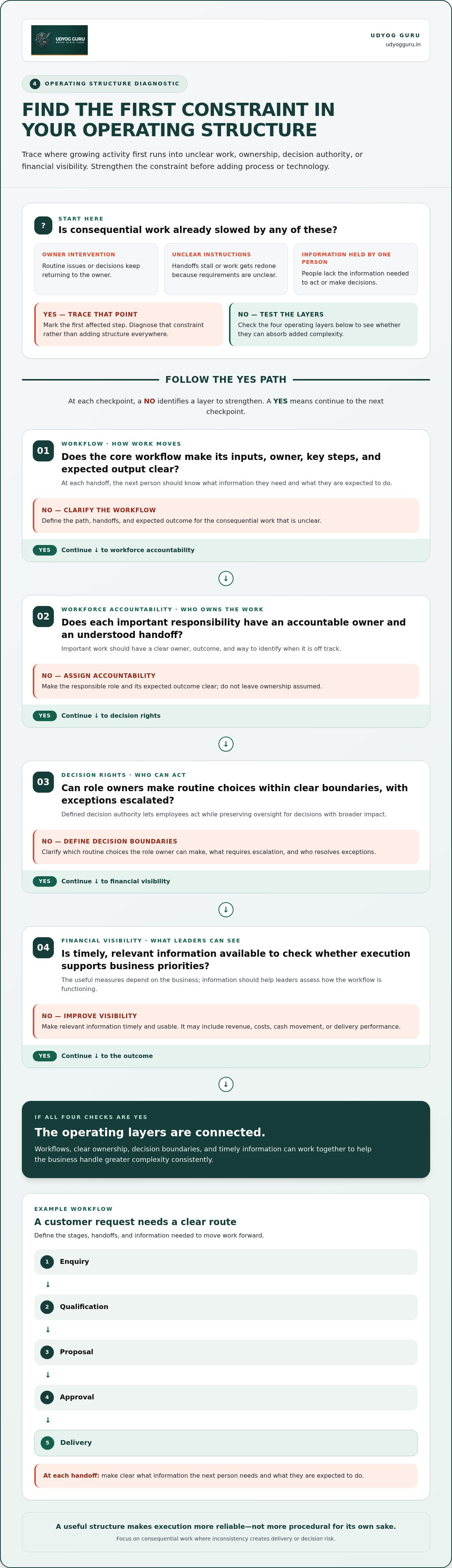
How to Strengthen Business Structure Without Creating Unnecessary Process
Improvement should begin with a recurring constraint, not a company-wide documentation exercise. Choose a consequential workflow where delays, rework, missed handoffs, or owner intervention affect delivery or control. Trace the cause before designing a fix. A new form or approval step may make activity more visible, but it won’t resolve a problem caused by unclear ownership or missing information.
Diagnose the constraint, identify its cause, assign ownership, install a focused control, and review the evidence. This sequence keeps structural business growth grounded in operational need rather than process for its own sake.
Prioritise the constraint before designing a solution
Select a recurring issue with observable consequences, rather than the loudest isolated complaint. Map the work from its starting point to its required output, including handoffs and decisions. Check whether the friction comes from the workflow, role clarity, decision authority, or access to information. A single delay may involve more than one layer.
Establish a baseline before changing the process. Choose a signal that reflects the bottleneck, such as how often work is returned for correction, how long it waits for approval, or how frequently the owner must intervene. Record how the signal is observed and use the same method after the change. Without a baseline, it’s difficult to distinguish a real improvement from a temporary fluctuation.
Install ownership, documentation, and review controls
Keep the intervention proportional to the problem. Document the steps needed for consistent execution, essential handoffs, and exception handling. Assign one accountable owner for the outcome, then define which routine decisions that person can make and which require escalation. This creates control without routing every choice through another approval layer.
- Map the constraint. Describe where work stalls or breaks down, and identify the affected workflow.
- Identify root causes. Trace the issue through process steps, responsibilities, authority, and information flows instead of assuming the visible symptom is the cause.
- Assign ownership. Name the role accountable for the workflow outcome and clarify its decision boundaries.
- Install focused controls. Add only the instructions, checkpoints, or records needed to support reliable execution and handoffs.
- Review evidence. Compare the chosen signal with its baseline, investigate remaining friction, and adjust the system as operating conditions change.
Review the workflow at a cadence suited to its importance and rate of change. The purpose is not to preserve a procedure unchanged; it’s to test whether it still helps people deliver the intended result. If the measure improves but a new queue appears elsewhere, trace the flow again rather than adding controls by default.
Udyog Guru’s Business X-Ray™ provides a diagnostic starting point for identifying operational gaps, while the Business Acceleration Engine™ focuses on implementation. Explore Udyog Guru’s business systems approach to connect diagnosis with system improvement.
How Udyog Guru Connects Diagnosis to Structural Business Growth
Strengthening an operating structure takes two distinct phases: identify where the system is constrained, then improve the parts that need attention. Udyog Guru’s framework follows this sequence through Business X-Ray™ as the Tier 1 diagnostic offering and Business Acceleration Engine™ as the Tier 2 implementation offering. The distinction matters because implementing generic processes before locating the constraint can add activity without addressing the underlying gap.
Move from operational diagnosis to structured implementation
Business X-Ray™ identifies operational gaps that can limit execution as a business develops. Its diagnostic role is to clarify where systems, responsibilities, or information need attention so priorities can be set from evidence rather than assumption. Findings may point to inconsistent workflow execution, unclear accountability, or a process that depends too heavily on the owner.
Business Acceleration Engine™ is the implementation offering that follows diagnosis. It translates identified needs into operating systems, such as clearer workflows, ownership, and delegation practices. Each business has different constraints, so implementation should reflect how work currently moves and what the operation needs to manage.
This diagnosis-to-implementation path supports structural business growth by connecting assessment to focused changes. The aim is not to install process everywhere; it is to strengthen the operating components limiting coordination, execution, or visibility. Explore Udyog Guru’s business transformation systems to see how diagnosis and implementation fit within its broader framework.
Integrate workforce, financial control, and technology deliberately
Operating systems depend on people being able to carry out their responsibilities with clear expectations. Workforce X-Ray™ and Workforce Acceleration Engine™ address workforce performance and systems, supporting the examination and improvement of how roles, accountability, and execution fit together. A workflow cannot operate consistently if ownership is unclear or responsibilities do not connect to business priorities.
Financial visibility provides another line of control. The Financial Command Dashboard supports financial visibility and control, helping leaders connect financial information with operational decisions. For example, clearer financial information can inform a review of how a delivery process is performing, but it does not replace the need to understand the workflow itself.
Technology should be introduced with the same discipline. The AI Tech Business Integration Bootcamp focuses on integrating technology and automation into existing workflows, helping business owners improve efficiency without custom software development. Automation is most useful when the task, ownership, and intended outcome are understood first.
Together, these offerings address connected parts of an operating structure: diagnosis identifies gaps, implementation responds to them, workforce systems support execution, financial visibility informs control, and technology integration can improve suitable workflows. The sequence keeps structural improvement grounded in actual business needs rather than treating growth as a reason to add tools or procedures indiscriminately.
Choose the Next Structural Improvement
The next stage of structural business growth begins with one practical decision: identify the operating constraint that most limits reliable execution, then address it deliberately. Resist the urge to redesign everything at once. A focused improvement gives your team a clear place to apply what it learns and evidence to guide the next adjustment.
Udyog Guru connects diagnosis through Business X-Ray™ with implementation through Business Acceleration Engine™. Workforce-focused systems and the Financial Command Dashboard address distinct needs within that broader transformation pathway, including people, accountability, and financial visibility alongside process improvement.
Use the framework in this guide to define your priority, then explore the approach that fits your business’s next step. Explore Udyog Guru’s structured business transformation systems and move forward with a clearer view of what to strengthen. Sustainable progress is built one well-chosen structural improvement at a time.
Frequently Asked Questions
Can a small business build scalable systems before hiring more people?
Yes. A small business can build scalable systems before hiring by clarifying how recurring work gets completed with the current team. Start with a task that regularly consumes owner time, such as preparing a proposal or processing an order. Define the necessary inputs, sequence, and quality check. Structural business growth doesn’t require a large workforce; it requires a sensible operating method that can be taught and adjusted as demand changes.
How often should a business review its operating structure?
Review the structure often enough to catch recurring friction, but there’s no single schedule that fits every business. Set a regular review point that suits the pace of change, and revisit the relevant workflow after a major shift in workload, responsibilities, or service delivery. If exceptions or delays appear more often between reviews, investigate sooner. The goal is to keep systems useful, not to revise them on a fixed calendar without reason.
What is the difference between a business structure and an organisational chart?
An organisational chart shows formal roles and reporting relationships; business structure also includes how work, decisions, and information move. A chart might show that a service lead reports to an owner, but not who approves a client change or what information must accompany a handoff. Use the chart to clarify relationships, then map the operating arrangements that determine how responsibilities are carried out.
Can automation fix a business process that is not working?
Automation can’t reliably correct a process whose steps, inputs, or ownership are unclear. It may move errors faster or make exceptions harder to detect. First identify what a successful outcome requires, where errors enter, and which decisions need human judgement. Then consider whether a stable, repetitive step is suitable for automation. Test the change on a limited workflow and monitor errors and exceptions before extending it.
Which signs suggest the founder has become a decision bottleneck?
Look for work that pauses until the founder responds, including routine approvals, customer exceptions, or questions employees face repeatedly. A decision log can reveal patterns: record the question, who raised it, how long it waited, and whether a similar issue has occurred before. If staff have the capability but lack authority or decision criteria, clarify those boundaries. The objective is not to remove founder oversight, but to reserve it for decisions that need it.
How can a business measure whether a structural change is working?
Choose a measure tied directly to the constraint before making a change, then compare it with the same measure afterward. For an approval delay, track waiting time; for quality issues, track returned work; for owner dependency, count recurring escalations. Also watch for trade-offs, such as faster completion accompanied by more errors. Interpret results in context, since a change in demand or work mix can affect performance independently of the new system.


