

Adding capacity before stabilizing the work can scale confusion faster than output. If every new customer brings more approvals, rework, and decisions back to the owner, the constraint may not be demand. It may be an operating system that depends too heavily on individual judgment. Learning how to scale business operations starts with diagnosing that constraint, not simply adding people or tools.
Growth often requires more resources, but adding capacity before responsibilities and workflows are clear can intensify day-to-day firefighting. This guide shows how to assess readiness, find bottlenecks, and standardize repeatable work before expanding capacity or introducing automation. You’ll learn how to clarify ownership and use operational and financial signals to guide decisions. The sequence matters: diagnose first, establish repeatable systems next, then expand with more visibility and less dependence on the owner.
Key Takeaways
- Learn how to scale business operations by addressing the workflow constraint that limits reliable delivery, rather than adding capacity blindly.
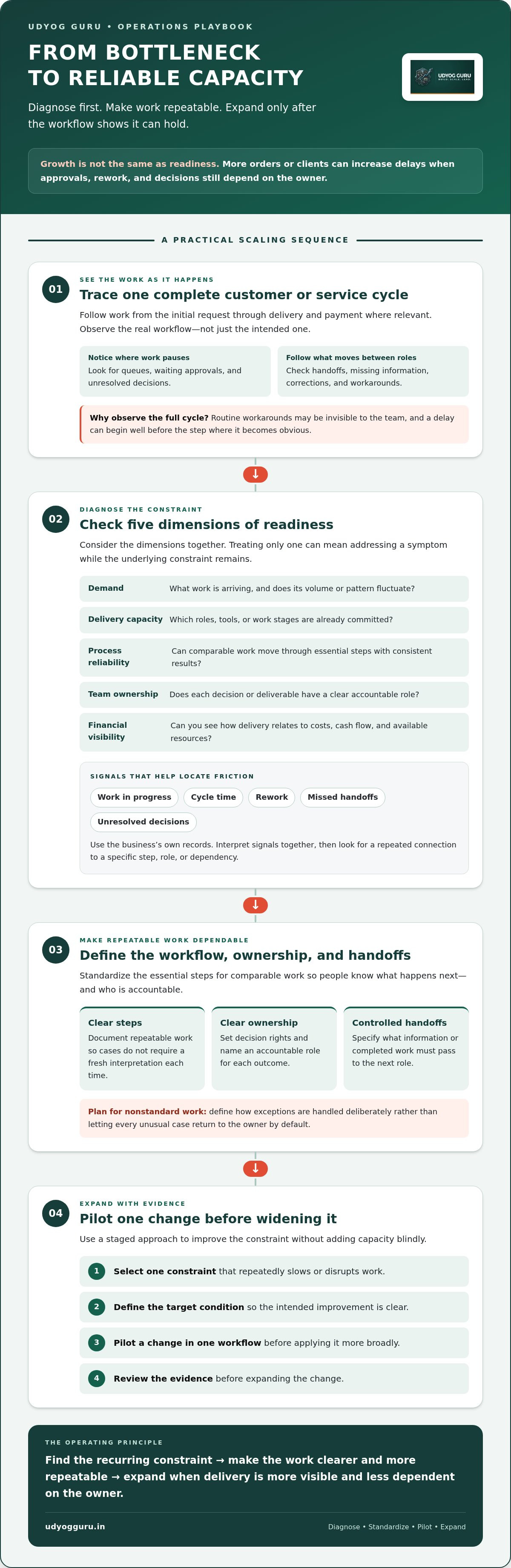
- Assess readiness across demand, delivery, process reliability, team ownership, and financial visibility by observing a complete customer or service cycle.
- Document repeatable workflows with clear decision rights, accountable owners, and handoff criteria, while defining how to handle nonstandard work.
- Use a staged approach: select one constraint, define the target condition, pilot a change in one workflow, and review the evidence before expanding it.
- See how Business X-Ray™ diagnosis and Business Acceleration Engine™ implementation, alongside workforce-focused systems, can support a more structured operating model.
What Does It Mean to Scale Business Operations?
Operational scaling means increasing the amount of work a business can complete while maintaining consistent delivery and avoiding a proportional rise in confusion, rework, or owner intervention. The goal isn’t simply to handle more orders or clients. It’s to make the operating system reliable enough that additional demand moves through defined processes, decisions are made by the right people, and exceptions are handled deliberately.
This is why how to scale business operations is a question of capacity and control, not revenue alone. Sales can rise while delivery still depends on one person’s memory, approval, or last-minute correction. Business Process Management offers a useful way to examine how work is structured and improved. Repeatable processes make it easier to identify where ownership and handoffs need definition.
Use these five conditions as an initial diagnostic:
- Repeatability: Can the work be completed consistently, or does each case require a fresh interpretation?
- Clear ownership: Is one role accountable for each decision and outcome?
- Capacity: Can the team absorb more work without routine delays or quality loss?
- Visibility: Can you see where work is waiting, being corrected, or exceeding available capacity?
- Controlled handoffs: Does each person know what information or completed work must pass to the next role?
How Is Operational Scaling Different from Simply Growing?
Growth describes an increase in sales, customers, or activity. Operational capacity describes whether the business can deliver reliably as volume rises. A business may gain orders yet struggle to fulfil them consistently if its processes, staffing, and decision rights haven’t adapted.
For example, an order may move smoothly from confirmation to fulfilment when volume is low. As orders increase, exceptions may all require the owner’s approval or intervention to resolve missing information. Sales have grown, but the workflow hasn’t scaled: the owner has become its control point, and delays can accumulate there.
Which Signs Show That Operations Are Not Ready to Scale?
Recurring approvals, repeated corrections, unclear ownership, and inconsistent delivery are signals to investigate. One busy period doesn’t prove the operating model is structurally weak. Look for patterns across comparable work: does the same step repeatedly wait for the owner, produce errors, or leave the next person without what they need?
Trace a complete order or service workflow to distinguish temporary workload pressure from a recurring constraint. Note where time is lost, work returns for correction, or decisions pause. If the same bottleneck appears across cycles, address it before adding volume. For a wider view of growth architecture, explore this scaling a business framework.
Diagnose Operational Readiness Before Expanding Capacity
Before adding people, tools, or new demand, examine how the business performs as a connected system. A delivery delay may start with incomplete customer information, unclear decision rights, or a team already committed to other work. Readiness depends on whether demand, delivery capacity, process reliability, team ownership, and financial visibility align. Looking at only one dimension can lead to treating a symptom while the underlying constraint remains.
Follow work through a complete customer or service cycle, from initial request to final delivery and payment where relevant. Observe what actually happens, including pauses, corrections, approvals, and handoffs. Owner impressions can identify concerns, but may miss routine workarounds that have become invisible to the team. A review of operational efficiency also considers how effectively processes and resources support the intended output.
During the observation, check whether the five dimensions reinforce one another:
- Demand: What work is arriving, and does its volume or pattern fluctuate?
- Delivery capacity: Which roles, tools, or work stages are already committed?
- Process reliability: Can comparable work move through the same essential steps with consistent results?
- Team ownership: Does each decision or deliverable have a clear accountable role?
- Financial visibility: Can you see how delivery activity relates to costs, cash flow, and available resources?
Which Operational Signals Should Owners Examine First?
Start with signals that reveal movement and friction: work in progress, cycle time, rework, missed handoffs, and unresolved decisions. Compare demand patterns with the capacity the team and its processes can provide, using the business’s own records rather than assumptions. Choose measures that fit the business model and current constraint. A service team and an order-based business may need different indicators.
Interpret signals together. A longer delivery cycle may reflect a queue of unresolved approvals, while high rework may point to unclear inputs or inconsistent quality checks. Neither measure identifies a cause on its own. Look for a repeated connection between the delay and a specific step, role, or dependency before changing the process.
How Can a Business Locate the Constraint Behind Delays?
Start with a delayed outcome and trace backward through the approvals, inputs, owners, and dependencies required to complete it. Ask where work first stopped progressing, what information or decision was missing, and whether the same point appears across other cycles. A likely constraint is recurring, visible in the work, and within the business’s influence.
A late delivery is an outcome, not automatically the bottleneck. The cause may be earlier in the chain, such as incomplete requests, competing priorities, or decisions waiting with one person. Separating cause from symptom helps you target a repair instead of adding capacity to the wrong stage. For a deeper diagnostic sequence, use this guide to identifying operational bottlenecks.
If the constraint is difficult to distinguish from its symptoms, a structured diagnostic such as Business X-Ray™ can help identify operational gaps before changes are implemented.
Build Repeatable Workflows, Clear Ownership, and Operating Control
A workflow becomes scalable when the people performing it can follow a shared sequence, understand who can make each decision, and identify when work is complete. Documentation reduces variation by recording the standard path, but it shouldn’t force unusual cases into a process that doesn’t fit. Define exceptions and the person or role responsible for resolving them. This creates control without removing the judgment that complex work sometimes requires.
Consider a customer request moving from intake to delivery. The intake step should produce complete information, the next owner should know what to do with it, and the handoff should specify what “ready” means. If any of these conditions is unclear, work may stall or return for correction. Practical guidance on scaling a business also emphasizes building operational readiness alongside growth plans.
| Informal execution | Documented, owned, and reviewable execution |
|---|---|
| Steps vary by person or memory. | Shared steps define the normal path and completion condition. |
| Decisions wait for the owner. | Decision rights and escalation points are assigned by role. |
| Handoffs rely on verbal updates. | Each handoff specifies the required information and next owner. |
| Problems surface after delays or errors. | Review points help identify recurring exceptions and process gaps. |
What Should a Scalable Business Process Document Specify?
Keep the document usable at the point of work. Identify the trigger, required inputs, process owner, key steps, and expected completion condition. Clarify which decisions the process owner can make, what must be escalated, and where human judgment is required. Use language and tools familiar to the team. A detailed document that people can’t use during the workflow won’t guide execution.
For exceptions, state what makes a case nonstandard and how to route it. Don’t document every theoretical scenario. Start with recurring variations that affect quality, timing, or responsibility, then revise the workflow as the team learns where the standard path needs clearer boundaries.
How Do Delegation and Accountability Support Operational Scale?
Delegation is not simply distributing tasks. Assign an accountable owner to an outcome and define the authority needed to move work forward, including which decisions can be made without the owner’s approval. Set a review rhythm that surfaces blockers and recurring exceptions without turning each review into another approval queue.
This structure connects workflow steps, decision rights, and handoffs into one operating system. For deeper process design, explore business process systematization. If implementation support would help translate process gaps into operating changes, Udyog Guru’s structured business systems support is a relevant next step.
Use a Staged Plan to Scale Business Operations
Operational change is more reliable when it addresses a diagnosed constraint rather than several symptoms at once. A staged plan lets you test whether a change improves the work before making it standard across the business. This makes how to scale business operations a sequence of controlled decisions, each guided by evidence from the workflow.
- Choose a constraint. Select a recurring point of friction that affects customer delivery, team capacity, rework, or owner dependency. Define where it occurs, who is affected, and what evidence shows it is recurring.
- Define the desired operating condition. Describe what should happen instead. For example, specify what information must be complete before work moves to fulfilment, who owns that handoff, and which decisions can be made without owner approval.
- Install a focused change. Adjust the process, role clarity, decision authority, or supporting tool that relates directly to the constraint. Pilot the change in one workflow first, involving the people who perform the work.
- Review the evidence. Compare the intended effect with what actually happens. Check relevant observations such as waiting work, corrections, handoff failures, or unresolved decisions. Keep, revise, or remove the change based on what the pilot reveals.
A pilot is a contained test, not a guarantee of success. It can reveal overlooked dependencies, unclear instructions, or exceptions that need a defined route. Record what changed and what the team observed, then refine the process before extending it to other workflows. Expanding too early can reproduce a flawed step across the business.
How Should Owners Prioritize the First Operational Change?
Rank candidate constraints by their effect on customer delivery, team capacity, repeated rework, and dependence on the owner. Then choose a problem with a clear process boundary and observable evidence, such as a recurring queue at one approval step. Before implementation, state both the intended change and the evidence that would suggest it helped. This keeps the review grounded in more than impressions.
When Should Technology or Automation Enter the Plan?
Technology should support a defined operating need, not compensate for an unclear process. First stabilize the workflow, clarify its owner, and identify where human judgment is required. Then consider whether automation can reliably handle a consistent step. For AI-supported work, define which outputs need human review and how exceptions will be routed before introducing the tool into routine operations.
Once a pilot shows a workable process, extend it in a controlled way and continue reviewing whether the original operating condition holds. For structured support in diagnosing gaps and implementing operational changes, explore Udyog Guru’s business systems programs.
How Udyog Guru Supports a More Scalable Operating System
Building a scalable operating system requires more than one process change. Operational gaps, team responsibilities, financial visibility, and technology choices affect one another, so the order of work matters. Udyog Guru’s programs provide structured support across these areas, connecting diagnosis with implementation and workforce systems. This helps business owners approach how to scale business operations through clearer priorities rather than treating each symptom in isolation.
The aim is not to promise a particular growth result. It is to establish a clearer view of how the business operates and use that understanding to guide practical system changes.
How Do Diagnosis and Implementation Fit Together?
Business X-Ray™ is Udyog Guru’s Tier 1 diagnostic offering. It identifies operational gaps that can affect how work moves through the business. Diagnosis helps clarify which issues deserve attention first, so decisions about operational change are based on the business’s structure rather than the assumption that every process needs repair.
Business Acceleration Engine™ is the Tier 2 systems implementation program. The progression links assessment with implementation: findings inform priorities, and those priorities shape the systems work that follows. This creates a disciplined basis for action without claiming a fixed timeline or guaranteed outcome.
How Can Workforce, Financial, and Technology Systems Reinforce Scale?
Operational procedures depend on people knowing their responsibilities and how their work connects to team outcomes. Workforce X-Ray™ and Workforce Acceleration Engine™ support workforce systems and team performance. Role clarity and delegation are connected: when accountability is easier to understand, teams have a clearer structure for carrying out work and coordinating responsibilities as the business develops.
Financial visibility adds another layer of control. The Financial Command Dashboard helps owners see business financial performance and bring relevant information into operational oversight. It complements process and workforce clarity by giving leaders financial signals to consider in business decisions.
Technology should fit the way work is organized. The AI Tech Business Integration Bootcamp is Udyog Guru’s Tier 3 program, focused on integrating technology into existing workflows. It connects technology adoption with actual business processes, rather than treating tools as a substitute for defined ownership or operational diagnosis.
Together, these areas form a structured progression: diagnose operational gaps, implement systems, strengthen workforce operations, improve financial visibility, and integrate technology into existing workflows. Business owners can use Udyog Guru’s programs to develop a more coherent operating system through this progression.
Make Your Next Growth Decision Operationally Sound
Make operational readiness part of how your business evaluates each new commitment. Before adding demand, complexity, or technology, ask whether the operating structure can support it without making the owner the default control point. Treat this as an ongoing management discipline, not a one-time exercise. It keeps decisions about how to scale business operations grounded in the actual needs of the business.
Udyog Guru’s structured programs connect business diagnosis, systems implementation, and financial visibility through Business X-Ray™, Business Acceleration Engine™, and the Financial Command Dashboard. These offerings help business owners examine operational priorities and strengthen the information available for decisions, without assuming every company needs the same changes.
Explore Udyog Guru’s structured business transformation programs to identify a practical next step for your operating system. Sustainable expansion comes from deliberate decisions and improvements that give your team a stronger foundation for what comes next.
Frequently Asked Questions
What is the first step in scaling business operations?
Begin by locating where work repeatedly stops, waits, or returns for correction, then verify the cause using actual cases. For example, compare completed customer proposals and note whether missing scope details, a delayed approval, or a late handoff caused friction. This is a practical first move in how to scale business operations: choose one constraint, record its effect, and define a focused change you can evaluate.
Can a small business scale operations without hiring more employees?
Yes, if avoidable work is consuming capacity the existing team could use more effectively. A business might reduce repeat data entry or clarify who can resolve routine customer queries, freeing time without adding headcount. Still, assess whether the team’s available hours and skills can meet actual demand after those changes. If the workload continues to exceed what the current team can deliver, process improvements alone won’t close the capacity gap.
How do you know when a business is ready to scale?
A business is better positioned to scale when it can deliver a typical customer commitment without constant owner intervention and can explain how it maintains quality. Test this with a representative piece of work handled by the team through its normal process. Note whether staff can resolve ordinary decisions, preserve necessary information, and identify unusual cases. Readiness doesn’t mean every issue is solved. It means key operating conditions are understood well enough to assess added demand.
What systems does a business need before scaling?
Start with systems that support execution and decision-making: a shared way to track active work, clear role expectations, and financial records owners can use to assess business health. For example, if customer projects are underway, the team should be able to identify their current stage and responsible owner without relying on scattered messages. The specific tools can vary. The essential test is whether people can find reliable information and act on it consistently.
Should a business automate its processes before scaling?
Usually, clarify the work before automating it. If staff handle the same request differently because key details or approval rules are unclear, automation may preserve those inconsistencies instead of removing them. First identify stable, repetitive steps and decide which cases require human judgment. Then choose technology for a defined task, such as transferring complete information between stages, and retain a way to review exceptions and correct errors.
What happens if a business scales before its operations are ready?
Higher demand can put more pressure on weak handoffs, uneven quality checks, or decisions that depend on one person. The effects differ by business, and scaling before every process is mature doesn’t guarantee failure. Watch for a practical warning: new work is entering faster than the team can resolve existing delays or corrections. Focus on the affected workflow, address its recurring cause, and reassess capacity before adding further complexity.


