

What if the problem isn’t that your team needs to respond faster, but that the same failures keep returning? When delayed work, customer issues, or last-minute decisions repeatedly interrupt planned priorities, a quick fix may get the day moving again without addressing the underlying cause. Understanding how to stop firefighting in business starts with examining the operating system that keeps producing the same urgent problems.
It’s reasonable to treat an urgent issue as the immediate priority. But if resolution depends on the owner, responsibilities are unclear, or follow-up stops once the pressure passes, the same problem is likely to return. The result is less time for planned work and a team spending its capacity managing symptoms instead of removing their causes.
This guide shows you how to treat recurring issues as signals of deeper operational gaps, then establish clear ownership, escalation, and follow-up without adding unnecessary complexity. You’ll learn how to trace problems back to workflows and decision points, and build more predictable routines. Business X-Ray™ provides a structured starting point for diagnosing operational causes, followed by Business Acceleration Engine™ to help implement improvements.
Key Takeaways
- Separate one-off emergencies from recurring incidents, which can indicate weaknesses in a process or workflow.
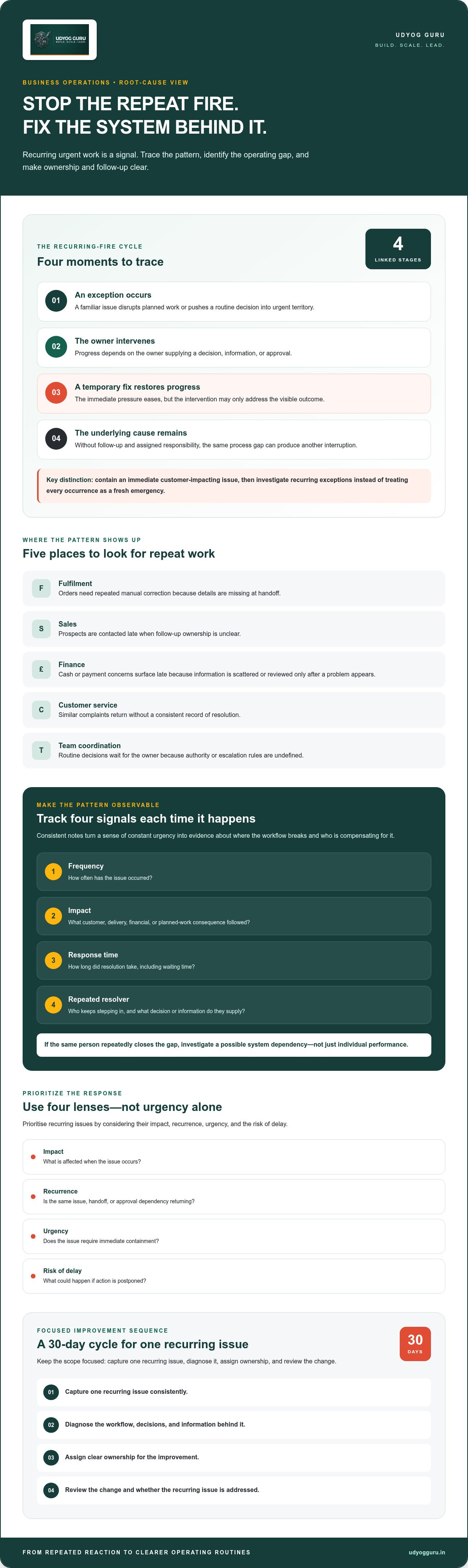
- Trace each repeat crisis through the cycle of exception, owner intervention, temporary fix, and unresolved cause.
- Learn how to stop firefighting in business by prioritising issues according to impact, recurrence, urgency, and the risk of delay.
- Use a focused 30-day sequence to capture one recurring issue, diagnose it, assign ownership, and review the change.
- Use Business X-Ray™ to diagnose operational gaps and Business Acceleration Engine™ to support implementation.
How to Stop Firefighting in Business Starts with Recognizing the Pattern
Business firefighting is recurring reactive work that displaces planned priorities without removing the conditions that caused the disruption. A genuine emergency can require immediate action. But repeated interruptions point to a different problem: the operating process may not reliably handle a predictable situation.
For an owner, this pattern can appear across the company. A delivery is held up until the owner approves a routine exception. A sales enquiry waits because nobody knows who should follow up. A payment issue surfaces late because financial information is scattered. A service complaint returns because the handoff or resolution was never recorded. Each incident may look isolated, yet the same dependency or process gap may sit beneath several of them.
Quick intervention can be necessary without being a complete response. Addressing a customer-impacting issue protects the immediate relationship; examining why it happened helps prevent the same interruption from recurring. A Systems Thinking perspective helps owners consider how connected workflows, decisions, and information shape an outcome instead of treating each incident as an isolated failure. To understand how to stop firefighting in business, identify the repeat pattern before redesigning the process.
What does firefighting look like in a small business?
Look for recurring work that pulls leadership back into routine execution. Team members may pause planned tasks to clarify priorities, wait for approvals, or resolve familiar exceptions. These interruptions fragment attention. Even after the immediate issue is addressed, planned decisions and improvement work may remain delayed.
- Fulfilment: Orders repeatedly need manual correction because details are missing at handoff.
- Sales: Prospects are contacted late when follow-up ownership is unclear.
- Finance: Cash or payment concerns become urgent because information is reviewed only after a problem appears.
- Service: Similar complaints recur without a consistent resolution record.
- Team coordination: Routine decisions wait for the owner because authority or escalation rules are undefined.
Separate immediate customer-impacting incidents from familiar internal exceptions. A service interruption affecting a customer may need containment now. A repeated internal approval delay still deserves attention, but log and investigate it rather than treating every occurrence as a fresh emergency.
When is a business problem a recurring fire?
Check whether the same issue, handoff, or approval dependency keeps returning, even when the details vary. Record each occurrence consistently. This turns an impression of constant urgency into evidence that can show where the workflow breaks and who is repeatedly compensating for it.
- Frequency: How often has the issue occurred?
- Impact: What customer, delivery, financial, or planned-work consequence followed?
- Response time: How long did resolution take, including time spent waiting?
- Repeated resolver: Who keeps stepping in, and what decision or information do they supply?
If the same person repeatedly closes the gap, that may indicate a system dependency, not simply an individual performance issue. A broader Business Diagnostic Scan can help frame questions across connected areas. Start with the observable pattern, then trace what in the business process keeps producing it.
Why Firefighting Repeats: Trace the Business System Behind Each Crisis
A recurring crisis is rarely explained by the final mistake alone. Unclear decision rights, inconsistent routines, delayed information, and constrained capacity can combine to make a process fail in the same place repeatedly. For example, a team may know a task is urgent but lack clear criteria for who owns it, what “complete” means, or when to escalate a delay. The visible incident is the symptom; the operating conditions are often the source.
The cycle is predictable: an exception occurs, the owner intervenes, a temporary fix restores progress, and the underlying cause remains. Because the immediate pressure lifts, there may be no time or assigned responsibility to examine the process. A quick fix can fail to prevent recurrence because it addresses the outcome, not the condition that produced it.
Which operating weaknesses create recurring fires?
Review the workflow across roles, decisions, and information, rather than inspecting only the point where the problem surfaced. Ask whether the team can see current priorities, deadlines, and escalation paths, and whether routine work has consistent instructions. Check whether financial or performance information arrives soon enough to support corrective action, or only after a deviation has become urgent.
- Decision rights: Is it clear which decisions employees can make independently and which require approval?
- Handoffs: Are required inputs, completion criteria, and the next owner defined at each transfer?
- Routine work: Can another team member follow the process without relying on informal memory?
- Capacity and visibility: Are priorities realistic, and can the people doing the work see deadlines, workload, and relevant performance signals?
These are design questions, not accusations. A missed step may reflect an unclear procedure or overloaded workflow rather than carelessness. Examine the system before assigning blame.
How do you trace a recurring issue to its root cause?
Choose one repeated incident and reconstruct its path from trigger to resolution. Keep the scope narrow: understand how the work moved, where it stalled, and what allowed the exception to reach the same point again. A focused review of operational bottleneck analysis can also help identify where work, decisions, or information are getting delayed.
- Record the trigger: Describe what happened, using observable facts rather than assumptions about intent.
- Map the sequence: Note the steps, handoffs, approvals, and information available at each point.
- Measure the effect: Capture the impact on delivery, customers, other work, or decision-making, along with the time taken to respond.
- Locate the enabling condition: Ask what made the incident possible. Was ownership unclear, a required input missing, a decision delayed, or capacity unavailable?
- Name the repeat resolver: Identify who stepped in and what knowledge or authority the process depended on.
This evidence shifts the question from “Who made the mistake?” to “What needs to change so the process can handle this condition reliably?” For a structured starting point to examine operational causes across the business, use the Business X-Ray™ diagnostic.
Firefighting vs. Root-Cause Work: Prioritize the Right Business Response
Not every urgent issue should wait for a process review. If a customer is affected, safety is at risk, or operations are disrupted, contain the immediate impact first. Then assign the corrective work separately, with an owner and a review point, so containment doesn’t become the whole response.
Immediate containment
Use this response when an active issue is harming customers, creating a safety concern, or blocking essential operations. Stabilize the situation, communicate what is known, and record what remains unresolved.
Repeated symptoms
Use this classification when the same type of exception returns, even if each occurrence appears small. Record the recurrence, impact, and people or handoffs involved so the pattern can be assessed rather than handled as an isolated event.
Root-cause correction
Use this work to change the process, decision right, information flow, or capacity condition that allows the issue to recur. Define how the team will verify that the change addresses the cause.
Decision rule: If delay could cause immediate customer, safety, or operational harm, contain the issue now. If the same process defect keeps returning, assign and track a separate corrective action even after the immediate impact is controlled.
To decide what receives attention first, assess four factors together: customer or financial impact, recurrence, urgency, and the risk of continued delay. A high-impact event may require immediate containment even if it is a first occurrence. A lower-impact issue may still merit planned correction if it repeats and continues to consume team capacity. This is a practical way to apply how to stop firefighting in business without treating every issue as equally urgent.
How should owners triage urgent business problems?
Stabilize the immediate effect, then name one accountable owner for the next action. Set a clear review point so the issue doesn’t disappear once the pressure eases. For unresolved risks, use defined escalation thresholds, such as customer impact continuing beyond the agreed response window, rather than relying on repeated informal interruptions to reach the owner.
How can teams prevent a quick fix becoming permanent?
Label the immediate workaround as temporary containment and document the corrective action separately. Give that action an owner, due date, and evidence requirement. For example, confirm that the revised handoff was followed or that the exception no longer occurs in the relevant workflow. This discipline turns a patch into a controlled transition toward business process systematization.
At review, check whether the corrective change addressed the original cause, not just the latest incident. If the issue returns, update the diagnosis and escalate the unresolved process risk. Containment protects the present; verified correction improves the system that governs future work.
A Practical 30-Day Plan to Stop Firefighting in Business
A 30-day cycle gives an owner a defined period to examine one recurring issue, test a process change, and review the evidence. Treat it as a planning framework, not a guaranteed fix or universal timeline. Keep the first cycle narrow: choose one frequent issue with meaningful customer, financial, delivery, or team impact. Trying to repair several workflows at once can make it hard to identify which change affected the result.
Before changing the process, establish a baseline. Record how often the issue occurs, how often the owner intervenes, how long resolution takes, and whether it contributes to missed commitments. Choose measures that fit the problem and capture them consistently. The sequence is straightforward: log the issue, diagnose its cause, install a defined operating change, then test and refine it against the baseline.
Weeks one and two: capture patterns and assign ownership
Use the first half of the cycle to gather evidence and select a process change. A shared issue log gives the team one place to record exceptions, rather than relying on memory or scattered messages. Review entries for repeated triggers, handoff gaps, or decision delays. Assign one accountable owner to investigate the highest-priority pattern and propose a practical adjustment.
Weeks three and four: install, measure, and refine the fix
Use the second half to make the revised workflow visible and testable. Document who owns each step, which decisions they can make, when escalation is required, and what counts as complete. Check the agreed measures regularly, record recurrences, and refine the process if the evidence shows the cause remains. Clear delegation and role design can be strengthened through workforce optimization strategies.
- Capture, days 1 to 7: Start a shared log with the trigger, impact, frequency, temporary fix, and responsible role for each occurrence. Select one issue to address and note its baseline measures.
- Diagnose, days 8 to 14: Compare the entries. Trace the selected issue through its steps and handoffs, then identify the condition that allows it to recur. Assign an owner to propose a process-level correction.
- Install ownership, days 15 to 21: Document the revised workflow, decision rights, escalation route, and completion criteria. Make responsibilities explicit so the new process doesn’t depend on the owner stepping in by default.
- Review and adjust, days 22 to 30: Compare new occurrences and response measures with the baseline. Record whether the issue recurs, check that the revised steps are being followed, and adjust the process where gaps remain.
Keep the review operational: what changed, what evidence supports the change, and what still needs attention? If diagnosis and implementation need a structured starting point, use Business X-Ray™ and Business Acceleration Engine™ as a diagnostic and implementation sequence.
How Udyog Guru Helps Replace Business Firefighting with Operating Systems
Reducing recurring crises takes more than a list of problems. It takes a sequence: diagnose where the operating system is breaking down, decide which gaps to address, then put clearer processes and accountability into practice. Udyog Guru’s business diagnostics and implementation systems support this progression, focusing on the conditions behind repeated interruptions rather than promising to eliminate every urgent issue.
From Business X-Ray™ diagnosis to implementation
Business X-Ray™ is Udyog Guru’s Tier 1 diagnostic starting point for examining operational gaps. It provides a structured way to look beyond individual incidents and identify where processes, decisions, or responsibilities may contribute to recurring problems. This gives owners a clearer basis for prioritising what needs attention instead of relying only on the loudest immediate concern.
Diagnosis is not the same as implementation. Once gaps have been identified and prioritised, Business Acceleration Engine™ is Udyog Guru’s Tier 2 implementation system for improving business systems. The distinction matters: first establish what appears to be happening across the operation, then structure the work of addressing selected gaps. Neither step guarantees that all future exceptions will disappear. Urgent events can still occur, and operating systems need review as conditions change.
For owners considering how to stop firefighting in business, this diagnostic-to-implementation sequence connects a recurring symptom with a deliberate operating response. It also gives the team a shared reference point for decisions, priorities, and follow-up, rather than leaving each resolution dependent on informal owner intervention.
When workforce systems or AI integration are relevant
Some recurring fires are rooted in team responsibilities rather than process instructions alone. If routine approvals repeatedly return to the owner, delegation boundaries may be unclear. If tasks are dropped between roles, accountability or handoffs may need attention. Udyog Guru’s Workforce X-Ray™ and Workforce Acceleration Engine™ address workforce performance and systems, making them relevant when delegation, ownership, or team coordination forms part of the recurring pattern.
Technology may also be relevant when repetitive tasks or workflow steps contribute to delays. Udyog Guru’s AI Tech Business Integration Bootcamp focuses on integrating technology into existing workflows and automating repetitive tasks without custom software development. The aim is to use technology within the operating process, not as a substitute for diagnosing unclear ownership or flawed workflow design.
Where late decisions stem from limited financial visibility, Udyog Guru’s Financial Command Dashboard supports financial visibility and control. It is relevant when missing or delayed financial information is part of the operational problem, rather than a default fix for unrelated issues.
Choose a structured starting point: explore Business X-Ray™ and Business Acceleration Engine™ to move from diagnosing operational gaps toward planned implementation.
Make the Next Operational Improvement Deliberate
The next step isn’t to redesign the entire business at once. Choose one recurring disruption, decide what evidence would show that its process is improving, and make time to review the change. That creates a practical starting point for how to stop firefighting in business: replace improvised responses with operating decisions the team can understand and repeat.
Udyog Guru’s systems support different parts of that work. Business X-Ray™ is the Tier 1 diagnostic offering, followed by Business Acceleration Engine™ as the Tier 2 implementation offering. Workforce-focused tools address related delegation and team-performance needs, while the Financial Command Dashboard supports financial visibility and control when limited information contributes to delayed decisions. The right focus depends on the operational issue being examined.
Build from evidence, not assumptions about what the business needs. Explore Udyog Guru’s business transformation systems and choose a structured next step for improving how your business operates. Consistent, focused changes can create more room for planned work.
Frequently Asked Questions
Is firefighting in business always a sign of poor management?
No. A sudden supplier disruption or unexpected equipment failure can require a capable team to respond immediately. The more useful measure is what happens next: does the business communicate clearly, restore essential work, and examine whether its response needs adjustment? Repeated issues that stay unresolved may indicate a gap in processes or decision-making. That calls for a closer operational review, not an automatic conclusion that an individual or leader is performing poorly.
Can a small business stop firefighting without hiring more staff?
Often, a business can reduce avoidable interruptions without adding headcount, although staffing may be a genuine constraint in some cases. Start by checking where existing capacity goes: duplicated approvals, repeated status requests, or work that could be grouped into a planned review. Then compare workload with actual team capacity. If essential tasks still exceed available time, changing the process alone may not resolve the constraint.
How do I know whether a business issue is urgent or just recurring?
An issue is urgent when waiting could create immediate harm, such as a customer being unable to access a critical service or a time-sensitive commitment being missed. Recurrence describes how often a similar failure happens, not how quickly it needs attention today. Assess these separately: contain immediate impact according to your response priorities, then schedule recurring patterns for investigation. This prevents familiar issues from being treated as emergencies simply because they feel routine.
What should a business owner track to reduce firefighting?
Track details that show both the operational burden and the pattern behind it: when an issue occurs, which workflow it affects, how much work is delayed, and whether a leader must step in. Also record open corrective actions and whether they were completed. A simple weekly review can reveal whether disruptions are concentrated in one process or spread across several. Avoid collecting measures that nobody uses to decide what to change.
Should I document every process before trying to stop firefighting?
No. Documenting everything upfront can consume time without addressing the most disruptive failures. Start with a process that is repeated, difficult to hand over, or sensitive to mistakes. A concise checklist can record the trigger, essential inputs, decision points, and expected completion state. Expand the documentation only when staff need more detail to perform the work consistently. Keep it usable: a process guide that’s hard to find or follow won’t support day-to-day execution.
Can automation alone stop recurring business fires?
No. Automation can handle suitable repetitive steps, but it won’t resolve unclear authority, poor-quality inputs, or a workflow with no defined exception path. Automating an unstable process may simply move errors faster or make them harder to spot. First clarify the task, the information it depends on, and who handles exceptions. Then consider whether technology fits. Review the process after introduction to ensure the automated step supports the intended work.
When should a business use a diagnostic before changing its processes?
Use a diagnostic when the cause is unclear, disruptions appear across several functions, or a local fix keeps shifting the problem elsewhere. It can help establish what is connected before the business makes broader changes. A contained issue with an evident cause may be suitable for a small, reversible adjustment and a planned review. If the evidence is conflicting or decisions rely on assumptions, map the current state first and use that picture to guide the change.


