

Growth that depends on the owner’s constant attention isn’t yet a repeatable system. If revenue, delivery, and team performance become unpredictable whenever the owner steps back, a business growth acceleration program should do more than offer advice. It should identify operational constraints and help turn the diagnosis into working systems. Sustainable growth depends on clear processes, useful performance information, and accountability built into day-to-day operations.
You may already see where pressure builds: decisions bottleneck with you, workforce or financial performance is hard to track, or execution gaps make results difficult to forecast. This guide explains how to assess a program by its diagnostic depth, implementation approach, and ability to establish repeatable systems. It also explains how Udyog Guru’s Business X-Ray™ supports diagnosis and the Business Acceleration Engine™ supports growth implementation, alongside workforce and financial systems that strengthen the operating model. Use the practical checks below to identify what limits growth and decide what kind of support could help your business scale with greater control.
Key Takeaways
- Separate growth activities from changes that improve how work gets done, then judge progress by observable operational improvements.
- Use a business growth acceleration program sequence to establish a baseline, identify constraints, prioritize interventions, and review results.
- Compare programs by their mechanisms: diagnosis, implementation, workforce support, financial visibility, technology, and measurement.
- Assess readiness by checking whether you can define a growth constraint, access useful operating information, and involve the people needed to implement change.
- Business X-Ray™ and Business Acceleration Engine™ connect diagnosis with implementation, with workforce and financial systems supporting the wider operating model.
What a business growth acceleration program should change
A business growth acceleration program should do more than generate ideas or set ambitious targets. It should examine how the business works, identify constraints, and turn the findings into practical changes. Growth depends on how reliably a company attracts and serves customers, makes decisions, coordinates people, and monitors performance. Because constraints differ from one business to another, the response should follow evidence from actual operations rather than a standard formula.
Growth activities can be useful without changing how a business operates. A workshop may introduce a sales method, for example, but if lead follow-up still depends on the owner remembering each next step, execution remains fragile. Durable change means defining the process, assigning responsibility, and making it possible to see whether the process is working. Startup accelerator programs can use mechanisms such as mentorship and education. For an owner assessing a program, the practical question is whether its approach also addresses the operating systems behind growth.
Acceleration means improving the business systems that enable growth, not relying on growth hype. Measurement doesn’t need to begin with a promised revenue result. Start with observable operating signals, such as fewer delays, clearer ownership, more consistent follow-through, or better visibility into financial performance. Choose signals that relate directly to the problem being addressed.
- Recurring bottlenecks: Work repeatedly waits for an approval, a piece of information, or a decision. Note where it pauses and what is needed to move it forward.
- Owner dependency: Routine delivery or problem-solving stalls when the owner is unavailable. Identify which decisions or tasks could be assigned more clearly.
- Weak visibility: Leadership lacks a timely, usable view of workforce or financial performance. List the decisions that are difficult to make with the information currently available.
- Inconsistent execution: The same task produces different results depending on who handles it or how busy the team is. Compare the steps people follow and where they interpret the process differently.
Which business problems can an acceleration program address?
Repeated delays and rework often point to a process defect, unclear decision rights, or missing accountability, not simply a need for people to work harder. Trace a stalled task from request to completion. Record where it pauses, who can make the next decision, and what information is missing. For example, if a customer order waits for approval, distinguish a slow approval step from an incomplete hand-off. That turns a general complaint into a constraint that can be examined and addressed.
Revenue challenges and operational constraints also need separate diagnosis. Weak demand may call for changes to the acquisition or sales process; missed delivery commitments may stem from capacity, hand-offs, or unclear procedures. Financial information matters too. If owners can’t readily see costs, cash movement, or performance against plans, growth decisions can become reactive instead of grounded in evidence. Define the issue in terms of what is happening, where it happens, and what business result it affects before choosing an intervention.
How is acceleration different from training or advice?
Training builds capability by helping people learn a method. Advisory work provides analysis, recommendations, or direction. Both can be valuable, but neither necessarily changes what happens in the business after a session ends. An implementation-focused approach links a finding to an operational change, clarifies who will apply it, and establishes a way to review whether the change is functioning.
Formats vary, and no single delivery model suits every company. Evaluate the mechanism: does it connect diagnosis to action, address the relevant process or accountability gap, and make progress visible? A useful outcome is not simply a plan to grow, but a more repeatable way to execute the work that supports growth. For example, a recommendation to improve follow-up becomes more actionable when the business defines who owns each lead, what the next step is, and how overdue follow-ups will be noticed.
How a business growth acceleration program moves from diagnosis to systems
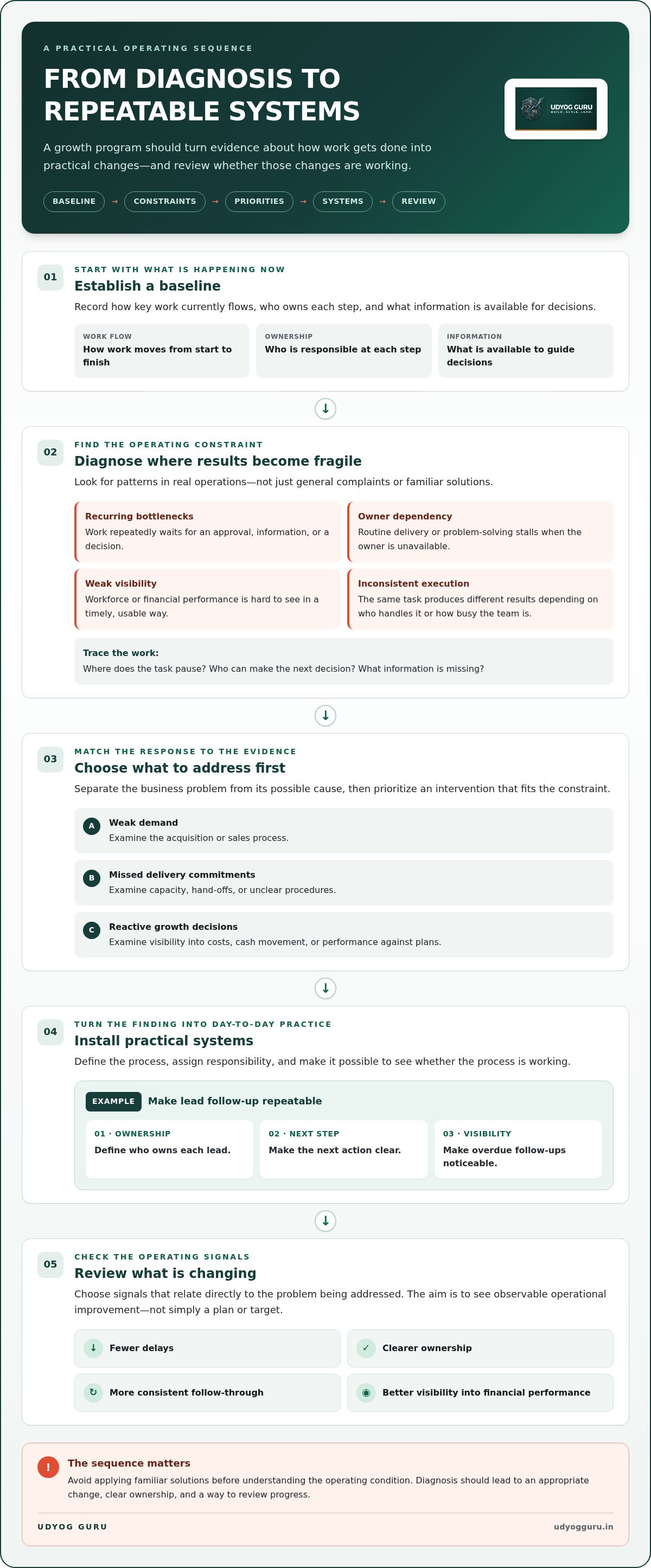
Diagnosis creates value when it leads to a change in how the business operates. A business growth acceleration program should move through a traceable sequence: establish a baseline, identify constraints, choose priorities, install practical systems, and review whether the intended signals are changing. The sequence can stay consistent while the interventions differ. A company struggling with delayed customer delivery may need clearer hand-offs; another with weak financial visibility may need more useful performance tracking.
This method helps prevent a common failure: applying familiar solutions before understanding the actual operating condition. A deeper look at the business diagnostic scan framework can help clarify what a structured examination of operational systems involves.
- Establish a baseline: Record how key work currently flows, who owns each step, and what information is available for decisions.
- Diagnose constraints: Locate recurring delays, rework, unclear ownership, and gaps in performance visibility. Use examples from recent work rather than assumptions.
- Prioritize interventions: Select constraints with meaningful business impact and a practical path to action. Avoid launching multiple changes that compete for the same people’s attention.
- Install systems: Define repeatable processes, decision responsibilities, and ways to monitor execution. Make the steps usable in everyday work.
- Review signals: Compare current operating evidence with the baseline and adjust the system where needed.
Start with an evidence-based business diagnosis
A useful diagnosis maps core operations in enough detail to support decisions: how work moves, who owns each step, which workforce responsibilities are clear or overlapping, and what financial information leaders can access. It separates visible symptoms from possible causes. For instance, a delayed order is a symptom; an unclear approval path or incomplete hand-off may be the underlying process issue. The distinction matters because correcting the symptom alone can leave the bottleneck intact.
Business X-Ray™ is Udyog Guru’s Tier 1 diagnostic offering. It provides a structured view of business systems and operational gaps. Diagnosis doesn’t prescribe the same remedy to every company. It gives owners a clearer basis for deciding what needs attention and why, using the business’s operating conditions as the starting point.
Translate findings into installed operating systems
Once constraints are visible, rank them by their effect on business performance and the practicality of addressing them. A high-impact issue may still need to be sequenced carefully if it depends on another process or role being clarified first. This keeps the action plan focused instead of spreading attention across too many changes at once. A simple priority record can state the constraint, its operational effect, the proposed change, and who will put it into practice.
Installation turns priorities into operating mechanisms. A process can specify the steps and hand-offs; accountability can identify who owns each decision; and performance visibility can show whether work is moving as intended. The Financial Command Dashboard supports financial visibility and control, helping leaders examine relevant information for business decisions. Review the signals, learn from deviations, and refine the operating method. Udyog Guru’s business systems approach connects diagnosis with this implementation focus.
Compare growth acceleration programs by mechanism, not marketing
Program labels and session counts reveal little about what will change inside a business. A cohort can provide shared learning, mentorship can help leaders examine decisions, and network activation can create relationship-led opportunities. Systems implementation addresses a different need: changing how work is carried out, measured, and owned. Compare the mechanism with the constraint you need to solve, then look for evidence of changes in daily operations.
The table compares these approaches across six practical dimensions. A mechanism may be strong in one area and limited in another; the right fit depends on your business’s needs and the work you expect to change.
| Mechanism | Diagnosis | Implementation | Workforce | Financial visibility | Technology | Progress measurement |
|---|---|---|---|---|---|---|
| Cohort learning | Often shared topics | Learning and exercises | Builds participant capability | Depends on the curriculum | May introduce tools | Attendance or learning milestones |
| Mentorship | Discussion of leader challenges | Guidance and recommendations | Can inform leadership decisions | Depends on the focus | May inform choices | Reflection or agreed actions |
| Network activation | Focus on relationships and opportunities | Supports outreach and connection | May clarify relationship ownership | Tracks commercial signals if defined | May use supporting platforms | Engagement or opportunity indicators |
| Systems implementation | Examines business-specific constraints | Changes processes and operating routines | Clarifies roles and accountability | Can establish usable reporting | Integrates tools with workflows where appropriate | Reviews operational indicators against a baseline |
These mechanisms can complement one another, but they aren’t interchangeable. The central test is what the team will do differently after participation. Are responsibilities clearer? Does a recurring workflow have defined steps? Can leaders review relevant performance signals? A business growth acceleration program should make its method assessable through these operational questions, not rely only on session counts or broad promises.
Match the program mechanism to the growth constraint
If strategy is uncertain, look for structured planning that turns choices into operating priorities. If work depends heavily on the owner, examine whether workforce roles, delegation, and accountability are addressed. For repetitive workflows, assess whether process redesign or technology integration can reduce avoidable manual effort. Match the mechanism to the diagnosed constraint, not to a trend. A technology change, for example, is useful only when it supports a defined workflow need.
What evidence makes a program’s method assessable?
Look for a defined baseline, explicit priorities, named implementation responsibilities, and review indicators. These are process signals a business can inspect; broad claims about revenue or growth aren’t equivalent evidence. Check how the intervention connects to routine work and how progress will be observed. For a wider view of the structural demands of scaling, explore this scaling business systems guide.
Assess readiness for a business growth acceleration program
Readiness isn’t defined by ambition alone. A business growth acceleration program is most useful when there’s an operating business to examine, a persistent constraint to address, and enough owner and team participation to put agreed changes into practice. If the problem is vague, make it specific enough to diagnose before setting implementation priorities.
Use this checklist to assess your starting point:
- Existing operations: The business has recurring work, such as serving customers, delivering a product or service, or managing ongoing internal processes.
- Defined constraint: You can describe a repeated issue, such as delayed hand-offs, decisions bottlenecking with the owner, or inconsistent execution.
- Owner participation: The owner can provide context, make decisions, and support changes to responsibilities or routines.
- Access to information: Relevant process, workforce, and financial information can be reviewed, even if it’s currently spread across different records.
- Capacity to implement: People responsible for the affected work can help document and adopt a revised process.
Implementation readiness rests on three foundations: clear ownership, baseline information, and a defined review rhythm. If one is missing, identify how to establish it as part of the work.
Signals that a business may be ready
Readiness is visible in recurring work that can be mapped and improved, not just in a general desire to grow. The owner can point to a persistent constraint and explain where it affects delivery, decisions, or performance. Relevant team members can contribute practical details about how work gets done and take part in adopting an improved method. These conditions make diagnosis more grounded and implementation more feasible.
Questions to resolve before implementation begins
Before changes start, agree on which constraint should be addressed first and what evidence makes it the priority. Identify the person responsible for coordinating implementation, the team members affected, and how progress will be reviewed. A useful business process systematization guide offers further context for examining how work can become more consistent and scalable.
Also distinguish a systems problem from a different business need. A funding gap calls for a financing decision; a shortage of people may require a workforce or hiring response; a need for new software is distinct from improving the process around tools already in use. These needs can intersect, but they aren’t interchangeable. Clarifying the primary constraint helps set a realistic scope for implementation rather than expecting one program mechanism to solve unrelated problems.
If operational evidence is incomplete, readiness doesn’t have to mean waiting indefinitely. Start by assembling what exists: a recurring task, its owner, common delays, and the information used to judge performance. That record can reveal what needs examination and who should be involved. Udyog Guru’s business diagnosis and systems implementation approach connects a defined constraint with practical operating changes.
How Udyog Guru connects business diagnosis with growth implementation
A useful business growth acceleration program connects two distinct stages: understanding how the business currently operates, then addressing the systems that constrain its capacity to grow. Udyog Guru’s tiered structure reflects that distinction. Business X-Ray™ is the Tier 1 diagnostic offering, while Business Acceleration Engine™ is Tier 2, the implementation-oriented next step. The sequence helps owners examine what needs attention before deciding where operational change is required.
Understand the roles of Udyog Guru’s named systems
Business X-Ray™ focuses on diagnosis, creating a structured view of business operations and gaps that may affect performance. Business Acceleration Engine™ is the growth implementation tier, connecting diagnosed priorities with work to strengthen operating systems. They have complementary but distinct roles: diagnosis clarifies where attention is needed, and implementation addresses how the business can act on those findings.
Workforce systems extend this approach to the people and responsibilities involved in delivering work. Workforce X-Ray™ examines workforce performance and optimization through a diagnostic lens, while Workforce Acceleration Engine™ focuses on workforce optimization within business operations. These tools are relevant when a constraint relates to role clarity, accountability, or how work is distributed across the team. They help owners consider workforce issues as part of business performance, rather than in isolation.
Financial visibility and technology integration support other parts of the operating model. The Financial Command Dashboard supports financial visibility and control, helping owners access a clearer view for business decisions. The AI Tech Business Integration Bootcamp focuses on integrating technology into existing workflows, including automation of repetitive tasks without custom software development. Technology integration is a specific operational capability, not a replacement for diagnosing the underlying constraint or deciding whether automation fits the process.
Together, these offerings address different layers: business diagnosis, growth implementation, workforce performance, financial control, and technology integration. Their relevance depends on the actual constraint. A business facing unclear workforce responsibilities may need to examine roles and accountability, while one seeking better financial oversight may focus on visibility. Match the system to the requirement instead of applying every tool by default.
Choose a logical next step for your business
Use three questions to guide the decision: What is the primary constraint? Is there enough operational information and owner participation to examine it? What kind of support is required to implement a change? If the issue isn’t clear, begin with diagnosis to define it. If the priority is understood, focus on the implementation support and operating systems relevant to that finding.
A defined next action can be modest: document one recurring bottleneck, identify who owns the process, and note what evidence would show whether it is changing. Owners seeking a structured systems approach can explore Udyog Guru’s business transformation programs and identify the tier or supporting system that aligns with their current need. Start with business evidence, then choose changes the team can implement and review.
Make the next growth decision actionable
Growth doesn’t have to start with a sweeping overhaul. Choose one recurring point of friction, then treat it as a design question: what should happen differently, and how will the team know the change is working? That focus turns improvement from an abstract ambition into a practical next step, while leaving room to adjust as the business learns.
A business growth acceleration program should connect that priority to the right operating changes, rather than add activity for its own sake. As the business evolves, systems supporting execution, workforce performance, financial control, and technology integration can be considered as connected parts of its operating architecture.
Ready to examine a constraint and identify a structured path forward? Explore Udyog Guru’s business transformation programs. Start with the question your business most needs to answer, then build a practical plan around it.
Frequently Asked Questions
What is a business growth acceleration program?
A business growth acceleration program is a structured approach to identifying barriers to performance and strengthening the systems that support growth. Its method can vary: some programs centre on peer learning or mentorship, while others work on a company’s internal operations. Before choosing an approach, define a practical question you need answered, such as why customer enquiries aren’t consistently progressing to sales. Then look for a method that addresses that issue and makes progress observable.
Who should consider a business growth acceleration program?
Consider one if your business is operating and a recurring obstacle is limiting execution, such as customer work piling up at one hand-off or routine decisions repeatedly returning to you. Bring examples, not just an ambition to grow: a delayed task, an unclear responsibility, or a report you can’t use to guide action. You’ll also need time and team involvement to test changes. Funding shortages or a need to hire may require a different response.
How is a growth acceleration program different from a business accelerator?
The labels can overlap, so compare the work rather than the name. A business accelerator commonly refers to a structured program that may combine cohort learning, instruction, mentorship, and business connections. A growth acceleration program may instead concentrate on internal operations and implementing business systems. For example, if your challenge is a slow approval process, determine whether the format helps change that process or mainly provides learning and discussion.
How long does a business growth acceleration program take?
There’s no standard duration; timing depends on the program’s design, the scope of the work, and the company’s ability to act on decisions. A fixed-calendar course and an implementation effort shaped around operational priorities can follow different schedules. Map the intended stages, such as assessment, action, and review, and consider what your team can realistically implement alongside normal work. A shorter timeline alone doesn’t establish that the method is suitable.
How can a business measure whether an acceleration program is working?
Choose indicators linked to the problem before changes begin. If the issue is approval delays, for instance, track how long a decision takes; if hand-offs cause rework, record where tasks return for correction. Compare those observations over time, and distinguish operational changes from participation measures such as sessions attended. Revenue may be influenced by market conditions and other business decisions, so avoid treating a change in sales alone as proof that a program caused it.
Can a business growth acceleration program work with existing software and processes?
Yes. Improvement can begin by examining how existing tools support the workflow, where information is duplicated, and which steps still rely on manual follow-up. Technology should address a defined need rather than be added simply because it’s available. Udyog Guru’s AI Tech Business Integration Bootcamp focuses on integrating technology into existing workflows, including automation of repetitive tasks without custom software development.
Is an acceleration program useful for a small business in India?
It can be useful if the business has recurring operations, a specific constraint, and the capacity to act on improvements. Size alone doesn’t determine fit: a small team may need clearer task ownership, while another business may need better visibility into its operating information. Across India, assess the method against your actual workflow, team responsibilities, and ability to review changes. A useful program should make its approach and implementation roles understandable.


