
A business mastery program that leaves your company dependent on your judgement has transferred ideas, not installed a system. A search for business mastery programs india can return short workshops, self-paced courses and longer implementation programs, but these formats solve different problems. The right choice depends on what is constraining your business, whether that is lead generation, operational clarity or responsibilities that still sit with you.
It is reasonable to expect more than attendance records or completed modules. A useful program should help identify the underlying constraint, connect it to practical changes and show how progress will be assessed. This article compares programs by what they diagnose, implement and measure, so you can judge fit before committing.
You will also see how a diagnosis-first path can connect business systems with workforce responsibilities, financial visibility and technology integration. Udyog Guru’s progression from Business X-Ray™ to Business Acceleration Engine™ and the AI Tech Business Integration Bootcamp shows how assessment can lead into implementation. The aim is to give you a clearer basis for choosing a structure that improves how your business operates, not simply what you know.
Key Takeaways
- Business mastery programs india can range from knowledge-focused courses to pathways that support practical systems implementation. Compare them by purpose, not format alone.
- Identify the operational constraint behind a growth problem before choosing training or implementation.
- Assess program fit through diagnostic depth, practical application, implementation, measurement and audience, rather than course hours or testimonials alone.
- Match the support to the constraint, whether it involves owner dependency, workforce performance, limited financial visibility or technology friction.
- Explore how Udyog Guru’s pathway links Business X-Ray™ diagnosis with business systems implementation and technology integration.
What Do Business Mastery Programs in India Actually Teach?
The label “business mastery” can describe several different learning and support models. Some programs teach concepts through workshops or lessons; others guide decision-makers through structured professional learning. An implementation pathway goes further by diagnosing an operating issue and applying changes to the practices and systems through which a business runs. The name alone does not tell you which model you are considering.
A business mastery program is structured learning or implementation designed to improve business performance. Education explains business methods, while implementation puts selected methods into operating practice. This distinction matters when assessing business mastery programs india: a course can build understanding without changing responsibilities, workflows or management routines. Professional learning sits within a broader education system in India, as outlined in Education in India. But a program’s educational framing does not, by itself, show how it applies to an individual company.
How business mastery formats differ
Format provides a starting point for understanding what a program is designed to do. It does not establish quality or suitability, but it helps set expectations about how learning may translate into work.
- Workshops are time-limited learning experiences focused on selected topics or challenges. Participants may leave with frameworks or ideas, but a workshop should not be assumed to include follow-through or implementation support.
- Self-paced course bundles collect lessons across subjects such as sales, marketing, finance or leadership. Learners control the pace, while applying the material to a specific company’s operating constraints is their responsibility unless the program includes further support.
- Executive programs provide structured professional learning for decision-makers. They can develop management knowledge and strategic perspective, but learning for leaders is distinct from installing new processes across an organisation.
- System implementation pathways focus on diagnosing an operating issue and applying changes to business practices. Their scope can differ, so look at the stages, support and measures involved rather than relying on the label.
What business owners should expect from an implementation pathway
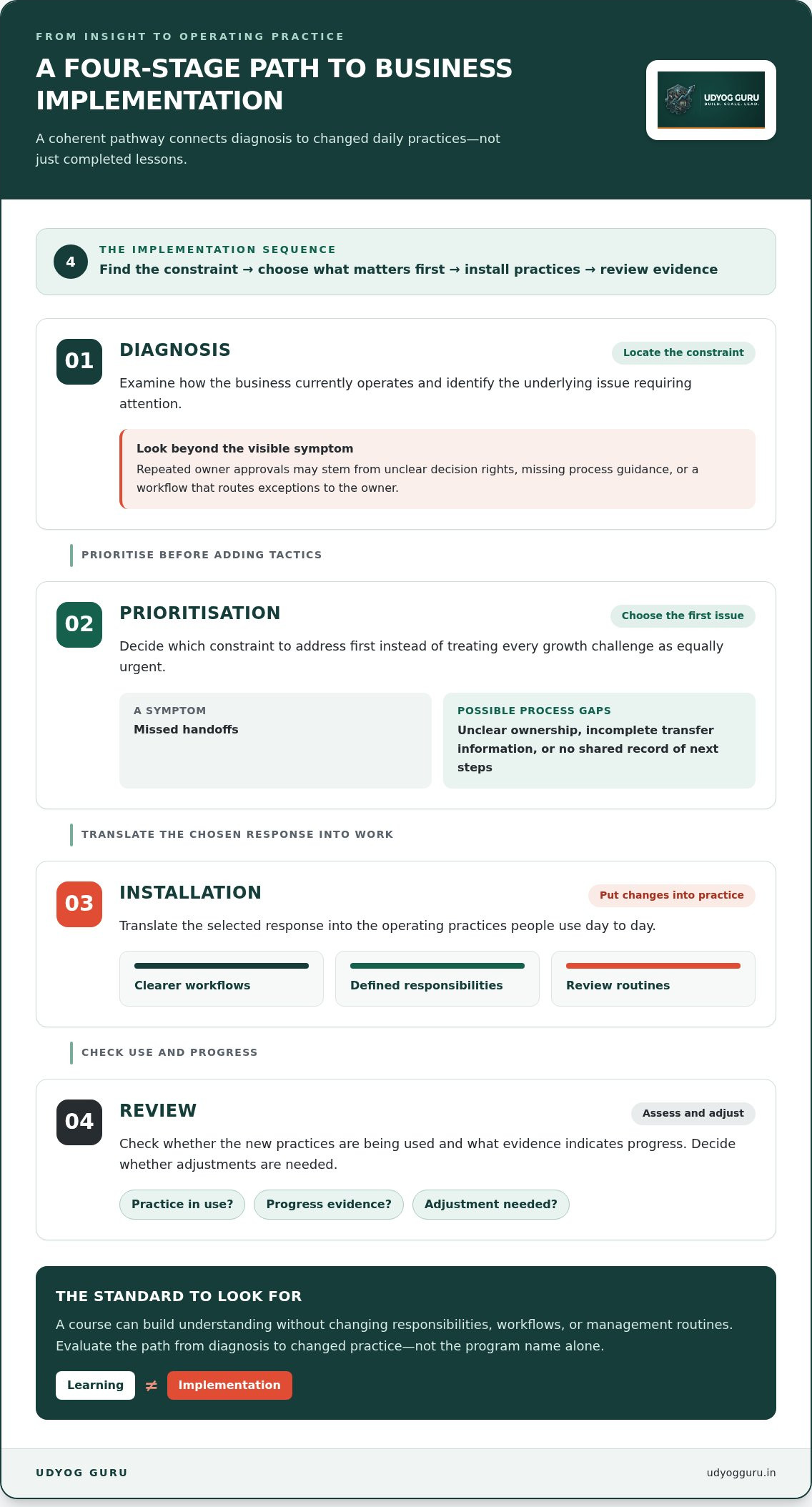
A coherent implementation sequence makes the connection between insight and daily operations explicit. Assess it through four distinct stages:
- Diagnosis: Examine how the business currently operates and identify the constraint requiring attention.
- Prioritisation: Decide which issue to address first, rather than treating every growth challenge as equally urgent.
- Installation: Translate the chosen response into operating practices, such as clearer workflows, responsibilities or review routines.
- Review: Assess whether the new practices are being used and what evidence indicates progress. Then determine whether adjustments are needed.
These stages connect business learning with the way work is assigned, completed and reviewed. For example, a lesson on delegation may explain principles. An implementation process would also examine where decisions currently sit and how responsibilities can be made clearer. Program duration, format and deliverables vary, so neither the word “mastery” nor a course catalogue proves that implementation is included. Evaluate the path from diagnosis to changed practice.
Why Diagnosis Must Come Before Business Growth Training
A business problem is a signal, not a diagnosis. Slowing sales, delayed delivery or an owner’s overloaded calendar can each have different causes. If you select training based only on the visible symptom, you may add tactics while leaving the operating constraint untouched. Diagnosis helps locate where the system is failing before you commit time and attention to a solution.
For example, repeated owner approvals may look like a delegation issue. The underlying cause could be unclear decision rights, missing process guidance or a workflow that routes every exception to the owner. Each cause calls for a different response. A general leadership lesson may build awareness, but it will not necessarily clarify who can make which decision or how work should move between roles.
Distinguish symptoms from operational causes
Look for the process behind a recurring frustration. Missed handoffs might reflect unclear ownership between sales and delivery, incomplete information at the point of transfer, or no shared record of next steps. Inconsistent reports may result from teams using different definitions or recording information at different stages. Adding a sales tactic or reporting tool without examining the process can increase activity without resolving the cause.
The Business Diagnostic Scan framework offers a useful way to think about this distinction: examine operations to locate friction, rather than treating each symptom as an isolated problem. The objective is not to label a team or individual. It is to identify the process, decision or information gap that repeatedly produces the same outcome.
Build a prioritised diagnosis
Use this short sequence before selecting a course, workshop or implementation pathway. Make the assessment specific enough to guide action:
- Define the symptom. State what is happening in observable terms, such as approvals repeatedly returning to the owner or customer details missing at handoff.
- Locate the process. Identify the business function and recurring workflow involved. Map the people, decisions and information moving through it.
- Identify evidence. Review available records, such as task ownership, approval trails, handoff notes or reporting practices. Compare repeated instances with isolated exceptions before treating the issue as a pattern.
- Set the priority. Choose the constraint that most directly blocks the business’s current operating objective. Record why it comes first and what observable practice should change.
This sequence helps prevent simultaneous, unfocused change. If the evidence points to unclear responsibilities, process and accountability work may take priority over adding another marketing tactic. If reporting is the bottleneck, the first task may be to clarify how information is captured and reviewed.
For businesses that need a structured starting point, Udyog Guru’s Business X-Ray diagnostic offering connects diagnosis to prioritised business improvement. The result is a firmer basis for choosing the next step: address the constraint revealed by operating evidence, not simply the symptom that is easiest to notice.
How to Compare Business Mastery Programs in India
Compare a program’s operating design, not just its syllabus. Course hours indicate time spent learning, testimonials describe selected participant experiences, and bold outcome statements are promotional claims unless they are tied to clear evidence. None of these factors alone shows whether a program addresses your business’s needs or supports changes in day-to-day work.
Compare the operating change supported, not just the content delivered. Use the criteria below to distinguish knowledge transfer from a process that connects business-specific priorities with practical application and review.
| Criterion | What to examine | Fit question |
|---|---|---|
| Diagnostic depth | Does the program assess business-specific constraints, or begin with a fixed curriculum? | Can its starting point reflect your operating priorities? |
| Practical application | Does learning connect to actual workflows, decisions or responsibilities? | What will participants apply in the business? |
| Implementation | Is the offer instruction, guided application or support for putting systems into use? | Who is expected to translate lessons into practice? |
| Measurement | Does it define observable progress beyond attendance or course completion? | How will you assess whether the intended practice is changing? |
| Audience | Is it designed for owners, functional leaders, teams or another decision-making group? | Does that audience match your role and business stage? |
Compare programme design and implementation
Read the program structure to understand the sequence it supports. A fixed curriculum may be useful for building broad knowledge, while a business-specific diagnostic can shape what receives attention first. Then distinguish three levels: instruction explains a method; guided implementation helps participants apply it; ongoing system use concerns whether the practice becomes part of regular operations. These are different forms of support, not interchangeable labels.
Check how responsibilities and progress reviews fit into the design. If a program addresses workflow changes, identify whether leaders, process owners or team members are expected to participate, and whether review points are described. The aim is to understand what changes during the program and what practice is expected to continue afterwards.
Assess evidence and suitability
Separate verifiable details from outcome language. Published information about curriculum, format, time commitment, intended participants and internal involvement can help you judge practical fit. Statements promising dramatic growth do not explain the conditions, measures or implementation behind that result. Treat testimonials as individual accounts, not as a substitute for knowing how progress is assessed.
For business mastery programs india, match the intended audience to your role and the people who would need to apply the learning. An owner-focused curriculum may not address a process that depends on several teams; a broad executive program may not target one specific operational constraint. Use the criteria to narrow your options, then consider a diagnosis-led business pathway when your priority is connecting assessment with operating change.
Which Business Mastery Program Fits Your Current Constraint?
The right path depends on where work is getting stuck, not on which subject sounds most comprehensive. For businesses comparing business mastery programs india, map the recurring constraint to the kind of support it requires. Owner dependency, weak financial visibility, workforce performance and technology friction are different operating issues, so they call for distinct starting points.
- Decisions repeatedly return to the owner: Examine how responsibilities, workflows and decision-making are structured. A broader business systems implementation focus may be relevant when the issue extends across operations, rather than sitting in one isolated task.
- Performance is difficult to see: If financial information is hard to interpret or review consistently, financial visibility may be the priority. The Financial Command Dashboard addresses this operating dimension.
- Team responsibilities or performance need attention: Workforce systems can help focus on how roles and team performance relate to the business’s operating needs. Workforce X-Ray™ and Workforce Acceleration Engine™ address this people-related dimension.
- Technology is creating friction: If tools or AI are difficult to connect to existing ways of working, the AI Tech Business Integration Bootcamp focuses on technology integration into workflows.
Growth architecture is a related but distinct question. If the primary challenge is how the business is structured to support expansion, explore structural business scaling as a separate lens rather than assuming a general growth course will address the underlying design.
When the business needs operational diagnosis
Recurring uncertainty is a signal to scan before selecting a wider implementation path. Notice whether staff interpret processes differently, ownership is unclear, or performance information does not provide a consistent view of what is happening. These patterns suggest that the constraint itself needs to be located before choosing what to change. A focused guide to operational bottleneck identification can help clarify that assessment.
Business X-Ray™ is Udyog Guru’s Tier 1 diagnostic offering. It provides a starting point when the priority is understanding where business operations need attention. If the constraint is already clear and calls for wider operating changes, Business Acceleration Engine™ is the Tier 2 implementation pathway. The distinction is practical: scan when the problem is uncertain; focus on implementation when the need is defined.
When the constraint involves people or technology
Choose workforce support when the central question concerns team performance, responsibilities or how people’s work connects to operational needs. Choose workflow-focused technology integration when the issue is adopting AI or technology within existing processes, rather than treating technology as a standalone fix. For a related planning perspective, see AI implementation planning for SMEs.
Match the pathway to the diagnosed constraint, then define the operating practice you want to examine or change. Explore Udyog Guru’s business systems pathways to identify a relevant starting point.
How Udyog Guru Structures Business Mastery From Diagnosis to Implementation
Udyog Guru’s framework connects business diagnosis with implementation and technology integration. Its tiers have distinct roles: Business X-Ray™ is the Tier 1 diagnostic offering, Business Acceleration Engine™ is Tier 2, and the AI Tech Business Integration Bootcamp is Tier 3. This gives business owners a way to look beyond course content and consider what kind of operating support their current priorities call for.
The framework does not mean every business must move through all three tiers in sequence. The useful question is which operating need is most relevant now: understanding where attention is needed, pursuing broader business systems implementation, or integrating technology into existing workflows.
From Business X-Ray™ to the Business Acceleration Engine™
Business X-Ray™ serves as the diagnostic starting point. Its role in the pathway is to direct attention toward business needs before selecting a broader response. A diagnostic step is especially relevant when the business has several symptoms but the central constraint is not yet clear.
Business Acceleration Engine™ is the Tier 2 offering. In the framework, it follows diagnosis as the business systems implementation pathway. The underlying logic is straightforward: first identify the areas requiring attention, then focus implementation on the systems relevant to those priorities. This avoids treating a program label as proof of specific deliverables or assuming that every business requires the same changes.
For an owner comparing business mastery programs india, this progression offers a practical evaluation lens. Consider whether your immediate need is to clarify the business situation or move forward with a broader implementation focus. The appropriate starting point depends on the constraint, not on an assumption that every tier must apply.
Extend the system across workforce, finance, and AI
Operational performance also depends on connected dimensions beyond core business processes. Udyog Guru’s offerings address workforce systems, financial visibility and technology integration as distinct areas:
- Workforce X-Ray™ and Workforce Acceleration Engine™ are workforce-focused offerings. They bring the people and team-performance dimension into the wider business improvement framework.
- Financial Command Dashboard addresses business financial visibility, complementing operational work with a focus on how financial information can be viewed.
- AI Tech Business Integration Bootcamp is the Tier 3 offering, focused on integrating technology into existing workflows rather than developing custom software.
These areas can complement broader operational improvement, but they represent different needs rather than interchangeable solutions. A workforce concern points toward examining team systems; limited financial visibility calls for attention to that dimension; technology friction makes workflow integration relevant.
A measured next step is to identify the operating area that needs the clearest attention, then assess whether diagnosis, implementation, workforce support, financial visibility or technology integration best matches it. That gives you a reasoned basis for exploring Udyog Guru’s framework without assuming that one pathway fits every business.
Turn Your Next Business Decision Into a Clear Starting Point
Your next step does not need to be a complete business overhaul. Choose one operating constraint that matters now, then decide what evidence would show that it is changing. This keeps the decision practical: the aim is not to collect more business knowledge, but to make a deliberate move toward a business that can operate with greater clarity and less dependence on guesswork.
For owners assessing business mastery programs india, Udyog Guru’s framework offers a progression from Business X-Ray™ to Business Acceleration Engine™ and the Tier 3 AI Tech Business Integration Bootcamp. Dedicated workforce offerings and the Financial Command Dashboard address additional operating dimensions, so your next step can reflect the area that needs attention rather than a one-size-fits-all agenda.
Start by identifying the constraint you want to address and explore how the framework aligns with that priority. Explore Udyog Guru’s business transformation programs and take a considered step toward stronger operating systems. Clearer decisions begin with a clear starting point.
Frequently Asked Questions
What is a business mastery program?
A business mastery program is structured learning or implementation intended to strengthen business capability and performance. It may take the form of a workshop, a set of online lessons, or a program that examines business operations and supports changes. For example, a founder might learn financial planning concepts in a course, while an implementation pathway may connect those concepts to the company’s own review routines. The program’s practical application matters more than its label.
How do I choose a business mastery program in India?
Start with the business constraint you want to address, such as inconsistent customer follow-up or limited visibility into costs. Then compare diagnostic depth, implementation support, progress measurement, intended audience and the commitment expected from you and your team. For business mastery programs india, distinguish published details, such as curriculum and format, from claims about future outcomes. A structured fit assessment can narrow the options without assuming that one format suits every company.
Are business mastery programs suitable for small businesses?
They can be suitable when the program addresses a priority that matters at the business’s current scale and the decision-maker can participate. A small firm with repeated rework, for instance, may need clearer process ownership rather than a broad curriculum covering unrelated functions. Consider the time available to examine existing practices and apply changes. Suitability depends on the program’s intended audience and approach, so do not assume every option is designed for every company size.
What is the difference between a business course and an implementation program?
A business course primarily organises instruction, such as lessons on pricing, cash-flow planning or customer acquisition. An implementation program may also connect learning and diagnosis to changes in business processes, such as introducing a consistent way to review proposals before they are sent. The distinction is about structure, not a guarantee: some courses include applied work, and program formats vary. Read the stated design to understand how learning relates to operational practice.
Can a business mastery program help reduce owner dependency?
A program may help address owner dependency if its scope examines why decisions and tasks repeatedly require the owner’s involvement. The causes might include undocumented procedures, unclear authority or responsibilities that have never been assigned explicitly. Changes need to be put into practice and used consistently; participation alone will not remove reliance on the owner. For instance, documenting approval limits can clarify which routine decisions a team member may handle independently.
How can I tell whether a business program delivers practical results?
Look for a clear link between the starting problem, the operating change being pursued, the people responsible for applying it and the method for reviewing progress. For example, a program focused on customer follow-up could specify how the team will record next steps and review open enquiries. These process indicators help assess practical application, but they are not guaranteed financial outcomes. Compare the published program details with the constraint you have identified in your business.


