

What if the safest way to keep control of your business is to stop making every decision yourself? If routine approvals keep returning to you, customer context sits in your head, and delegation feels risky, the problem may be unclear decision rights rather than a lack of effort. To reduce business owner dependency, identify where the business relies on you unnecessarily and define how responsibility can move without losing visibility.
This doesn’t mean stepping away blindly. Transfer work and authority in measurable stages, with clear operating rules, performance measures, and escalation paths. You stay informed while the team gains defined room to act.
This article shows you how to diagnose owner-dependent activities, clarify who owns each decision, and build practical procedures for consistent execution. It also explains how workforce systems and performance visibility can support oversight as responsibilities shift. The sequence starts with diagnosis, then moves to structured implementation, an approach reflected in Udyog Guru’s Business X-Ray™ and Business Acceleration Engine™.
Key Takeaways
- Spot owner dependency by mapping recurring work across commercial, operational, and administrative functions.
- Record who makes each decision, what knowledge it requires, and what happens when the work stalls.
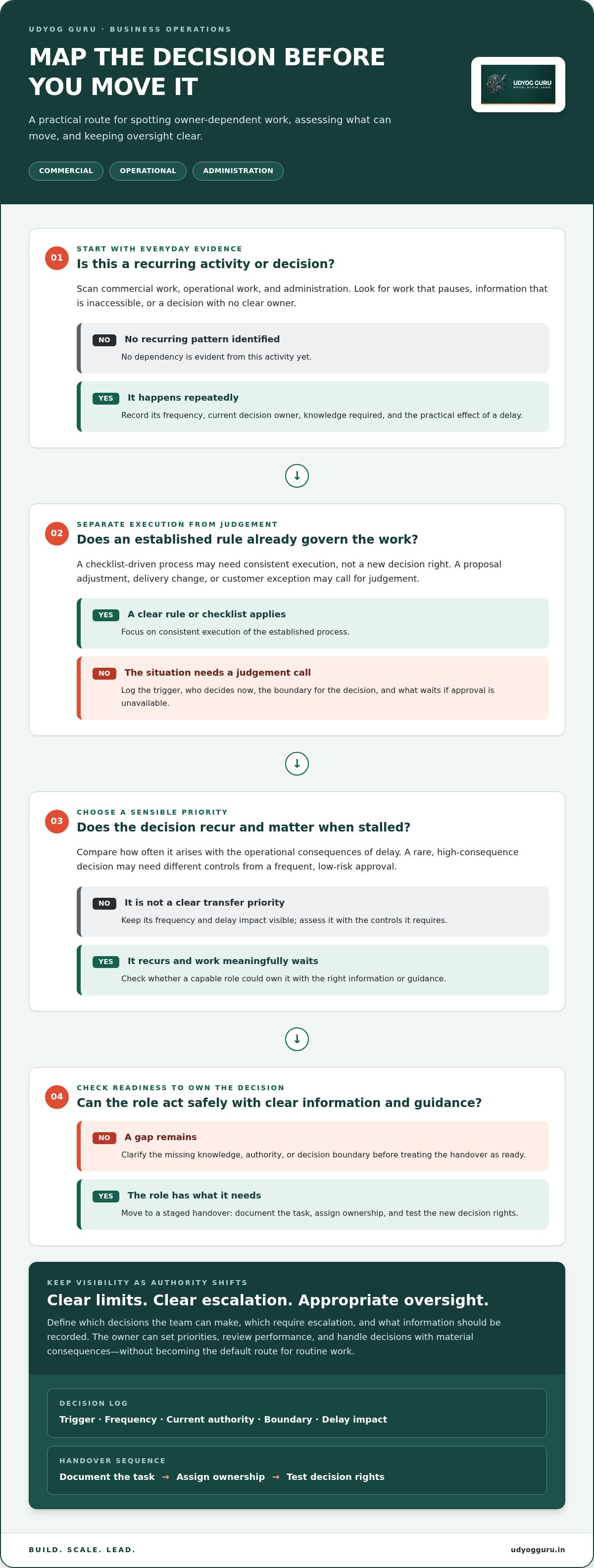
- Reduce business owner dependency through a staged handover: document the task, assign ownership, and test the new decision rights.
- Set clear operating limits and escalation paths so the team can act while you retain appropriate oversight.
- Diagnose the operating gaps before changing roles or workflows, then strengthen ownership, accountability, and visibility.
What Does It Mean to Reduce Business Owner Dependency?
A business is owner-dependent when essential work or decisions cannot progress without the owner’s input, approval, or unwritten knowledge. To reduce business owner dependency is to make routine work move through clear responsibilities and decision rules while preserving appropriate oversight. The goal isn’t to remove the owner from the business. It’s to stop the owner becoming the default route for every operational issue.
Quotable definition: Owner involvement is strategic when it sets direction and boundaries; it becomes a bottleneck when normal work stops until the owner responds.
Healthy oversight includes setting priorities, reviewing performance, and handling decisions with material consequences. Routine operational dependence looks different: a team member waits for approval on a familiar customer response, a manager cannot resolve a standard workflow exception, or a process relies on details only the owner knows. Delegation supports this distinction. In Delegation in Management, authority is assigned so others can act within defined responsibilities, rather than merely receiving tasks to complete.
Which Signs Show That a Business Depends Too Much on Its Owner?
Look for repeated patterns, not isolated requests. Customer escalations may consistently reach the owner even when the issue falls within a team member’s role. Routine approvals may queue in the owner’s inbox, or work may pause because no one knows who can approve a change. A supplier question, scheduling exception, or standard service adjustment can each reveal a gap when the next step is unclear.
Record recurring approval requests, unresolved handoffs, decisions reopened for owner review, and tasks delayed while someone seeks missing context. For each instance, compare the expected next step with what happened: who had the information, who had authority, and where did the work stop? These observations are stronger evidence than a general impression that “everything comes back to me.” The useful measure is whether essential work repeatedly stalls at the same decision point.
Why Is Owner Dependency an Operating Risk?
When customer history, process knowledge, or exception-handling rules sit primarily with one person, continuity depends on that person being available and able to respond. If they’re occupied or temporarily unavailable, decisions can wait, handoffs can remain unresolved, and customers or employees may receive inconsistent answers. This is a structural risk, not a prediction that disruption will occur.
Approval queues also limit team autonomy. Employees may learn to seek permission rather than apply judgement, even in familiar situations. That slows normal operations and prevents managers from building decision capability. A more resilient structure defines which decisions the team can make, which require escalation, and what information should be recorded so others can act consistently.
Reducing owner dependency is relevant beyond a future sale. It supports continuity, helps the organisation handle work across its roles, and allows decisions to move to the people who have the necessary information. For broader context on how roles and operating structure support sustainable growth, see this business scaling framework.
How to Diagnose the Work and Decisions That Depend on You
Start with evidence from everyday work, not assumptions about which roles should change. Build an inventory across three operating areas: commercial activity, such as qualifying enquiries and approving proposals; operational activity, such as scheduling work and resolving delivery exceptions; and administration, such as reviewing records or authorising routine payments. Look for where work pauses, information is inaccessible, or a decision has no clear owner.
For each recurring activity, capture its frequency, current decision owner, knowledge required, and the practical effect of a delay. A simple table is enough. For example, a proposal approval may happen regularly, require knowledge of pricing boundaries, and remain with the owner. That record makes the dependency visible without assuming the task must be transferred immediately.
How Can You Map Owner-Dependent Decisions?
Separate decisions from tasks already governed by an established rule. A checklist-driven invoice process may need consistent execution, but not a new decision right. Deciding whether to adjust a proposal, change a delivery sequence, or resolve a customer exception may require judgement. Record the information needed, who currently approves the decision, and what is delayed if approval is unavailable. Flag decisions that recur or could be handled safely within documented boundaries.
Use a compact decision log with fields such as:
- Trigger: What situation calls for a decision?
- Frequency: How often does it arise in normal operations?
- Authority: Who decides now, and who could own it?
- Boundary: What limits or conditions should guide the decision?
- Delay impact: What work, customer response, or handoff waits?
This makes prioritisation more precise. Start with decisions that recur, have meaningful operational consequences when stalled, and could be owned by a capable role with the right information or guidance. A rare, high-consequence decision may need different controls from a frequent, low-risk approval.
How Do You Identify Knowledge and Relationship Concentration?
Check whether people can perform a process from accessible instructions or only by asking the owner. Look for steps learned through experience, undocumented exceptions, and customer commitments stored in private messages or memory. For each priority dependency, specify a transfer action: document the steps, record decision criteria, review a sample case together, or include another team member in the relevant customer discussion.
Prioritise transferring the knowledge, not just writing a document. A procedure may explain the sequence but omit why a particular customer receives a different response. Capture the context, constraints, and point at which escalation is appropriate. Then ask the person taking on the work to practise using that information and note what remains unclear. This turns a broad concern into a testable handover.
For a wider view of operational gaps, this business diagnostic scan framework places individual dependencies within the larger operating structure. Udyog Guru’s Business X-Ray™ diagnostic provides a structured starting point for assessing those gaps before roles or workflows change.
Does Reducing Owner Dependency Mean Losing Control?
No. Reducing owner dependency means controlled transfer, not owner disengagement. The owner defines operating boundaries, retains decisions that require owner-level judgement, and reviews performance through agreed measures. Within those boundaries, the team can act without waiting for approval at every routine step.
Quotable distinction: Delegated execution assigns someone the task; transferred decision authority gives the responsible person permission to choose how to complete it within defined limits.
This distinction matters because assigning responsibility without authority often preserves the bottleneck. An employee may prepare a customer response, for example, but if the owner must approve every version, the work still depends on the owner. Documented standards and decision limits let the employee respond independently in normal situations and escalate when a stated trigger is met.
What Should Stay With the Owner and What Can Be Delegated?
Keep decisions tied to business strategy, material risk, or authority specifically reserved by the owner. Assign repeatable operational decisions to a role when that person has the information, capability, and clear boundaries needed to act. The right limit depends on the consequence of an error, the team member’s experience, and the decision’s effect on customers or operations.
| Control area | Owner-led model | Controlled delegation |
|---|---|---|
| Decision ownership | Owner approves each routine action. | Role owner decides within documented limits. |
| Escalation rules | Unclear issues default to the owner. | Defined triggers specify when escalation is required. |
| Review cadence | Owner checks individual actions as they occur. | Owner reviews agreed results at scheduled points. |
Use the table as a design prompt, not a blanket policy. A customer-service role might resolve standard requests using approved response principles, while an unusual commitment or significant service exception remains subject to escalation. Set the boundary according to the real risk and the role’s capability, not simply the owner’s preference for involvement.
How Do Guardrails Preserve Quality During Handover?
Guardrails make authority usable. For each transferred decision, document the accountable role, the limits of that person’s authority, required checks, and the conditions that trigger escalation. Standards should explain both the expected outcome and relevant exceptions, so employees can apply judgement rather than follow a script blindly.
Set a review point that checks patterns and results, not every routine action. If reviews reveal repeated errors or uncertainty, refine the boundary, guidance, or training before reclaiming the decision. This preserves visibility while helping the responsible person build sound judgement. To reduce business owner dependency without weakening control, make authority explicit, keep escalation routes usable, and review whether the system is working as designed.
How to Reduce Business Owner Dependency in Stages
Transfer responsibility through a controlled pilot, not a broad handover that changes several roles at once. Start with a recurring, lower-risk activity, establish how it should work, and test whether the receiving role can complete it with the right information and authority. A staged approach makes gaps visible while leaving room to adjust the operating rules.
- Select one dependency. Choose a recurring activity that currently requires your input but has limited consequences if a team member makes a correctable mistake. A routine customer update or standard internal approval may be a more suitable first pilot than a high-risk financial or strategic decision.
- Document the operating path. Record what triggers the work, the information and inputs needed, the steps to follow, the decision points, and what counts as completion. State which choices the role can make independently and which exceptions require escalation.
- Assign one accountable role. Name the person responsible for completing the activity and give them access to the necessary context, instructions, and authority. Explain how the task connects to other roles so the handover doesn’t create a new gap elsewhere.
- Test and refine the handover. Walk through the process together, then observe the receiving role completing it under supervision. Note questions, delays, missing information, or decisions that still return to you. Update the procedure or boundaries before treating the transfer as established.
How Do You Transfer a Process Without Creating Confusion?
Keep the procedure focused on execution and decision-making, rather than creating documentation for its own sake. It should identify the trigger, required inputs, sequence, decision points, accountable role, and evidence that the work is complete. Depending on the activity, completion evidence might be a recorded status or a customer update.
During the supervised run, let the receiving role use the instructions rather than relying on verbal reminders. If a step depends on knowledge that isn’t written down, or the person can’t tell whether they have authority to proceed, revise the process. The handover is ready for wider use when the role can follow the documented path and knows how to handle an exception.
How Should You Track Progress After Delegation?
Choose a small set of indicators that show whether the transfer is working: completed handoffs, owner approvals still requested, work completed to the required standard, and exceptions escalated under the agreed rules. Review them consistently. If the same question or exception keeps returning, investigate whether the instructions, authority boundary, or training needs adjustment.
Connect the pilot to the wider design of your business processes. Team ownership and accountability also depend on how workforce responsibilities are organised. Udyog Guru’s Business Acceleration Engine™ supports implementation of core business systems. Explore structured business system implementation to develop a practical handover plan.
How Udyog Guru Can Support a Less Owner-Dependent Business
Once owner-dependent decisions and handoffs are visible, identify which operating gaps to address first. Changing roles before understanding the underlying issue can shift work without transferring the knowledge, authority, or accountability needed to complete it. A diagnostic-first approach helps distinguish between a process gap, an unclear role, and a decision boundary that needs definition.
How Can a Diagnostic and Implementation Framework Fit the Work?
Business X-Ray™ is Udyog Guru’s Tier 1 diagnostic offering. It provides a structured starting point for examining business operations and identifying areas that need attention. For owner dependency, the diagnostic helps clarify where work, decisions, or essential knowledge remain concentrated before implementation priorities are set.
Diagnosis and implementation serve different purposes. The diagnostic stage helps identify and assess gaps; it doesn’t mean every finding should trigger an immediate role change. Use the findings to decide which dependency matters most, what responsibilities need clarification, and where operating rules require further definition.
Business Acceleration Engine™ is Udyog Guru’s Tier 2 implementation offering. It supports putting business systems into practice after priorities have been considered. For owner dependency, this may involve strengthening delegation, service delivery procedures, or financial processes, depending on the diagnosed needs. The framework structures the work around those priorities.
Where Do Workforce and Financial Visibility Systems Fit?
Some owner bottlenecks stem from how work is assigned and managed across the team. Workforce X-Ray™ and Workforce Acceleration Engine™ support examination and development of workforce systems, including how responsibilities and accountability are organised. This matters because a process can be documented yet still depend on the owner if no role clearly owns the work or understands its authority.
Financial and operational visibility also informs oversight. The Financial Command Dashboard gives business owners visibility into business operations and finances. Rather than requiring the owner to intervene in every routine decision, useful visibility helps them review relevant information and decide where attention is needed.
To reduce business owner dependency, use diagnosis to identify the actual constraint, then align implementation and workforce systems with that finding. Explore Udyog Guru’s business systems to see how its diagnostic and implementation offerings can support this work.
Make the Next Operating Decision Deliberate
Choose one dependency to address next, and use it to test whether your operating structure supports action without unnecessary owner intervention. The objective isn’t to remove your judgement; it’s to build that judgement into clear roles, decision boundaries, and review practices the team can use consistently. That is the practical direction for leaders who want to reduce business owner dependency while maintaining oversight.
Udyog Guru connects diagnosis and implementation through Business X-Ray™, its Tier 1 diagnostic offering, and Business Acceleration Engine™, its Tier 2 implementation offering. Workforce X-Ray™ and Workforce Acceleration Engine™ address workforce systems, bringing role ownership and accountability into the operating picture. These systems support different needs, so begin with the part of your operating structure that presents the clearest constraint.
Start by identifying what most often holds work in place, then choose the next step: diagnosis, implementation, or clearer workforce structure. Explore Udyog Guru’s business transformation systems and take a measured step towards an operating system that gives your team clearer authority while keeping you connected to the decisions that matter.
Frequently Asked Questions
Can a small business reduce owner dependency without hiring a senior executive?
Yes. A small business can begin by reallocating suitable work within its existing team. Identify someone already familiar with the activity, such as a team member who prepares customer updates, and clarify what they can decide independently. Provide the necessary information and define when to seek approval. If the work exceeds the team’s available capacity or capability, assess that as a separate resourcing need rather than transferring it without support.
How long does it take to reduce business owner dependency?
There’s no universal timeline. The work depends on how many activities rely on the owner, how much knowledge is undocumented, and whether team members are ready to take ownership. Begin with one recurring activity and record the current level of owner involvement. After the handover, review whether the work is completed as expected and what still needs attention. Treat each transfer as an operating change to refine, not a project with a guaranteed finish date.
What happens if customers insist on dealing only with the business owner?
Keep the relationship stable while gradually widening it. Introduce a second accountable contact during a normal customer interaction, share relevant history and commitments with that person, and explain which requests they can handle. The owner can remain involved in strategic conversations while routine matters move to the team. Track which requests still reach the owner and why. If customers bypass the new contact, clarify that person’s role and reinforce the handoff in future interactions.
Can owner dependency be reduced if the business has no written procedures?
Yes. Start with one recurring process that causes a meaningful delay, rather than trying to document the entire business at once. For example, capture how an incoming service request is received, what details must be collected, and who determines the next action. Ask the person taking responsibility to use the draft instructions. Their questions will expose missing context or unclear steps, which you can correct before documenting another process.
Does reducing owner dependency mean the owner should stop working in the business?
No. The owner can continue setting priorities, guiding strategy, and reviewing performance while reducing involvement in routine execution. The right balance depends on the business’s risks and the team’s capability. For example, an owner might retain responsibility for a major strategic commitment but allow a team lead to resolve standard scheduling changes. The practical test is whether ordinary work can continue when the owner is occupied or unavailable.
How can an owner tell whether delegation is working?
Delegation is working when the assigned role completes the work to an agreed standard without repeated intervention, while exceptions remain visible. Track measures that fit the activity, such as completion status, corrections required, escalations, and requests for owner approval. If the same issue appears repeatedly, determine whether the cause is a knowledge gap, unclear authority, or an unrealistic workload. Use that evidence to adjust the handover instead of judging progress by task assignment alone.


