

What if the answer to how to stop micromanaging your team isn’t to check less, but to make constant checking unnecessary? When routine decisions and approvals keep returning to you, it’s reasonable to worry that work may miss the mark. But repeated follow-ups often point to unclear responsibilities, standards, or decision boundaries, not simply a lack of trust.
Effective oversight still matters. The goal is to maintain visibility without interrupting every task or becoming the default decision-maker. That requires a clear operating system for who owns the work, what they can decide, and when progress should be reviewed.
This guide shows you how to identify what drives excessive checking, delegate with defined ownership and boundaries, and set review routines that match the work’s risk. You’ll also learn how clear expectations and appropriate authority help team members take ownership while keeping important work on track. The result is a practical shift from monitoring each step to managing through outcomes, decision rights, and reliable checkpoints.
Key Takeaways
- Spot micromanagement through observable habits, such as repeated check-ins, unnecessary approvals, or taking delegated work back.
- Trace each intervention to its trigger so you can distinguish unclear processes or authority from capability gaps and discomfort with uncertainty.
- Choose oversight based on the task’s risk, reversibility, and the team member’s experience rather than applying the same level of checking to every task.
- Learn how to stop micromanaging your team by resetting delegation around clear results, decision boundaries, and agreed review points.
- Build a lightweight operating rhythm that makes ownership and exceptions visible without tracking every action.
How to Stop Micromanaging Your Team by Recognizing the Pattern
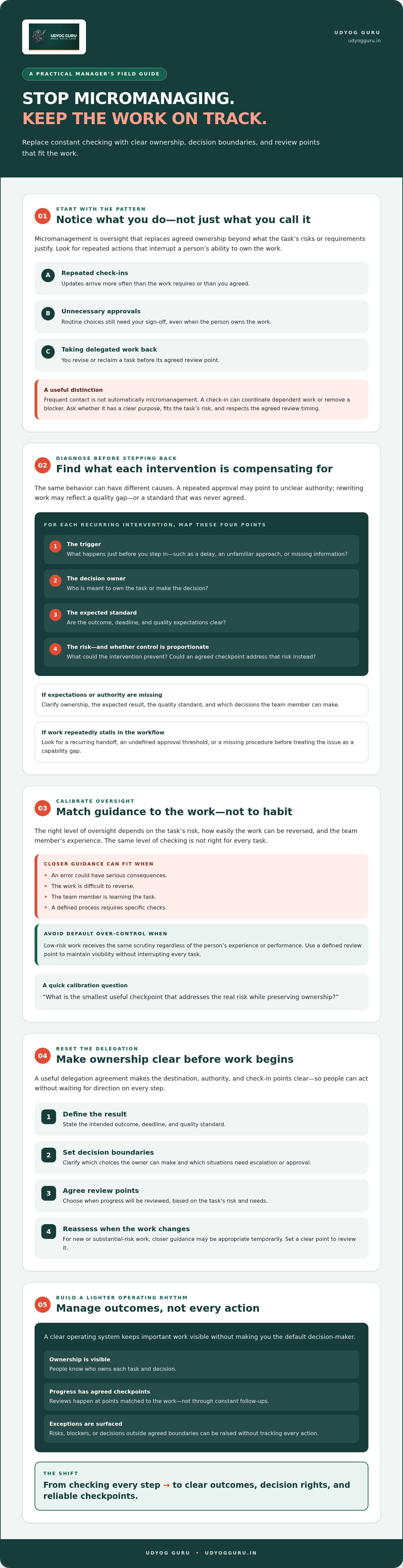
Start with actions, not labels. Micromanagement is a pattern of controlling work beyond what its risks or requirements justify. It doesn’t establish a manager’s personality or motive. Repeatedly checking progress, requiring approval for routine choices, or taking a task back before an agreed review point can restrict ownership. The Micromanagement overview describes the concept and its potential effects, but assessing your own pattern means examining what you do and why.
To assess how to stop micromanaging your team, compare each intervention with the task’s actual needs. Close supervision can be appropriate when errors could have serious consequences, work is difficult to reverse, a team member is learning, or a defined process requires specific checks. The concern is routine over-control: applying the same scrutiny to low-risk work regardless of experience or performance.
What does micromanaging a team look like in day-to-day work?
Look for repeated actions that interrupt agreed ownership. You might revise a low-risk document before its agreed review, ask for updates more often than the work requires, or insist on approving routine decisions. Each action may seem minor, but together they can teach employees to wait for direction instead of acting within their role.
Frequent contact alone doesn’t prove micromanagement. A brief check-in can remove a blocker or coordinate work that depends on another person. Ask whether the contact serves a clear purpose, matches the task’s risk, and respects the review timing already agreed. If it does none of these, it may be unnecessary control.
Why does micromanagement persist even when managers intend to help?
There are several possible drivers. You may be responding to missed deadlines, quality concerns, unclear ownership, or limited confidence in a process. Treat these as possibilities to test, not universal explanations or psychological diagnoses. Your intervention may be compensating for a real capability gap, or it may be covering for an unclear standard or decision boundary.
Run a short self-audit. For each recurring intervention, record:
- What you pull back: a decision, task, approval, or progress update.
- When you intervene: the trigger, such as a delay, an unfamiliar approach, or missing information.
- What risk you believe it prevents: for example, rework, a missed deadline, or a poor-quality result.
- Whether the control is proportionate: could a defined checkpoint address the risk instead?
Patterns in your notes can help separate necessary oversight from system gaps. If the same decisions repeatedly return to you, check whether ownership, expected standards, or authority have been made clear.
Diagnose the System Behind Micromanagement Before You Step Back
Micromanagement is disproportionate oversight that replaces agreed ownership. Before reducing your involvement, identify what the repeated intervention is compensating for. A manager who approves every routine decision may be responding to unclear authority. One who rewrites a task may be correcting a quality gap, or reacting to a standard that was never agreed. The behaviour alone doesn’t reveal the cause.
Map each recurring intervention against four points: its trigger, the person who owns the decision, the expected standard, and the risk you believe the intervention prevents. This makes the diagnosis operational rather than personal. Harvard Business School Online’s guidance on how to stop micromanaging also emphasises delegation and clear expectations. Those steps are easier to apply consistently when you know where responsibility or process is breaking down.
Is the root cause unclear ownership, skill, or process?
Check whether the employee can state the intended outcome, deadline, quality standard, and decisions they’re authorised to make. If one element is missing, clarify it before concluding that the person lacks initiative. If the task is new or carries substantial risk, closer guidance may be appropriate temporarily. Set a clear point to reassess it.
Then inspect the workflow. Does work repeatedly stall at the same handoff? Is an approval threshold undefined, or is a procedure missing? These patterns can indicate process friction, not necessarily a capability problem. If repeated oversight appears tied to workflow delays or bottlenecks, use this guide to identifying operational bottlenecks in business to examine where work is getting stuck.
How can a manager identify personal checking triggers?
For a defined review period, log each interruption, status request, reversal, and approval you initiate. Record what evidence you had at the time and what uncertainty prompted you to act. For example, note whether you requested an update because a deadline was genuinely at risk or because progress wasn’t visible in the format you expected.
- Trigger: What happened immediately before you intervened?
- Evidence: What fact suggested action was necessary?
- Uncertainty: What outcome or risk were you unsure about?
- System check: Was the owner, standard, workflow, or approval limit unclear?
Look for repetition. If the same role or workflow generates frequent escalations, the pattern may point to a structural gap rather than an isolated performance issue. If the cause remains unclear across people or processes, Udyog Guru’s Workforce X-Ray™ diagnostic may be relevant for examining workforce performance issues.
Compare Oversight Options: Keep Accountability Without Constant Checking
Accountability doesn’t require visibility into every action. The right review method gives you enough evidence to spot risk while leaving the work owner room to decide how to proceed. Choose the level of oversight based on the task’s stakes, how easily errors can be reversed, the employee’s experience, and their demonstrated reliability. These factors can change, so treat oversight as adjustable rather than permanent.
| Review method | Visibility | Autonomy | Best fit |
|---|---|---|---|
| Task-by-task control | High, with frequent direction | Low | Unfamiliar work, serious consequences, or required approval points |
| Agreed checkpoints | Regular, at defined milestones | Moderate to high between reviews | Work with identifiable stages, dependencies, or learning needs |
| Outcome-based review | Focused on agreed evidence and results | High within stated boundaries | Familiar, reversible work with clear standards and a reliable owner |
When should a manager retain close oversight?
Use closer guidance when the work is unfamiliar, time-sensitive, or could have significant consequences if handled incorrectly. It may also be appropriate while an employee learns a process or where established safety, compliance, or approval requirements apply. Explain why additional oversight is needed, what evidence you need, and when you’ll reassess it. Without a review point, temporary supervision can become default control.
When can outcome-based delegation replace task-by-task supervision?
Choose outcome-based review when you can agree on the result, constraints, decision authority, and review points in advance. For example, agree on a report’s required content and delivery date, then let the owner choose the research and drafting method. Set a checkpoint where it will reveal meaningful progress or surface a material risk.
Replace informal status requests with agreed evidence: a completed milestone, a draft ready for review, or a blocker that needs a decision. This makes progress visible without asking the employee to narrate every step. For recurring tasks, record the owner, deadline, decision boundaries, and review points in a shared place so the process is easy to follow.
For how to stop micromanaging your team, use the least intrusive review method that still protects the result. If agreed checkpoints repeatedly reveal missed standards or emerging risks, increase guidance temporarily and identify what needs to change. If the work remains on track, preserve the agreed autonomy rather than adding checks by habit.
How to Stop Micromanaging Your Team With a Delegation Reset
Delegation becomes safer when you transfer responsibility in defined stages instead of handing over every decision at once. Choose a bounded task with a clear result and limited downside if an adjustment is needed. This gives the employee room to exercise ownership while giving you evidence about whether the boundaries and support are working.
How do you delegate clearly without dictating every step?
Use this five-step reset to establish the work agreement before execution begins:
- Select a task. Start with a specific, reversible responsibility rather than a high-consequence decision.
- Define the result. State the purpose, deliverable, deadline, constraints, and quality criteria in plain language.
- Set authority. Identify what the employee can decide independently and which conditions require escalation.
- Agree checkpoints. Set review dates or milestones and specify what evidence to share, such as a draft, completed stage, or blocker.
- Review the outcome. Compare the work with the agreed standard, then adjust the next delegation boundary based on what you learn.
Check for shared understanding before work starts. Ask the employee to describe the expected result, name the decisions they can make without approval, and explain when they would escalate. Make escalation conditions observable. For example, a dependency might be delayed beyond the agreed date, a cost might exceed an approved limit, or a required standard might not be achievable. Clear thresholds prevent avoidable interruptions while making it easier to raise genuine risks.
How can you respond when delegated work misses expectations?
First compare the result with the original agreement. Was the deadline explicit? Was the quality standard understood? Did the employee have the information and authority required to complete the task? A missed expectation may reveal a capability gap, but it may also expose an unclear instruction, missing process, or unavailable resource. Diagnose before you reclaim ownership.
Discuss the gap using specific evidence, then agree on a correction and a revised boundary for the next assignment. You might add an earlier checkpoint, clarify a decision limit, or provide guidance on an unfamiliar step while leaving the rest of the task with its owner. One error is useful feedback, not proof of permanent inability.
Learning how to stop micromanaging your team means treating delegation as a repeatable operating practice: set the agreement, observe the evidence, and recalibrate proportionately. If workforce responsibilities or performance patterns remain unclear, explore Udyog Guru’s workforce systems as a possible next step.
Build a Team Operating System That Makes Micromanagement Less Necessary
Clear delegation works best when the team has a reliable way to see priorities, ownership, progress, and exceptions. Without a shared operating rhythm, managers often fill visibility gaps with individual status requests. A lightweight system makes work legible without turning each task into a stream of monitored actions.
What routines help teams work with greater autonomy?
Agree on one shared place to record priorities, owners, deadlines, and blockers. Then set a regular review focused on results and decisions that need support. Keep the routine proportionate to the work. A routine task may need a milestone update; a time-sensitive project may need closer review at defined stages.
- Priorities: Make current commitments and changes visible to the team.
- Ownership: Assign one clear owner for each deliverable and decision.
- Progress: Review agreed measures or milestones, not every action taken.
- Exceptions: Define which risks, blockers, or deadline changes should be raised promptly.
Use a retrospective after work is completed to identify where handoffs, standards, or decision paths caused friction. Improve the workflow at its source rather than adding another approval layer by default. Over time, check whether manager-initiated interventions are declining while quality, timeliness, and appropriate escalation remain visible. Fewer interruptions are useful only if the agreed outcomes are still being met.
When might a workforce diagnostic help identify recurring problems?
If unclear accountability or performance patterns continue across tasks or team members, examine the structure before treating each case as an isolated issue. Recurring escalations may point to a shared gap in roles, workflows, or expectations. A workforce diagnosis may help clarify the pattern when local adjustments haven’t made its cause apparent.
Udyog Guru’s Workforce X-Ray™ is a workforce diagnostic for identifying workforce performance issues. Its Workforce Acceleration Engine™ supports workforce improvement. These offerings may be worth considering when the operating rhythm and delegation boundaries still leave persistent patterns unresolved.
To understand how to stop micromanaging your team in daily operations, make ownership visible, review agreed outcomes, and use exceptions to improve the system rather than increase routine control. If a structured next step would be useful, explore Udyog Guru’s business systems.
Replace Constant Checking With Clear Ownership
Micromanagement is rarely corrected by simply stepping back. Sustainable change comes from diagnosing what prompts repeated intervention, setting clear decision boundaries, and matching review points to the work’s risk. A consistent team operating rhythm then keeps priorities, progress, and exceptions visible without requiring updates on every action.
Start with one bounded responsibility. Define the expected result, the decisions its owner can make, and the evidence you’ll review. Use what happens next to refine the delegation system, not to assume that one missed expectation means ownership should be withdrawn. This practical approach to how to stop micromanaging your team preserves accountability while giving people room to build sound judgement.
If unclear workforce responsibilities or performance patterns continue across tasks, Udyog Guru offers Workforce X-Ray™, a workforce diagnostic, and Workforce Acceleration Engine™, a workforce offering that supports improvement. Explore Udyog Guru’s business systems to consider whether a structured next step fits your needs.
Make one boundary clearer, then review the evidence. If recurring workforce issues need a more structured assessment, explore Udyog Guru’s workforce systems. With deliberate adjustments, your team can take greater ownership while important work remains visible and on track.
Frequently Asked Questions
How do I stop micromanaging my team without losing control?
You can preserve oversight without directing every action by defining the result, decision boundaries, and review points before work begins. State which choices the employee owns and what evidence you’ll review, such as a milestone or completed deliverable. For how to stop micromanaging your team, use checkpoints to surface risks or remove blockers, not to approve routine steps. Adjust oversight if the evidence shows quality or timing is at risk.
Why do I keep micromanaging my employees?
Repeated checking can have several possible drivers, and the cause may differ by task. You might be responding to uncertainty, unclear quality standards, a skill gap, or a previous delivery problem. Record what prompted each intervention and the risk you wanted to prevent. Then check whether clearer expectations, added support, or a process change would address that risk more directly than continued approval of routine decisions.
How do you delegate without micromanaging?
Agree on the outcome, constraints, authority, deadline, and check-in before the employee starts. For example, specify the required deliverable and quality criteria, clarify which decisions they can make independently, and identify conditions that require escalation. Set a review point tied to a meaningful milestone rather than asking for constant informal updates. Ask the employee to restate the agreement so both sides share the same understanding of ownership.
Can micromanaging reduce team productivity?
It can slow decision flow when routine choices repeatedly wait for managerial approval. Frequent updates and revisions may also divert attention from the work itself, while taking tasks back can reduce opportunities for employees to practise ownership. These effects depend on the team and task, so assess the actual pattern: note where work stalls, which approvals add value, and whether agreed outcomes are being met.
What should I do if an employee makes a mistake after I delegate?
Compare the result with the original agreement before assigning blame or changing ownership. Check whether the expected standard was clear, the risk was understood, and the employee had the information, authority, and process support needed. Address any immediate consequences, then agree on a specific correction. For the next similar task, adjust the boundary or review point if the evidence supports it. One mistake alone doesn’t establish permanent inability.
How often should managers check in with their team?
Set check-in frequency according to task risk, employee experience, deadline pressure, and meaningful milestones. Familiar, reversible work may need only an outcome review; unfamiliar or higher-consequence work may justify closer guidance at defined stages. Agree on the cadence in advance, including what progress evidence to share and which blockers to escalate promptly. If updates aren’t informing a decision or managing a risk, reconsider whether they’re necessary.
What is the difference between accountability and micromanagement?
Accountability makes ownership, expected results, decision authority, and review points clear. The manager evaluates agreed outcomes and responds to risks or missed standards. Micromanagement adds disproportionate control over routine methods, often through unnecessary approvals, repeated status requests, or taking work back without a clear need. The distinction isn’t whether a manager checks progress; it’s whether the oversight is proportionate to the task and preserves the employee’s agreed ownership.


