

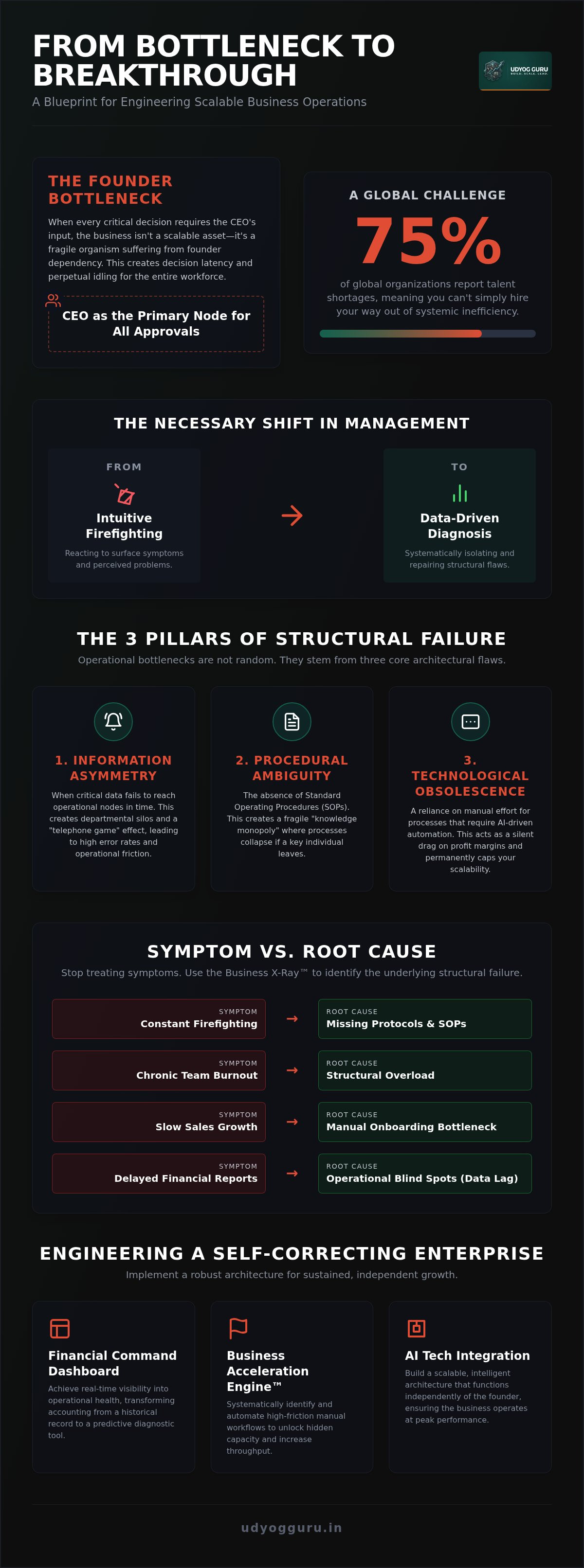
Your organization's growth ceiling isn't determined by market volatility, but by the structural integrity of your internal architecture. When every critical decision requires the CEO's input, the business isn't a scalable asset; it's a fragile organism suffering from founder dependency. You've likely experienced the friction of team performance variance or the anxiety of unpredictable cash flow despite high sales volume. With 75% of global organizations reporting talent shortages in 2026, you can't simply hire your way out of systemic inefficiency.
Identifying operational bottlenecks in business requires a clinical approach rather than a motivational one. You'll learn to move beyond intuitive firefighting by utilizing a rigorous diagnostic protocol designed to isolate and repair the structural flaws hindering your throughput. This article provides a blueprint for transitioning to data-driven operational control using the Business X-Ray™ framework. We'll examine how to install a Financial Command Dashboard and build a scalable architecture that maintains peak performance without your constant manual intervention.
Key Takeaways
- Master the Business X-Ray™ protocol to systematically map your value stream and isolate the specific structural failures limiting your organization's throughput.
- Shift from intuitive management to a data-driven model for identifying operational bottlenecks in business, ensuring capital is invested in repairing actual constraints rather than perceived symptoms.
- Implement a Financial Command Dashboard to achieve real-time visibility into operational health, transitioning your accounting from a historical record to a predictive diagnostic tool.
- Utilize the Business Acceleration Engine™ and AI Tech Business Integration Bootcamp to automate high-friction manual workflows and build a scalable architecture that functions independently of the founder.
The Anatomy of an Operational Bottleneck: Defining Structural Failure
An operational bottleneck is a structural constraint that limits the total output of the business machine. It's not a personnel issue or a lack of effort; it's a technical misalignment between business architecture and market demand. When you're identifying operational bottlenecks in business, you must view the organization as a series of interconnected pipes. If one segment is narrower than the rest, the entire system's throughput is capped at the capacity of that single narrow point. This concept is grounded in the Theory of Constraints, which suggests that focusing on non-constraints is a waste of resources.
Founders frequently misdiagnose perceived bottlenecks. They might see a slow sales team and invest in more training, only to realize the actual bottleneck was a manual onboarding process that couldn't handle the volume. Utilizing a Business X-Ray™ allows you to distinguish between these surface symptoms and the underlying mechanical failure. Fixing the wrong area leads to wasted capital and increased complexity. The most pervasive clog is often the Founder Bottleneck, where decision-making latency occurs because the CEO remains the primary node for all approvals. This creates a state of perpetual idling for the rest of the workforce.
Symptoms vs. Root Causes in Business Systems
Firefighting is a diagnostic signal. It isn't a byproduct of a difficult market, but a symptom of a missing protocol. When identifying operational bottlenecks in business, we often find that chronic burnout isn't a lack of resilience. Instead, it signals a structural overload in the workforce architecture. Data lag further complicates this by creating operational blind spots. If your financial reports are three weeks late, you're making decisions based on a post-mortem rather than real-time diagnostics.
The Cost of Undiagnosed Operational Clogs
The financial impact of an undiagnosed clog extends far beyond simple delays. It creates a friction that erodes profit margins even when revenue is growing. You're paying for capacity you can't use. Lost opportunity costs in scaling enterprises are often quantified by the gap between current output and the theoretical maximum of the pipes you've built. Friction also damages customer retention cycles. If your fulfillment engine stutters, your acquisition costs skyrocket as you struggle to replace churned clients. This inefficiency acts as a silent tax on every unit of revenue generated.
The Three Pillars of Structural Failure in Scaling Enterprises
Scaling an enterprise requires more than capital; it demands a rigorous audit of the underlying architecture. When identifying operational bottlenecks in business, we categorize structural failures into three distinct pillars. First is Information Asymmetry, occurring when critical data fails to reach operational nodes in time to inform decision-making. Second is Procedural Ambiguity, which is the absence of standardized protocols for recurring tasks. Third is Technological Obsolescence, characterized by a reliance on manual effort for processes that require AI-driven automation. To address these, founders should initiate a business diagnostic scan to audit their current infrastructure and isolate these points of failure.
Procedural Ambiguity is particularly dangerous because it creates a "knowledge monopoly" where only a few veteran employees understand how the machine actually works. This lack of Standard Operating Procedures (SOPs) makes your organization fragile. If a key individual leaves, the process collapses. Technological Obsolescence acts as a silent drag on your profit margins. Relying on manual workflows in an era of rapid AI integration is a design flaw that caps your scalability regardless of your team's talent. You can't out-work a structural defect.
The Information Flow Crisis
Silos within Indian SMEs frequently prevent horizontal scaling. In these environments, departments operate as isolated islands rather than integrated components. This lack of connectivity triggers a 'Telephone Game' effect where instructions degrade as they pass through layers of management. The result is a high error rate and significant operational friction. You must install a 'Single Source of Truth' to ensure transparency across the organization. This isn't just a management preference; it's a structural requirement for any firm following a comprehensive guide to identifying and fixing operational bottlenecks. Without a unified data stream, your teams are flying blind and reacting to outdated signals.
The Manual Labor Trap
Many founders confuse scaling headcount with scaling throughput. This is a fundamental architectural error. Tasks that are 'too human'—such as manual data entry or complex reporting—are inherently prone to high error rates. These tasks create a bottleneck in the executive decision-making loop. Globally, 75% of organizations report challenges in filling roles in 2026, making manual-heavy models unsustainable. If your leadership team waits days for a manual spreadsheet update, your response time to market shifts is already compromised. Identifying operational bottlenecks in business often reveals that manual reporting is the primary clog in your growth engine. Transitioning to automated workflows ensures that your human capital is focused on high-level strategy rather than mechanical repetition. To begin this transition, consider a professional Business X-Ray™ to map your current manual dependencies and engineer a path toward automation.
Conducting a Business X-Ray™: The Systematic Diagnostic Protocol
Identifying operational bottlenecks in business requires a transition from subjective observation to objective measurement. The Business X-Ray™ serves as the primary diagnostic tool in this process, utilizing a five-step protocol to expose systemic clogs. First, you must map the Value Stream, which involves documenting every technical and human touchpoint from initial lead acquisition to final product delivery. Second, we measure Cycle Time by quantifying the precise duration of each operational node to identify where momentum stalls. For a clear and concise overview of operational bottlenecks, one must recognize that these stalls are rarely isolated incidents but symptoms of deeper architectural flaws.
The third step involves identifying the 'Drum-Buffer-Rope' mechanism. This identifies the slowest component that dictates the entire organization's pace. Fourth, we perform a rigorous audit for Founder Dependency, tracking exactly how many workflows terminate if the CEO is offline for 48 hours. Finally, these findings are synthesized into a structural repair plan that prioritizes the most critical failures first. This methodical progression ensures that you're treating the source of the friction rather than just managing the heat it generates.
Quantifying Inefficiency Through Time-Motion Studies
Data must always supersede intuition when you're diagnosing a business machine. Time-motion studies allow you to compare your actual throughput against the theoretical capacity of your systems. If your workforce architecture is designed for 100 units but only delivering 60, the gap represents a quantifiable loss. Utilizing a Workforce X-Ray™ helps identify human-capital clogs where team performance variance creates operational drag. These studies provide the hard evidence needed to justify structural shifts over temporary personnel changes.
Isolating the Critical Constraint
The Pareto Principle applies directly to operational clogs. Typically, 80% of your delays originate from just 20% of your operational nodes. Distinguishing between a temporary surge in volume and a permanent, structural bottleneck is essential for long-term stability. Investing in the wrong area doesn't just waste capital; it adds unnecessary complexity to an already strained system. Focusing on scaling a business through structural integrity requires you to isolate and eliminate these critical constraints with surgical precision. Once the primary clog is removed, the entire system's throughput increases proportionally.
Installing Financial Control Systems for Founders to Prevent Clogs
Identifying operational bottlenecks in business often begins with the detection of financial friction. Traditional "post-mortem" accounting, which only reviews performance 30 days after the fact, is an insufficient diagnostic tool for a scaling enterprise. By the time a monthly P&L reveals a margin contraction, the structural clog has already cost the organization significant capital. You must install a Financial Command Dashboard to shift from historical reporting to predictive diagnostic control. Cash-flow friction acts as a sensitive early warning system; it's the smoke that signals a fire in your workforce or supply chain architecture. Integrating financial metrics with operational KPIs provides a 360-degree view of the business machine, allowing you to see exactly where a procedural failure is bleeding cash.
The 15-Minute CEO Dashboard Protocol
High-level management requires a calibrated view of specific performance indicators. The 15-minute protocol focuses on four critical nodes: Burn rate, Customer Acquisition Cost (CAC), Lifetime Value (LTV), and the Operational Efficiency Ratio. This ratio is particularly vital, as it measures the cost of generating revenue against the total operational spend. By aggregating this data into a single interface, you eliminate the administrative drag of managing 10 disparate spreadsheets. This real-time visibility prevents the catastrophic error of over-leveraging during aggressive growth spurts. It ensures that every unit of capital is fueling throughput rather than being absorbed by undiagnosed systemic leaks in your delivery engine.
Automating Fiscal Transparency
Human error in financial reporting is a preventable bottleneck that creates executive blind spots. AI-driven integrations now allow for the automated synchronization of banking, sales, and operational data, removing the manual labor trap discussed in previous sections. This creates a closed-loop accountability system where every expense is tied to a specific operational outcome or department. As you delegate operations to your team, this transparency ensures that your workforce remains aligned with the organization's fiscal architecture. You can maintain structural integrity and professional authority without micro-managing individual transactions. To secure this level of data-driven oversight, founders should implement a Financial Command Dashboard to ensure their scaling machine remains calibrated for maximum profitability.
Engineering Scalability: The Path to a Self-Correcting Enterprise
The ultimate objective of identifying operational bottlenecks in business isn't merely a one-time repair but the installation of a self-correcting enterprise. By deploying the Business Acceleration Engine™, founders can drive predictable, system-led growth that operates independently of their daily intervention. This transition requires a fundamental shift in the founder's role, moving from the 'Operator' who manually clears clogs to the 'Architect' who designs systems that prevent them. Building a culture of 'Systems Thinking' within the organization ensures that the team views every friction point as a signal for architectural refinement rather than a personnel failure. When the workforce is trained to recognize systemic drag, the business machine begins to calibrate itself in real-time.
The AI Integration Advantage
AI integration represents a significant leap in eliminating the 'Headcount Bottleneck' that traditionally plagues Indian SMEs. Through the AI Tech Business Integration Bootcamp, organizations can automate 'clog-prone' manual workflows that previously required high levels of human oversight. Modern tech stacks now allow for the continuous monitoring of process health, flagging deviations before they escalate into systemic failures. Automating repetitive customer and internal communications frees up human capacity for high-value strategic tasks. This technological layer acts as an automated immune system for the business machine, ensuring that throughput remains constant even during rapid scaling phases. It replaces the fragile human-led reporting nodes with a robust, data-driven architecture.
Final Implementation: From Diagnosis to Installation
The journey from operational chaos to structural integrity follows a logical progression from initial assessment to final calibration. It begins with the Business X-Ray™ to map the value stream and quantify cycle times, followed by the installation of the Financial Command Dashboard to maintain long-term structural health through real-time data visibility. The final phase is the deployment of the Business Acceleration Engine™, which serves as the permanent infrastructure for sustainable growth. Founders who successfully navigate this diagnostic protocol stop firefighting and start engineering their organizations for maximum efficiency. If you're ready to transition from intuitive management to rigorous operational control, the installation of these automated protocols is your next structural requirement. Start your transformation by securing a Business X-Ray™ to uncover the hidden constraints holding your enterprise back.
Calibrating Your Organization for Frictionless Scale
Identifying operational bottlenecks in business is the foundational step in transitioning from a founder-dependent organism to a self-correcting machine. By utilizing the proprietary Business Acceleration Engine™ framework, you move beyond the exhaustion of reactive firefighting and into the precision of structural engineering. This shift requires a commitment to data over intuition, ensuring every operational node is calibrated for maximum throughput. The installation of a Financial Command Dashboard provides the real-time diagnostic visibility required to maintain long-term systemic health, while our AI Tech Business Integration Bootcamp ensures your manual workflows are replaced with scalable, automated protocols.
The transition from operator to architect is a rigorous process that yields a sustainable, high-performance asset. Your organization's growth is limited only by its internal architecture; once the clogs are removed, the path to expansion becomes a predictable outcome of system design. Schedule your Business X-Ray™ and diagnose your structural clogs today. Your business is a solvable puzzle of logic and process. We look forward to helping you engineer its next phase of growth.
Frequently Asked Questions
How can I tell if the bottleneck in my business is a person or a process?
You can distinguish between a person and a process by examining performance consistency across multiple operators at the same node. If every employee struggles with the same task, the underlying architecture is flawed. However, if performance variance only occurs with one individual despite a clear protocol, it's a workforce issue. Utilizing a Workforce X-Ray™ provides the data needed to isolate whether you have a training gap or a systemic design failure.
What are the most common operational bottlenecks for Indian SMEs scaling past 50 employees?
Indian SMEs scaling past 50 employees often encounter clogs related to information asymmetry and decision-making latency. At this stage, the "telephone game" effect degrades instructions across departments. Identifying operational bottlenecks in business for these firms usually reveals a lack of standardized SOPs and a heavy reliance on manual data entry. This creates a founder-dependency trap where the CEO remains the primary node for minor approvals, capping organizational throughput.
Can AI really help in identifying and fixing operational bottlenecks?
AI is instrumental in identifying operational bottlenecks in business by monitoring process health and flagging real-time deviations from established benchmarks. Through the AI Tech Business Integration Bootcamp, founders learn to automate high-friction manual workflows that are prone to human error. AI systems can process vast datasets to reveal hidden constraints that human observation might miss, allowing for a more clinical and precise intervention in the business machine's architecture.
How often should a founder conduct a Business X-Ray™ diagnostic scan?
A founder should ideally conduct a Business X-Ray™ diagnostic scan on a quarterly basis or whenever the organization enters a new growth tier. Regular scanning ensures that the business architecture remains calibrated to increasing volume. As market demands shift, new constraints can emerge in previously stable nodes. Periodic diagnostics allow for the systematic repair of structural flaws before they escalate into significant financial leaks or operational crises.
Why does increasing my team size often make operational bottlenecks worse?
Increasing team size often exacerbates bottlenecks because adding headcount to a broken process increases communication complexity exponentially. Without a scalable architecture, more people simply create more nodes that require management and coordination. This leads to higher operational friction and increased decision-making latency. You can't hire your way out of a structural defect; you must first repair the pipes before increasing the volume of the flow.
What is the difference between a bottleneck and a temporary delay?
A bottleneck is a permanent structural constraint that limits the total output of your system regardless of effort. In contrast, a temporary delay is a transient surge caused by a short-term spike in volume or a one-time external event. Identifying the difference is critical for capital allocation. Fixing a temporary delay with a permanent structural change adds unnecessary complexity, while ignoring a true bottleneck ensures your growth remains capped.
How does a Financial Command Dashboard help in bottleneck identification?
The Financial Command Dashboard identifies bottlenecks by revealing cash-flow friction and operational inefficiency in real-time. It moves the founder away from post-mortem accounting and toward predictive control. When an operational node stutters, the financial impact is visible immediately through fluctuating margins or rising acquisition costs. This data-driven visibility allows you to pinpoint the exact location of a systemic clog without relying on subjective staff reports or intuition.
Is it possible to remove founder dependency in a service-based business?
Removing founder dependency in a service-based business is entirely possible through the installation of the Business Acceleration Engine™. This involves codifying the founder's expertise into standardized protocols and automated workflows. By building a self-correcting enterprise where the team follows a rigorous diagnostic and implementation framework, the business functions as a scalable machine. The founder transitions from being the primary operator to the systems architect who oversees the organizational health.


