

What if the primary obstacle to your expansion isn't a lack of sales, but a failure in your internal diagnostic architecture? Relying on founder intuition to navigate complex growth cycles is a systemic risk that often leads to catastrophic profit leakage. To achieve true operational resilience, you must transition from gut-feeling management to a structured framework of financial systems for business scalability. Most leaders mistakenly view financial reporting as a historical record rather than a real-time navigation tool. This perspective creates a dangerous dependency on manual reports that are often outdated before they reach your desk, leaving the business structurally vulnerable.
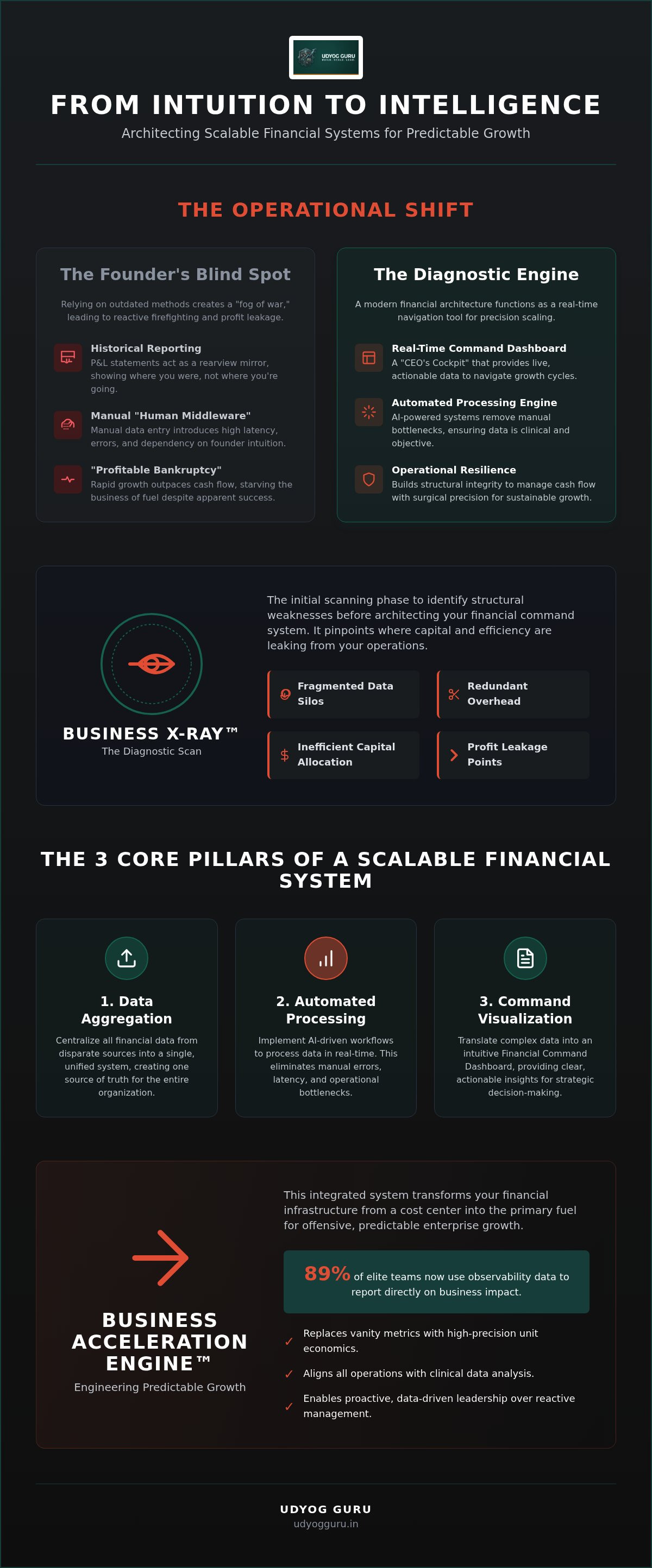
You likely recognize the frustration of being unable to isolate which business units are driving growth and which are merely consuming capital. This article details how to install a high-precision financial command system that functions as a CEO's cockpit for national scaling. By utilizing a Business X-Ray™ to scan for operational inefficiencies, you'll learn to replace founder micromanagement with a predictable, automated engine. We'll explore the diagnostic protocol needed to implement a Financial Command Dashboard, ensuring your enterprise operates profitably through clinical data analysis. This architectural shift provides the structural integrity required to manage cash flow with the precision of a business surgeon, aligning your operations with the 89% of elite teams that now use observability data to report directly on business impact.
Key Takeaways
- Transition from historical accounting to a diagnostic engine that identifies profit leakage in real-time.
- Construct automated financial systems for business scalability to eliminate manual reporting bottlenecks and founder dependency.
- Replace vanity metrics with high-precision unit economics to quantify the true profitability of every customer and product.
- Utilize the Business X-Ray™ to conduct a rigorous diagnostic scan of existing data silos before implementing a centralized Financial Command Dashboard.
- Position your financial infrastructure as the essential fuel for the Business Acceleration Engine™ to drive offensive, predictable enterprise growth.
The Founder’s Blind Spot: Why Traditional Accounting Fails Scalability
Traditional accounting often serves as a post-mortem rather than a real-time diagnostic tool. For many SMEs, the Profit and Loss (P&L) statement is a lagging indicator; it tells you where the business was thirty days ago, not where it's leaking capital today. Relying on last month’s records to make today’s scaling decisions is like driving a high-performance vehicle while looking only at the rearview mirror. To achieve sustainable growth, you must implement financial systems for business scalability that function as a diagnostic engine. This shift moves your focus from symptomatic tracking, such as noticing a drop in cash reserves, to diagnostic tracking, where you identify a specific bottleneck in customer acquisition costs or operational overhead. By following a identifying operational bottlenecks in business protocol, you can treat the root cause of fiscal instability rather than just the symptoms.
The Firefighting Cycle in SME Finance
Manual data entry creates a persistent "fog of war" for the founder. When financial data is trapped in spreadsheets and manual ledgers, the business becomes entirely dependent on the founder’s intuition to interpret fragmented reports. This dependency is a structural weakness that prevents true enterprise-level understanding business scalability. Without automated systems, companies often fall into the trap of "profitable bankruptcy." This occurs when rapid growth accelerates cash consumption faster than revenue is collected, effectively starving the machine of the fuel it needs to function. The clinical reality is that growth without a systematic financial architecture isn't expansion; it's a slow-motion collapse of your operational margins.
The Business X-Ray™ Approach to Fiscal Health
The Business X-Ray™ serves as the initial scanning phase for your financial architecture. It identifies where structural weaknesses exist, such as fragmented data silos, redundant overhead, or inefficient capital allocation. Moving from basic bookkeeping to advanced financial engineering requires a rigorous calibration of your financial systems for business scalability. By establishing transparency as the foundation, you transform your finance department from a compliance cost center into a strategic command unit. This transition ensures that every rupee of capital is mapped to a specific growth outcome, providing the clinical clarity necessary for high-velocity scaling. It's about building a machine that doesn't just record history, but actively predicts and secures your future profitability through precise data architecture.
Architecting a Scalable Financial System: The Core Components
Constructing robust financial systems for business scalability requires a shift from manual oversight to an automated architecture. This structural framework rests on three critical pillars: Data Aggregation, Automated Processing, and Command Visualization. Without these components, a scaling enterprise remains trapped in a cycle of reactive management. The primary bottleneck in most growing organizations is "Human Middleware," which refers to the manual extraction and manipulation of data by staff. This process introduces high latency and increased error rates, effectively blinding the founder during periods of rapid expansion. By removing this manual layer, you ensure that your fiscal data remains clinical, objective, and immediately actionable.
Integrating the Workforce X-Ray™ into this architecture allows you to link payroll efficiency directly to unit profitability. This diagnostic layer ensures that as you increase headcount, your labor costs remain proportional to output, preventing the "bloat" that often accompanies national scaling. Modernizing these fiscal protocols no longer requires custom software development. Instead, it involves the precise calibration of existing tools through AI integration. Research indicates that 94% of financial services organizations have already adopted AI and generative AI in their observability practices as of 2026. Founders who fail to install these automated protocols risk operating a machine with misaligned gears. For a systematic evaluation of your current setup, you can explore how to optimize your financial engine through a diagnostic lens.
Automated Data Ingestion Protocols
The first step in architectural installation is setting up automated data ingestion. This involves establishing direct, real-time feeds from bank statements, CRM platforms, and inventory management systems into a centralized repository. This creates a "Single Source of Truth," ensuring that every department operates from the same dataset. By eliminating manual entry, you reduce data latency from weeks to minutes. This real-time visibility allows you to identify profit leakage as it happens, rather than discovering it during a quarterly review. It's the difference between performing a live scan and reading an autopsy report.
Technology Integration for Modern Founders
Modern founders must use low-code or no-code tools to bridge the gaps between disparate financial silos. These tools act as the connective tissue in your financial body, allowing data to flow seamlessly without human intervention. The AI Tech Business Integration Bootcamp provides the specific technical training needed to automate these reporting workflows. Through this bootcamp, founders learn to build "fail-safe" triggers that alert management to cash flow anomalies or budget overruns instantly. This proactive engineering ensures the business remains within its defined profitability parameters, allowing for offensive scaling without the constant fear of a liquidity crisis.
Diagnostic Metrics: Quantifying True Profitability for Enterprise Growth
Total revenue is a dangerous vanity metric that often masks deep-seated operational rot. While a rising top line suggests growth, it provides no insight into the structural health of your machine. High-precision financial systems for business scalability prioritize diagnostic KPIs over surface-level numbers to ensure every increase in volume translates into a corresponding increase in net surplus. Without this clinical focus, you risk scaling a deficit. Diagnostic metrics allow you to perform a surgical examination of your margins, identifying exactly where capital is being deployed effectively and where it's being hemorrhaged through inefficient processes.
Unit economics serve as the fundamental building block of this diagnostic protocol. You must calculate the precise profitability of a single customer or product unit after accounting for all variable costs. If the unit economics aren't robust, scaling will only accelerate your losses. The contribution margin represents the engine room of scalability, providing the raw power needed to cover fixed costs and generate enterprise-level surplus. Additionally, you must track the Efficiency Ratio, which measures the relationship between workforce output and net profit. This ratio acts as a pressure gauge, indicating whether your human capital is being utilized as a high-performance asset or becoming a drag on your fiscal architecture.
The Scalability Index
In the Indian SME context, the Scalability Index relies heavily on the ratio between Customer Acquisition Cost (CAC) and Lifetime Value (LTV). A healthy system requires an LTV that significantly outweighs the CAC, ensuring that the cost of fueling the machine doesn't exceed the value it produces. Burn rate management is equally critical; it tracks your runway for aggressive national expansion, ensuring you don't exhaust your capital reserves before reaching the next growth milestone. True operating leverage is achieved when your profit grows at a faster rate than your expenses, a state that's only possible when your financial systems for business scalability are properly calibrated to minimize marginal costs as volume increases.
Workforce Performance Auditing
Applying the Workforce X-Ray™ allows you to link specific team activities directly to financial outcomes. This audit identifies "Revenue-Leakage" in team workflows, where manual interventions or redundant protocols consume time that should be spent on value-generating tasks. By quantifying the ROI of automated delegation systems, you can see the clinical impact of removing the founder from the operational loop. This process transforms the workforce from a monolithic expense into a series of optimized nodes, each contributing to the overall structural integrity of the business. When your team operates within these automated frameworks, the ROI of every headcount becomes a predictable data point rather than a speculative estimate.
Installation Protocol: Establishing Your Financial Command Dashboard
The installation of a financial dashboard for business owners requires a methodical deployment of technical protocols. This isn't a cosmetic reporting tool; it's a high-precision instrument panel for navigating complex market dynamics. To build effective financial systems for business scalability, you must follow a structured four-stage installation process that prioritizes data integrity over aesthetic design. This architectural approach ensures that your decision-making is rooted in clinical reality rather than speculative projections.
First, conduct a Diagnostic Scan using the Business X-Ray™ to identify existing data silos that prevent a unified view of fiscal health. Second, move into Protocol Design, where you define the hierarchy of information essential for the CEO’s decision-making, filtering out noise in favor of high-impact data. Third, the Implementation phase connects the Business Acceleration Engine™ to specific financial triggers, ensuring that operational actions are tied directly to profit outcomes. Finally, Calibration involves refining the dashboard for real-time accuracy, eliminating the lag that plagues traditional reporting. This systematic approach ensures your command center is both reliable and responsive.
The CEO’s 15-Minute Daily Protocol
A properly engineered dashboard allows a founder to assess the entire organization’s health in under 15 minutes. This daily protocol focuses on three red-flag indicators: cash runway, contribution margin variance, and acquisition efficiency. By monitoring these clinical data points, you move from reviewing the past to predicting the future. Instead of wondering why profit dipped last month, you'll see the early warning signs of a bottleneck before it impacts your bottom line. This level of foresight is the hallmark of a business that's built to scale nationally without constant intervention.
Removing Founder Dependency
The Financial Command Dashboard is the primary tool for delegating accountability to department heads. By providing clear, data-driven targets, you empower your team to manage their own units profitably. Automated alerts act as a "Check Engine Light" for your business, notifying the relevant manager the moment a metric falls outside its calibrated range. This ensures operational clarity across all national branches without requiring your direct presence. Establishing these financial systems for business scalability is the final step in removing yourself from the daily firefighting cycle. If you're ready to install these protocols, you can request a diagnostic session to begin your transformation.
Engineering Predictable Growth with the Business Acceleration Engine™
A high-performance machine cannot operate without a consistent supply of pressurized fuel. In the context of enterprise expansion, your financial systems for business scalability act as this fuel, providing the necessary pressure to drive the Business Acceleration Engine™. Without a calibrated financial architecture, the engine stalls under the weight of operational complexity. Transitioning from defensive tracking, where you merely protect existing assets, to offensive scaling allows you to deploy capital with clinical precision. This shift ensures that every rupee invested is mapped to a specific growth vector, transforming the business from a founder-led experiment into a system-driven enterprise.
The AI Tech Business Integration Bootcamp plays a critical role in sustaining this fiscal transparency. By automating the data flow between your operational nodes and your command center, the bootcamp removes the human error that typically degrades financial integrity during rapid growth. This automation ensures that your "fuel" remains pure and your engine remains efficient. As you scale, the complexity of your financial body increases, making it vital to maintain a rigorous diagnostic protocol. This systematic approach allows you to identify and repair leaks in real-time, securing the structural integrity of your organization as it expands across the national market.
Scaling Without Chaos
Rapid expansion often triggers the "Growth Paradox," a condition where increased sales volume leads to a proportional decrease in net profit due to unmanaged overhead. The Udyog Guru methodology prevents this diagnostic failure by ensuring that your financial systems for business scalability are installed before the acceleration phase begins. Maintaining clinical control during national expansion requires a centralized view of all branch operations. By utilizing a system-driven architecture, you eliminate the chaos of decentralized reporting. This order allows the CEO to remain in the cockpit, making high-level strategic adjustments based on data rather than reacting to localized fires.
Next Steps for the Systems-Driven CEO
The transition to a system-driven enterprise begins with a precise assessment of your current infrastructure. Your first step is to apply for a Business X-Ray™ to identify the specific financial bottlenecks that are currently throttling your growth. Once these silos are diagnosed, enrolling in the AI Tech Business Integration Bootcamp will provide the technical framework needed to automate your command center. This process replaces founder intuition with a robust, repeatable protocol for fiscal management. By installing these systems now, you secure the future of your organization. Secure your Financial Command Dashboard today.
Architecting Your Fiscal Command Center
Transitioning from a founder-led operation to a system-driven enterprise requires a fundamental shift in how you perceive your fiscal architecture. You've seen that traditional accounting is merely a lagging record, whereas high-precision financial systems for business scalability act as a real-time diagnostic engine. By implementing a proprietary Financial Command Dashboard, you replace opaque gut feelings with clinical data, ensuring every operational move is backed by structural logic. This transformation eliminates the human middleware bottleneck, allowing your business to scale nationally without the typical chaos of expansion.
Establishing order in the face of operational chaos isn't a matter of effort; it's a matter of engineering. Our AI-Driven Automation Protocols and clinical diagnostic methodology are designed to install the structural integrity your machine needs to thrive. If you're ready to identify the hidden leaks in your organization and calibrate your engine for predictable growth, the next step is a professional assessment. Request Your Business X-Ray™ Diagnostic Scan today to begin your installation. It's time to build a business that operates with the precision of a high-performance machine.
Frequently Asked Questions
What is the difference between an accounting system and a financial command system?
An accounting system serves as a historical ledger focused on tax compliance and regulatory reporting. In contrast, a financial command system acts as a real-time diagnostic engine that identifies operational bottlenecks as they occur. While traditional accounting looks at the past, a command system provides the predictive data required for high-precision decision-making. It transforms raw numbers into actionable insights, allowing founders to steer their organization based on clinical evidence rather than intuition.
How much time does it take to implement a Financial Command Dashboard?
The timeline for establishing a Financial Command Dashboard depends on the complexity of your existing data silos identified during the Business X-Ray™ phase. Generally, the initial diagnostic and protocol design stages are completed within a few weeks. The full integration of automated triggers and real-time visualization follows a structured installation path. This methodical approach ensures that the system is properly calibrated to your specific operational needs before it becomes your primary decision-making tool.
Can I track profitability in real-time without custom software development?
You can achieve real-time profitability tracking without expensive custom software development by leveraging modern low-code tools and AI integration. These technologies act as the connective tissue between your current banking, CRM, and inventory platforms. By installing automated data ingestion protocols, you eliminate the "Human Middleware" responsible for manual entry errors. This architecture creates a single source of truth that delivers clinical data directly to your dashboard with minimal latency and maximum accuracy.
Does my business need to be a certain size before I implement these scalability systems?
There is no minimum size requirement for implementing financial systems for business scalability; in fact, the most successful enterprises install these protocols before they begin aggressive expansion. Waiting until your organization is large often results in "profitable bankruptcy" where growth outpaces your ability to manage cash flow. Establishing a systematic financial architecture early ensures that your machine is built to handle the increased load of a national operation without collapsing under structural stress.
How does AI help in tracking business profitability for Indian SMEs?
AI serves as a powerful diagnostic tool for Indian SMEs by automating repetitive reporting tasks and identifying patterns that human analysis might overlook. It enables predictive cash flow forecasting and real-time fraud detection, which are critical for maintaining fiscal health. Through the AI Tech Business Integration Bootcamp, founders learn to embed these modern protocols into their workflows. This technological layer ensures that your financial tracking remains transparent and accurate as your business complexity increases during national scaling.
What happens if my current accountant is only focused on tax compliance?
If your accountant focuses solely on tax compliance, they are functioning as a business historian rather than a strategic architect. Tax reporting is a mandatory compliance cost, but it doesn't provide the diagnostic clarity needed to drive growth. You don't need to replace your accountant; instead, you must install a Financial Command Dashboard that operates independently of manual bookkeeping. This system provides the real-time visibility your accountant’s monthly reports cannot offer, providing the data needed for offensive scaling.
Is it possible to manage a national business without being physically present?
Managing a national business without physical presence is entirely possible once you've removed founder dependency through automated systems. A Financial Command Dashboard provides a "CEO's cockpit" view of all regional branches, allowing you to monitor performance metrics from any location. Automated alerts act as a check engine light, notifying you immediately if a specific branch falls outside its calibrated profitability parameters. This level of clinical control ensures that the business operates consistently regardless of your physical coordinates.
What are the most common financial bottlenecks in scaling Indian businesses?
The most common bottlenecks in scaling Indian businesses include fragmented data silos and a heavy reliance on manual reporting. These issues create a "fog of war" that hides profit leakage and inefficient capital allocation. Many founders also fall into the trap of tracking vanity metrics like total revenue instead of high-precision unit economics. By establishing robust financial systems for business scalability, you can identify these structural weaknesses early and repair them before they throttle your expansion efforts.


