
The era of the heroic founder is over, and those who continue to manage by intuition are merely presiding over a slow-motion mechanical failure. In a 2026 market where AI-Native startup funding has surged by 218%, clinging to legacy management styles is a terminal risk. You've likely reached the structural limit of what manual oversight and sheer willpower can achieve. You feel the weight of founder dependency, where every decision requires your intervention and profitability remains a blurred figure on a late-night spreadsheet. It's exhausting to maintain an operation that threatens to stall the moment you look away.
This guide provides the clinical methodology required to install a high-precision business transformation framework for SMEs, shifting your organization from a chaotic organism to a calibrated machine. You'll learn to transition from intuition-based chaos to a data-driven operational architecture that functions without your constant intervention. We'll examine the diagnostic layers of the Business X-Ray™ and the installation of a Financial Command Dashboard to ensure your scaling is both predictable and autonomous. By the end of this analysis, you'll possess the blueprint to replace operational noise with rigorous structural clarity.
Key Takeaways
- Identify the hidden structural fragilities in your current operations by applying a Business X-Ray™ to diagnose and eliminate founder-dependency.
- Implement a rigorous business transformation framework for SMEs that replaces guesswork with a clinical, 5-step protocol for identifying high-impact revenue variables.
- Leverage AI-driven automation as a Business Acceleration Engine™ to eliminate the "fog of war" in daily workflows and repetitive data analysis.
- Install a Financial Command Dashboard to achieve a centralized, real-time architecture for monitoring profitability and team performance consistency.
- Transition your organization from a chaotic, intuition-led entity into a scalable, system-centric machine that operates independently of the owner’s constant intervention.
The Anatomy of Data-Driven Business Management: Moving Beyond Intuition
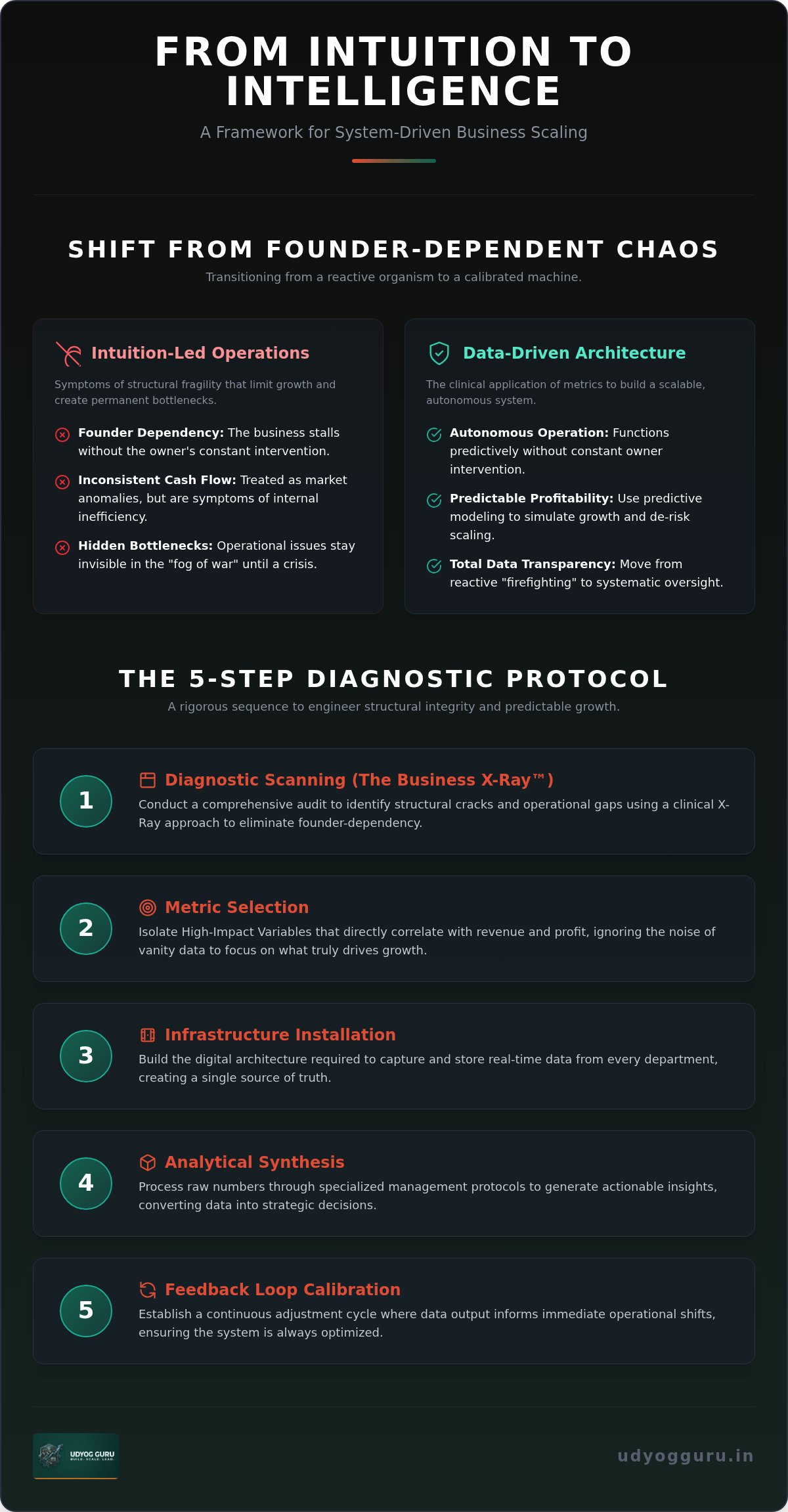
Data-driven management is the clinical application of organizational metrics to drive scaling. It represents a fundamental shift from the "art" of business to the "science" of operations. For many Indian SME founders, decisions are traditionally rooted in gut feel or historical anecdotes. While this might suffice during the initial survival phase, it creates a state of structural fragility as the company grows. Relying on intuition is a high-risk strategy that leads to a condition known as Founder Dependency. This occurs when the business cannot function without the owner's constant intervention; effectively turning the founder into a permanent bottleneck rather than a strategic architect.
Adopting a business-as-science philosophy means viewing your company as a machine requiring precise calibration. Every department, from sales to logistics, is a component that must be synchronized. Transitioning from reactive "firefighting" to "systematic oversight" requires total data transparency. Without this visibility, you aren't managing; you're simply responding to crises as they emerge. A robust business transformation framework for SMEs provides the diagnostic tools to move beyond this chaos.
The Symptoms of Intuition-Led Operations
The first indicator of an intuition-led business is inconsistent cash flow patterns. These fluctuations are often treated as market anomalies, but they're usually symptoms of internal inefficiencies. The lack of a business diagnostic scan means these issues remain hidden until they become catastrophic. You might notice high team turnover because performance expectations are vague and evaluations feel subjective. Employees don't leave businesses; they leave environments where they can't predict how their success is measured. Operational bottlenecks stay invisible in the "fog of war" until a missed deadline or a lost client forces a confrontation.
The Scientific Foundation of Scaling
Data acts as the connective tissue between disparate departments, ensuring that marketing spend aligns with production capacity and financial reserves. This integration is essential for any successful Digital Transformation initiative in 2026. Instead of looking at historical reporting, which is essentially an autopsy of the past, data-driven leaders use predictive business modeling. This allows you to simulate growth scenarios before committing resources. Within a business transformation framework for SMEs, data isn't just a collection of numbers. It's the only cure for operational chaos. It provides the structural integrity needed to scale without the engine breaking under the pressure of new volume.
The Diagnostic Protocol: A 5-Step Business Transformation Framework
Scaling a business without a diagnostic protocol is equivalent to performing surgery in the dark. To achieve structural integrity, founders must follow a rigorous, five-step sequence that treats the organization as a high-performance machine. This business transformation framework for SMEs is designed to strip away layers of operational noise and reveal the underlying mechanics of growth. It's not a suggestion; it's a technical requirement for any enterprise aiming to survive the competitive pressures of 2026.
- Step 1: Diagnostic Scanning - Conduct a comprehensive audit to identify structural cracks and operational gaps using a clinical X-Ray approach.
- Step 2: Metric Selection - Isolate the High-Impact Variables that directly correlate with revenue and profit, ignoring the noise of vanity data.
- Step 3: Infrastructure Installation - Build the digital architecture required to capture and store real-time data from every department.
- Step 4: Analytical Synthesis - Process raw numbers through specialized management protocols to generate actionable insights.
- Step 5: Feedback Loop Calibration - Establish a continuous adjustment cycle where data output informs immediate operational shifts.
Transitioning to this model requires more than just buying software. It demands a fundamental commitment to data-driven decision-making for SMEs. Starting with a Business X-Ray™ allows for this level of diagnostic clarity before you invest in expensive infrastructure or new hires.
Isolating High-Impact Variables
Most founders drown in data because they fail to distinguish between vanity metrics and true scaling metrics. Social media likes or website traffic are irrelevant if they don't impact the acquisition funnel or operational throughput. You must focus on the variables that drive the engine. Identifying operational bottlenecks in business through quantitative auditing ensures that your resources are allocated where they generate the highest return. If a metric doesn't lead to a specific management decision, it shouldn't be on your dashboard.
Installing the Feedback Loop
A feedback loop allows you to automate delegation without losing organizational control. By setting up Alert Thresholds, the system notifies you only when a metric deviates from its calibrated range. This removes the need for micromanagement while ensuring immediate diagnostic intervention when necessary. Moving from manual tracking to automated reporting engines creates a level of consistency that intuition can never replicate. It's the difference between guessing your way through a crisis and executing a pre-planned recovery protocol based on real-time evidence.
Engineering Structural Transparency: Intuition vs. Systematic Data Analysis
Transitioning from a Founder-Centric model to a System-Centric data model is a fundamental requirement for structural integrity. Most SMEs operate as extensions of the founder’s personality, where decisions are filtered through subjective experience rather than objective reality. This creates a "fog of war" where operational facts are obscured by individual perception. A business transformation framework for SMEs installs the transparency required to dissolve this fog, replacing bias with systematic analysis. When transparency is engineered into the architecture, the business stops being an unpredictable organism and starts behaving like a calibrated machine.
Eliminating Founder Dependency
A founder’s gut feeling is often the primary bottleneck in scaling a business. When you rely on intuition, you force the entire organization to wait for your personal cognitive processing. This limits growth to your individual bandwidth and creates a single point of failure. To remove this dependency, you must replace verbal instructions with data-driven protocols for repeatable success. It demands a psychological shift from "Doer" to "Systems Architect." You aren't there to perform the work; you're there to design the systems that ensure the work is performed to a specific standard every time.
The Transparency Dividend
Installing a Single Source of Truth provides what we call the Transparency Dividend. Real-time data reduces internal friction because it eliminates the subjectivity that fuels office politics. When performance is quantified, there’s no room for debate about who is contributing and who is coasting. This is where workforce optimization strategies become operational reality. You move from having opinions on team performance to having data on output. This structural clarity also informs expansion decisions. Without precise financial visibility, a ₹50,00,000 investment in new equipment is a gamble; with it, it's a calculated diagnostic step in your growth protocol.
Implementation Architecture: Integrating AI and Automation into Your Framework
In 2026, AI has evolved from a peripheral experiment into the core acceleration engine for operational scaling. For an Indian SME, the primary bottleneck is no longer just the quality of decision-making; it's the latency between data generation and data analysis. A modern business transformation framework for SMEs must integrate AI protocols to bridge this gap, ensuring that information moves at the speed of the market. This integration isn't a programming task for developers. It's a structural requirement for management architecture designed to eliminate the friction of manual oversight.
By installing an AI implementation roadmap for SMEs, you move from static spreadsheets to dynamic, AI-powered dashboards. These systems provide real-time control by synthesizing vast amounts of raw data into immediate diagnostic insights. You're no longer looking at historical reports that serve as autopsies of the past. Instead, you're operating with a live feed of your company’s internal mechanics.
Automating the Data Pipeline
Manual data entry is a significant structural vulnerability that introduces human error and creates a dangerous time lag in reporting. A Zero-Touch data entry philosophy ensures that your business health is scanned daily without manual intervention. Automation protocols can be installed to link your financial accounts, workforce output, and supply chain metrics into a single stream. This eliminates the risk of "creative accounting" or subjective reporting from department heads. When the data pipeline is automated, you can trust the integrity of the output, allowing you to focus on high-level diagnostic interpretation rather than clerical verification.
AI-Driven Predictive Management
The transition from reactive to predictive management is where AI provides its highest return. Using advanced algorithms, you can forecast cash flow shortages 90 days in advance, allowing for strategic adjustments before a crisis manifests. These systems identify customer churn patterns and operational inefficiencies before they impact the bottom line. Scaling your decision-making speed with AI-assisted diagnostics ensures that your organization remains agile as it grows. To begin this systematic upgrade, you can enroll in the AI Tech Business Integration Bootcamp to learn the precise protocols for installing these engines into your existing architecture.
The Financial Command Center: Installing Udyog Guru’s Data-Driven Ecosystem
The Financial Command Dashboard serves as the central cockpit for organizational control. It represents the final stage of a business transformation framework for SMEs, where abstract metrics are converted into a live, interactive architecture. This ecosystem doesn't rely on fragmented software or generic spreadsheets. Instead, it utilizes a tiered progression that begins with a Business X-Ray™. This initial diagnostic scan is the technical prerequisite for any scaling attempt, as it identifies the specific operational gaps that would otherwise cause the engine to seize under increased load.
Once the diagnostic phase is complete, the Business Acceleration Engine™ is installed to drive predictable growth. This isn't a motivational exercise; it is the installation of high-precision workflows and automated data captures. Because these systems are complex, a structured bootcamp approach is necessary for correct calibration. The AI Tech Business Integration Bootcamp provides the technical training required for founders to manage these new digital assets effectively, ensuring the machine remains calibrated as market conditions fluctuate.
Achieving Total Operational Control
The 15-minute CEO dashboard protocol is the standard for modern SME management in 2026. It allows you to track the entire business at a single glance, moving from high-level financial health to granular workforce metrics without switching platforms. Integrating workforce metrics with financial outcomes provides a holistic view of the organization’s structural integrity. You can see exactly how a shift in team performance impacts your runway or profitability in real-time. Systematic implementation beats piecemeal software adoption because it ensures all components of the machine are speaking the same language, eliminating the data silos that create operational friction.
Your Blueprint for Structural Transformation
The path to operational autonomy follows a logical progression from Tier 1 Diagnostic Scanning to Tier 3 AI Integration. By moving through this roadmap, you replace manual oversight with automated reporting engines. The primary dividend of this transformation is time. Founders who successfully install these automated data systems report reclaiming 20 or more hours a week. This time is no longer spent firefighting; it is spent on high-level architecture and market expansion. To begin this process, you must move beyond the fog of intuition and secure a clinical baseline. Secure your Business X-Ray™ diagnostic scan today to initiate your structural transformation.
Calibrating Your Organization for Autonomous Scaling
Transitioning your company from an intuition-led entity to a high-precision machine is the only viable strategy for structural survival in 2026. This shift requires the rigorous installation of a business transformation framework for SMEs that prioritizes structural transparency over founder-centric guesswork. By leveraging systematic diagnostic scanning and AI-driven automation, you effectively remove the operational bottlenecks that currently restrict your growth potential. You've seen how data dissolves the "fog of war" and establishes a single source of truth for your entire team.
Udyog Guru provides the national expertise required to navigate this transition through our proprietary Business X-Ray™ diagnostic system and specialized AI Tech Business Integration Bootcamp. These tools are designed to engineer a business that functions with precision, regardless of your personal intervention. You don't have to preside over operational chaos or suffer from founder burnout. It's time to install the architecture of a sustainable, self-managing enterprise. Install your Financial Command Dashboard and reclaim control of your business today. Your organization deserves the clarity of science.
Frequently Asked Questions
What is a data-driven decision-making framework for small businesses?
A data-driven decision-making framework is a structured architecture that uses objective metrics rather than subjective intuition to guide organizational strategy. It functions as a business transformation framework for SMEs by establishing clear protocols for data collection, analysis, and implementation. By converting raw operational facts into actionable management insights, this framework ensures that every decision is backed by verifiable evidence. It provides the structural integrity needed to transition from a chaotic, reactive environment to a predictable, system-centric operation.
How can a non-technical founder implement data-driven management?
Non-technical founders can implement data-driven management by focusing on system architecture rather than code. The process begins with a Business X-Ray™ to identify existing operational gaps without requiring deep technical knowledge. Founders can then utilize pre-built tools like the Financial Command Dashboard to visualize performance metrics. Enrolling in a structured program, such as the AI Tech Business Integration Bootcamp, provides the necessary protocols to automate data flows without the need for custom software development or advanced programming skills.
Why is intuition-based management dangerous for scaling a company?
Intuition-based management is dangerous because it creates a terminal bottleneck known as Founder Dependency. When decisions rely solely on the owner's gut feeling, the business lacks the repeatable protocols necessary for autonomous scaling. This subjective approach leads to structural fragility, as the organization cannot function without the founder's constant intervention. As volume increases, the lack of objective data transparency makes it impossible to identify hidden inefficiencies, eventually causing the operational engine to seize under the pressure of growth.
What are the core components of a Financial Command Dashboard?
The core components of a Financial Command Dashboard include real-time visibility into cash flow, profitability margins, and departmental throughput. It functions as a centralized cockpit that integrates financial data with workforce performance metrics to provide a holistic view of the organization. Key features include automated alert thresholds for immediate diagnostic intervention and predictive modeling tools. This architecture allows founders to monitor the health of their business machine at a glance, ensuring that all components are operating within their calibrated ranges.
How does AI integration improve a business’s data-driven framework?
AI integration acts as an acceleration engine that significantly reduces the latency between data generation and strategic analysis. Within a business transformation framework for SMEs, AI protocols automate repetitive data entry and synthesize vast datasets into predictive insights. This allows founders to forecast cash flow requirements and identify customer churn patterns 90 days in advance. By removing human error from the reporting pipeline, AI ensures that the management architecture remains agile, precise, and capable of processing high-volume data streams in real-time.
How long does it take to install a systematic business engine?
The installation of a systematic business engine follows a methodical, tiered progression rather than an overnight change. The initial diagnostic phase, or Business X-Ray™, typically provides clarity within a few weeks. Full implementation of the Business Acceleration Engine™ and the integration of automated dashboards usually requires 90 to 180 days of structured calibration. This timeline ensures that the new operational architecture is deeply embedded into the company’s workflows, providing a sustainable foundation for long-term scaling rather than a temporary fix.
Can data-driven management help in reducing owner burnout?
Data-driven management is the primary cure for owner burnout by enabling high-precision delegation. When a business operates on objective data protocols, the founder no longer needs to micromanage every task to ensure quality. The implementation of a Workforce Acceleration Engine™ allows the team to function autonomously within a transparent system of accountability. By reclaiming 20 or more hours a week through automated reporting, founders can shift their focus from daily firefighting to long-term strategic architecture, significantly reducing cognitive load.
What is the difference between a business diagnostic scan and a regular audit?
A regular audit is a historical autopsy focused on compliance and financial accuracy, whereas a business diagnostic scan, like the Business X-Ray™, is a forward-looking structural examination. The diagnostic scan identifies the underlying causes of operational friction and identifies the gaps that prevent scaling. While an audit confirms what has already happened, a diagnostic scan provides the blueprint for future repair and optimization. It treats the business as a living machine, focusing on the health of its internal engines rather than just its ledger.


