

Only 30% of managers rate their leaders as exceptional or outstanding at holding people accountable for performance, according to Gallup’s 2025 research. That points to a structural problem, not simply a lack of effort: commitments can be made, yet ownership, completion criteria, and emerging delays remain unclear. A team accountability framework can close those gaps without turning progress checks into surveillance or missed deadlines into blame.
If responsibilities overlap, outcomes are hard to measure, or managers learn about risks too late, the frustration is understandable. Accountability should make work more predictable, not reduce team autonomy. The difference lies in how expectations are defined, recorded, and reviewed.
This article shows how to assign one clear owner to each result, define observable evidence of completion, and set a review rhythm that surfaces delivery risks early. You’ll also learn how to respond to missed commitments with problem-solving and consistent follow-through rather than automatic blame. Together, ownership, evidence, and review cadence create an operating loop that helps teams deliver reliably while preserving trust.
Key Takeaways
- Separate individual responsibility, shared coordination, and managerial oversight so each commitment has a clear place in the workflow.
- Build a team accountability framework around five elements: a defined outcome, one accountable owner, contributors, evidence of completion, and a review cadence.
- Set expectations around results and agreed check-ins, not minute-by-minute activity monitoring or automatic blame.
- Start with a small number of consequential outcomes, then refine ownership, measures, and review practices as the team learns.
- Watch for duplicate ownership, outdated measures, and excessive meetings as signs that the framework needs adjustment as the business grows.
What Is a Team Accountability Framework, and What Does It Solve?
A team accountability framework is a repeatable system for assigning, tracking, and reviewing commitments. It connects a desired outcome to an accountable owner, supporting contributors, a deadline, and evidence that shows whether the result is complete. It also sets when progress will be reviewed and how a blocker or change in scope should be raised.
This structure addresses familiar execution failures: work without a clear owner, hand-offs where responsibility becomes blurred, delays that surface too late, and blockers that remain unresolved because no escalation route is defined. Accountability is a management process, not a personality trait or a punishment mechanism. Its purpose is to make expectations and follow-through visible so the team can diagnose gaps and respond while there is still time to act.
Three roles need to remain distinct. Individual responsibility means completing assigned work. Shared coordination means contributors align dependencies and hand-offs. Managerial oversight means setting priorities, resolving conflicts, and intervening when a risk exceeds the team’s authority. Oversight should enable delivery, not replace ownership.
What belongs inside a team accountability framework?
Each commitment needs an outcome, one accountable owner, a deadline, and observable completion criteria. Replace “make progress on the customer onboarding process” with a defined result, such as an approved process document that includes the agreed steps and has been reviewed by the relevant teams. The evidence will vary by task, but it should let others determine whether the commitment is complete.
Add a review cadence, an escalation route for blockers, and a method for recording decisions or changes. These elements create a shared reference point: contributors know what to deliver, the owner can coordinate dependencies, and managers can focus on exceptions instead of repeatedly asking for status updates.
How does accountability differ from responsibility?
Responsibility concerns performing assigned tasks; accountability concerns owning the agreed result and coordinating its completion. Several contributors may be responsible for parts of the work, while one person remains accountable for keeping the overall outcome on track. A Responsibility assignment matrix (RACI) can help clarify who is responsible, accountable, consulted, and informed, particularly when a commitment crosses team boundaries.
Example: For a revised onboarding process, an operations contributor drafts the workflow, a team lead reviews it, and a subject-matter expert checks its accuracy. One designated owner coordinates feedback and confirms that the approved version meets the agreed criteria. That owner doesn’t perform every task; they ensure the pieces combine into the intended result.
The Five Components That Make Team Accountability Work
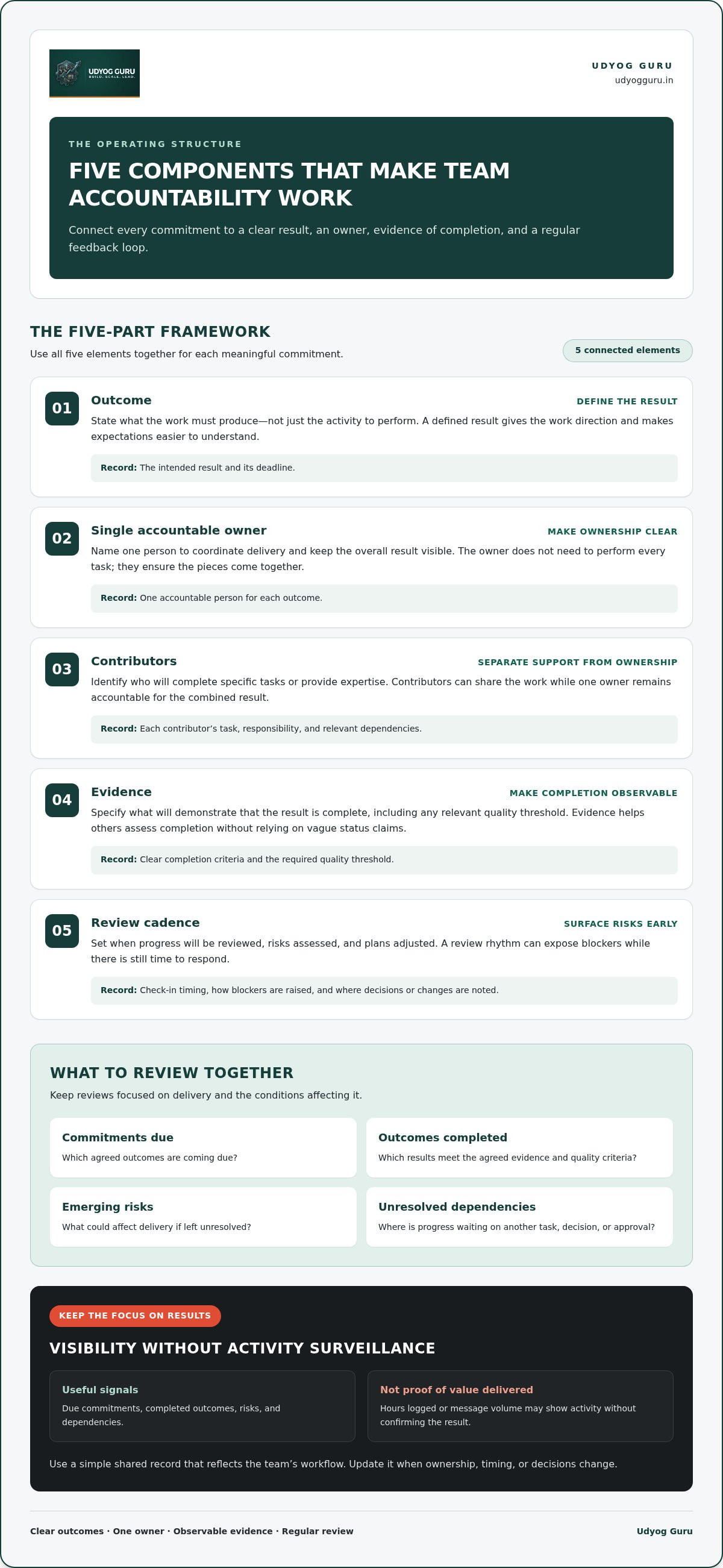
A reliable team accountability framework links each commitment to a defined result and a regular feedback loop. Five components form its operating structure:
- Outcome: State the result the work must produce, not just the activity to perform.
- Single accountable owner: Name one person to coordinate delivery and keep the result visible.
- Contributors: Identify who will complete specific tasks or provide expertise, without making ownership ambiguous.
- Evidence: Specify what will demonstrate completion, including a relevant quality threshold.
- Review cadence: Set when the team will check progress, assess risks, and adjust the plan.
These components work as a connected system. Without a clear outcome, activity has no direction. Without an owner, hand-offs can leave gaps. Without evidence, “make progress” remains open to interpretation. Without a review cadence, blockers may stay hidden until a deadline is missed. A small number of meaningful measures helps the team make decisions; tracking every message or hour can turn visibility into activity surveillance.
How should teams define ownership and completion?
Assign one accountable owner to each outcome, then name contributors and their responsibilities separately. Record who can make relevant decisions, which approvals are required, and what dependencies could affect delivery. Define completion using observable evidence, a deadline, and any quality threshold that matters. This gives contributors room to decide how to do the work while making the expected result unambiguous.
What should a useful accountability review measure?
Review commitments that are due, outcomes completed, emerging risks, and unresolved dependencies. Distinguish these result-focused measures from activity indicators such as hours logged or message volume, which may show effort without confirming value delivered. Keep the information in a simple shared record that reflects the team’s actual workflow, and update it when ownership, timing, or decisions change.
For example, a team preparing a new customer onboarding process could record its accountable owner, contributors, approval deadline, and agreed evidence of readiness. During reviews, the team can identify a delayed approval as a dependency and resolve it before it disrupts the outcome. This connects accountability to the broader workforce optimization framework, where roles, workflows, and measurable follow-through work together. Udyog Guru’s Workforce X-Ray™ and Workforce Acceleration Engine™ support workforce diagnosis and implementation, including clearer roles and follow-through.
Team Accountability vs. Micromanagement: How to Avoid Blame and Surveillance
Accountability is not continuous monitoring, and a missed commitment shouldn’t trigger automatic fault-finding. A team accountability framework sets an agreed result, makes relevant progress visible, and defines when support or intervention is needed. Micromanagement shifts attention to minute-by-minute activity, often without clarifying whether the work is producing the required outcome.
The difference is operational. A manager who checks an agreed milestone and asks whether a dependency threatens delivery is providing exception-based support. A manager who repeatedly requests status updates outside the agreed review rhythm, or treats online activity as proof of performance, adds surveillance without resolving the underlying risk. Clear expectations let people choose how to complete the work while making delivery signals available to the team.
What does healthy accountability look like in practice?
Healthy accountability uses predictable check-ins and visible outcomes rather than sudden status requests. The owner raises risks as soon as they become apparent, identifies the decision or resource needed, and explains the effect on the commitment. Managers preserve autonomy by intervening on defined exceptions, such as a blocked approval, a changed priority, or a forecast deadline risk. They help remove the constraint without taking over routine execution.
How should managers respond when a commitment is missed?
Start with a neutral review of the variance, not an assumption about intent. Ask what changed, what evidence shows the current status, and whether capacity, unclear requirements, a dependency, or a delayed decision affected delivery. Keep the discussion specific to the work and the conditions around it.
Then agree on a recovery action, a revised commitment where necessary, and a support owner if someone else needs to resolve a blocker. Record the decision and its effect on related work. This creates a useful reference for the next review and reduces repeated ambiguity.
Use neutral questions to examine the operating conditions:
- “Which part of the agreed outcome is complete, and what remains?”
- “What changed after the commitment was set?”
- “Which dependency or decision is preventing the next step?”
- “What recovery action and support would make the revised date realistic?”
If similar delays recur, look for a process pattern: overloaded capacity, recurring hand-off gaps, unclear decision rights, or estimates that don’t reflect the work. Addressing that pattern is more useful than treating each delay as misconduct. Individual accountability still matters, but it should be assessed against clear expectations, available evidence, and consistent processes. This approach supports candid risk reporting and timely correction while keeping the focus on reliable execution.
How to Build a Team Accountability Framework in Five Steps
Install the process in stages. A focused first rollout makes ownership visible without turning every task into a reporting requirement.
- Select consequential outcomes. Choose a small set tied to current priorities, customer delivery, or essential operational performance. Leave out routine, low-value tasks that don’t need team-level visibility or coordination. Before setting deadlines, map the hand-offs, dependencies, and decisions each outcome requires.
- Assign ownership and contributors. Give each outcome one accountable owner, then identify the people responsible for specific tasks and the decision-makers who can resolve approvals or trade-offs. This separates coordination from execution and makes gaps between roles easier to detect.
- Define completion and evidence. Describe the result in observable terms, set a realistic due date, and record any relevant quality threshold. For example, “prepare the client handover” is vague; “complete the handover checklist and obtain the required review by the agreed date” gives the team a testable endpoint.
- Set the operating rules. Agree on where commitments and decisions are recorded, how often the team reviews them, and how owners raise risks or request support. Keep the record aligned with the team’s real workflow instead of adding a parallel reporting process. Clear process ownership also supports wider business process systematization.
- Run a trial cycle, then adjust. Use the first review cycle to identify unclear measures, missed dependencies, delayed decisions, or meetings that take more time than they return in useful action. Refine those parts using evidence from the work. Keep the core rules, such as one accountable owner and defined completion criteria, consistent so the system remains predictable.
Which commitments should the team track first?
Prioritise outcomes that materially affect delivery or essential operations, especially those involving multiple roles or important hand-offs. Exclude individual activities that need no coordination and don’t change a team-level result. Mapping dependencies before assigning dates helps distinguish a genuine delivery commitment from a deadline based on assumptions about other people’s work.
How should the team launch and refine the framework?
Explain the definitions, ownership rules, evidence requirements, review frequency, and escalation expectations before the first check-in. During the trial, note confusion, recurring delays, and blockers that appear across commitments. Adjust measures or review design where they obscure progress or overload the team, while preserving the basic operating rules. This keeps the team accountability framework practical as needs change.
Udyog Guru’s Workforce X-Ray™ and Workforce Acceleration Engine™ help businesses diagnose workforce and workflow gaps and put clearer workforce practices into operation.
How to Sustain Team Accountability as the Business Grows
As a business adds roles, teams, and decision layers, informal coordination becomes less dependable. Work passes through more hand-offs, and the person responsible for one task may not control the decisions or resources needed for the final result. A team accountability framework must therefore make ownership, dependencies, and escalation routes explicit across the workflow, not only within individual roles.
Review the design when priorities, team structure, workflows, or decision rights materially change. Repeated missed commitments are another signal to investigate. Before adding more metrics or meetings, identify whether the cause is unclear ownership, insufficient capacity, blocked dependencies, delayed decisions, or a process that no longer fits how work is done.
When should a team revisit its accountability design?
Look for three warning signs: duplicate ownership, stale measures, and meeting overload. Duplicate ownership can leave people assuming someone else is coordinating the outcome. A measure that no longer reflects a meaningful result can distort decisions. Meetings that repeatedly surface status without resolving risks add reporting effort but not control. Trace each symptom to its source, then adjust the roles, measures, or review process contributing to the execution gap.
Recurring delays deserve the same diagnostic discipline. Compare the commitment with what happened: Was the owner clear? Did capacity change? Did another team’s hand-off arrive late? Was a decision waiting at the wrong level? This separates a structural issue from an isolated variance and helps managers make targeted corrections instead of expanding the tracking system indiscriminately.
How can workforce systems support consistent execution?
When local adjustments don’t resolve repeated problems, a workforce diagnosis can help examine the connections between roles, workflows, and measurable follow-through. Udyog Guru’s Workforce X-Ray™ identifies workforce gaps and helps leaders examine where accountability design may be breaking down.
Once the underlying needs are clearer, Workforce Acceleration Engine™ supports putting workforce practices into operation. Together, these tools connect diagnosis with implementation rather than simply adding another measure or meeting. They help address delivery issues through workforce and workflow design, not by treating every issue as an individual performance problem.
Explore Udyog Guru’s workforce systems for structured workforce diagnosis and implementation.
Make Reliable Follow-Through Part of How Your Team Works
A dependable team accountability framework connects clear outcomes with one accountable owner, defined evidence of completion, and a review rhythm that surfaces risks early. It distinguishes ownership from doing every task, so contributors can coordinate while managers focus on decisions, dependencies, and support. When commitments slip, diagnose the conditions around the work before assigning blame.
Start with a small set of important outcomes, then review how the process performs. As roles and hand-offs change, revisit ownership, measures, and escalation paths instead of adding more tracking by default. Consistent rules make accountability clearer while leaving teams room to decide how best to deliver.
Udyog Guru’s Workforce X-Ray™ helps diagnose workforce gaps, while Workforce Acceleration Engine™ supports workforce implementation. Explore Udyog Guru’s workforce systems to build clearer roles and more consistent follow-through into how your team works.
Frequently Asked Questions
What is a team accountability framework?
A team accountability framework is a repeatable management process for assigning, tracking, and reviewing commitments. It connects each intended outcome to a clear owner, contributors, evidence of completion, and a review point. For example, rather than assigning “improve onboarding,” a team can specify the outcome, who coordinates delivery, which teams contribute, and what will demonstrate that the agreed result is ready.
How do you create accountability in a team?
Create accountability by agreeing on a small set of meaningful outcomes, assigning one accountable owner to each, and clarifying contributors, deadlines, and completion evidence. Set a predictable review rhythm and define how people raise blockers or request decisions. Start with outcomes that affect customer delivery or essential operations. After the first review cycle, examine where expectations or hand-offs were unclear and adjust the process based on what happened.
What are the key elements of an accountability framework?
The key elements are a defined outcome, one accountable owner, named contributors, observable evidence of completion, and a review cadence. Useful designs also record deadlines, dependencies, decision rights, and escalation routes. Together, these details show who coordinates delivery, what completion means, and how the team will respond to risk. Measures should help people assess results and make decisions, rather than count activity without clarifying progress.
How can managers hold teams accountable without micromanaging?
Managers can hold teams accountable without micromanaging by agreeing on results, evidence, and check-in points in advance. Team members retain discretion over how to complete the work, while the manager monitors agreed outcomes and intervenes when a defined exception arises, such as a blocked decision or threatened deadline. Avoid unpredictable status requests and minute-by-minute activity checks. Ask what support or decision is needed to keep delivery on track.
What happens when a team member misses a commitment?
First, establish what changed and what the available evidence shows. Check whether unclear expectations, capacity constraints, delayed decisions, or dependencies contributed to the missed commitment before drawing conclusions about individual performance. Then agree on a recovery action, a realistic revised date if needed, and who will address any blocker. Record recurring causes so the team can identify process weaknesses instead of treating every delay as an isolated failure.
How often should a team review its commitments?
Set a review cadence that matches the pace and risk of the work. A team handling fast-moving, interdependent commitments may need frequent check-ins, while stable work may require less frequent reviews. The schedule should be predictable and useful, not a fixed ritual that creates meeting overload. Review what is due, what is complete, emerging risks, and unresolved dependencies, then adjust the rhythm if issues surface too late or reviews add little value.
Can accountability frameworks improve team performance?
They can support more reliable execution by making outcomes, ownership, and delivery risks easier to see and address. The framework itself doesn’t guarantee better performance; results depend on clear expectations, suitable measures, timely decisions, and consistent follow-through. Assess whether it helps the team complete important commitments, surface blockers earlier, and reduce confusion across hand-offs. If performance remains uneven, examine role clarity, capacity, and workflow design before adding more tracking.


