
What if a missed target points to a broken workflow, not an underperforming employee? A workforce diagnostic assessment examines the operating conditions around people, including role clarity, capability, processes, and management practices, before drawing conclusions about individual performance.
This distinction matters when leaders can see a gap but can’t tell whether it stems from skills, workload, unclear accountability, or a process that obstructs good work. Without evidence, capability decisions can rest on assumptions. And when an assessment feels like monitoring, it can weaken trust. A sound diagnostic focuses on how work is designed and supported, not on assigning blame. It goes beyond a performance review to show how workforce strengths and constraints align with operational needs.
This guide explains what a workforce diagnostic assessment examines, how to interpret its findings, and how to turn them into practical improvements. You’ll learn how to identify strengths and capability gaps, separate development needs from structural constraints, and use evidence to refine roles, workflows, delegation, and accountability. Udyog Guru’s Workforce X-Ray™ provides a structured approach to workforce diagnosis, while Workforce Acceleration Engine™ supports the implementation of workforce improvements.
Key Takeaways
- Use a workforce diagnostic assessment to identify whether performance constraints stem from capability, role design, workflows, delegation, or accountability.
- Connect each assessment dimension to observable work so findings are specific and useful for decisions.
- Distinguish a workforce diagnosis from a performance appraisal by comparing their purpose, evidence, scope, and follow-up.
- Use a proportionate five-step process, from defining the question and scope to reviewing evidence and planning follow-up.
- Turn each finding into a targeted intervention with a clear owner and a measure for reviewing progress.
What a Workforce Diagnostic Assessment Measures, and Why It Matters
A workforce diagnostic assessment is a structured review of workforce capability and the conditions that shape how work gets done. It examines whether people have the skills, information, authority, and operational support their roles require. The aim is to locate constraints before choosing an intervention, rather than assuming every missed target calls for more training or closer supervision.
A workforce diagnosis evaluates how people, roles, and operating conditions interact; individual performance scoring evaluates how a person performs against expectations. That distinction keeps the inquiry grounded in evidence. Leaders can compare role expectations with observed work, examine hand-offs and recurring errors, and check whether accountability is clear. Isolated complaints and intuition can raise a question, but they can’t establish its cause. A balanced review also helps prevent a blame exercise: the goal is to understand the system and identify where it needs adjustment.
This approach is part of the broader practice of Organizational development, which focuses on improving how organisations function. In practice, diagnosis gives leaders a reasoned basis for decisions about role design, workflow, management routines, and capability development.
What questions should a workforce diagnostic answer?
Connect assessment questions to observable work. If customer requests are delayed, for example, examine whether the responsible team has the skills, accurate information, and authority needed to resolve routine cases. Then trace the workflow: where does the request pause, and what information or approval is required at each hand-off?
The assessment should also clarify whether ownership is explicit, delegation matches decision rights, and management routines surface problems early. These questions help distinguish a capability gap from a process that makes reliable work difficult.
When does a business need a workforce diagnostic?
Recurring rework, unclear ownership, repeated delays, or decisions that depend on a founder’s involvement can signal an operating constraint. One mistake may be temporary; the same breakdown across people or work cycles suggests a pattern worth investigating. Compare evidence across relevant roles and over time before deciding where the cause lies.
Once the constraint is clearer, leaders can choose a proportionate response instead of applying blanket training or changing roles without evidence. For a broader view of the operating improvements that can follow, explore this workforce optimisation framework. Udyog Guru’s Workforce X-Ray™ provides a structured approach to workforce diagnosis.
Which Workforce Dimensions Should a Diagnostic Assessment Examine?
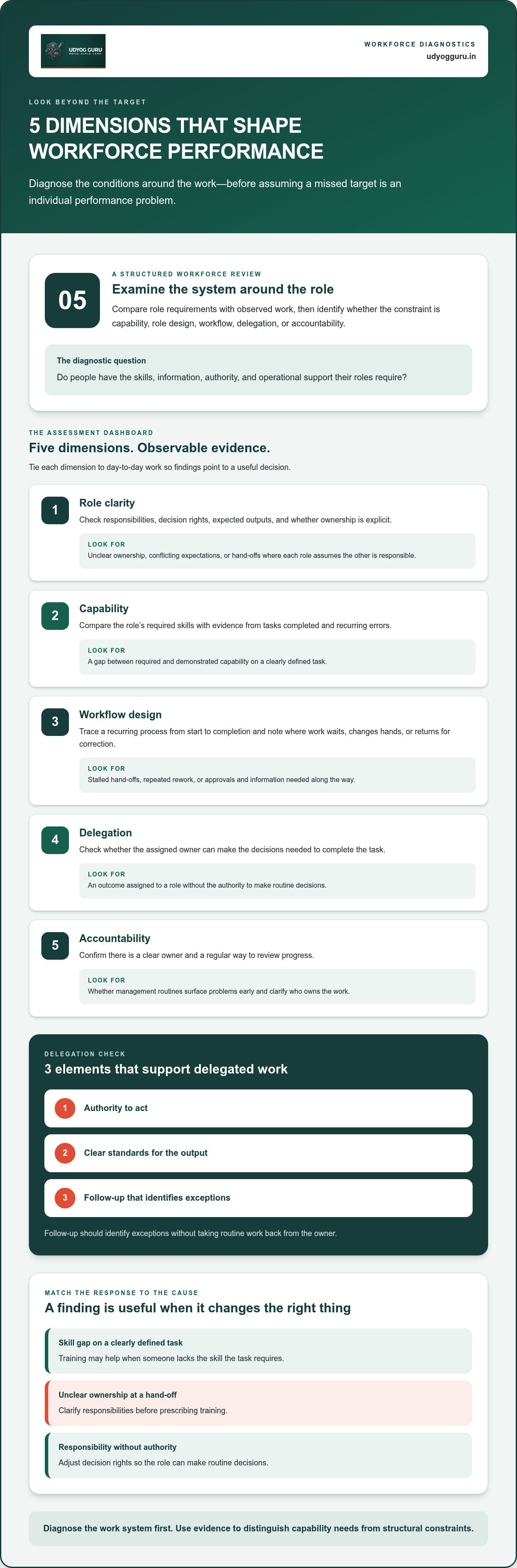
A useful assessment looks beyond whether people are meeting targets. It examines the conditions that shape consistent work: role clarity, capability, workflow design, delegation, and accountability. Workforce performance depends both on the capabilities people bring and on the operating conditions that enable or constrain their work.
Tie each dimension to observable evidence. Instead of labelling a team “not proactive,” check whether team members know which decisions they can make, have the information they need, and are expected to act within a defined timeframe. Specific findings can guide a change in training, process, authority, or management practice. AIHR’s Workforce Analysis: HR's Introduction and Guide offers further context on analysing workforce needs and capabilities.
How do role clarity and capability affect workforce performance?
Start with the role’s responsibilities, decision rights, and expected outputs. Compare those requirements with evidence from day-to-day work, such as completed tasks, recurring errors, escalation patterns, and the information employees need to make decisions. A gap between required and demonstrated capability may indicate a development need. Unclear ownership or conflicting expectations point instead to role design.
Match the response to the cause. Training may help when someone lacks a skill for a clearly defined task. If two roles each assume the other owns a hand-off, clarify responsibilities before prescribing training. If a role carries an outcome but lacks authority to make routine decisions, adjust its decision rights.
How do workflows and accountability shape team output?
Map a recurring process from start to completion. Record where work waits, changes hands, returns for correction, or depends on approval. Then check whether delegation includes three elements: authority to act, clear standards for the output, and follow-up that identifies exceptions without taking routine work back from the owner.
- Workflow: Are steps and hand-offs defined, or does work stall between teams?
- Delegation: Can the assigned owner make the decisions needed to complete the task?
- Accountability: Is there a clear owner and a regular way to review progress?
These observations help distinguish a capability gap from a process or management-system constraint. For a closer look at tracing delays to their source, see this guide to operational bottleneck diagnosis. Leaders seeking a structured workforce review can explore Workforce X-Ray™.
Workforce Diagnostic Assessment vs Performance Appraisal: What Is Different?
A performance appraisal commonly reviews an individual’s contribution against role expectations. A workforce diagnostic assessment examines the wider conditions influencing work, including role design, resources, workflows, decision rights, and management routines. One focuses primarily on individual performance; the other investigates how people and the operating system interact.
The distinction isn’t a choice between people and processes. Appraisal findings can reveal patterns that call for a broader diagnosis, while diagnostic findings can clarify whether an individual needs development or the work environment needs repair.
| Dimension | Performance appraisal | Workforce diagnosis |
|---|---|---|
| Purpose | Review an individual’s contribution and development against expectations. | Locate constraints affecting workforce or team performance. |
| Evidence | Role outcomes, work examples, and manager feedback. | Work outputs, recurring delays, hand-offs, role requirements, and process evidence. |
| Scope | Usually an employee and their role. | A role, team, workflow, or broader operating system. |
| Output | Performance feedback and individual development priorities. | Findings about capability, role design, resources, workflow, authority, or accountability. |
| Follow-up | Development actions and a future performance review. | Changes to capability support or operating conditions, with a review of their effect. |
Is a workforce diagnostic just an employee performance review?
No. It can use workforce evidence, but it shouldn’t reduce the analysis to ratings. If a team repeatedly misses a hand-off deadline, for example, the diagnostic asks whether ownership is clear, required information arrives on time, and the responsible role has authority to act. A skill gap may call for targeted development; an approval bottleneck or poorly designed role calls for a system change. Separating these causes prevents training from becoming the default response to every performance issue.
How can assessment avoid blame and surveillance?
Trust depends on a clearly defined purpose. Explain the work-related questions before collecting information, identify which evidence is relevant, and describe how findings will inform operational decisions. Use multiple sources, such as work outputs, process records, role expectations, and employee input, rather than treating a single metric or anecdote as proof.
Report conditions that can be acted on, not labels attached to employees. “Routine decisions wait for approval” points to a decision-rights issue; “the team lacks initiative” assigns a trait without establishing its cause. Transparent, system-level findings make it possible to address development needs while correcting constraints in resources, workflows, or management practice. The appraisal and diagnostic can then complement each other: one supports individual feedback, while the other guides improvements to the conditions in which performance occurs.
How to Conduct a Workforce Diagnostic Assessment in Five Steps
Size a workforce diagnostic assessment to the business question, the roles involved, and the available evidence. This practical sequence moves from scope to action, then checks whether the operating condition changed.
Step 1: Define the question and scope
State the problem in observable terms. “Customer requests are missing the agreed response window” is more useful than “The service team is inefficient.” Identify the workflow, roles, or team in scope, the period you’ll examine, and the decisions the assessment needs to inform. Keep the boundary narrow enough to investigate properly.
Step 2: Set a baseline
Choose operational indicators that show the current condition, such as turnaround time, rework, unresolved hand-offs, missed deadlines, or escalation frequency. Use measures that connect directly to the question; no universal benchmark suits every role or organisation. Record how each measure is defined and the period it covers so later comparisons are meaningful.
Step 3: Gather and cross-check evidence
Combine role documentation, workflow observations, existing performance indicators, and structured input from people involved in the work. Check each source for relevance, consistency, and a direct link to the diagnostic question. A process document may describe the intended hand-off, while observation shows whether it happens in practice. Don’t treat one metric or anecdote as a complete explanation.
Step 4: Identify causes and prioritise findings
Separate symptoms from likely causes. A delay may arise from missing capability, unclear ownership, an approval dependency, or incomplete information. Rank findings by operational impact, recurrence, and ability to address them. For each priority, record the intended change, an accountable owner, and an observable review measure. This turns analysis into a manageable action plan rather than an undifferentiated list of problems.
Step 5: Implement, review, and follow up
Apply the intervention that matches the diagnosed cause, then compare the result with the baseline. If a hand-off was redesigned, review whether delays or returns for correction changed. Set a follow-up point in advance. If the measure hasn’t shifted, revisit the diagnosis instead of assuming the team failed to implement it. For process-related findings, this guide to business process systematization provides additional context.
For a structured workforce diagnosis, explore Workforce X-Ray™.
Turn Workforce Diagnostic Findings into Operating Improvements
A diagnosis creates value only when findings lead to changes in how work is structured and managed. Convert each priority finding into a clear chain: the observed issue, its likely root cause, the intervention, the accountable owner, and a measure for reviewing whether the underlying condition changed. This keeps the response tied to evidence instead of leaving the assessment as a list of recommendations without follow-through.
What should happen after a workforce diagnostic?
Group findings by cause, then choose an action that addresses that cause directly. If responsibilities overlap, clarify role ownership and decision rights. If work repeatedly stalls between teams, revise the workflow or hand-off. If an employee lacks a skill needed for a clearly defined task, plan targeted development. Where delegation is the constraint, define the authority, standards, and follow-up the task owner needs.
Separate immediate corrections from longer-term workforce development. A missing approval rule or unclear task owner may be addressed through an operating change; building capability may require sustained development and review. Assign each action an owner and a review point, then track a relevant condition, such as hand-off delays or repeated corrections, alongside action completion. Completing a task doesn’t by itself prove the diagnosed constraint has been removed.
How does Udyog Guru support workforce optimisation?
Udyog Guru’s Workforce X-Ray™ is its workforce diagnostic offering, providing a structured way to understand workforce conditions and operational constraints. Its findings can inform decisions about role clarity, delegation, workflows, and capability priorities.
Workforce Acceleration Engine™ is the related workforce optimisation offering, focused on carrying improvements into implementation. Together, diagnosis and optimisation connect an assessment of current conditions to practical operating changes and management systems. The workforce diagnostic assessment becomes the starting point for an improvement cycle: identify the constraint, make a relevant change, assign ownership, and review the evidence.
Explore Udyog Guru’s workforce systems to learn about its diagnostic and optimisation approach.
Turn Workforce Insight into Lasting Operational Change
A workforce diagnostic assessment helps leaders identify whether performance constraints stem from capability, role design, workflows, delegation, or accountability. The key is to follow evidence to its root cause before choosing an intervention. This helps distinguish individual development needs from operating-system defects.
Each priority finding should lead to a specific change, a clear owner, and a review measure. Track whether the underlying work condition improves, not just whether an action was completed. This creates a practical cycle of diagnosis, implementation, and adjustment.
Udyog Guru’s Workforce X-Ray™ provides a structured workforce diagnostic, while Workforce Acceleration Engine™ supports the optimisation that follows. Together, they connect workforce insight to clearer roles, stronger delegation, and more consistent management systems.
Explore Udyog Guru’s workforce diagnostic and optimisation systems to take a structured next step. With a clear diagnosis and accountable follow-through, leaders can improve the conditions that help teams do their best work.
Frequently Asked Questions
What is a workforce diagnostic assessment?
A workforce diagnostic assessment is a structured review of workforce capabilities and the operating conditions that shape work. It examines whether roles, skills, workflows, decision rights, and management routines support the required outcomes. Rather than assuming a performance problem belongs to an individual, leaders use evidence to locate constraints and choose an appropriate response, such as clarifying ownership, adjusting a process, or addressing a specific capability need.
Is a workforce diagnostic assessment the same as a performance appraisal?
No. A performance appraisal typically reviews an individual’s contribution against role expectations, while a workforce diagnostic examines broader factors affecting performance across a role, team, or workflow. The approaches can complement each other. Appraisal evidence may point to a recurring issue, and a diagnosis can help determine whether the cause is individual development, unclear responsibilities, missing resources, or a process constraint.
What does a workforce diagnostic assessment measure?
It measures work-related dimensions such as role clarity, required and demonstrated capabilities, workflow steps, hand-offs, delegation, decision authority, and accountability. The measures depend on the business question. If work is delayed, for example, leaders might examine turnaround time alongside approval dependencies and hand-off points. Findings should connect to observable work, not vague traits or a single performance score.
How do you conduct a workforce diagnostic assessment?
Define the business question and the roles or processes in scope. Set a baseline using relevant operational indicators, then gather and cross-check evidence from sources such as role documents, workflow observations, existing measures, and structured input. Identify likely causes, prioritise issues by impact and recurrence, and assign an owner and intended change to each priority. Review the relevant measure afterward to see whether the underlying condition changed.
Can a small business benefit from a workforce diagnostic assessment?
Yes. A small business can focus on one recurring operational issue rather than reviewing every role at once. If routine decisions regularly return to the owner, for instance, examine decision rights, delegation, and the information employees need to act. Keep the scope proportionate to the evidence available and the decision at hand. This can help distinguish a capability need from a process or role-design constraint.
Who should be involved in a workforce diagnostic assessment?
Involve the leader accountable for the outcome, the people who perform the work, and managers responsible for the relevant workflow or decisions. Include functions that own key hand-offs when a process crosses team boundaries. Participants should explain how work is expected to happen and what occurs in practice. Clear communication about the assessment’s purpose helps keep the discussion focused on improving work conditions rather than assigning blame.
What should a business do after completing a workforce diagnostic assessment?
Turn priority findings into an action plan that names the root cause, intervention, accountable owner, and review measure. Clarify roles where ownership is uncertain, adjust workflows where work stalls, strengthen delegation where authority is missing, and address capability gaps with appropriate development. Track whether the diagnosed condition improves, not only whether the action was completed. Udyog Guru’s Workforce X-Ray™ supports workforce diagnosis, while Workforce Acceleration Engine™ supports workforce optimisation. Explore Udyog Guru’s workforce systems to take a structured next step.


