
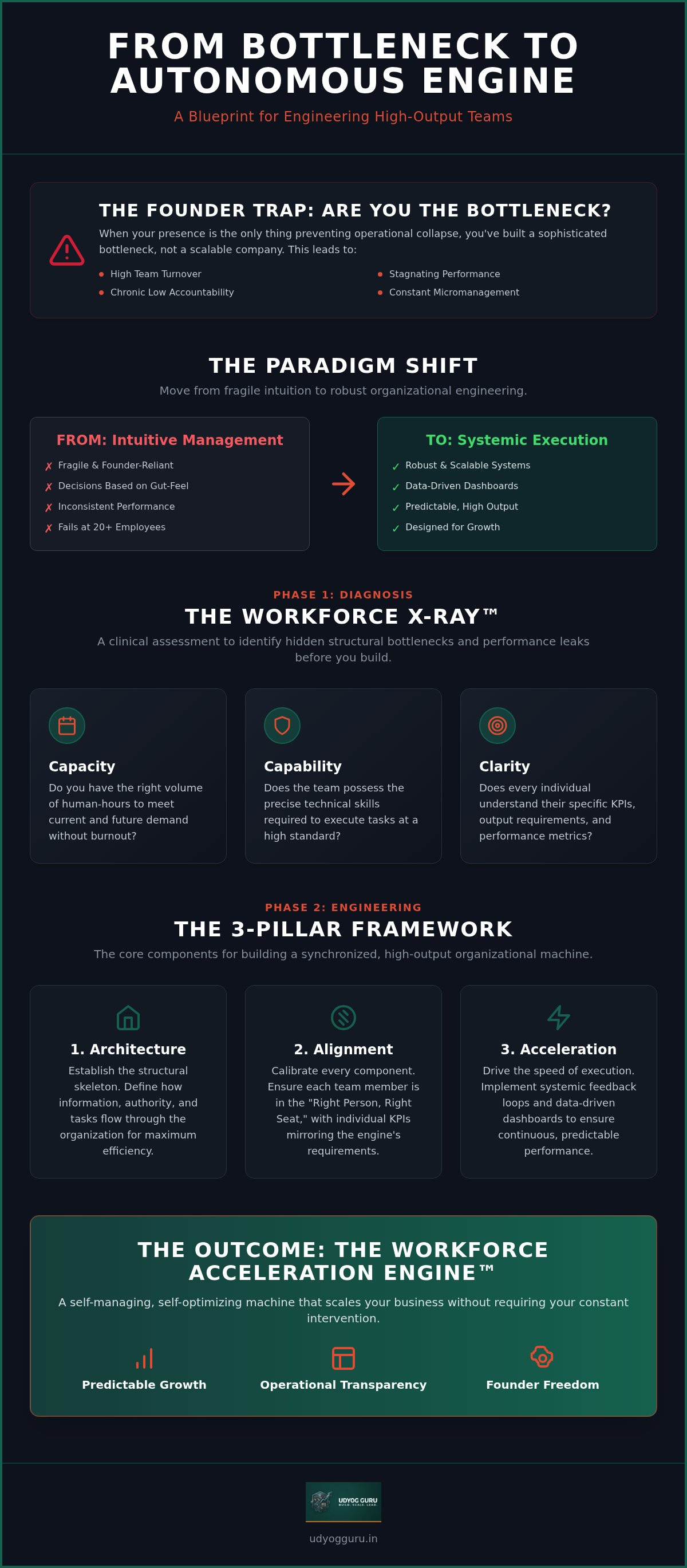
If your physical presence is the primary mechanism preventing operational collapse, you haven't built a company; you've engineered a sophisticated bottleneck. Most founders find themselves trapped in a cycle of high team turnover and chronic low accountability because they rely on human intuition rather than structural integrity. It's frustrating to watch performance stagnate while you're forced to micromanage every output to ensure quality remains consistent.
This article provides the diagnostic frameworks required to install advanced workforce optimization strategies that convert manual teams into autonomous, high-output systems. We'll move beyond motivational rhetoric to focus on the cold, hard mechanics of organizational engineering. You'll learn to master the structural protocols needed to remove yourself from the daily grind and achieve total operational transparency through data-driven dashboards.
We'll begin by conducting a clinical assessment of your current team dynamics through the lens of a Workforce X-Ray™ before detailing the installation of a Workforce Acceleration Engine™ to drive predictable growth across your enterprise. By the end of this guide, you'll possess the blueprint to transform your workforce into a self-managing machine that scales without your constant intervention.
Key Takeaways
- Identify precise performance leaks within your organization by conducting a Workforce X-Ray™, a diagnostic protocol designed to reveal hidden structural bottlenecks.
- Shift from intuitive management to systemic execution by installing advanced workforce optimization strategies that prioritize structural integrity over manual oversight.
- Master the three-pillar framework of Architecture, Alignment, and Acceleration to calibrate your team's output to the specific mechanical requirements of your scaling enterprise.
- Deploy the Workforce Acceleration Engine™ to ensure predictable performance and scalable growth without compounding the founder's daily operational burden.
- Establish a high level of operational transparency by integrating data-driven dashboards that provide a clinical view of employee performance and system health.
The Clinical Necessity of Workforce Optimization in Scaling Organizations
Scaling an enterprise requires a fundamental shift in how human capital is deployed. Most founders rely on management-by-intuition, a fragile method where decisions are based on gut feeling and personal oversight. While this works in small teams, it inevitably fails at the 20+ employee threshold. At this stage, the complexity of the organization exceeds the founder's cognitive bandwidth, leading to operational bottlenecks and chronic firefighting. Workforce optimization (WFO) is not a peripheral HR function; it's a core structural engineering requirement. Without robust workforce optimization strategies, the organization becomes a collection of disconnected parts rather than a synchronized high-output engine. It's the difference between a loose group of laborers and a calibrated machine.
Identifying Structural Inefficiencies
When a business scales without a blueprint, hidden underperformance becomes the silent killer of profitability. Traditional HR interventions often fail because they treat symptoms, like low morale or high turnover, rather than diagnosing the systemic cause. These issues usually stem from poor team calibration where roles are loosely defined and accountability is non-existent. You'll notice the symptoms quickly. The founder is constantly pulled back into low-level tasks, and performance remains inconsistent across departments. This isn't a people problem but a failure of the organizational architecture. We must treat these inefficiencies as mechanical defects that require immediate technical repair. If you don't address these leaks, no amount of new hiring will fix the underlying output deficit.
The Workforce X-Ray™: Diagnostic Precision
To repair these structural fractures, we must move from guesswork to clinical examination. The Workforce X-Ray™ serves as a high-resolution scanning tool to identify where the organizational engine is leaking energy. It analyzes the workforce through three distinct layers. First, capacity measures if you have the right volume of hours to meet demand. Second, capability assesses whether the team possesses the technical skill level to execute at high standards. Third, clarity determines if every individual understands their specific output requirements and performance metrics. By using data to diagnose these gaps, you can install precise workforce optimization strategies that target the root cause of inefficiency. This diagnostic approach ensures that every hire and every process adjustment is backed by structural logic rather than emotional reaction. It's about building a predictable system where high output is the default, not the exception.
Core Strategies for Engineering High-Output Teams
The engineering of a high-output team rests on a three-pillar framework: Architecture, Alignment, and Acceleration. Architecture establishes the structural skeleton of the organization, defining how information and authority flow through the machine. Alignment ensures every component is calibrated to the business's specific output requirements, while Acceleration drives the speed of execution through systemic feedback loops. Most founders focus on headcount management, simply adding more people to solve problems, but this often increases friction. Instead, effective workforce optimization strategies prioritize capacity optimization. This means maximizing the throughput of each individual by ensuring the system they operate within is free of mechanical drag. It's about optimizing the engine's displacement rather than just adding more cylinders.
Skills-to-Task Calibration
Achieving a "Right Person, Right Seat" configuration isn't a matter of intuition; it requires a technical diagnostic scan of individual capabilities. We quantify skill gaps to determine if the human capital currently installed can support the goals of the Business Acceleration Engine™. This calibration involves Sustaining Growth through Workforce Acceleration by aligning individual performance metrics with the broader organizational blueprint. When individual KPIs mirror the engine's requirements, the workforce operates with surgical precision. If you haven't yet assessed your team's current structural health, identifying these gaps is the first step toward systemic repair. It ensures that every member of the team is technically capable of meeting their specific output protocols.
Architecting Automated Delegation Protocols
Founder dependency is a design flaw that limits the growth of scaling enterprises. To remove yourself as the central bottleneck, you must install automated delegation protocols that function without manual oversight. This involves shifting from verbal instructions to rigid decision-making frameworks. During the installation phase, we set up delegation engines for repetitive, high-frequency tasks. This ensures that the workforce knows exactly how to proceed when faced with standard operational variables, eliminating the need for constant permission or oversight. By implementing a Workforce Acceleration Engine™, you transition from a manual operator to a systems architect. This structural integrity is what allows an enterprise to scale without a corresponding increase in the founder's daily workload.
Workforce Management vs. Strategic Workforce Optimization
Traditional workforce management is a tactical exercise in scheduling and attendance tracking, whereas strategic workforce optimization strategies involve the rigorous engineering of the organizational structure itself. Many founders confuse the two, believing that a digital time-clock or a basic project management tool equates to an optimized system. Management is reactive, focusing on who is present and what tasks are assigned. Optimization is proactive and clinical, focusing on how the system generates maximum output with minimum friction. If you're merely tracking hours, you're monitoring the fuel gauge while ignoring the fact that the engine's cylinders are misfiring.
Software alone is not a strategy; it's simply the telemetry used to measure the health of your organizational architecture. Installing a new platform without first repairing your underlying protocols is like putting a high-end GPS on a vehicle with a broken transmission. You'll have better data on your lack of progress, but you won't move any faster. True optimization requires a shift from tracking time to engineering output. We must move beyond the legacy mindset of "hours worked" and begin measuring the precise displacement of value within the business engine.
Tactical Scheduling vs. Strategic Alignment
Most enterprises stagnate at the management level because it's easier to track presence than to architect performance. Tactical scheduling ensures seats are filled, but it fails to align workforce capacity with market demand cycles or long-term scaling objectives. Strategic alignment requires a surgical look at how team members are deployed during peak operational loads. When your capacity is calibrated to your demand, you eliminate the "hidden" costs of idle time and the burnout associated with systemic overextension. This alignment is the foundation of long-term scalability, ensuring the workforce grows in lockstep with the company's technical requirements.
Quantifying Human Capital ROI
To achieve total operational transparency, we utilize the Financial Command Dashboard to track workforce efficiency with mathematical precision. This allows us to calculate the true cost of operational friction, which is the lost revenue resulting from bottlenecks, miscommunications, and manual oversight. We no longer guess at team value; we diagnose it. Workforce ROI is the clinical measurement of Net Value Add divided by Total Human Capital Expenditure, adjusted for the Drag Coefficient of operational friction identified during your diagnostic scan. By quantifying these metrics, you can make data-driven decisions about where to install new protocols and where to trim systemic waste, ensuring every rupee spent on your team generates a predictable, high-output return.
Implementation Protocols: From Manual Oversight to Systemic Execution
The transition from a manual, founder-dependent team to a high-output organization requires a rigorous five-step installation protocol. We move away from the chaos of micromanagement toward a state of technical order. These workforce optimization strategies are designed to repair structural fractures and ensure that your human capital functions as a synchronized engine. This process isn't about motivational coaching; it's about the clinical application of systems engineering to the workforce.
- Step 1: Conduct a Workforce X-Ray™: This clinical scan identifies performance leaks and structural bottlenecks where human capital is being underutilized or mismanaged.
- Step 2: Codify Standard Operating Procedures (SOPs): We define the precise protocols for all high-frequency tasks. Without these blueprints, consistency is impossible to maintain.
- Step 3: Install Automated Accountability Loops: We replace manual check-ins with system-driven triggers that alert the team when output thresholds aren't met.
- Step 4: Integrate AI and Technology: We use advanced tools to augment human output, removing the mechanical drag of repetitive manual labor.
- Step 5: Monitor via the Financial Command Dashboard: All workforce data is centralized into a single source of truth, providing real-time telemetry on system health and efficiency.
Installing Accountability Frameworks
Accountability is often misunderstood as a personality trait. In reality, it's a structural byproduct of a well-engineered system. We establish a "Protocol of Ownership" where every team member is responsible for specific system outputs rather than vague lists of tasks. This allows the founder to track performance without the inefficiency of constant intervention. By linking your business diagnostic scan to these accountability frameworks, you ensure every role is calibrated to the actual needs of the enterprise. This creates a self-correcting workforce where performance gaps are identified and repaired automatically by the system itself.
Integrating AI and Automation Engines
The final phase of optimization involves the integration of advanced technology to drive speed and accuracy. We leverage the principles of the AI Tech Business Integration Bootcamp to identify "Automation-First" opportunities within existing team workflows. This isn't about replacing your staff but about removing the human error associated with data entry and logistical coordination. Systematic technology integration increases the displacement of your organizational engine, allowing your team to focus on high-level problem solving while the machine handles the repetitive load. If your current team requires constant supervision to remain productive, your implementation protocols are incomplete. You must transition from being a supervisor to a systems architect. To begin your structural transformation, you can deploy the Workforce Acceleration Engine™ today.
Sustaining Growth through the Workforce Acceleration Engine™
Scaling an enterprise often leads to a paradoxical increase in founder workload, a symptom that indicates a failure in the underlying organizational architecture. True growth requires the installation of the Workforce Acceleration Engine™, a protocol designed to generate predictable team output regardless of individual variables. By implementing advanced workforce optimization strategies, you ensure the organization scales through systemic expansion rather than sheer human effort. This final stage of optimization transforms the business into a self-sustaining entity that operates with mechanical consistency. It marks the transition from a labor-intensive operation to a capital-efficient machine.
Removing Founder Dependency
The "Business Surgeon" approach focuses on the clinical excision of the founder from daily operations. This isn't a retreat from leadership; it's a structural requirement for scaling a business without inducing systemic collapse or founder burnout. A resilient structure must be engineered to survive individual departures, ensuring that the exit of any single component, including the owner, doesn't halt the engine. We build redundancy into every protocol so that functions are governed by the system rather than the person. This ensures that the enterprise possesses the structural integrity to maintain high output even during periods of transition or market volatility.
The Path to Operational Transparency
Total transparency is achieved through the Financial Command Dashboard, which acts as the "Flight Deck" of your enterprise. This tool allows you to maintain a clinical distance from operational chaos, replacing frantic energy with rigorous data analysis. You're no longer guessing at performance; you're monitoring real-time telemetry. The workforce-as-a-machine philosophy dictates that every action is a measurable input leading to a predictable output. When the machine is fully calibrated, growth becomes an inevitable byproduct of the system's design. This level of transparency provides the clarity needed to make high-level strategic adjustments without getting lost in the weeds of daily management.
Ultimately, sustaining growth is a matter of maintaining the calibration of your organizational engine. As new team members are onboarded, they're integrated into the existing protocols, ensuring that the culture of high accountability remains intact. This systemic execution allows the business to grow independently of its owner, providing the freedom to focus on high-level architecture rather than low-level repair. You've successfully moved from a manual team to a high-output, system-driven workforce that generates value with surgical precision.
Architecting Your High-Output Organizational Engine
Transforming a manual team into a high-output engine requires a clinical shift from intuition-based oversight to rigorous structural engineering. We've detailed how identifying performance leaks and installing automated accountability protocols can stabilize a scaling organization. By implementing advanced workforce optimization strategies, you move beyond the chaos of firefighting and establish a foundation for predictable, independent growth. This evolution isn't about working harder; it's about the precision of your organizational architecture.
The transition to a self-managing workforce is a solvable puzzle of logic and process. Our proprietary Business X-Ray™ methodology and specialized AI Tech Business Integration Bootcamp are specifically engineered to remove founder dependency and install a permanent framework for efficiency. With our proven Financial Command Dashboard systems, you gain the clinical data required to maintain total operational transparency. This ensures your enterprise scales without compounding your personal workload.
It's time to stop managing individuals and start architecting a high-performance machine. Book your Workforce X-Ray™ diagnostic scan today to identify your operational bottlenecks and begin the installation of your high-output organizational engine. You possess the blueprint; now you must execute the repair.
Frequently Asked Questions
What is the difference between workforce management and workforce optimization?
Workforce management is a tactical process focused on scheduling and attendance, while workforce optimization strategies involve the structural engineering of the entire organizational engine. Management ensures people are present; optimization ensures their output is calibrated to the business's technical requirements. By shifting from reactive tracking to proactive systemic repair, you move beyond simple oversight. This approach prioritizes structural integrity and logical progression, transforming a loose group of employees into a synchronized, high-output machine.
How do I know if my business needs a Workforce X-Ray™?
Your business requires a Workforce X-Ray™ if the founder is the primary mechanism preventing operational collapse or if performance remains inconsistent across departments. Common diagnostic indicators include chronic firefighting, high team turnover, and a lack of data-driven transparency in employee output. This clinical scan identifies specific performance leaks and structural fractures. If you can't step away from daily operations without risking a breakdown, your organizational architecture is defective and requires immediate technical examination.
Can workforce optimization strategies work for small teams of under 10 people?
Workforce optimization strategies are essential for small teams because they establish the foundational protocols required for sustainable scaling. Implementing these systems early prevents the founder-dependent bottlenecks that typically emerge at the 20-employee threshold. By architecting high-output workflows from the start, you ensure that every new hire is integrated into a calibrated engine. This proactive approach builds a resilient structure that supports growth without increasing the founder's personal daily operational burden.
What are the most effective workforce optimization tools for Indian SMEs?
For Indian SMEs, the most effective tools are those that provide total operational transparency, such as the Financial Command Dashboard and the Workforce Acceleration Engine™. Rather than relying on generic project management software, these proprietary systems focus on quantifying human capital ROI and automating delegation protocols. These tools are designed to work within the specific logistical realities of the Indian market, offering a clinical view of performance that eliminates guesswork and manual micromanagement.
How does AI integration improve workforce performance without replacing people?
AI integration improves performance by removing the mechanical drag of repetitive, low-value tasks, allowing your team to focus on high-level problem solving. Through programs like the AI Tech Business Integration Bootcamp, we teach founders to embed automation into existing workflows. This doesn't replace people; it augments their capacity. By reducing human error and increasing the speed of execution, AI serves as a force multiplier that enhances the overall displacement of your organizational engine.
What happens if my team resists the implementation of new optimization protocols?
Resistance to new protocols is usually a diagnostic symptom of a lack of clarity in roles or performance expectations. We address this by installing a "Protocol of Ownership," where every team member understands their specific output requirements. When accountability is engineered into the system, resistance fades because the path to success is clearly defined. The goal is to move from emotional management to a "business-as-science" approach where data, not intuition, governs performance.
How long does it typically take to see results from a Workforce Acceleration Engine™?
Initial improvements in transparency and clarity are often visible within weeks of installing the Workforce Acceleration Engine™. However, the full calibration of a high-output workforce typically follows a methodical, progressive timeline as new protocols are integrated into daily operations. The focus is on building a sustainable machine rather than providing a temporary motivational boost. This steady implementation ensures that the resulting growth is predictable and the system remains robust as the enterprise continues to scale.
Is workforce optimization only about reducing costs?
Workforce optimization is about achieving structural integrity and predictable scaling, not just reducing operational costs. While cost reduction is a frequent byproduct of removing systemic waste, the primary objective is to engineer a business that grows independently of its owner. We focus on maximizing output and ensuring total transparency through data-driven dashboards. This approach views the business as a solvable puzzle of logic, where efficiency is the mechanical result of a well-oiled system.


