

What if the decisions that built your company are now preventing it from scaling? In a transition from founder-led to process-driven company, routine approvals, informal instructions, and unresolved exceptions can keep work returning to the founder, even as the team grows.
That dependence often starts with good intentions. The founder knows the customers, standards, and risks, so stepping in can feel faster and safer than handing over a decision. But when knowledge stays informal, employees have less authority to act consistently, and growth brings more delays and operational uncertainty.
This guide shows how to identify where the business relies too heavily on you, then transfer work through clear decision rights, documented workflows, and named accountability. You’ll also learn how to monitor performance without becoming the approval point again. The sequence matters: diagnose dependencies before changing processes, establish ownership before adding automation, and use relevant measures to maintain visibility and quality. Udyog Guru’s Business X-Ray™, workforce systems, and Financial Command Dashboard support these steps by helping surface operational gaps, strengthen accountability, and track performance.
Key Takeaways
- Spot founder dependency by tracking repeated approvals, undocumented workarounds, and decisions that stall without your input.
- Choose a recurring, high-impact workflow and document its steps, decision points, and ownership before transferring it.
- Set clear decision rights so employees know what they can handle independently and when an issue needs escalation.
- Make the transition from founder-led to process-driven company in stages, then monitor ownership, exceptions, rework, and turnaround time.
- Use diagnosis to set priorities, then choose implementation and performance tools that fit the processes your business needs to strengthen.
When does a founder-led company need process-driven operations?
A founder-led company relies heavily on the founder’s knowledge, judgment, and direct involvement to move work forward. A process-driven company defines how recurring work gets done, who can make which decisions, and when exceptions need escalation. These models aren’t opposites: leadership sets direction, while processes make execution more consistent. Process-driven operations turn repeatable work into owned, documented routines, reducing dependence on any one person without removing strategic oversight.
The need for a transition from founder-led to process-driven company becomes clear when growth exposes operational dependencies. A founder may still need to set priorities, shape the offer, or handle high-consequence relationships. But routine approvals, predictable customer issues, and familiar exceptions shouldn’t automatically wait for the founder’s input.
What does founder dependency look like in daily operations?
Map the decisions and interruptions that keep recurring: pricing exceptions, delivery changes, customer complaints, expense approvals, or handoffs between teams. For each, note who raises the issue, what information is needed, and whether a team member could resolve it using defined criteria.
Then identify work that pauses when the founder is unavailable. If a customer response, purchase, or delivery handoff stalls because only one person knows the next step, the dependency is operational, not merely personal. Separate responsibilities that require founder judgment, such as setting risk limits, from repeatable tasks that can be assigned authority and a clear escalation route.
Which signals show that informal operations are limiting growth?
Compare how different employees handle the same recurring task. Variations may be appropriate when circumstances differ, but unexplained differences can indicate that the method exists only in memory or informal instructions. Look for repeated corrections, avoidable rework, customer follow-ups, and approvals that add waiting time without changing the decision.
These signals are diagnostic evidence, not a reason to document every activity at once. Prioritise recurring work where inconsistent execution could affect customers, finances, compliance, or delivery. A structured business diagnostic scan can help identify where work depends on individual knowledge before you decide what to standardise.
Company needs also change as it grows. The organizational life cycle offers a framework for considering how management needs shift across stages. In practice, company size alone isn’t the trigger. Look for recurring decision bottlenecks, inconsistent processes, or work that stops without the founder. Once those patterns are visible, build processes around the work the founder currently owns.
How to build processes around the work the founder currently owns
Once a founder-dependent workflow is visible, transfer it in a controlled sequence. The aim isn’t to document every action or remove judgment. It’s to make repeatable decisions understandable, assign responsibility, and define how exceptions are handled. A useful procedure helps someone complete the work reliably without turning every small variation into a new approval request.
How do you select the first workflows to systematize?
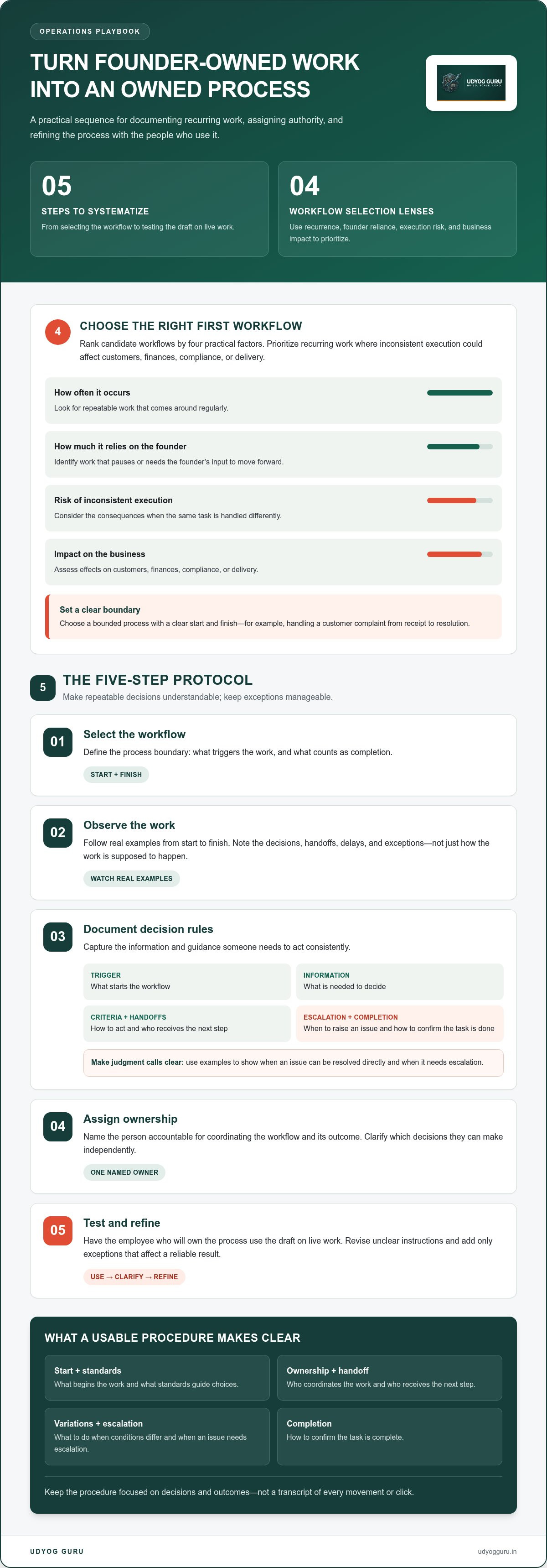
Rank candidate workflows by how often they occur, how much they rely on the founder, the risk of inconsistent execution, and their impact on customers, finances, compliance, or delivery. Choose a bounded process with a clear start and finish, such as handling a customer complaint from receipt to resolution. For further process-design guidance, see business process systematization.
Then build the protocol through five steps:
- Select the workflow. Define the process boundary, including what triggers it and what counts as completion.
- Observe the work. Follow real examples from start to finish. Note decisions, handoffs, delays, and exceptions instead of relying only on how the work is supposed to happen.
- Document decision rules. Record the trigger, information needed, criteria for action, handoffs, escalation conditions, and completion standard. Use examples to explain judgment calls, such as when a customer issue can be resolved directly and when it needs escalation.
- Assign ownership. Name the person accountable for coordinating the workflow and its outcome. Clarify which decisions they can make independently.
- Test and refine. Ask the employee who will own the process to use the draft on live work. Revise unclear instructions and add only exceptions that affect a reliable result.
How should founder knowledge become a usable operating procedure?
Keep the procedure focused on decisions and outcomes, not a transcript of every movement or click. A strong SOP explains what starts the work, what standards guide choices, who receives the next handoff, what to do when conditions differ, and how to confirm the task is complete. Duquesne University’s Small Business Development Center also discusses the principles behind Building Scalable Operations.
A process owner is accountable for coordinating the workflow, monitoring its outcome, and resolving or escalating deviations within their authority. The founder can retain oversight of risk thresholds and strategic exceptions while transferring routine execution and decisions. That distinction is central to a practical transition from founder-led to process-driven company: the founder’s standards are preserved in the operating protocol, while the team gains a defined way to act.
If you need to identify operational gaps before prioritising workflows, Udyog Guru’s Business X-Ray™ provides a diagnostic starting point.
How to delegate decisions without losing quality or control
Delegating operational decisions doesn’t require the founder to surrender strategic oversight. It requires a clear boundary between decisions the team can make within an agreed protocol and decisions that could materially change risk, commitments, or business direction. Protect quality through observable standards, proportionate reviews, and defined escalation rules, not by routing every choice back for approval.
Which decisions should stay with the founder, and which can move?
Keep decisions involving strategy, material risk, or a change in business direction with the founder. Delegate repeatable choices when the employee has the authority, information, and resources to act within defined boundaries. Set those boundaries to reflect the company’s operating conditions. For example, specify which customer commitments, spending decisions, or delivery exceptions need escalation based on their potential impact.
| Decision route | Use it for | Operating rule |
|---|---|---|
| Founder approval | Strategic shifts or decisions with material business risk | Founder decides before the commitment is made. |
| Delegated authority | Recurring choices covered by an established process | Owner acts independently within documented boundaries. |
| Escalation | Exceptions outside the owner’s authority or the process criteria | Owner shares the relevant facts and pauses only the affected decision. |
Escalation preserves founder input for defined risks without turning routine work into a queue. A useful rule states what triggers escalation, who receives it, and what information they need to decide. The employee should still resolve matters that fit the agreed criteria, even if the founder might choose a different approach. Otherwise, authority exists on paper but not in practice.
How can accountability protect quality after delegation?
Assign one accountable owner to each workflow and define its expected output. Make quality observable: specify what a completed task must contain, which standards it must meet, and what evidence shows the work is ready for the next handoff. A customer response, for instance, can be assessed against accuracy, required information, and the agreed service standard, rather than the founder’s personal preference for wording.
Set review intervals according to operational risk. A high-impact workflow may need closer review early on, while a stable, lower-risk process can be checked less often. Review completion, rework, and exceptions, then adjust the protocol when patterns reveal a genuine gap. Duquesne University’s SBDC also discusses building scalable operations through repeatable systems. For team-level alignment, Udyog Guru’s Workforce X-Ray™ and Workforce Acceleration Engine™ support workforce performance and systems.
This is the control structure behind a successful transition from founder-led to process-driven company: decision authority moves closer to the work, while clear standards and exception reporting keep the founder informed where their judgment matters.
How to implement the transition in stages and measure adoption
A transition from founder-led to process-driven company is an operating change, not a documentation exercise. Roll it out in stages so the team can apply each process, surface gaps, and adjust the design before it becomes standard practice.
What should the transition plan include?
For each workflow, record the accountable owner, the founder’s role after handover, decision boundaries, and how performance will be reviewed. If the team has limited capacity for change, introduce one process at a time instead of changing several interconnected routines at once. Diagnose bottlenecks first. Adding technology before work and ownership are clear can automate confusion rather than resolve it.
- Diagnose: Identify where work stalls, repeats, or depends on founder intervention.
- Select: Choose a high-impact workflow based on its operational consequences and readiness for change.
- Document: Capture the steps, decisions, handoffs, exception rules, and completion standard.
- Transfer ownership: Communicate the owner’s authority and the founder’s retained oversight.
- Test: Observe the process in use and record where the protocol helps or fails.
- Refine: Correct unclear steps, then establish a review rhythm for continued monitoring.
A diagnostic such as Udyog Guru’s Business X-Ray™ can help identify operational gaps before you set implementation priorities. Introduce technology later, once the workflow is understood and ownership is established.
Which indicators show that the new process is working?
Measure execution and outcomes, not simply activity. Track whether an owner is assigned, work meets the defined standard, exceptions are resolved, rework occurs, and decisions move through the process without unnecessary founder intervention. Pair these signals with relevant operational or financial indicators, such as delivery reliability or the figures the workflow is intended to influence.
Process adoption is demonstrated by consistent ownership, completed work, and measurable changes in exceptions, rework, and decision flow, not by the existence of a written procedure.
Establish a baseline from the company’s own records before judging progress. Set improvement thresholds that reflect the workflow’s starting point and risk; universal targets can conceal important differences between teams and processes. The Financial Command Dashboard supports operational and financial visibility, helping leaders review relevant measures without taking routine decisions back from process owners.
To diagnose operational gaps and set implementation priorities, explore Udyog Guru’s Business X-Ray™.
How Udyog Guru supports the move from founder-led to process-driven
A transition from founder-led to process-driven company benefits from a clear sequence: diagnose where the operating model depends on the founder, prioritise the gaps, then choose an implementation pathway. Udyog Guru’s systems support different stages, from identifying operational gaps to strengthening workforce systems and business visibility.
When is a diagnostic scan useful for founder-dependent operations?
A diagnostic is useful when founder dependency appears across several workflows or teams, rather than in one isolated task. Repeated approval requests, inconsistent handoffs, unclear ownership, and work that stalls without the founder can point to connected operating gaps. Business X-Ray™ identifies operational gaps and helps business owners assess where to focus before setting implementation priorities.
Diagnosis and implementation are distinct stages. The scan helps clarify what needs attention; it doesn’t replace the work of defining processes, decision rights, and accountability. Prioritising from evidence can help leaders address consequential bottlenecks first instead of attempting to change every workflow at once.
How can workforce and technology systems support the new operating model?
Once priority workflows are clear, role ownership becomes central to adoption. Workforce X-Ray™ and Workforce Acceleration Engine™ support workforce performance and systems, helping businesses examine how responsibilities and operating practices fit together. The Financial Command Dashboard supports operational and financial visibility, allowing business owners to maintain oversight through information rather than routine intervention.
Technology should follow process design. First define the workflow, its owner, decision criteria, and exceptions. Then identify repetitive tasks that may be suitable for technology enablement. Udyog Guru’s AI Tech Business Integration Bootcamp focuses on integrating technology into existing workflows and automating repetitive tasks. It supports established process design rather than replacing it.
Business Acceleration Engine™ provides an implementation pathway for businesses ready to work on their operating systems. Follow the diagnostic logic: identify the gaps, select priorities, then work through implementation. The appropriate sequence depends on what the business scan reveals and which constraints have the greatest operational impact.
If recurring decisions still return to you, or different teams experience the same bottlenecks, begin with a structured diagnosis. Explore Business X-Ray™ to identify operational gaps and clarify which improvements to prioritise next.
Build an Operating System That Scales With You
A successful transition from founder-led to process-driven company doesn’t remove the founder’s influence. It turns valuable judgment into clear decision rights, repeatable workflows, and accountable ownership, so the team can handle routine work while the founder retains strategic oversight.
Start by diagnosing where work depends on you, then prioritise workflows with the greatest operational impact. Document decision criteria and escalation points, transfer ownership deliberately, and measure adoption through completion, exceptions, rework, and founder interventions. Use the company’s own baseline to guide refinements rather than relying on arbitrary targets.
Udyog Guru’s Business X-Ray™ provides a diagnostic starting point for identifying operational gaps, while Business Acceleration Engine™ supports structured business implementation. Together, these offerings help clarify what needs attention and provide a pathway for improving business systems.
Explore Udyog Guru’s business transformation systems to identify a practical next step. Build the operating structure one process at a time, and let the business grow with greater clarity and less dependence on any single person.
Frequently Asked Questions
What is the difference between a founder-led and process-driven company?
A founder-led company relies heavily on the founder’s knowledge and direct decisions to keep work moving. In a process-driven company, recurring work follows defined workflows, decision rights, and accountability. The founder still sets direction and handles strategic matters, but routine choices don’t need to return to them. The distinction is not leadership versus systems; it’s whether execution depends on one person’s presence or on clear operating practices.
How do I know if my business depends too much on me as the founder?
Your business may rely too heavily on you if routine approvals repeatedly reach your desk, employees use undocumented workarounds, or decisions stall when you’re unavailable. Look for work that only one person knows how to complete, repeated corrections, inconsistent handling of the same task, or customer issues that require your intervention by default. These patterns help distinguish valuable founder judgment from operational knowledge that needs to be shared.
How do you transition from founder-led to process-driven operations?
Start by identifying workflows that repeatedly depend on you, then prioritise one with clear customer, financial, compliance, or delivery impact. Observe how the work is done, document its triggers, decision rules, handoffs, exceptions, and completion standard, then assign an owner with defined authority. Test the procedure in real work, review the results, and refine it before applying the same method to another workflow.
Will documented processes make a company less flexible?
No. A well-designed process should clarify how to handle routine work and exceptions, not force every situation into identical steps. Define the standard route, the conditions where employees can adapt within their authority, and the risks that require escalation. Review exceptions to determine whether they need a one-off response or a process change. This structure supports consistent decisions while leaving room for informed judgment.
What processes should a founder delegate first?
Begin with recurring workflows that consume founder time and have clear boundaries, such as routine customer follow-ups, standard approvals, or predictable delivery handoffs. Prioritise tasks where inconsistency could affect customers, finances, compliance, or delivery. Avoid starting with a broad, complex function that has unclear ownership. A contained process with a clear trigger and completion point makes it easier to document authority, test the handover, and learn from exceptions.
How can a founder maintain quality after delegating work?
Define quality through observable standards, such as the information a completed task must include or the conditions it must meet before handoff. Give one owner responsibility for coordinating the workflow, and specify which exceptions require escalation. Review completion, rework, unresolved exceptions, and customer or operational outcomes at intervals suited to the process’s risk. This preserves visibility without requiring the founder to approve each routine decision.
How long does it take to move from founder-led to process-driven?
There is no fixed timeline that applies to every business. The work depends on how many workflows rely on the founder, how complex their decisions and handoffs are, and how much capacity the team has to document and test changes. Treat the transition as staged improvement: establish a baseline, implement a defined process, assess adoption and exceptions, then choose the next priority. Evidence from each stage helps determine the pace.


