
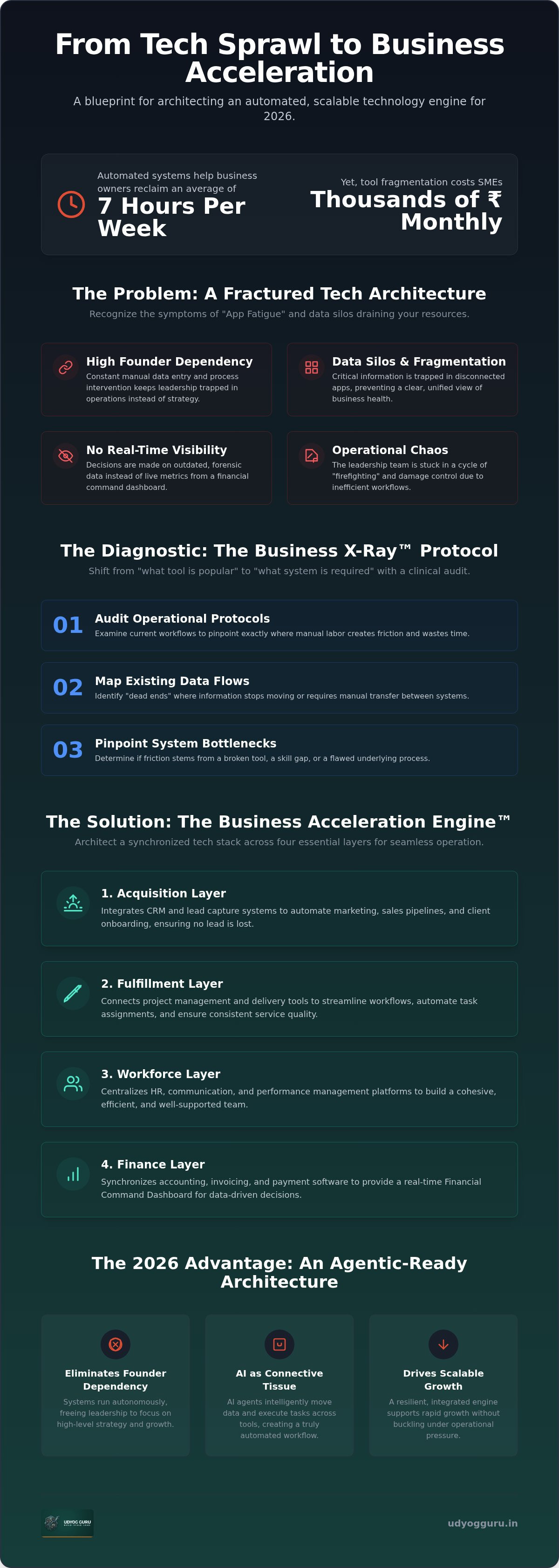
As of early 2026, empirical data indicates that small business owners leveraging automated systems reclaim an average of seven hours per week, yet many Indian enterprises remain paralyzed by tool sprawl that drains thousands of ₹ in monthly overhead. You likely recognize the symptoms of a fractured system: data silos that prevent a clear view of your finances and a heavy reliance on manual intervention to keep basic processes moving. It’s an unsustainable architecture that prevents true scalability and forces leadership into the role of a firefighter rather than a strategist.
This structural protocol defines exactly how to select technology for business automation by treating your company as a machine requiring precise calibration. We’ll move through a diagnostic examination of your current workflow to identify where your tech stack is failing. Our objective is to architect a lean, integrated Business Acceleration Engine™ that replaces founder dependency with automated reporting and clinical operational clarity. This guide serves as your blueprint for installing a technology engine designed for the high-performance demands of the 2026 market, ensuring your software serves as a structural asset rather than a liability.
Key Takeaways
- Identify why the "shiny object" syndrome leads to tool fragmentation and how to transition toward a synchronized Business Acceleration Engine™.
- Utilize the Business X-Ray™ diagnostic framework to audit current operational protocols and pinpoint exactly where manual labor can be replaced by automation.
- Learn a clinical protocol on how to select technology for business automation by architecting a stack across four essential layers: Acquisition, Fulfillment, Workforce, and Finance.
- Implement an "Agentic-Ready" architecture that integrates AI agents into your existing workflows to eliminate founder dependency and drive scalable growth.
- Discover the structural advantages of the AI Tech Business Integration Bootcamp for embedding sustainable, high-ROI technology systems into your SME.
Beyond the 'Shiny Object': Why Small Business Tech Stacks Fail in 2026
The modern technology stack is not a menu of independent applications; it is a synchronized operational engine. In 2026, the primary cause of operational friction for Indian SMEs is "App Fatigue," a condition where tool fragmentation creates more work than it eliminates. When a founder subscribes to a new CRM or project management tool without a structural integration plan, they aren't solving a problem. They're adding a new component to a machine that lacks a drive belt. This leads to the "Foundational Leak," where critical data becomes trapped in silos, necessitating manual rework to bridge the gaps between systems. With global software spending projected to reach ₹120 trillion in 2026, businesses are paying more for tools they don't fully utilize.
To understand how to select technology for business automation, leadership must adopt a clinical perspective. Technology is the structural architecture of your organization. If the architecture is flawed, the business cannot support the weight of rapid growth. You must view every subscription not as a standalone solution, but as a gear within a larger Business Acceleration Engine™ that requires precise calibration to function.
The Symptoms of a Broken Technology Architecture
A malfunctioning tech stack presents clear diagnostic markers that signal systemic failure. First, there's high founder dependency on manual data entry. If you're copying lead information from a website form into a spreadsheet or manually updating payment statuses, your engine has seized. Second, there's a total lack of real-time visibility. Without a Financial Command Dashboard, you're making decisions based on forensic data from last month rather than live metrics. Finally, operational chaos manifests as constant firefighting. When information flow is delayed or inaccurate, the leadership team spends its energy on damage control instead of system optimization.
The 2026 Shift: From Software to Systems
The current market landscape has shifted the focus from software ownership to integration protocols. You don't need custom software development to achieve autonomy. You need a system built on existing platforms that communicate seamlessly. In this framework, AI serves as the connective tissue, acting as the intelligent layer that moves data and executes tasks across specialized tools. Transitioning from a reactive to a proactive technology posture means you stop buying software to fix immediate pain. Instead, you install systems that prevent pain from occurring. This shift moves the business from a collection of fragile apps to a resilient, automated machine.
The Diagnostic Phase: Conducting a Business X-Ray™ Before Tool Selection
Most Indian SMEs fail to scale because they attempt to solve structural problems with software subscriptions. Before any tool is integrated, a rigorous diagnostic phase is mandatory to ensure the new component aligns with the existing organizational anatomy. The Business X-Ray™ protocol serves as this essential first step, shifting the focus from "what tool is popular" to "what system is required." By auditing current operational protocols, leadership can identify exactly where manual labor creates friction and where automated systems can provide the highest return on investment.
Mapping existing data flows is a critical component of this diagnostic. You must identify "dead ends" where information stops moving or requires manual intervention to reach the next department. These redundancies often hide the true cause of operational stagnation. Once you have a clear map of your data architecture, you can prioritize tool selection based on the specific requirements of your Business Acceleration Engine™. This clinical approach ensures that every addition to your stack is a functional gear rather than a decorative attachment.
Identifying Operational Bottlenecks
To pinpoint system weaknesses with precision, you must utilize a business diagnostic scan. This process determines whether operational friction stems from the tool itself, the person operating it, or a fundamentally broken underlying process. Many founders find that they're paying for high-tier SaaS features while their team relies on manual workarounds. These hidden costs, often exceeding thousands of ₹ in lost productivity every month, must be quantified before you can understand how to select technology for business automation effectively. You're not just looking for a tool; you're looking for a cure for systemic inefficiency.
Defining Functional Integration Requirements
Once the diagnosis is complete, you must categorize your needs into "Core Engine" components and "Adjacent Tech." Your Core Engine includes non-negotiable systems like your CRM and Financial Command Dashboard. These must have high data portability and robust API availability to ensure they don't become future silos. Adjacent Tech consists of niche tools that serve specific, temporary functions. Before installation, analyze your workforce’s technical capacity to adopt these new protocols. A system is only as effective as the team’s ability to operate it. If the gap is too wide, you may need a targeted diagnostic intervention to recalibrate your team's workflow before proceeding with the integration.
Architecting the Engine: Core Components of a Scalable Technology Stack
A scalable technology architecture isn't built through the random acquisition of apps. It's organized into four critical layers: Acquisition, Fulfillment, Workforce, and Finance. When determining how to select technology for business automation, you must evaluate the total cost of ownership (TCO) with clinical precision. While custom-built solutions offer total control, they frequently become technical debt for Indian SMEs due to high maintenance costs and lack of interoperability. Integrated SaaS platforms, by contrast, leverage existing API ecosystems to reduce overhead. With global software spending projected to rise 15.1% in 2026, the priority for leadership is to choose systems that offer rapid deployment over vanity features.
At the center of this structural engine sits the Financial Command Dashboard. This isn't just an accounting tool; it's the primary reporting layer that aggregates data from all other sectors into a single source of truth. Without this central nervous system, you're unable to diagnose which parts of your machine are underperforming. Every tool you install must feed into this dashboard to ensure that operational decisions are based on hard data rather than founder intuition.
The Acquisition and CRM Layer
Your marketing and sales technology must feed directly into lead-to-cash automated workflows without manual intervention. This ensures that every ₹ spent on customer acquisition is tracked through to the final invoice. For those following a scaling a business framework, your CRM must be capable of handling national-level lead volumes. If your CRM requires manual data entry to move a prospect through the funnel, it isn't an asset; it's a bottleneck that will eventually choke your growth.
The Workforce and Operational Layer
Managing a scaling team requires more than just basic communication tools. You need to integrate project management platforms with workforce optimization strategies to track performance metrics in real time. This allows for automated delegation and accountability tracking across the entire organization. Choose platforms that facilitate asynchronous work rather than constant distraction. By reducing the reliance on real-time meetings, you allow your workforce to focus on high-output tasks that drive the business forward.
The Installation Protocol: Integrating Systems to Eliminate Founder Dependency
The transition from a manual operation to an autonomous engine requires a multi-phased surgical protocol. Once you understand how to select technology for business automation, the focus shifts to installation, a process that must be executed with clinical precision to avoid systemic rejection. Many Indian founders experience operational downtime because they attempt to "flip a switch" on new software without a staged rollout. A disciplined approach ensures that your new Business Acceleration Engine™ integrates seamlessly with existing workflows, replacing founder-led oversight with systematic accountability.
To maintain long-term structural integrity, you must establish Standard Operating Procedures (SOPs) for every tool in the stack. Without these protocols, system decay is inevitable as team members revert to manual workarounds or "shadow IT" solutions. A staged installation allows for the calibration of each module before the next is introduced, ensuring the business remains functional throughout the transformation.
Phase 1: The System Cleanse and Data Migration
The first phase of installation is the decommissioning of redundant applications and the cleansing of legacy data. You must identify every "zombie" subscription that drains ₹ from your monthly budget without providing a measurable ROI. During this cleanse, data integrity is paramount. Migrating fragmented information into a centralized master data architecture creates a "Single Source of Truth." This ensures that every department, from fulfillment to finance, operates from the same set of verified facts, eliminating the friction caused by conflicting data silos.
Phase 2: Automated Interconnectivity
With a clean data foundation, the next step is deploying AI-driven middleware to bridge communication gaps between your SaaS platforms. You should focus on how to automate business workflows with AI to replace repetitive administrative tasks. This phase involves building automated triggers that handle status updates, lead routing, and client notifications. Finally, calibrate your Financial Command Dashboard to pull live data from these automated streams. This results in real-time reporting accuracy that allows you to manage the business through metrics rather than manual check-ins. If your current systems lack this level of interconnectivity, you may require a professional system audit to identify the missing links in your architecture.
Modernizing Operations: The AI Tech Business Integration Bootcamp Approach
The selection of a technology stack is a diagnostic exercise, but its integration is a surgical one. Understanding how to select technology for business automation is only the first phase of the protocol. To achieve true operational autonomy, leadership must move beyond the passive acquisition of software and focus on embedding sustainable systems. The AI Tech Business Integration Bootcamp provides the clinical environment for this transition, allowing founders to architect their own Business Acceleration Engine™ under professional supervision. This approach ensures that the technology isn't just an expense on the balance sheet but a structural asset that maintains long-term technical health.
Operational autonomy is the final objective of this modernization process. It requires a business that functions independently of the founder's daily manual intervention. By utilizing the Bootcamp model, owners install the connective tissue between their tools, ensuring that data flows seamlessly across the organization. This eliminates the "founder as a bottleneck" syndrome and replaces it with a self-correcting machine designed for high-performance output.
Why Implementation Beats Instruction for Business Owners
Traditional consulting often fails Indian SMEs because it provides a roadmap without the vehicle. Instruction alone doesn't solve the problem of tool fragmentation or data silos. The Bootcamp model prioritizes hands-on implementation, moving owners through the technical complexity of integration in real time. This is how you achieve 2026-ready scalable business systems for SMEs. The ROI of a professionally architected stack is measured in reclaimed hours and reduced overhead. When your systems are integrated, you stop paying for redundant features and start profiting from automated efficiency.
Your 90-Day Modernization Roadmap
A structured 90-day roadmap is essential for transitioning from operational chaos to systematic growth. This sequence follows a rigorous protocol:
- Days 1-30: Diagnostic and Design. Execute the Business X-Ray™ to identify gaps and architect the blueprint for your Business Acceleration Engine™.
- Days 31-60: Installation and Integration. Decommission legacy apps and deploy AI-driven middleware to bridge communication between core systems.
- Days 61-90: Calibration and Training. Finalize the Financial Command Dashboard and train the workforce to operate within the new technology-first culture.
This roadmap concludes with a fully calibrated system that enables predictable scaling. By the end of the 90-day cycle, the business has transitioned from a collection of fragmented apps to a synchronized engine. This allows leadership to focus on market expansion while the technology handles the burden of fulfillment and reporting.
Transitioning from Operational Chaos to Systematic Autonomy
The transformation of your business from a collection of fragmented applications into a high-performance Business Acceleration Engine™ requires more than just software subscriptions. It demands a clinical commitment to structural integrity. By following a rigorous diagnostic protocol, you move beyond the "shiny object" syndrome and begin to treat your technology as a synchronized operational engine. Mastering how to select technology for business automation is the decisive factor that separates stagnant SMEs from those capable of achieving a national scale operational framework.
The path to operational clarity is paved with precise data and integrated systems. Through our proprietary Business X-Ray™ diagnostic and the implementation of a Financial Command Dashboard, you can eliminate founder dependency and reclaim your role as a strategist. You don't have to navigate this technical transition in isolation. Apply for the AI Tech Business Integration Bootcamp to Engineer Your Business Engine and start embedding sustainable systems into your architecture today. It's time to stop firefighting and start engineering a business that runs with the precision of a well-calibrated machine.
Frequently Asked Questions
What is the best technology stack for a small business in 2026?
The optimal stack is an "Agentic-Ready" architecture designed as a Business Acceleration Engine™. Rather than a collection of isolated apps, it consists of four integrated layers: acquisition, fulfillment, workforce, and finance. This composable approach allows you to swap modular components as market conditions evolve without causing systemic failure. The primary objective is to ensure every tool communicates through a central Financial Command Dashboard for total operational visibility.
How do I know if I need to change my current business software?
You must change your software when tool fragmentation creates a "Foundational Leak" in your data. Diagnostic markers include high founder dependency on manual data entry, the existence of data silos between departments, and a lack of real-time reporting. If your team spent more than five hours last week manually syncing spreadsheets, your current technology architecture has failed and requires immediate structural recalibration.
Can AI really replace manual data entry in my small business?
AI acts as the connective tissue that eliminates repetitive administrative labor. By understanding how to select technology for business automation, you can implement AI-driven middleware that handles lead routing, invoice processing, and status updates. This transition reduces the manual workload for leadership and ensures data integrity across your entire Business Acceleration Engine™. AI doesn't just replace entry; it automates the logic of your entire workflow.
What is the difference between custom software and an integrated SaaS stack?
Custom software development often creates high technical debt and maintenance burdens for Indian SMEs. An integrated SaaS stack utilizes established, high-performance platforms connected via robust APIs. This approach offers lower total cost of ownership and higher structural flexibility. Udyog Guru focuses on integrating these existing technologies to build a resilient engine, avoiding the long lead times and high failure rates associated with building from scratch.
How much should a small business spend on its technology stack?
Spending must be viewed as a structural investment rather than a monthly expense. While specific ₹ amounts vary based on scale, your budget should prioritize tools that offer a measurable ROI through reclaimed hours and automated fulfillment. With global software spending projected to rise 15.1% in 2026, the focus for Indian founders is on maximizing the efficiency of every ₹ by choosing integrated systems over fragmented, high-cost subscriptions.
How do I ensure my team actually uses the new technology we implement?
Adoption requires a shift from instruction to implementation through established Standard Operating Procedures. You must embed the technology into the daily culture of the workforce to prevent system decay. Programs like the AI Tech Business Integration Bootcamp teach leadership how to install these systems so the team has no choice but to follow the automated protocol. This replaces intuition-based work with a disciplined, tech-first operational culture.
What is a Business X-Ray™ and why is it needed for tech selection?
The Business X-Ray™ is a proprietary diagnostic framework used to scan your organizational anatomy. It identifies operational gaps and manual bottlenecks before you commit to new software subscriptions. This clinical assessment ensures that your technology selection is based on a scientific diagnosis of your actual needs rather than "shiny object" marketing. It provides the blueprint required to architect a scalable and integrated Business Acceleration Engine™.
Do I need to be a technical founder to choose a tech stack?
You don't need to be a coder to function as a Systems Architect for your business. Understanding how to select technology for business automation is about mastering the logic of data flow and integration protocols. By utilizing a Financial Command Dashboard, you can manage your entire organization through metrics and automated reporting. Your role is to diagnose the operational needs and oversee the installation of the machine's components.


