

Delegation isn't a soft management skill; it's a mechanical protocol that must be installed into your company's architecture to eliminate human error. If your business requires your constant presence to function, you haven't built an enterprise; you've built a high-pressure cage. Most founders are currently trapped in a cycle of firefighting because their team's output depends entirely on their oversight. This lack of structural integrity leads to operational chaos. By implementing automated delegation systems, you can shift from manual supervision to systematic governance, ensuring that every task follows a precise, pre-defined trajectory.
You're likely exhausted by the cognitive overload of managing every micro-decision. You know that scaling requires a workforce that operates with clinical precision, yet accountability remains elusive. This article provides the blueprint for engineering that accountability. We'll examine how to diagnose your current bottlenecks and install mechanical delegation frameworks that remove founder dependency. You'll learn the exact protocols needed to transform your operations into a predictable growth engine. This process allows you the freedom to focus on high-level strategy while your team executes with surgical accuracy.
Key Takeaways
- Identify founder dependency as a structural bottleneck that triggers decision fatigue and operational stagnation within the business engine.
- Utilize the Business X-Ray™ to conduct a precise diagnostic scan, identifying specific tasks for conversion into mechanical protocols.
- Replace unreliable verbal instructions with automated delegation systems that utilize digital dashboards to maintain continuous team accountability.
- Follow a rigorous five-step installation protocol, starting with a workforce performance audit to calibrate your team for autonomous execution.
- Deploy the Workforce Acceleration Engine™ to shift from manual oversight to systematic management, ensuring predictable growth without founder intervention.
The Pathology of Founder Dependency: Why Manual Delegation Fails
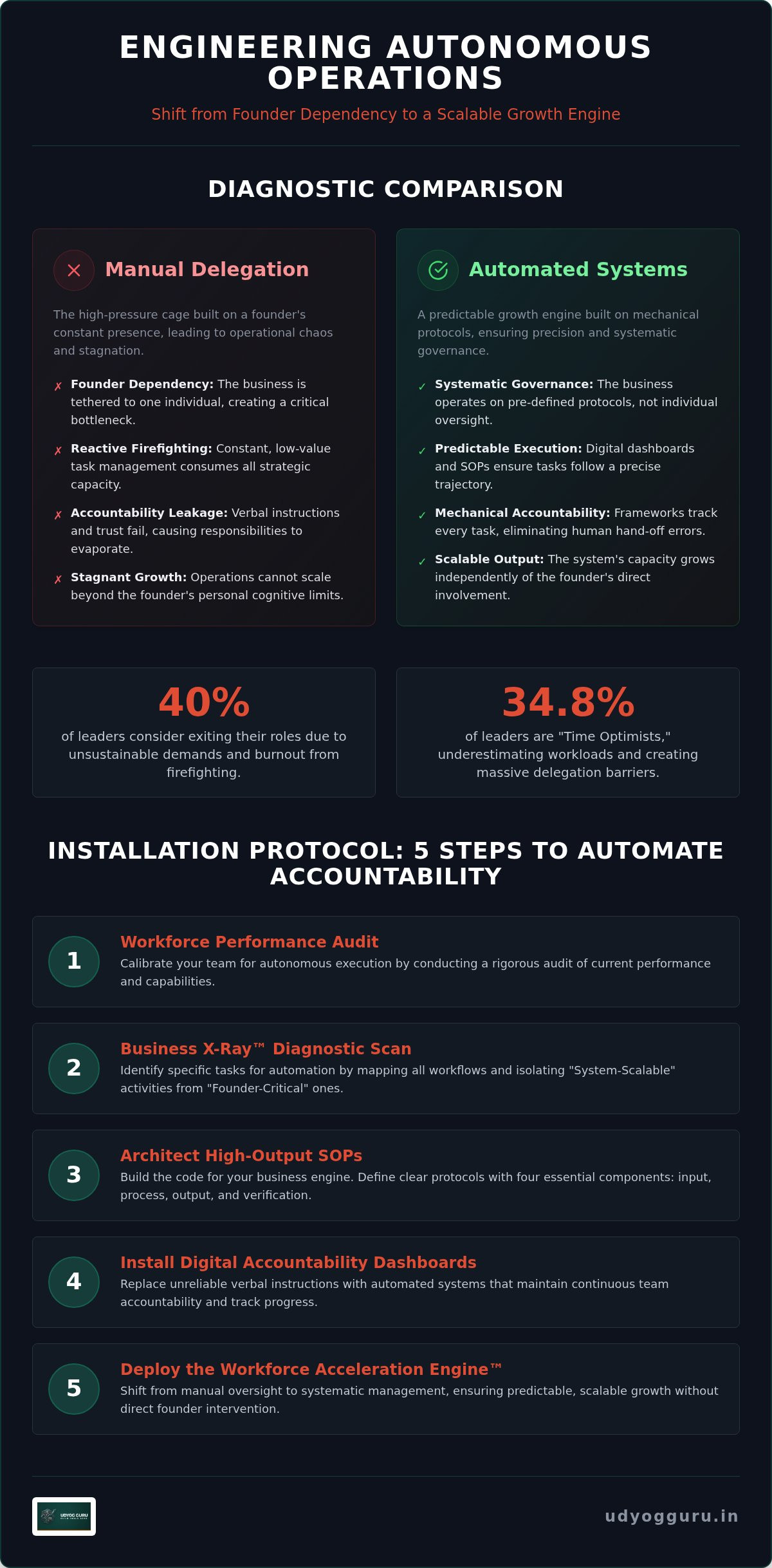
Founder dependency is a structural bottleneck that restricts the throughput of your business engine. It isn't a leadership style; it's a diagnostic failure where the enterprise’s central nervous system remains tethered to a single individual. When every critical decision requires your input, the business cannot scale beyond your personal cognitive limits. This architecture inevitably produces chronic symptoms: constant firefighting, severe decision fatigue, and stagnant growth. Without automated delegation systems, you're forced to manage through manual task-passing, which leads to "accountability leakage." This occurs when responsibilities evaporate during human hand-offs because there's no mechanical framework to catch and track them. To repair this, we utilize the Workforce X-Ray™ as a diagnostic scan to identify these specific leakage points in your current workflow.
The High Cost of Operational Firefighting
Operational firefighting is a resource drain that prevents the installation of sustainable systems. A 2025 study revealed that 34.8% of leaders identify as "Time Optimists," consistently underestimating workloads and creating massive delegation barriers. When you're trapped in low-value task management, your capacity for long-term strategic innovation is effectively zero. This cognitive overload is dangerous. According to DDI’s Global Leadership Forecast, 40% of leaders consider exiting their roles due to these unsustainable demands. Every hour spent resolving a preventable team error is an hour stolen from the architectural development of your company. Firefighting keeps you reactive, ensuring the business remains a fragile machine that breaks the moment you step away.
Why "Trust" is Not a Scalable Delegation Strategy
Many founders rely on interpersonal trust as a substitute for structural oversight. While trust is a valuable cultural element, it's a poor foundation for scaling an enterprise. Relying on "good people" to "do the right thing" creates a single point of failure risk. If a key employee leaves or falters, the process collapses because the intelligence resides in the person rather than the protocol. Professional scaling requires a transition to delegated administration, where roles and rights are managed through a decentralized, IT-supported model. This shift is the cornerstone of a robust workforce optimization strategy. By installing automated delegation systems, you replace the ambiguity of human "trust" with the clinical certainty of mechanical accountability. This ensures that team output remains predictable regardless of individual fluctuations.
The Anatomy of an Automated Delegation System
An effective business isn't a collection of people; it's a series of interlocking protocols. To transition from manual oversight to autonomous performance, you must construct a multi-layered framework. This structure ensures that automated delegation systems operate with surgical precision rather than chaotic guesswork. The architecture consists of four critical layers: the diagnostic layer to identify bottlenecks, the protocol layer to define execution, the automation layer to trigger actions, and the accountability layer to monitor results. Each layer must be calibrated to support the next, creating a cohesive environment for scalable growth.
Diagnostic Mapping with the Business X-Ray™
Before installation, you must perform a comprehensive scan of all recurring processes. The Business X-Ray™ allows you to categorize tasks by complexity, frequency, and required expertise. This diagnostic step isolates "Founder-Critical" activities, which require your unique strategic input, from "System-Scalable" tasks that can be offloaded to the team. By mapping these workflows, you reveal the hidden inefficiencies that drain your cognitive bandwidth and stall expansion. For founders ready to begin this process, a structural business diagnosis is the first step toward operational clarity.
Architecting the Standard Operating Procedure (SOP)
SOPs function as the code that runs your business engine. A high-output SOP must contain four essential components: input, process, output, and verification. If any element is missing, the system will fail. Verification is particularly critical because it replaces micromanagement with data-driven confirmation. When these protocols are clear and accessible, your workforce can execute tasks without seeking constant permission. This creates a self-correcting environment where the system, not the founder, enforces the standard of excellence. It's the difference between a team that "tries" and a machine that "delivers."
The Automation and Accountability Layers
The final stages involve using technology to trigger these protocols without human intervention. Tools like Zapier or Make can serve as the connective tissue between your SOPs and your team's daily actions. By 2026, the integration of AI into automated delegation systems has made it possible to move beyond simple rule-based triggers. These systems now analyze patterns and predict potential bottlenecks, allowing for proactive adjustments. This creates a data-driven feedback loop where performance tracking is objective. Instead of subjective performance reviews, you rely on the system's output logs to measure team efficiency with clinical accuracy.
Diagnostic Comparison: Manual Task-Passing vs. Systematic Protocols
The transition from a founder-led operation to a scalable enterprise requires a shift from biological reliance to mechanical certainty. Manual task-passing is characterized by "signal decay," where verbal instructions lose 20 percent of their clarity with every human hand-off. In contrast, automated delegation systems utilize digital triggers that maintain 100 percent signal integrity from initiation to completion. While manual systems rely on the hope that instructions are remembered, systematic protocols ensure that every action is logged, tracked, and verified. This diagnostic distinction is the difference between a business that survives on effort and one that thrives on architecture.
Human Oversight vs. Digital Command Centers
Manual reporting is inherently flawed because it's prone to cognitive bias and reporting delays. Employees often filter information before it reaches the founder, obscuring operational friction until it becomes a crisis. By 2026, high-output enterprises have replaced these subjective check-ins with digital command centers. The Financial Command Dashboard serves as the central nervous system for this objective oversight. It provides real-time data on system health, allowing you to monitor team output without the emotional toll of constant micromanagement. When you manage through a dashboard rather than a meeting, you remove the personality clashes and focus entirely on the calibration of the business engine.
Scalability of Automated Feedback Loops
Human-centric delegation scales linearly; to manage more people, you must hire more managers, which exponentially increases your overhead and communication complexity. Automated delegation systems allow for exponential scaling because they handle a 10x increase in task volume without adding a single hour to the founder's workload. This is the core principle of Workforce Acceleration. Consider the structural shift required to move from 5 to 50 employees. At 5 members, you can manage through proximity. At 50, proximity fails. Without systematic protocols, the "re-work" cost alone can consume up to 30 percent of your operational budget. Automated verification loops catch errors at the point of origin, ensuring that quality remains consistent as the enterprise expands. This mechanical approach transforms the workforce from a collection of individuals into a high-precision execution engine.
Installation Protocol: 5 Steps to Automate Team Accountability
Installing automated delegation systems isn't a creative exercise; it's a structural repair that follows a rigid sequence. To move from founder-led chaos to mechanical precision, you must treat your business as an engine that requires specific calibration. This installation protocol removes the ambiguity of human management and replaces it with a definitive architecture for execution. By 2026, the complexity of scaling requires that founders move beyond manual oversight and into the realm of architectural governance. This five-step sequence ensures your workforce operates with surgical accuracy, regardless of your personal involvement.
Step 1 & 2: Diagnosis and Architecture
The installation begins with data. You must first conduct a workforce performance audit to establish a clinical baseline of your current team output. This diagnostic identifies the top three bottlenecks that require immediate automation. Once these friction points are isolated, you map the workflow architecture using a Business Diagnostic Scan. During this phase, you define the "Success Protocol" for each delegated task, which serves as the objective standard for completion. For every role, you must create a single sentence that defines the delegation trigger. This ensures that the system, not the founder, initiates the work. If you're ready to identify your structural leaks, you can request a diagnostic scan to begin the process.
Step 3 & 4: AI Integration and Automation
The next phase involves integrating intelligence into the architecture. Through the AI Tech Business Integration Bootcamp, you install AI protocols designed to automate routine decision-making and data entry. This reduces the cognitive load on your team and eliminates human error in repetitive processes. You then install automated trigger points for task initiation and deadline alerts. These act as "Accountability Checkpoints" within the workflow. The system must self-correct. When a checkpoint is missed, the system automatically generates an alert, notifying the relevant parties without requiring founder intervention. This creates a closed-loop environment where performance is monitored by the software of the business rather than the emotions of the manager.
Step 5: Calibration and Oversight
The final step is the calibration of the entire engine. You utilize the Financial Command Dashboard to monitor the health of your automated delegation systems in real time. This dashboard provides a high-level view of operational efficiency, allowing you to spot trends or systemic failures before they impact the bottom line. You aren't managing people; you're managing the data that reflects their output. This objective oversight allows for continuous refinement of the protocols. It's a progressive cycle of assessment and adjustment that ensures your workforce remains a high-precision execution engine as you scale toward your growth targets.
Scaling Output with the Workforce Acceleration Engine™
The ultimate objective of operational engineering is the total decoupling of the founder from the daily execution cycle. This is achieved through the Workforce Acceleration Engine™, which facilitates the transition from "managing people" to "managing the system." When you operate at this level, you aren't supervising individual tasks; you're monitoring the throughput of a mechanical framework. High-output enterprises in 2026 recognize that manual management is a scaling inhibitor. By implementing automated delegation systems, you ensure that team output remains predictable regardless of organizational size. This systematic approach converts human effort into a reliable asset that generates consistent results.
Managing the Engine, Not the Parts
To achieve sustainable business scaling, you must adopt the persona of a Systems Architect. A manager focuses on the performance of individual parts, but an architect focuses on the integrity of the entire machine. You use real-time data to identify which specific protocol requires calibration. If a department's output drops, you don't blame the personnel; you diagnose the system failure. This diagnostic-led approach maintains operational clarity even during periods of rapid expansion. It allows the enterprise to absorb a higher volume of tasks without compromising the structural integrity of the workflow. You're no longer the bottleneck; you're the designer of the solution.
The Future of Business: AI-Enhanced Operations
The integration of artificial intelligence represents the "Tier 3" stage of modern business maturity. It's the final layer of the delegation architecture. While automated delegation systems provide the structure, AI provides the predictive intelligence to optimize that structure. The AI Tech Business Integration Bootcamp is designed specifically to guide non-developers through this installation process. The curriculum focuses on identifying decision-making nodes that can be automated, allowing your team to focus on high-level execution. This process isn't about replacing humans; it's about augmenting the business engine to operate at peak efficiency. You learn to install "intelligent triggers" that anticipate bottlenecks before they manifest as operational crises.
Your business should be a machine that produces profit, not a cage that consumes your time. As you finalize your operational repair, remember this fundamental diagnostic truth: "A business that depends on its owner is a job; a business that depends on a system is an asset." For founders ready to install these high-output protocols and reclaim their strategic freedom, the AI Tech Business Integration Bootcamp provides the technical blueprint for total operational autonomy. It's time to stop working in the engine and start designing the machine that drives your future.
Executing the Structural Shift to Operational Autonomy
Transitioning your enterprise from a state of founder dependency to one of mechanical precision requires more than a shift in mindset; it requires a complete architectural overhaul. You've seen how manual task-passing triggers signal decay and why trust is an insufficient foundation for scaling. By utilizing the proprietary Business X-Ray™ diagnostic tool, you can isolate structural leaks and replace them with high-output protocols. The installation of automated delegation systems ensures that your workforce operates as a calibrated machine, driven by the Workforce Acceleration Engine™ framework rather than personal oversight.
This clinical, data-driven methodology is the only path to achieving predictable growth and reclaiming your strategic bandwidth. If you're ready to move beyond the reactive cycle of firefighting and start engineering a sustainable asset, the next step is clear. You must calibrate your business for the future by integrating advanced intelligence into your daily operations. Register for the AI Tech Business Integration Bootcamp to begin the systematic repair of your operational engine and secure your role as a Systems Architect. Your business is a solvable puzzle of logic; it's time to install the solution.
Frequently Asked Questions
What exactly is an automated delegation system?
An automated delegation system is a mechanical framework that utilizes digital triggers and pre-defined protocols to assign tasks and monitor team output without human intervention. Unlike manual delegation, these automated delegation systems rely on logical architecture to ensure tasks move through the business engine. It removes the need for verbal instructions, replacing them with systematic triggers that activate based on specific workflow conditions, ensuring consistent delivery.
How is automated delegation different from project management software?
Project management software is a static storage tool for tasks, whereas an automated system is an active execution engine. A software tool requires a human to log in and manually update statuses; an automated protocol uses "if-then" logic to push the work forward autonomously. It bridges the gap between a list of things to do and the actual, verified completion of those tasks through integrated feedback loops.
Can AI really handle delegation for a small business in India?
Yes, AI can handle complex delegation by analyzing operational data and triggering the correct protocols for your team. In 2026, Indian enterprises are increasingly using AI to manage routine decision nodes and resource allocation. This isn't about replacing leadership; it's about using technology to enforce the standards you've set, ensuring your workforce operates at peak efficiency without your constant presence or manual oversight.
What is the first step to remove founder dependency?
The first step is a clinical diagnostic scan of your current business architecture to measure existing bottlenecks. By performing a Business X-Ray™, you identify which processes are tethered to your personal involvement. This allows you to isolate founder-critical tasks from system-scalable ones, providing the blueprint for installing mechanical protocols. You can't fix a structural leak until you've accurately diagnosed the point of failure.
Do I need custom software to automate my delegation?
No, you don't need custom software development to implement these systems. Modern business maturity involves integrating existing, high-performance tools through specialized protocols. Programs like the AI Tech Business Integration Bootcamp teach you how to stitch together current technologies to create a seamless, automated environment. This approach is faster, more cost-effective, and avoids the structural risks associated with building bespoke software from scratch.
How does the Workforce X-Ray™ help with delegation?
The Workforce X-Ray™ acts as a diagnostic tool that maps the performance and capacity of your team members. It identifies "accountability leakage" points where tasks currently fall through the cracks due to manual hand-offs. By visualizing these gaps, the tool allows you to design precise automated delegation systems that align task complexity with the correct skill level, ensuring the workforce engine runs without friction.
Is automated delegation suitable for service-based businesses?
Automated delegation is essential for service-based businesses where quality consistency is often a major bottleneck. These enterprises rely on repetitive, high-stakes workflows that benefit from mechanical triggers. By installing systematic protocols, you ensure that every client deliverable follows a verified sequence. This removes the variability of human performance and allows you to scale your service offerings without a proportional increase in your management time.
What happens if the system fails or a task is missed?
The architecture includes automated "Accountability Checkpoints" designed to detect and report failures immediately. If a protocol isn't completed by a specific deadline, the system triggers a self-correction alert through the Financial Command Dashboard. This ensures that missed tasks are flagged for review before they become operational crises. You don't need to hunt for errors; the system is engineered to expose them automatically for calibration.


