
Your team's stagnant productivity isn't a personnel problem; it's a structural defect in your business architecture. When high workforce costs fail to yield a corresponding increase in output, the system itself requires a clinical intervention to identify hidden inefficiencies. Executing a comprehensive workforce performance audit allows you to move beyond the fog of daily operations and perform a diagnostic scan of your entire organizational engine. This process isn't about motivation, but about the rigorous calibration of roles and responsibilities to ensure every asset is utilized at its highest capacity.
You likely recognize the exhaustion of chronic founder dependency, where every critical decision still requires your direct oversight. This guide promises to reveal the precise methodology for auditing workforce performance to eliminate operational chaos and install scalable systems. We'll examine the tiered layers of team accountability, provide a clear blueprint for removing low-value work bottlenecks, and demonstrate how to architect a workforce that functions with the reliability of a well-oiled machine. By the end of this diagnostic walkthrough, you'll have the framework necessary to transition from a person-dependent business to a system-driven enterprise.
Key Takeaways
- Identify the structural distinction between subjective employee reviews and a clinical workforce performance audit designed to scan for systemic inefficiencies.
- Recognize the diagnostic symptoms of the "Founder Trap" and "Scale Paradox" where increasing headcount fails to produce proportional growth in output.
- Learn how to install a Financial Command Dashboard to create a direct, data-driven link between team activities and fiscal reality.
- Discover the methodology for mapping a Delegation Protocol that ensures team members own specific business outcomes rather than just completing isolated tasks.
- Follow a systematic 5-step protocol to deploy the Workforce X-Ray™ and build a scalable workforce architecture that functions without constant manual oversight.
What is a Workforce Performance Audit? The Clinical Definition
A Performance audit is a rigorous, objective examination of an organization's economy, efficiency, and effectiveness. In the context of scaling SMEs, a workforce performance audit functions as a clinical diagnostic scan designed to measure how precisely your human capital aligns with your core business objectives. Instead of focusing on individual personalities or workplace "vibes," this methodology analyzes the structural integrity of your operational engine. It's a "Business-as-Science" approach that treats your organization as a mechanical system requiring precise calibration. The primary goal is to achieve total operational clarity, effectively removing the "firefighting" culture that plagues disorganized teams.
When you measure the machine, you identify where the gears are grinding. A workforce performance audit provides the blueprint for this calibration. It shifts the focus from "who is doing what" to "what outcome does this role exist to produce." This distinction is critical for founders who feel trapped in daily operations. Without this clinical clarity, you're merely managing people. With it, you're architecting a scalable engine that functions independently of your constant presence.
The Anatomy of a High-Performance Audit
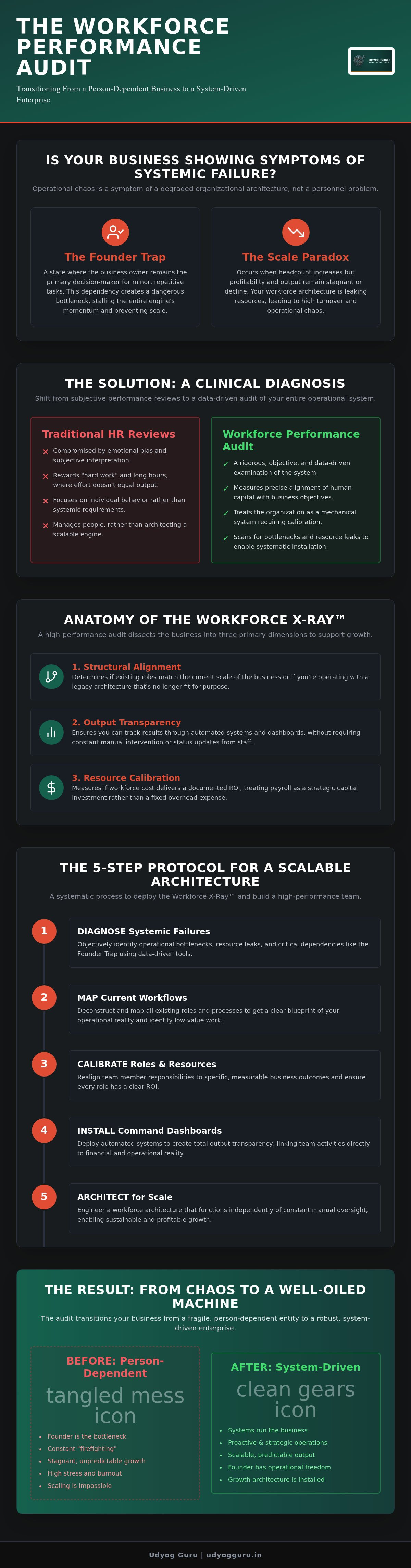
Successful audits dissect the business into three primary dimensions to ensure the architecture supports growth rather than hindering it:
- Structural alignment: This determines whether existing roles actually match the current scale of the business or if you're operating with a legacy architecture that's no longer fit for purpose.
- Output transparency: This ensures you can track results through automated systems without requiring manual intervention or constant status updates from staff.
- Resource calibration: This measures whether your workforce cost is delivering a documented ROI, treating payroll as a capital investment rather than a fixed overhead expense.
Why Traditional HR Reviews Fail Scaling SMEs
Standard performance appraisals are often compromised by emotional bias and subjective interpretation. Managers frequently reward "hard work" or long hours, but in a scaling system, effort doesn't always equal output. High activity levels can actually mask deep structural inefficiencies if that effort is directed toward low-value tasks. Traditional reviews fail because they focus on individual behavior rather than systemic requirements. This is why we utilize the Workforce X-Ray™; it provides a data-driven diagnostic that reveals the objective reality of your operations. By scanning the business for bottlenecks and resource leaks, you move from intuitive management to systematic installation. You're no longer guessing if a team member is productive; you're seeing the data reflected in your operational dashboard.
Symptoms of Systemic Failure: When to Audit Your Workforce
Operational chaos is rarely the result of a single bad hire. It's usually the symptom of a degraded organizational architecture. The most prominent indicator of systemic failure is the "Founder Trap," a state where the business owner remains the primary decision-maker for minor, repetitive tasks. This dependency creates a dangerous bottleneck, stalling the entire engine's momentum. When your team cannot execute without your direct intervention, you haven't built a business; you've built a high-stress job for yourself. Recognizing the Crucial Role Of HR Audits is the first step in diagnosing these structural fractures before they lead to total engine failure.
Another critical symptom is the Scale Paradox. This occurs when headcount increases but profitability remains stagnant or declines. If your payroll costs are rising while your output per employee is flatlining, your workforce architecture is leaking resources. This often leads to high employee turnover, as high-performing individuals exit due to role ambiguity and the exhaustion of navigating operational chaos. To correct this, you must pivot toward Workforce Optimization Strategies that engineer high-output systems instead of just adding more bodies to a broken process.
Identifying Operational Bottlenecks
A workforce performance audit scans the business to locate "Dead Zones," which are specific points in a workflow where tasks stall or disappear entirely. You can measure the severity of these bottlenecks by tracking your "Firefighting Indicator." This metric quantifies the percentage of time your team spends on unplanned repairs and crisis management versus proactive growth tasks. High levels of manual intervention in what should be automated or delegated processes indicate a lack of structural discipline. These manual overrides are expensive, unscalable, and prone to human error, effectively draining your operational ROI.
The Scalability Ceiling
Many SMEs hit a revenue plateau because their current team structure is physically incapable of supporting the next tier of growth. This "Scalability Ceiling" is often masked by a culture of "busy-ness." Employees may appear productive, but a diagnostic scan reveals they're engaged in low-value maintenance rather than business growth activities. Communication channels become clogged with unnecessary meetings and redundant reporting, further slowing the system. If you find your team working harder but achieving fewer milestones, it's time to conduct a workforce performance audit through a Workforce X-Ray™ to identify the specific clogs in your communication architecture and clear the path for expansion.
The Diagnostic Framework: Components of a Workforce X-Ray™
Executing a workforce performance audit requires a structured diagnostic framework that moves beyond surface-level observations. The Workforce X-Ray™ serves as the primary clinical tool for this examination, providing a high-resolution scan of your organizational architecture. The foundation of this framework is the Financial Command Dashboard. This system creates a direct, data-driven link between team output and fiscal reality. It ensures that payroll isn't just a recurring expense, but a calibrated investment in the business engine. By mapping every role to a specific financial outcome, you eliminate the ambiguity that leads to resource leakage.
A secondary, yet equally vital component, is the Technology Integration Audit. This phase of the diagnostic scan evaluates whether your current software stack is accelerating your team's output or acting as a friction point. Tools that require excessive manual intervention or fail to sync with other systems create "technical debt" that slows the entire organization. This structural assessment is a core element of a broader Business Diagnostic Scan, which is essential for engineering the operational clarity required to scale without chaos.
Quantitative Output Metrics
To achieve clinical precision, you must shift your tracking from "hours worked" to "value units produced." Research indicates that knowledge workers produce an average of 5 hours and 12 minutes of focused work in a standard 8-hour day, with the remainder consumed by administrative friction. A workforce performance audit establishes the baseline for automated performance tracking by identifying these high-value output units for every department. The Financial Command Dashboard then aggregates this data, providing a real-time view of your workforce ROI. This allows you to identify underperforming sectors of the machine before they impact your quarterly profitability.
The Delegation and Accountability Scan
This component of the framework utilizes the "Absence Stress Test" to determine the business's level of founder dependency. If the engine stalls when you stop, the architecture is flawed. The scan also identifies "Shadow Roles," which occur when employees perform tasks outside their defined architecture to compensate for systemic gaps. These roles are invisible drains on productivity and indicate a lack of clear accountability protocols. By installing tiered accountability frameworks, you ensure that every manager owns an outcome rather than just a list of tasks. This creates a self-correcting system where performance is managed by the architecture itself, not by your constant manual oversight.
Implementing the Audit: A 5-Step Protocol for Business Owners
Traditional audit models often fail because they focus on retrospective reporting rather than active system repair. Deploying a workforce performance audit through our diagnostic framework involves the active installation of new business logic across your entire organization. This protocol isn't a suggestion; it's a systematic repair of your business engine designed to move you from daily firefighting to a calibrated state of operational excellence. The process follows a logical sequence from initial assessment to final, automated implementation.
- Phase 1: Installation of Tracking Systems. You can't calibrate what you don't measure. We deploy integrated financial and operational tracking to link every unit of payroll spend to a specific, measurable output.
- Phase 2: The Diagnostic Scan. We utilize the Workforce X-Ray™ to perform a high-resolution scan of your current team structure. This identifies the specific points where your business architecture is failing to support your growth targets.
- Phase 3: Identification of "Low-Value Work." This phase isolates tasks that consume high levels of human capital but yield negligible ROI. These inefficiencies are marked for immediate automation or removal to clear the path for high-impact activities.
- Phase 4: Structural Re-Architecture. Based on the scan results, we realign your team roles to match the requirements of the Workforce Acceleration Engine™. This ensures every role is architected for maximum output.
- Phase 5: Automated Reporting. We install a permanent monitoring system that provides a 15-minute daily view of your organizational health, ensuring the system remains calibrated without constant manual intervention.
Removing the Human Error Factor
Subjective management is the primary cause of operational friction in scaling SMEs. By integrating principles from our AI Tech Business Integration Bootcamp, we use AI to audit team efficiency without the need for manual oversight. This creates an automated delegation loop where tasks are tracked and verified by the system itself. When the architecture manages the workflow, human forgetfulness and bias are removed from the equation, ensuring that critical outcomes never fall through the cracks of a disorganized inbox.
From Diagnosis to Acceleration
The transition from "firefighting" to systematic management occurs when your audit findings are hard-wired into the Workforce Acceleration Engine™. This isn't about providing vague advice; it's about installing the systems that turn audit data into increased revenue. We measure the success of a workforce performance audit by its ROI, specifically through increased profit margins and the restoration of founder freedom. When the machine runs itself, you're free to focus on the high-level strategy that drives the next revenue tier. To begin this transformation, you must first commit to a rigorous diagnostic scan of your current workforce architecture.
The Result of a Scientific Audit: Scalable Business Architecture
The completion of a workforce performance audit marks the transition from structural repair to systematic scaling. This process results in total operational clarity, where every team member operates within a defined architecture and understands their exact output requirements. By removing the ambiguity of legacy role descriptions, you replace subjective effort with objective results. The central nervous system of this new architecture is the Financial Command Dashboard, which provides you with a 15-minute daily view of your entire organization's health. This dashboard synthesizes operational data into actionable insights, allowing you to monitor the engine's performance without being consumed by its daily mechanics.
This structural overhaul effectively reduces owner dependency to near-zero for daily operational tasks. When the system is calibrated, the founder's role shifts from a "firefighter" to a "Systems Architect," focusing exclusively on high-level strategy and expansion. This shift is essential for Scaling a Business: The Structural Engineering of Sustainable Growth in 2026, as it creates the foundation necessary to support increased complexity without a corresponding increase in operational chaos. A business that depends on the founder's constant presence is a fragile machine; a business driven by architecture is a scalable asset.
The High-Output Team Machine
A business operating at peak calibration functions as a high-output team machine where delegation is entirely automated. The culture shifts from "attendance-based" monitoring to a "results-based" ecosystem where output is the only metric of success. This environment prepares your organization for advanced optimization through the AI Tech Business Integration Bootcamp, where we integrate sophisticated automation into your existing workflows. By hard-wiring accountability into the architecture, you ensure that tasks move through the system with mechanical precision, freeing your leadership team to focus on innovation rather than maintenance.
Your Next Steps as a Systems Architect
A one-time workforce performance audit provides the diagnosis, but sustainable growth requires the continuous calibration of a Workforce Acceleration Engine™. Diagnosis without installation is merely an academic exercise. To begin the transformation of your organizational architecture, the first step is booking a Workforce X-Ray™. This diagnostic scan identifies the specific fractures in your current team structure and provides the blueprint for repair. By closing the gap between your current operations and a scalable architecture, you position your business to dominate its market through superior efficiency and structural discipline.
Calibrating Your Organizational Engine for Scale
Transitioning from a person-dependent business to a system-driven enterprise requires more than incremental changes; it demands a fundamental structural repair. Executing a workforce performance audit provides the objective data necessary to identify systemic fractures and remove the bottlenecks that stall growth. By installing the Financial Command Dashboard, you gain a high-resolution view of your operations, ensuring every unit of payroll spend is calibrated for maximum ROI. This diagnostic approach replaces the exhaustion of daily firefighting with the precision of a well-engineered machine.
Your journey toward operational excellence begins with a clinical assessment of your current architecture. We provide the tools to bridge the gap between your present bottlenecks and a scalable future through our proprietary Workforce Acceleration Engine™ framework. You don't have to navigate this transformation by intuition alone. Begin your diagnostic journey with the Workforce X-Ray™ to identify your specific operational clogs and install the systems required for sustainable expansion. Your business has the potential to function with mechanical reliability, allowing you to reclaim your role as a strategic architect.
Frequently Asked Questions
What is the primary difference between a performance review and a workforce performance audit?
A performance review evaluates an individual's behavior and traits, whereas a workforce performance audit is a structural diagnostic of the business architecture itself. While reviews are often subjective and backward-looking, an audit scans the alignment between team output and organizational objectives. It identifies systemic friction points rather than personal failings. This clinical approach ensures that the machine is calibrated to support the people, rather than blaming individuals for failures caused by a broken delegation protocol.
How long does a comprehensive workforce performance audit typically take for an SME?
For most SMEs, the initial diagnostic phase of a workforce performance audit typically requires two to four weeks of data collection and analysis. This timeline allows for the installation of tracking systems and the execution of the Workforce X-Ray™. The duration varies based on the complexity of your current organizational engine and the transparency of your existing data. A methodical scan ensures that every operational bottleneck is identified before the implementation of the Workforce Acceleration Engine™ begins.
Will a workforce audit negatively impact my team’s morale?
A workforce audit generally improves morale by replacing operational chaos with role clarity and objective accountability. Employees often experience stress due to "Shadow Roles" and ambiguous expectations; a diagnostic scan eliminates these stressors by defining exact output requirements. When a team operates within a calibrated system, high performers are recognized through data rather than intuition. This structural integrity fosters a professional environment where results are prioritized over attendance or subjective manager bias.
Can I perform a workforce performance audit on a remote or hybrid team?
You can, and should, perform a workforce performance audit on remote or hybrid teams to ensure transparency in decentralized operations. Remote environments often suffer from "clogged" communication channels and invisible bottlenecks that are difficult to detect without a clinical scan. By using digital tracking and the Financial Command Dashboard, you can monitor output units regardless of physical location. This ensures that your distributed workforce architecture remains as efficient and calibrated as a centralized team.
What tools are required to conduct a data-driven workforce audit?
Conducting a data-driven audit requires a Financial Command Dashboard integrated with your operational tracking software. These tools provide the "Business-as-Science" data needed to link payroll spend to specific value units produced. You don't need custom software development; instead, you utilize integrated platforms that automate the delegation loop. These systems provide the high-resolution data required for a Workforce X-Ray™, allowing you to scan for inefficiencies and calibrate the organizational engine with surgical precision.
How often should a scaling business perform a Workforce X-Ray™?
A scaling business should perform a Workforce X-Ray™ at least once per year or whenever the organization transitions to a new revenue tier. Rapid growth often introduces structural debt, where legacy roles don't support the current scale of the machine. Regular diagnostics ensure that your workforce architecture remains aligned with your evolving business objectives. This proactive maintenance prevents the "Scale Paradox" and ensures that your operational engine is always calibrated for maximum output.
Does a workforce audit require me to fire underperforming staff?
A workforce audit is designed to re-architect roles and systems rather than serve as a mechanism for termination. The primary goal is to identify "Low-Value Work" and reassign human capital to high-impact activities within the Workforce Acceleration Engine™ framework. While the scan may reveal where staff are poorly aligned with their roles, the solution is usually structural re-calibration. You're fixing the machine's design to ensure every component contributes to the overall ROI of the organization.
How does a workforce audit help in reducing founder burnout?
An audit reduces founder burnout by eliminating chronic dependency and installing automated systems that manage daily operations. When a workforce performance audit is complete, the business functions as a self-correcting engine that doesn't require your constant manual intervention. By establishing clear accountability protocols and delegation loops, you shift from "firefighter" to "Systems Architect." This restoration of founder freedom allows you to focus on high-level strategy while the architecture handles the repetitive operational tasks.


