
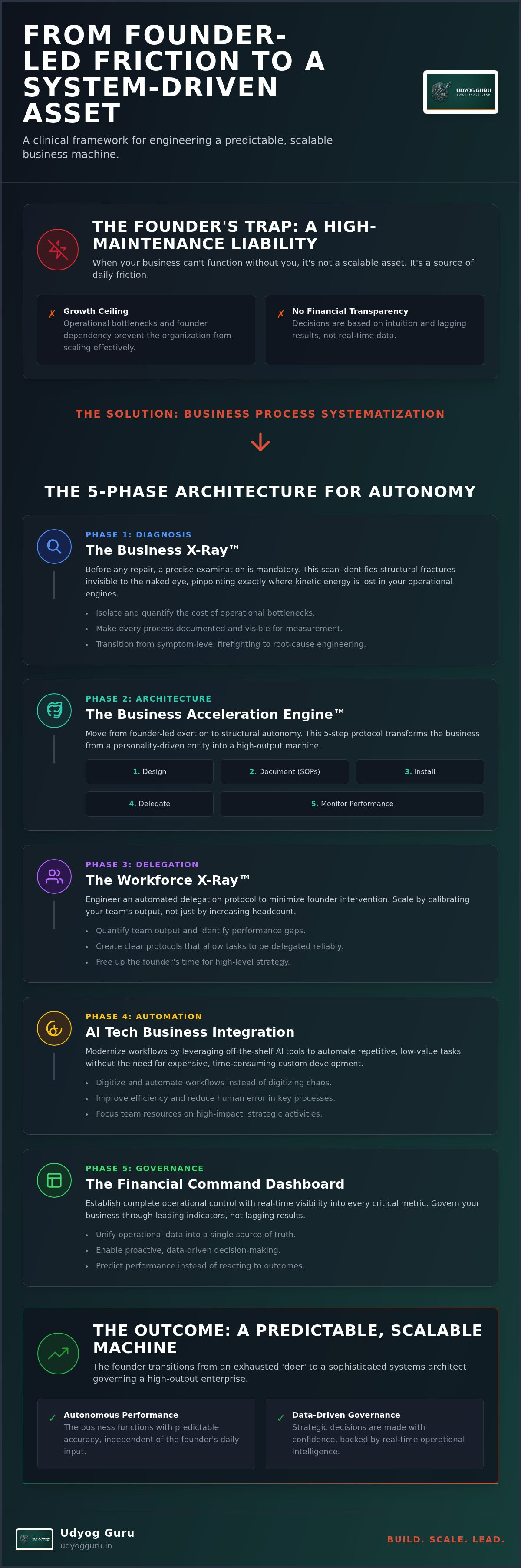
A business that requires the founder's constant physical or mental presence to function isn't a scalable asset; it's a high-maintenance liability masquerading as an enterprise. Most Indian entrepreneurs eventually hit a hard growth ceiling where operational bottlenecks and a lack of real-time financial transparency turn their vision into a source of daily friction. You likely feel the weight of being the primary engine for every decision, which creates a dangerous dependency that prevents the organization from breathing on its own.
This article provides the clinical framework for business process systematization, moving beyond motivational fluff to deliver a rigorous diagnostic protocol for your operations. By applying the Business X-Ray™ methodology, you can identify hidden structural fractures and install the Business Acceleration Engine™ to ensure consistent, high-output performance. We will examine the precise architectural layers required to transition from an exhausted 'doer' to a sophisticated systems architect who governs a predictable, scalable machine through the Financial Command Dashboard.
Key Takeaways
- Conduct a Business X-Ray™ to diagnose structural fractures and transition your enterprise from intuitive management to a clinical, protocol-driven architecture.
- Implement a rigorous framework for business process systematization that replaces owner-dependent tasks with scalable standard operating procedures for consistent growth.
- Deploy the Workforce X-Ray™ to quantify team output and engineer an automated delegation protocol that minimizes founder intervention in daily operations.
- Modernize workflows through the AI Tech Business Integration Bootcamp by utilizing off-the-shelf AI tools to automate repetitive tasks without the need for custom development.
- Establish a Financial Command Dashboard to gain real-time visibility into operational data, allowing you to govern your business through leading indicators rather than lagging results.
The Anatomy of Business Process Systematization: From Chaos to Architecture
Business process systematization isn't a mere administrative upgrade; it's the structural engineering of an organization's biological functions. Most Indian founders operate through intuitive management, relying on sheer willpower and ad-hoc decisions to navigate daily friction. This approach creates a fragile ecosystem where growth is limited by the founder's personal bandwidth. To achieve scalable growth, the business must be treated as a high-precision machine that requires a clinical, protocol-driven architecture. This shift demands that the founder evolves from a primary operator, who is the central point of failure, into a Systems Architect who designs the blueprints for autonomous performance.
Systematization efforts frequently collapse because founders skip the diagnostic phase. Attempting to install automation or new software without a clear understanding of the current state is like performing surgery without a scan. This discipline aligns with the broader principles of business process management, which focuses on the end-to-end design and monitoring of workflows. Without this foundational logic, you're simply digitizing chaos rather than eliminating it. Effective business process systematization requires a commitment to order over inspiration, ensuring every component of the enterprise functions with predictable accuracy.
Diagnostic Protocols: The Business X-Ray™
Before any structural repair can begin, a precise examination is mandatory. Conducting a business diagnostic scan allows you to identify structural fractures that are invisible to the naked eye. By visualizing the organization as a series of interconnected engines, such as acquisition, fulfillment, and workforce management, you can pinpoint exactly where kinetic energy is being lost. Transparency is the first step toward calibration. If a process isn't documented and visible, it cannot be measured or optimized for high-output results.
Identifying Operational Bottlenecks
A common error in scaling enterprises is mistaking symptom-level friction for root-cause failures. Using the identifying operational bottlenecks in business protocol helps founders stop firefighting and start engineering permanent solutions. These bottlenecks often manifest as inconsistent output or delayed delivery, but the source is usually a broken protocol or a missing feedback loop. Quantifying the cost of these inefficiencies is vital for long-term health. In the Indian market, where operational costs are rising, even a minor leak in process efficiency can result in thousands of ₹ wasted each month. You must isolate the specific gear that's grinding before you can scale the entire engine.
Architecting the Framework for Sustainable Scaling
Sustainable expansion requires a transition from founder-led exertion to structural autonomy. Many Indian enterprises fail during growth phases because they attempt to scale by simply increasing headcount, which often compounds existing operational chaos. True scaling is a process of mechanical calibration. It involves a 5-step protocol: diagnostic scanning, structural design, procedural documentation, protocol installation, and continuous performance monitoring. By implementing business process systematization, you transform the enterprise from a personality-driven entity into a high-output machine capable of predictable results.
This transition is best achieved through the installation of the Business Acceleration Engine™. This framework ensures that every operational gear is aligned with the organization's growth objectives. Instead of relying on the founder's intuition to manage daily tasks, the business adopts a systematic approach to enhancing efficiency that allows for expansion without sacrificing quality or profitability. If you're ready to move beyond manual intervention, you can explore how our business transformation protocols install these systems for you.
Standard Operating Procedures: The Blueprint of Growth
Standard Operating Procedures (SOPs) serve as the engineering manuals for your business biology. These aren't static documents buried in a folder; they're active protocols that dictate exactly how a core function must be executed. Drafting these manuals requires a clinical level of detail to ensure repeatability across decentralized teams. During the 'Installation Phase,' the focus shifts from documenting paper-based theories to practical application. This ensures that every team member, regardless of their seniority, produces an output that meets your exact technical specifications without requiring your direct supervision.
Strategic Business Scaling Protocols
Effective growth depends on maintaining structural integrity as load increases. Applying specialized scaling a business principles prevents the common trap of over-indexing on customer acquisition while fulfillment engines remain fragile. You must balance the intake of your acquisition funnels with the structural capacity of your delivery systems. Maintaining operational clarity during rapid expansion prevents the 'growth plateau' where the weight of overhead crushes profitability. Scaling isn't about working harder; it's about ensuring the engine is calibrated to handle the increased RPM of a larger market presence.
Engineering Workforce Optimization and Automated Delegation
Human capital is often the most volatile variable in a scaling enterprise. Without a clinical approach to management, team output becomes inconsistent, forcing the founder back into the role of a primary operator. Engineering a high-output delivery system requires the Workforce X-Ray™, a diagnostic tool designed to quantify team alignment and individual productivity. By identifying structural gaps in human performance, you can align your talent with the broader goals of business process systematization, ensuring every team member functions as a calibrated component of the organizational machine. This diagnostic protocol removes the guesswork from management, replacing subjective intuition with objective data.
Workforce Acceleration Systems
Maximizing the efficiency of your team requires the implementation of specific workforce optimization strategies. These protocols focus on designing feedback loops that operate independently of founder supervision. In many Indian organizations, communication friction leads to delayed execution and lost revenue. By installing standardized communication protocols, you reduce the 'noise' within the system. This allows information to flow through the workforce engine with minimal resistance, ensuring that tasks are completed according to the established blueprints without requiring constant manual intervention. The goal is to build a self-sustaining ecosystem where every department understands its mechanical role.
Automated Accountability Frameworks
The transition from a doer to a Systems Architect depends on your ability to delegate with confidence. This is achieved through the Workforce Acceleration Engine™, which establishes automated accountability frameworks. Instead of micromanaging daily activities, you install KPIs that act as high-sensitivity sensors for team performance. These sensors provide real-time data on output quality and speed, allowing the system to self-correct before a minor variance becomes a structural failure. When accountability is baked into the architecture, the need for constant founder oversight is eliminated. This is particularly vital in the competitive Indian market, where operational speed is a primary differentiator. By automating the delegation process, you ensure that the workforce engine continues to drive growth even when you are focused on high-level strategic engineering or market acquisition.
Modernizing Operations through Systematic AI Integration
Technology serves as the ultimate lever for the Systems Architect, yet many founders mistake software acquisition for structural improvement. Modernizing an enterprise requires a clinical integration of technology into the existing biological functions of the business. Through the AI Tech Business Integration Bootcamp, founders can install a framework for modernization that utilizes non-custom, off-the-shelf AI tools to automate repetitive workflows. This strategy allows for scaling efficiency without the prohibitive costs and long lead times of custom software development. By focusing on business process systematization, you ensure that AI serves the system rather than becoming another disconnected tool that requires manual oversight.
AI Implementation Roadmap for SMEs
Successful modernization follows a structured sequence rather than erratic experimentation. Applying the ai implementation roadmap for smes allows you to identify high-impact, low-effort automation opportunities that yield immediate operational clarity. This involves scanning core operations for high-frequency, low-complexity tasks, such as initial lead qualification or data reconciliation, and replacing manual labor with algorithmic precision. During adoption, maintaining protocol integrity and data security is paramount. You must ensure that every automated workflow adheres to the same rigorous standards as your manual SOPs, preventing the introduction of technical debt or operational noise into the engine.
Systematic Tech Integration for Modern Founders
The role of the founder is to design a tech stack that communicates autonomously, reducing the administrative bottlenecks that plague scaling enterprises. This requires training the workforce to view AI as a productivity multiplier rather than a replacement for human judgment. By automating data entry and internal reporting, you free your team to focus on high-output delivery and strategic growth. An integrated tech stack acts as a central nervous system, ensuring that information flows between departments without human intervention. This calibration of technology and human capital is essential for maintaining a competitive edge in the Indian market. To begin the modernization of your operations, you can register for the AI Tech Business Integration Bootcamp to install these advanced protocols today.
Establishing Financial Command and Operational Control
The final stage of structural transformation involves installing high-sensitivity monitoring systems to ensure long-term stability. While previous phases focused on repair and optimization, establishing financial command provides the visibility required to govern the organization with clinical precision. Most Indian founders operate using lagging indicators, such as monthly bank statements or quarterly GST filings, which only reveal historical failures. To achieve true business process systematization, you must transition to leading operational data. This shift allows you to detect variances in the system before they compromise the organization's fiscal health, ensuring that every rupee invested generates a predictable return.
Achieving fiscal control requires automated reporting systems that eliminate manual data manipulation. When your financial data is pulled directly from your operational engines, the risk of human error or biased reporting is removed. This level of mechanical accuracy is vital for maintaining the structural integrity of a scaling enterprise. It allows the Systems Architect to view the business as a series of mathematical equations rather than a collection of stressful problems. By removing the emotional friction from financial management, you ensure that decisions are driven by data rather than intuition.
The Founder’s Command Center
A sophisticated enterprise requires a single source of truth for all operational metrics. The Financial Command Dashboard acts as your central nervous system, capturing data from acquisition, fulfillment, and workforce engines in real-time. By monitoring profitability, cash flow, and customer acquisition costs (CAC) as they occur, you can make strategic engineering decisions based on evidence rather than anxiety. For instance, if your acquisition cost exceeds a specific threshold of ₹10,000 per lead, the system should trigger an immediate protocol for recalibration. This level of transparency ensures that the founder is never blind to the internal mechanics of the asset, allowing for precise adjustments to the engine's RPM.
Achieving Operational Excellence
Transformation is complete when the business functions as a self-sustaining asset. This final calibration ensures that the organization runs with zero founder dependency, turning a chaotic job into a valuable machine. When the architecture is sound, the business becomes a predictable growth machine that naturally attracts external investors or potential buyers who value structural reliability over personality. You've successfully transitioned from a 'Manager' who fights daily fires to an 'Asset Owner' who observes the engine's performance from the command center. This structural autonomy is the ultimate objective of engineering operational clarity. It provides the freedom to either scale further into new markets or exit the enterprise with a high-valuation asset that stands on its own structural integrity, proving that the machine is more powerful than the operator.
Transitioning to a Systems-Led Architecture
The journey from operational chaos to a high-output machine requires more than just willpower; it demands a clinical commitment to business process systematization. You've seen how a proprietary diagnostic framework identifies structural fractures and how removing founder dependency is the only path to legitimate scaling. By installing the Financial Command Dashboard, you replace the anxiety of intuition with the clarity of real-time data. It's time to stop acting as the primary engine and start operating as the Systems Architect who governs a self-sustaining asset.
Structure dictates performance. Your enterprise shouldn't be a source of constant friction; it should be a calibrated machine that functions with mechanical precision. We provide the protocols needed to transform your business into an autonomous entity that thrives without your manual intervention. Schedule your Business X-Ray™ diagnostic scan today to begin the rigorous calibration of your enterprise and secure your path toward scalable growth.
Frequently Asked Questions
What is the primary difference between business automation and systematization?
Automation is the tactical application of technology to specific tasks, while business process systematization is the strategic engineering of the entire organizational architecture. You cannot effectively automate a process that hasn't been clinically defined and optimized. Systematization ensures the underlying logic is sound, while automation provides the kinetic energy to execute those protocols at scale. Without this foundational architecture, automation merely increases the speed of operational failure and structural noise.
How long does it take to implement a full business process systematization protocol?
The duration of a transformation protocol depends on the current state of your organizational biology and the complexity of your engines. A standard installation typically moves through tiered phases, starting with a diagnostic scan. While initial clarity can be achieved in weeks, full calibration through the Business Acceleration Engine™ requires a methodical approach to ensure structural integrity. This progressive implementation ensures that each department is stabilized before the next layer of complexity is added.
Can a creative or service-based business really be fully systematized?
Creative and service-based enterprises are prime candidates for systematization because their reliance on human capital often creates high founder dependency. While the creative output itself is unique, the acquisition, delivery, and reporting protocols must be engineered for consistency. By treating these functions as mechanical processes, you ensure high-output delivery without sacrificing quality. Systematization provides the rigid framework that allows creativity to function within a predictable, profitable structure across the Indian market.
What is a Business X-Ray™ and why is it the first step in the process?
The Business X-Ray™ is a proprietary Tier 1 diagnostic framework designed to identify structural fractures and operational bottlenecks within an enterprise. It's the mandatory first step because you cannot repair an engine without a precise scan of its internal mechanics. This protocol provides a single source of truth regarding your current operational health, allowing for a targeted installation of solutions rather than relying on the guesswork of intuitive management or temporary inspiration.
Do I need custom software to systematize my business processes?
Custom software development is not a requirement for effective business process systematization. In fact, modern enterprises achieve higher efficiency by integrating off-the-shelf tools and AI through protocols like the AI Tech Business Integration Bootcamp. These non-custom solutions offer lower technical debt and faster deployment times. The focus remains on engineering the workflow architecture rather than building expensive, proprietary code that requires constant maintenance and specialized IT support from external vendors.
How does systematization help in reducing founder burnout?
Founder burnout is a symptom of high dependency, where the organization cannot function without the owner's constant manual intervention. Systematization addresses this root cause by installing autonomous protocols that handle daily decision-making and operational execution. As you transition into the role of a Systems Architect, the business begins to run as a self-sustaining asset. This structural shift eliminates the mental load of firefighting, allowing you to focus on strategic growth and high-level engineering.
What role does AI play in modern business process systematization?
AI serves as a high-leverage productivity multiplier within the modern systematization framework. Through the AI Tech Business Integration Bootcamp, founders learn to embed AI into existing workflows to automate repetitive tasks and reduce administrative bottlenecks. This isn't about replacing human judgment but about removing the friction of manual data entry and routine communication. AI provides the algorithmic precision needed to maintain a high-output delivery engine in a competitive, data-driven environment without custom development.
How do I ensure my team follows the new systematic protocols?
Team adherence is engineered through automated accountability frameworks and the Workforce Acceleration Engine™. Instead of relying on manual supervision, you install KPIs that act as high-sensitivity sensors for every protocol. These sensors provide real-time data on performance variances, allowing the system to self-correct. When accountability is baked into the organizational architecture, team members follow protocols because the system makes variances visible and quantifiable, ensuring consistent output across all departments without micromanagement.


