

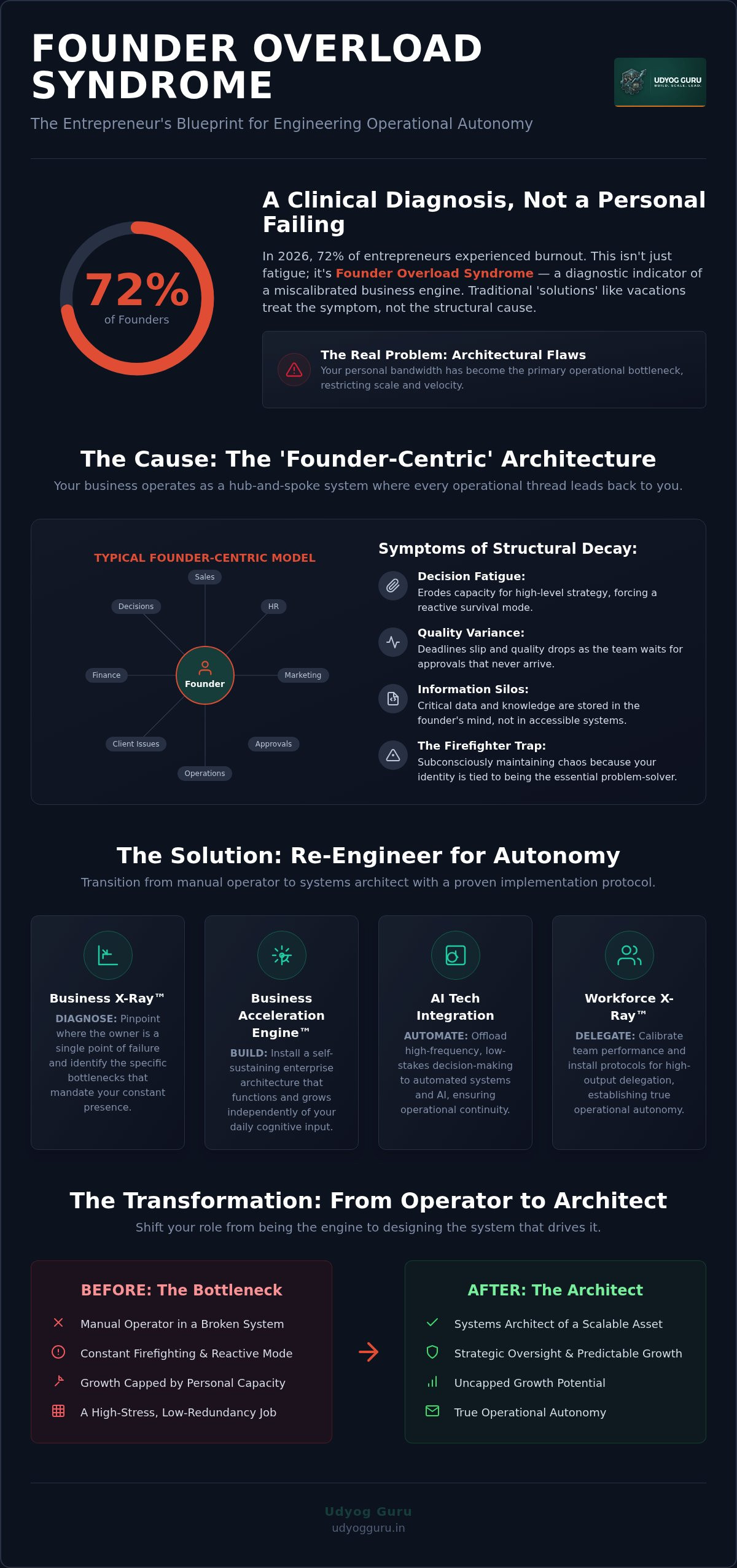
72% of entrepreneurs reported experiencing burnout symptoms in 2026, yet most seek relief through temporary lifestyle adjustments rather than structural repair. This data suggests that the exhaustion you feel isn't a personal failing; it's a diagnostic indicator of a miscalibrated business engine. You likely recognize that your personal bandwidth has become the primary bottleneck, restricting the scale and velocity of your operations. To find lasting business owner burnout solutions, you must stop treating the symptoms and start diagnosing the architectural flaws that mandate your constant presence.
True operational autonomy requires a complete re-engineering of your organizational architecture to eliminate founder dependency. We'll examine how to transition from a manual operator to a systems architect by installing the Business X-Ray™ diagnostic framework. This guide provides a blueprint for deploying a self-sustaining enterprise architecture that ensures predictable growth and operational clarity without requiring your constant intervention.
Key Takeaways
- Redefine burnout as "Founder Overload Syndrome," treating it as a structural failure of business architecture rather than a personal endurance issue.
- Implement effective business owner burnout solutions by utilizing the Business X-Ray™ to diagnose and repair the specific bottlenecks that mandate your constant presence.
- Install the Business Acceleration Engine™ to create a self-sustaining enterprise that functions independently of your daily cognitive input.
- Offload high-frequency decision making to automated systems through the AI Tech Business Integration Bootcamp, ensuring operational continuity.
- Execute a Workforce X-Ray™ to calibrate team performance, enabling high-output delegation and establishing true operational autonomy.
A Clinical Diagnosis of Business Owner Burnout
Occupational burnout is frequently mischaracterized as a psychological state requiring emotional resilience. While the clinical definition of burnout emphasizes exhaustion and reduced professional efficacy, for the entrepreneur, it's more accurately diagnosed as Founder Overload Syndrome. This condition occurs when the business architecture mandates that the owner's personal bandwidth serves as the primary operational bottleneck. Most business owner burnout solutions fail because they treat burnout as a biological fatigue issue rather than a structural engineering defect.
Traditional remedies, such as extended vacations or mindfulness practices, are insufficient for a scaling enterprise. These interventions provide temporary relief to the operator while leaving the malfunctioning machine intact. Tactical exhaustion is the result of a temporary heavy workload. Systemic burnout is the result of a flawed architecture where every decision, regardless of its significance, requires the founder's cognitive input. This creates the Firefighter Trap, a state where the founder subconsciously maintains operational chaos because their identity is tied to being the essential problem solver.
The distinction between working hard and working in a broken system is critical. When a founder is the only individual capable of resolving customer complaints or approving minor expenditures, the business isn't a scalable asset; it's a high-stress job with no redundancy. True business owner burnout solutions require a shift from being the engine of the company to becoming the architect of the system that drives it.
The Symptoms of Structural Decay
Structural decay manifests through measurable performance indicators that signal a system in distress. Decision fatigue erodes the founder's capacity for high-level strategic planning, forcing them into a reactive, short-term survival mode. Quality variance and slipped deadlines emerge as team members wait for approvals that never arrive, indicating that the human elements of the business are uncalibrated. Burnout is the inevitable result of a founder-dependent architecture that has reached its maximum capacity for manual intervention.
The Diagnostic Scan: Identifying the Root Cause
A rigorous business diagnostic scan is required to pinpoint where the owner has become a single point of failure. This process involves a detailed analysis of the Owner-to-Task ratio across all core departments to identify where delegation has been replaced by bottlenecking. You must distinguish between healthy growth stress, which challenges the system's capacity, and destructive operational friction, which indicates a fundamental misalignment in the business engine. Effective solutions focus on recalibrating this ratio to ensure the enterprise scales without increasing the founder's daily cognitive load.
The Architecture of Dependency: Why Your Business Breaks Without You
The "Founder-Centric" model is an architectural defect that restricts an organization’s growth to the ceiling of the owner's cognitive capacity. In this configuration, the business operates as a hub-and-spoke system where every operational thread leads back to a single central processor. Information silos develop because critical data and institutional knowledge are stored in the founder's mind rather than in accessible systems. This lack of transparency forces even minor decisions back to the CEO’s desk, creating a permanent state of high-friction management. Modern SME scaling requires moving toward operational clarity for founders to dismantle these silos and restore strategic bandwidth. To begin this repair, you might consider a preliminary structural assessment to identify these hidden dependencies and implement sustainable business owner burnout solutions.
The Failure of Manual Management
Manual management relies on verbal instructions and ad-hoc oversight, which inevitably leads to "Management by Crisis." This method is unsustainable because it ignores the physics of scaling. Operational systems typically fracture at predictable intervals: the 10, 25, and 50-employee marks. At 10 employees, personal relationships can still bridge process gaps. By 25, the owner can no longer monitor every interaction. At 50, the lack of documented protocols results in total operational entropy. Effective business owner burnout solutions necessitate a transition from personality-driven leadership to process-driven governance. Without this shift, the owner remains trapped in a cycle of perpetual repair.
Mapping the Operational Bottlenecks
Cognitive choke points occur where the owner is the sole possessor of the data required for a task to proceed. These bottlenecks are often invisible until they cause a complete stoppage in the workflow. Implementing a scalable business architecture allows for the distribution of decision-making power by codifying logic into the system itself. You can quantify this risk by calculating an "Owner Dependency Score" for current workflows. This metric measures the percentage of core processes that cannot be completed if the founder is unavailable for 48 hours. Reducing this score is the primary objective of any systematic recovery protocol.
Structural Business Owner Burnout Solutions: Engineering Redundancy
Recovery from Founder Overload Syndrome requires the installation of structural redundancy. While previous sections diagnosed the pathology of dependency, permanent business owner burnout solutions demand a transition to an owner-independent growth model. By installing the Business Acceleration Engine™, you replace manual effort with a calibrated machine designed for predictable expansion. This shift ensures the enterprise maintains 100% operational efficiency even during your total absence, transforming the business from a person-dependent entity into a self-sustaining asset.
Central to this transformation is the Business Playbook, a comprehensive operational manual that standardizes every core protocol. This isn't a static document but a living architecture that dictates how the business engine processes data and delivers value. When every procedure is codified, the need for your constant oversight evaporates. To ensure the human components are as reliable as the mechanical ones, the Workforce X-Ray™ provides a rigorous audit of team performance, ensuring high-output delegation is possible across all tiers of the organization.
Automated Delegation Protocols
Effective delegation is a mechanical process, not a leap of faith. You must engineer accountability through data-driven performance tracking rather than relying on subjective check-ins. The Workforce Acceleration Engine™ optimizes team output by aligning individual KPIs with systemic requirements, ensuring high-output results without the need for micromanagement. By utilizing a 15-Minute CEO Dashboard, you gain high-level oversight of the entire operation. This allows you to monitor the health of the engine without deep-diving into daily tasks, preserving your cognitive energy for high-level calibration rather than low-level repair.
The Business X-Ray™ Methodology
Achieving this level of autonomy requires a clinical scan of the entire organization. The Business X-Ray™ identifies where energy and time are leaking due to uncalibrated workflows or redundant steps. Once diagnosed, departments are restructured to operate as autonomous modules that interact seamlessly within the larger enterprise architecture. It's vital to understand that scaling a business requires a total shift in operational engineering, moving away from human-centric management toward a system-centric engine. This methodology provides the precise calibration needed to implement lasting business owner burnout solutions and secure a path to operational autonomy.
Technology as a Calibrator: AI and Automation Solutions
Technology serves as the precision calibrator for a disordered business engine. While previous sections detailed the structural redundancy needed, 2026 technology provides the mechanism for autonomous operations that were scientifically impossible five years ago. Integrating advanced AI allows you to offload high-frequency, repetitive cognitive tasks that previously required your direct intervention. The AI Tech Business Integration Bootcamp is designed to install these automated protocols, effectively replicating the "Founder’s Brain" for the initial triage of operational data. This ensures that only high-value strategic decisions reach your desk, providing one of the most effective business owner burnout solutions available today. To begin your technical recalibration, you can enroll in the next bootcamp session to automate your core workflows.
AI-Driven Workflow Integration
Identifying low-value, high-energy tasks is the first step in technical delegation. You must build a tech stack where individual platforms communicate internally, eliminating the need for human "bridge" roles that often result in data fragmentation. Automated reporting protocols further reduce the friction of communication, providing real-time status updates without manual entry. This systemic integration transforms the business into a self-correcting machine where information flows through predefined channels rather than through the founder’s inbox. By removing yourself as the central relay for information, you restore the bandwidth necessary for high-level enterprise architecture.
The Financial Command Center
"Cash Flow Anxiety" is a primary contributor to the emotional burden of ownership, yet it's often the result of operational opacity. Implementing the Financial Command Dashboard replaces manual spreadsheets with predictive financial modeling, offering real-time fiscal control. This data-driven oversight allows for a business growth framework supported by verified metrics rather than intuition. When you have total visibility into the fiscal engine, the psychological stress of the unknown is removed, allowing for a disciplined approach to scaling. By utilizing these business owner burnout solutions, you transition from a reactive manager to a high-level systems architect, ensuring the enterprise remains stable regardless of market fluctuations.
The Path to Operational Autonomy: Implementation Protocol
Installing sustainable business owner burnout solutions requires a rigorous, five-step implementation protocol designed to replace manual intervention with systemic reliability. This process moves beyond temporary relief, focusing instead on the permanent recalibration of the business engine. Each phase builds upon the previous one to ensure a logical progression toward total operational autonomy.
- Step 1: Conduct a Business X-Ray™: Perform a clinical diagnostic to identify structural dependencies where your personal input is the single point of failure.
- Step 2: Map Core Processes: Document every high-frequency workflow to create a "Business Architecture" that serves as the organization’s primary operational manual.
- Step 3: Deploy the Workforce Acceleration Engine™: Calibrate your team’s output to ensure they can execute the documented architecture without your constant oversight.
- Step 4: Integrate AI Protocols: Offload the initial triage of operational data to automated systems, effectively replicating your cognitive logic within the software stack.
- Step 5: Monitor via the Financial Command Dashboard: Maintain real-time oversight of the enterprise’s fiscal health, allowing you to manage by exception rather than by direct involvement.
Transitioning from Operator to Architect
The transition toward autonomy demands a fundamental psychological shift where you stop doing and start designing. You must view your business as a machine that requires precise engineering rather than a collection of tasks that require your effort. In this new architecture, your primary KPI becomes System Health rather than daily output. A healthy system is one that scales predictably without increasing your personal stress levels. By prioritizing the integrity of the engine over individual fires, you ensure the enterprise can handle increased velocity without fracturing the founder's bandwidth.
Sustaining the New Enterprise Architecture
Maintaining a self-sustaining enterprise requires continuous calibration through regular structural audits. Systems naturally tend toward entropy, and without periodic scanning, the organization may revert to owner-dependency. The long-term ROI of investing in systems over manual labor is significant, as it transforms the business into a transferable asset rather than a high-pressure job. For founders ready to finalize their transition, the next step is to install a professional business growth framework. This scientific protocol ensures that your business owner burnout solutions remain effective as the company scales into its next phase of development.
Recalibrating the Enterprise for Sustainable Growth
Operational autonomy is the only permanent remedy for founder overload. We've established that burnout isn't a personal deficiency but a diagnostic indicator of a flawed business architecture that mandates your presence at every decision point. To implement lasting business owner burnout solutions, you must shift your focus from manual management to systemic engineering. This transition requires the integration of proprietary diagnostic tools, such as the Financial Command Dashboard, and the offloading of cognitive tasks through our specialized AI Tech Integration Bootcamp.
By installing a self-sustaining engine, you ensure that your organization scales predictably without taxing your personal bandwidth. Udyog Guru provides the clinical expertise and structural frameworks used by scaling enterprises nationwide to remove founder dependency. It's time to stop fighting operational fires and start designing a machine that functions with precision in your absence. To begin this transformation, Schedule your Business X-Ray™ diagnostic scan with Udyog Guru today. Your path to a resilient, autonomous enterprise starts with a rigorous assessment of your current architecture.
Frequently Asked Questions
What are the first signs of business owner burnout I should look for?
The primary indicators of burnout manifest as structural bottlenecks within your organization. Look for chronic decision fatigue, where minor operational choices consume your strategic bandwidth, and a persistent "firefighter" mentality that prioritizes reactive repair over long-term planning. When your business reaches a growth ceiling that directly correlates to your personal working hours, you've reached the limits of a founder-centric architecture. Identifying these mechanical failures is the first step toward implementing effective business owner burnout solutions.
Can business owner burnout be solved without hiring more staff?
You can resolve burnout without expanding your headcount by recalibrating your existing operational engine. Systemic efficiency is achieved by replacing manual oversight with automated protocols and high-output delegation. Our AI Tech Business Integration Bootcamp teaches founders how to offload repetitive cognitive tasks to intelligent systems, effectively increasing organizational capacity without the overhead of new recruitment. This approach ensures that your current team operates at peak performance through a more robust, self-sustaining architecture.
How does the Business X-Ray™ help in reducing founder stress?
The Business X-Ray™ functions as a clinical diagnostic scan of your entire enterprise to identify hidden structural dependencies. It maps every core workflow to pinpoint where you've become a single point of failure, allowing for a precise surgical repair of your operations. By providing a clear blueprint of operational gaps, this framework eliminates the chaos of the unknown. This clarity directly reduces founder stress by replacing intuitive guesswork with data-driven architectural certainty.
Is it possible to automate a business that relies heavily on my personal expertise?
Codifying your unique expertise into a scalable business architecture allows for the automation of specialized workflows. While your high-level strategy remains human, the initial triage and routine execution of your expertise can be replicated through AI and standardized protocols. This transformation requires translating your professional intuition into a series of logical, data-driven rules that the system can follow. This process ensures the business maintains your quality standards without requiring your direct daily intervention.
How long does it take to implement a Business Acceleration Engine™?
Implementation of the Business Acceleration Engine™ follows a methodical, tiered timeline based on the complexity of your current architecture. While initial diagnostic scans provide immediate clarity, the full installation of owner-independent growth protocols typically progresses through distinct phases of process mapping and system integration. This deliberate pace ensures that each new structural layer is fully calibrated and stable before moving to the next. The goal is a permanent transition to a self-sustaining enterprise.
What role does AI play in preventing founder burnout in 2026?
In 2026, AI serves as a high-precision mechanism for offloading the cognitive load that traditionally leads to exhaustion. Rather than simple task automation, modern AI protocols handle the initial triage of operational data and complex communication threads. This technology acts as a digital extension of the founder's brain, allowing the system to make routine decisions based on your predefined logic. Integrating these tools is essential for modern business owner burnout solutions that target cognitive overload.
How can a Financial Command Dashboard reduce my daily operational anxiety?
The Financial Command Dashboard provides real-time fiscal visibility, replacing the high-friction process of manual spreadsheet management. By consolidating fragmented financial data into a single, predictive interface, it eliminates the cash flow anxiety that stems from operational opacity. You gain the ability to monitor the health of your fiscal engine at a glance, allowing you to manage by exception. This level of data-driven control restores confidence and reduces the emotional burden of ownership.
What is the difference between a business coach and a business systems architect?
A business systems architect focuses on the structural integrity and mechanical efficiency of the enterprise, whereas a business coach typically prioritizes motivational support and personal intuition. Architects view challenges as solvable puzzles of logic and process, designing self-sustaining engines that operate independently of the founder. We don't offer one-on-one executive coaching; instead, we provide the blueprints and technical protocols required to repair broken architectures and install permanent operational autonomy.


