
What if the primary bottleneck in your company's growth isn't a lack of talent, but the persistence of your own manual oversight? While 89% of small businesses in the U.S. have adopted AI in some capacity as of 2026, most use it as a superficial patch rather than a structural engine. You don't need another software subscription; you need a diagnostic reset of your entire operational architecture. Enrolling in an AI for business owners bootcamp isn't about learning to code. It's about installing a systematic protocol that converts operational chaos into a calibrated, self-sustaining machine.
You've likely felt the friction of a business that stops the moment you look away, creating a ceiling that no amount of linear hiring can break. This article demonstrates how to move from manual oversight to automated precision through a rigorous integration framework. We'll explore how the AI Tech Business Integration Bootcamp serves as the installation phase for your scaling engine. By utilizing a Business X-Ray™ to identify systemic weaknesses, you can replace founder dependency with predictable, data-driven protocols that ensure your business remains resilient and autonomous.
Key Takeaways
- Identify the structural defects caused by manual dependencies and learn why traditional SME structures fail to scale without a systematic diagnostic reset.
- Discover how the AI for business owners bootcamp installs a Tier 3 integration protocol to transition your role from a daily manager to a systems architect.
- Utilize the Business X-Ray™ diagnostic framework to deconstruct existing workflows and pinpoint exactly where AI can replace manual oversight with automated precision.
- Evaluate the superior ROI of systematic AI protocols over costly custom software development while learning to avoid the "tech bloat" that creates operational friction.
- Establish a predictable growth engine by embedding automation into your core business architecture, effectively removing the founder as the primary bottleneck.
Beyond the Hype: Why an AI Bootcamp is Essential for Modern Business Owners
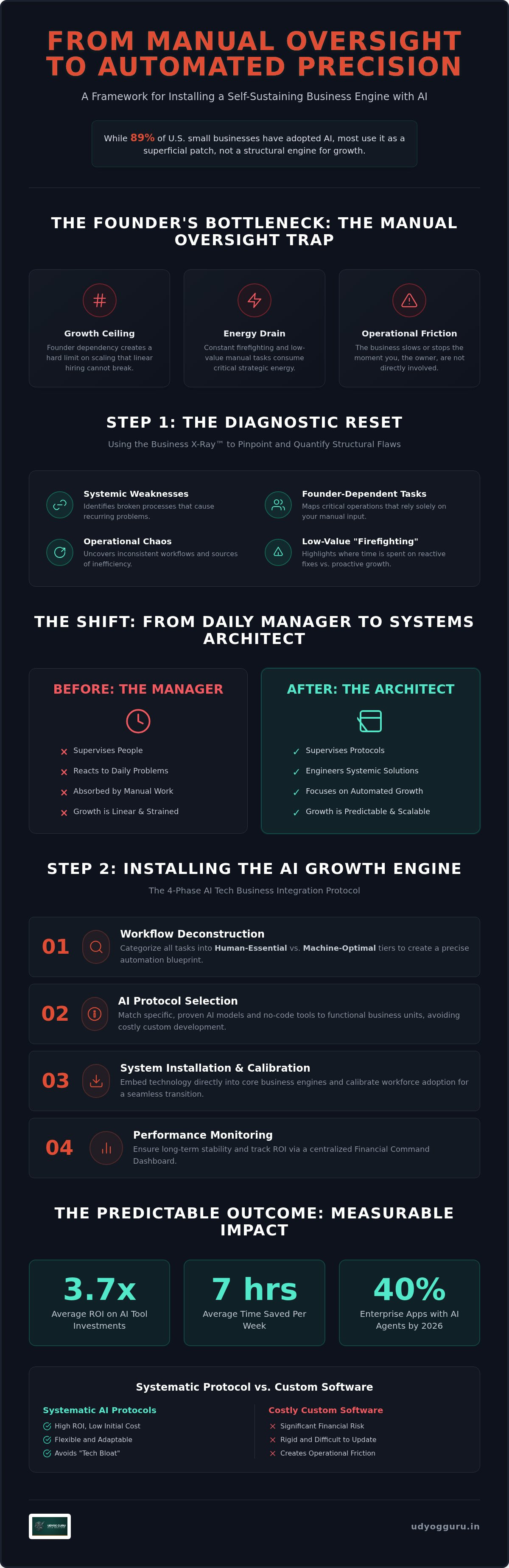
Most business owners view artificial intelligence as a collection of disjointed tools. This perspective is a structural error. Realizing true operational autonomy requires moving past basic AI awareness into a rigorous integration protocol. While an overview of AI applications in business reveals a wide range of uses, these remain superficial without a core architectural change. The efficiency gap in traditional SME structures is rarely a lack of effort; it's a lack of systemized precision. Manual oversight acts as a friction point that prevents national scaling. Research indicates that business owners using AI tools save an average of 7 hours per week, yet without a protocol, that time is often re-absorbed into other manual inefficiencies.
The Diagnosis: Identifying Structural Defects
Before any tool is installed, a diagnostic phase is mandatory. Using a business diagnostic scan allows an owner to identify the exact coordinates of operational chaos. The goal is to map founder-dependent tasks that AI can commoditize. If you're stuck in firefighting loops, your management energy is being drained by low-value activities. This is where an AI for business owners bootcamp becomes essential. It provides the framework to stop energy leaks by identifying which processes are ripe for automated precision. A diagnostic-first approach prevents the common mistake of investing in high-cost technology that doesn't solve the underlying structural defect.
AI as a Structural Installation
Scaling is a matter of engineering. Moving beyond basic generative tools is essential for building a resilient ecosystem. The role of AI in scaling a business is to increase throughput without a linear increase in overhead. By the end of 2026, Gartner expects 40% of enterprise applications to include task-specific AI agents. This shift requires a "Business-as-Science" mindset. The AI for business owners bootcamp treats technology as a calibrated engine rather than a temporary fix. It focuses on installing a sustainable machine that operates with predictable growth. Small businesses already report an average ROI of 3.7x on their AI tool investments. Achieving this requires a transition from a manager who supervises people to a systems architect who supervises protocols.
The Architecture of the AI Tech Business Integration Bootcamp
The AI Tech Business Integration Bootcamp (Tier 3) functions as a precise installation phase for enterprises seeking to eliminate operational friction. This program moves beyond the superficial layer of software adoption and focuses on embedding technology directly into the core business engines. The architecture of this transition is divided into four distinct phases. Phase 1 begins with workflow deconstruction to identify specific bottlenecks where manual oversight slows throughput. Phase 2 involves protocol selection, where we match specific AI models to functional business units. Phase 3 focuses on the installation and workforce calibration required for seamless adoption. Finally, Phase 4 ensures long-term stability through monitoring via the Financial Command Dashboard.
Workflow Deconstruction Protocols
Achieving operational clarity requires a deep analysis of repetitive operational cycles. By categorizing tasks into Human-Essential and Machine-Optimal tiers, owners can create a blueprint for systematic scaling. This process is not about replacing staff; it's about commoditizing low-value labor to free up strategic energy. Practical SBA guidance on AI for small business highlights that successful integration depends on this foundational strategy. This deconstruction allows for the creation of a tailored roadmap that aligns with the specific needs of the organization, ensuring that every automated layer serves a diagnostic purpose.
The "No-Code" Advantage for Owners
Custom software development often represents a significant financial risk for SMEs, frequently leading to rigid systems that are difficult to update. The AI for business owners bootcamp advocates for a modular approach using no-code ecosystems instead. This strategy allows owners to leverage existing AI infrastructure to build proprietary workflows without the overhead of a dedicated development team. It ensures that the business remains agile and capable of integrating new advancements as they emerge. By avoiding the "tech bloat" associated with custom builds, you maintain a leaner and more responsive operational engine. If you're ready to transition from a manager to a systems architect, a structured integration protocol provides the necessary framework for sustainable, autonomous growth.
Comparing AI Protocols: Custom Software vs. Systematic Integration
Evaluating the return on investment for technological upgrades requires a clinical look at total cost of ownership. Custom software development often results in a rigid architecture that demands constant maintenance and high capital expenditure. In contrast, systematic integration utilizes existing AI models to build flexible, high-output engines. This approach avoids the "Tech Bloat" trap, where disparate tools create more administrative friction than they resolve. An AI for business owners bootcamp prioritizes the installation of a cohesive ecosystem over the acquisition of isolated features. This speed of implementation significantly outperforms traditional consulting, which often prioritizes long-term advice over immediate structural repair. These integrated systems are designed for long-term scalability, allowing for modular updates as technology evolves.
The Financial Impact of Systematic AI
Reducing operational expenditure (OPEX) is a primary objective of any diagnostic intervention. By replacing manual oversight with automated precision, an organization can achieve higher throughput without increasing headcount. These outputs are directly monitored through the Financial Command Dashboard, providing real-time data on system efficiency. We track the "Time-Freedom" metric for business owners as a key indicator of successful installation. If the founder is still required for daily operational decisions, the protocol hasn't been fully calibrated. Systematic AI ensures that capital is deployed toward growth engines rather than being consumed by manual labor inefficiencies.
Integration with Workforce Optimization
A calibrated AI engine functions as a force multiplier for your existing team. It enhances workforce optimization strategies by automating delegation and ensuring accountability without manual follow-up. This shift removes the human error inherent in verbal instructions and fragmented email chains. Training your team to operate alongside an AI-driven engine is the final stage of workforce calibration. It ensures that every team member is focused on high-value cognitive tasks while the machine handles the repetitive operational cycles. This synergy creates a high-output environment where the workforce is no longer a bottleneck but a driver of sustainable expansion.
Strategic Implementation: A Roadmap for AI Adoption in SMEs
Executing a successful technological transition requires more than just software acquisition; it demands a phased deployment strategy. Business owners should begin by consulting the AI Roadmap for SMEs to establish a structural baseline for their operations. Initial efforts focus on "Quick-Win" automations within marketing content creation and customer communication, where 68% and 52% of small businesses respectively are already reporting efficiency gains as of 2026. Once these primary engines are calibrated, the protocol scales into complex operational layers such as supply chain logistics and financial forecasting. Throughout this process, a "Human-in-the-Loop" protocol remains mandatory for quality assurance, ensuring that automated precision is always verified by strategic human oversight.
The 90-Day Installation Cycle
A rigorous 90-day cycle ensures that the integration of new technology is both thorough and sustainable. This timeline is broken down into three distinct phases of repair and installation:
- Month 1: Conduct a comprehensive diagnostic scan to identify primary workflow bottlenecks and initiate the first layer of automation.
- Month 2: Focus on workforce calibration, transitioning the team into AI-assisted delegation models to increase departmental throughput.
- Month 3: Achieve full integration, shifting the management focus to dashboard-driven monitoring through the Financial Command Dashboard.
This structured progression ensures that the AI for business owners bootcamp delivers a calibrated machine rather than a fragmented collection of tools. By following this sequence, owners can systematically reduce their daily operational burden.
Avoiding Common Implementation Failures
SMEs often fail by succumbing to "Shiny Object Syndrome," where the allure of trendy features overrides structural necessity. A professional implementation prioritizes operational integrity and data security over novelty. Managing the cultural shift within the workforce is equally critical. Employees must be trained to view these systems as force multipliers that enhance their own output capacity. By adhering to a disciplined integration protocol, you avoid the tech bloat and fragmentation that plague unguided adoption. If you're ready to engineer a self-sustaining growth engine and remove yourself from the daily firefighting loops, you can apply for the AI Tech Business Integration Bootcamp to begin your structural transformation.
Tier 3 Transformation: Installing the AI Integration Protocol
The final phase of the AI Tech Business Integration Bootcamp focuses on the permanent installation of the protocols developed in previous stages. This Tier 3 transformation provides the structural repair necessary for a business to function as a self-sustaining machine. Rather than managing individual tasks, the owner utilizes the Financial Command Dashboard to supervise the entire operational engine. This data-driven control ensures that every automated process contributes to a measurable return on investment. The transition from a reactive manager to a proactive Systems Architect is the defining characteristic of a business that has achieved true operational clarity. By replacing manual dependencies with calibrated technology, you ensure that the organization remains resilient against market volatility.
Operational Clarity and Founder Autonomy
Predictability is the primary metric of a well-engineered business. When your company operates without constant manual intervention, you've achieved a level of founder autonomy that is essential for national-scale expansion. The shift from firefighting to engineering growth allows you to focus on high-level strategy and market positioning. This isn't just about saving time; it's about building a resilient architecture that doesn't break under the pressure of rapid scaling. By the end of the AI for business owners bootcamp, the founder is no longer the central bottleneck but the architect of a high-output system. This autonomy provides the freedom to pursue new acquisitions or market segments with the confidence that the core engine is stable.
Next Steps for the Systems-Driven Owner
Transitioning into this new operational model begins with a precise assessment of your current infrastructure. You must conduct an initial Business X-Ray™ to identify the specific defects and energy leaks within your organization. This diagnostic framework provides the blueprint for your Tier 3 integration and determines your readiness for the installation phase. Once your readiness is established, you can apply for the AI Tech Business Integration Bootcamp to begin the systematic overhaul of your scaling engine. A systems-driven owner recognizes that sustainable growth is a logical outcome of structural integrity rather than brute force. You can schedule a diagnostic scan to begin your transformation and take the first step toward total operational autonomy.
Engineering Your Operational Autonomy
Transitioning from manual oversight to automated precision is a structural necessity for any enterprise aiming for national scale. By utilizing a clinical, data-driven approach, you replace the friction of founder dependency with the efficiency of a calibrated machine. The proprietary Business X-Ray™ diagnostic ensures that every layer of your architecture is optimized before any installation begins. This process moves you beyond superficial tool adoption into a comprehensive ecosystem where your business operates with predictable, systematic clarity.
Enrolling in an AI for business owners bootcamp provides the technical blueprint required to install Tiered Acceleration Engine™ systems throughout your organization. This transformation allows you to finally step out of daily firefighting loops and into the role of a Systems Architect. You've seen the roadmap and the ROI potential; now it's time to calibrate your engine for long-term resilience. Install the AI Integration Protocol in your business today. Your journey toward a self-sustaining, autonomous enterprise begins with a single diagnostic step.
Frequently Asked Questions
What is an AI for business owners bootcamp?
This program is a specialized Tier 3 initiative designed to embed technology and automation into core business workflows. It focuses on achieving operational clarity and removing founder dependency through a systematic integration protocol. Unlike generic training, this AI for business owners bootcamp serves as a clinical installation phase for your enterprise. It transforms the business into a self-sustaining machine that operates with predictable precision and reduced manual oversight.
Do I need a technical background to join the AI Tech Business Integration Bootcamp?
Technical expertise isn't a prerequisite for participation. The curriculum is engineered specifically for business leaders and owners who need to supervise systems rather than write code. We focus on the strategic application of no-code AI ecosystems and the architecture of automated delegation. The objective is to equip you with the diagnostic skills to identify automation opportunities and manage the integration of modern technology into your existing business engines.
How does AI integration differ from just using tools like ChatGPT?
Tool usage is a superficial patch while integration is a structural repair. While 89% of small businesses in the U.S. use AI tools in some capacity as of 2026, most fail to build a cohesive ecosystem. Integration involves creating task-specific AI agents that handle repetitive operational cycles autonomously. This systemic approach ensures that technology is an integral part of your business architecture rather than a collection of isolated utilities that require separate manual management.
Can AI really help me reduce my dependency on manual workforce management?
AI allows you to transition from a daily manager to a Systems Architect by automating repetitive tasks and delegation protocols. This shift removes the human error inherent in manual oversight and fragmented communication chains. By embedding automation into your core operations, you ensure workforce accountability without constant intervention. The result is a high-output environment where the owner is no longer the primary bottleneck, allowing for national-scale expansion.
What is the expected ROI for an SME integrating AI protocols?
Small businesses report an average ROI of 3.7x on their AI tool investments as of 2026. This financial gain is driven by reduced operational expenditure and increased departmental throughput. Additionally, business owners using these protocols save an average of 7 hours per week. These gains are monitored through the Financial Command Dashboard, providing real-time data on the efficiency and profitability of your newly installed automated systems.
How long does it take to see operational results from the bootcamp?
Operational results typically manifest within a rigorous 90-day installation cycle. The first month focuses on the initial diagnostic scan and primary workflow automation to capture quick wins. By the third month, full integration is achieved, allowing for dashboard-driven monitoring of the entire organization. This methodical progression ensures that the system is properly calibrated for long-term stability and predictable growth, rather than providing a temporary or erratic performance boost.
Will I need to hire developers to implement the systems taught?
You don't need to hire developers or technical staff to implement the protocols taught in the AI for business owners bootcamp. The program advocates for a modular, no-code approach that leverages existing AI infrastructure. This strategy maintains organizational agility and avoids the financial risk associated with custom software development. Your current workforce is trained to operate alongside the AI-driven engine, ensuring that your team remains lean and focused on high-value strategy.
How does this bootcamp integrate with the Business Acceleration Engine™?
The bootcamp serves as the Tier 3 installation phase of the broader transformation framework. While the Business Acceleration Engine™ identifies growth gaps and scales throughput, the bootcamp provides the technological architecture to automate those gains. Both systems are designed to link directly into the Financial Command Dashboard. This integration provides the owner with total data-driven control, ensuring that the entire organization functions as a unified and highly efficient scaling machine.


