

The modern business is often less an engine of growth and more a series of manual life-support systems tethered to the founder’s daily intervention. With Gartner reporting that 65% of organizations utilized workflow automation by 2025, the critical challenge in 2026 is no longer adoption, but how to automate business workflows with AI without inducing systemic rejection. Most attempts at automation fail because they prioritize the "tool" over the architectural diagnosis. This results in tool sprawl and a fragmented ecosystem of disconnected software that requires even more manual oversight to manage.
You likely recognize the symptoms of this operational decay, such as bottlenecks caused by manual data entry and a persistent dependency on your personal involvement in every minor decision. This article provides a clinical, step-by-step protocol to transition from this state of chaos to a high-output, autonomous system. We'll examine the diagnostic necessity of a Business X-Ray™ to identify structural gaps before moving into the installation of agentic AI. By the end of this guide, you'll understand how to build a predictable, scalable growth engine that provides true data-driven financial control.
Key Takeaways
- Learn why a clinical Business X-Ray™ is essential to diagnose operational gaps before you attempt to install any automation software.
- Understand the evolution from basic RPA to agentic reasoning engines that allow you to automate business workflows with AI with greater precision.
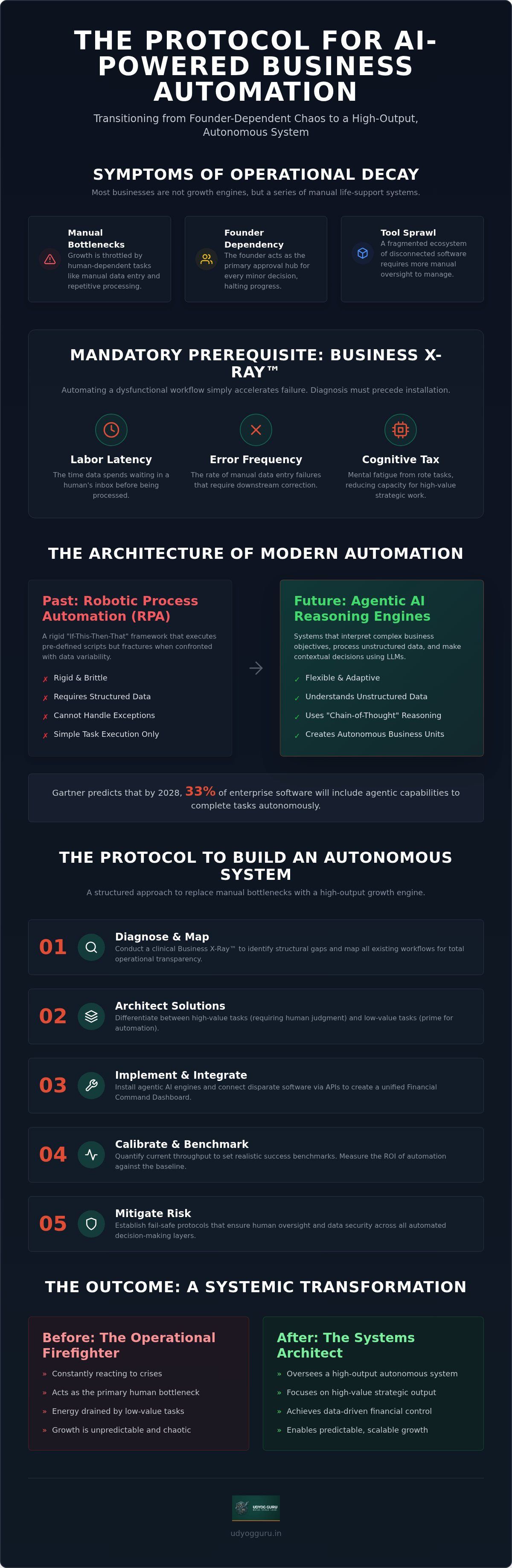
- Implement a rigorous 5-step protocol designed to replace manual bottlenecks with high-output, autonomous systems that drive predictable growth.
- Mitigate operational risks by establishing fail-safe protocols that ensure human oversight and data security across all automated decision-making layers.
- Transition from an operational firefighter to a Systems Architect by integrating your workflows through the AI Tech Business Integration Bootcamp.
Diagnosing the Workflow: Why Automation Requires a Business X-Ray™
AI workflow automation represents the structural replacement of human intervention with autonomous reasoning engines. It isn't a surface-level software patch; it's a fundamental reconfiguration of how a company processes information. Before you attempt to Business process automation (BPA), you must conduct a rigorous assessment of your current architecture. Automating a dysfunctional or undocumented workflow simply accelerates operational failure. This is why a clinical business diagnostic scan, or a Business X-Ray™, is the mandatory prerequisite for any technological installation.
Scaling enterprises often suffer from "Manual Friction," a condition where growth is throttled by human-dependent tasks. Symptoms include delayed reporting, inconsistent data entry, and a founder who acts as the primary bottleneck for every minor decision. To effectively automate business workflows with AI, you need total operational transparency. This transparency serves as the training ground for AI models. Without a clear map of your processes, you're essentially trying to install a high-performance engine into a chassis that hasn't been inspected for structural integrity.
The Anatomy of a Bottleneck
A diagnostic lens allows you to isolate repetitive cognitive tasks that drain executive energy. You must differentiate between high-value decision making and low-value data processing. High-value tasks require human intuition, ethical judgment, and complex context. Low-value tasks, such as lead triaging, invoice reconciliation, or basic customer support, are prime candidates for automation. To map the true cost of human-led workflows, consider these variables:
- Labor Latency: The time data spends waiting in a human's inbox before being processed.
- Error Frequency: The statistical rate of manual data entry failures that require downstream correction.
- Cognitive Tax: The mental fatigue experienced by staff performing rote tasks, which reduces their capacity for strategic output.
Establishing the Baseline for Installation
Installation of the Business Acceleration Engine™ cannot occur in a vacuum. You must quantify your current throughput without AI to set realistic success benchmarks. If you don't know your current lead-to-close speed or your manual reporting accuracy, you won't be able to measure the ROI of your automation protocols. We utilize the Workforce X-Ray™ to identify specific roles that are ready for transition. This diagnostic tool determines which team members are bogged down by mechanical tasks and which are ready to be elevated to "Systems Architects." By establishing this baseline, you ensure that when you automate business workflows with AI, the resulting system is calibrated for maximum output and predictable, scalable growth.
The Architecture of Modern Automation: From RPA to Agentic AI
Traditional automation relied on Robotic Process Automation (RPA), a rigid "If-This-Then-That" framework that fractured when confronted with data variability. In 2026, the paradigm has shifted toward "Reasoning Engines." These systems don't just execute pre-defined scripts; they interpret complex business objectives. Large Language Models (LLMs) act as the central nervous system of the workflow. They process unstructured data and make contextual decisions. By utilizing APIs to bridge disparate software, these engines feed real-time operational data directly into your Financial Command Dashboard. This transforms passive reporting into active oversight. It marks the transition from simple task automation to the creation of Autonomous Business Units. Gartner predicts that by 2028, 33% of enterprise software will include these agentic capabilities to complete tasks autonomously.
How Agentic AI Reasons Across Systems
Agentic AI employs advanced logic patterns like "Chain-of-Thought" reasoning to decompose high-level goals into actionable steps. Unlike "Zero-Shot" responses that provide immediate, static answers, these agents verify their work against your specific business protocols. The efficacy of these systems depends on their "Context Windows." This is the volume of operational data the AI can process during a single execution. Modern systems prioritize autonomous execution. They don't just send an alert. They identify a missing vendor invoice, draft the request, and cross-reference the response against the ledger. This is how you effectively automate business workflows with AI in a high-stakes environment.
Building the Scalable Business Architecture
A robust architecture is designed for elasticity. Workflows must be engineered so they don't collapse when transaction volume doubles. When you automate business workflows with AI, you must integrate them into your scaling a business framework using a diagnostic-first mindset. This ensures data integrity across the tech stack. If the underlying data is corrupted, the AI's reasoning will be flawed. Installing a Business Acceleration Engine™ ensures your systems are calibrated for structural integrity and long-term performance.
Step-by-Step Protocol to Automate Business Workflows with AI
Transitioning from manual operations to an automated architecture requires more than just software acquisition; it demands a clinical implementation manual. To effectively automate business workflows with AI, founders must follow a rigorous 5-step protocol that prioritizes structural integrity over speed. This systematic approach ensures that each automated unit aligns with the broader AI implementation roadmap for SMEs. We begin by targeting high-impact, low-complexity "Quick Wins" to demonstrate immediate ROI before scaling into more complex cognitive territories.
Step 1: Protocol Selection and Mapping
The first phase involves documenting the "Current State" of a process versus its intended "Automated State." You must define the specific inputs, the reasoning logic required, and the desired outputs with surgical precision. Workflow Mapping is the blueprint of business engineering. Without this map, the AI lacks the context necessary to make autonomous decisions. This step identifies where human intervention is a necessity and where it's merely a legacy bottleneck.
Step 2: Tool Calibration and Integration
Once the map is finalized, you must select the appropriate LLM for your specific business domain. Not all reasoning engines are created equal; some excel at creative synthesis while others are optimized for mathematical accuracy. During this stage, we configure middleware like Make or Zapier to act as the central nervous system, connecting your tech stack. It's vital that the Financial Command Dashboard is integrated here to ingest automated report data, providing real-time oversight of the system's performance.
Step 3: Installation and Stress Testing
Before full deployment, the automated protocol must run in a "sandbox" environment. This isolated testing phase allows us to identify "Edge Cases" where the AI's reasoning might fail due to unexpected data variables. We refine prompts and logic branches to ensure clinical accuracy in all outputs. This stress test is the final gate before the protocol enters the live operational environment.
Step 4: Human-in-the-Loop (HITL) Deployment
Deployment isn't a "set and forget" event. We install mandatory HITL checkpoints where a human architect reviews the AI's output before it's finalized. This maintains accountability and prevents "hallucinations" or logical errors from impacting the client experience. Over time, as the system demonstrates 99.9% accuracy, these checkpoints can be thinned, but never entirely removed from high-stakes decisions.
Step 5: Optimization and Systematic Scaling
The final step is the transition from a single automated task to a comprehensive ecosystem. We analyze the performance data to find further efficiencies, moving from "Quick Wins" to complex, end-to-end autonomous business units. This is how you automate business workflows with AI to achieve true operational autonomy and predictable growth.
Mitigating Operational Risks: Security and Accountability
The primary psychological barrier to operational autonomy is the founder's fear of losing control over critical processes. When you automate business workflows with AI, you aren't abdicating authority; you're delegating it to a high-precision reasoning engine that operates within strictly defined parameters. This delegation requires the installation of "Fail-Safe" protocols that act as the structural boundaries of autonomous action. These protocols ensure that while the AI manages the mechanics of execution, the founder retains ultimate decision-making power through structured oversight and real-time reporting. Maintaining a Financial Command Dashboard allows for precise oversight of automated expenses, ensuring that the cost of system execution remains aligned with revenue targets and operational budgets.
Automated Delegation and Accountability
Accountability in an automated ecosystem is maintained by using specialized AI to track the performance metrics of other operational agents. You must establish Alert Protocols that trigger immediate human intervention the moment a workflow encounters data outside its calibrated "safe zone." This tiered framework ensures the Workforce Acceleration Engine™ remains optimized without requiring constant manual supervision from leadership. It replaces the common "Robo Boss" anxiety with a systematic audit process where human architects act as the final quality assurance layer for high-stakes outputs. This hierarchy prevents tool sprawl and ensures that every automated action is traceable to a specific business objective, maintaining a clear line of responsibility even as the system scales.
Data Security for Proprietary Frameworks
Protecting proprietary business logic is a non-negotiable requirement for scaling enterprises in 2026. When you choose to automate business workflows with AI, the choice between utilizing private AI instances versus public models determines the long-term integrity of your intellectual property. Private instances ensure your proprietary data isn't ingested into third-party training sets, effectively creating a secure perimeter around your operational secrets. Masking sensitive financial data during processing further mitigates the risk of exposure, while maintaining a Scientific Audit Trail provides a chronological, unalterable record of every automated action. This level of transparency is essential for both regulatory compliance and internal system diagnostics. To secure your business architecture against these operational risks, you should start with a Business X-Ray™ diagnostic to identify vulnerabilities before full-scale installation.
Installation and Calibration: The AI Tech Business Integration Bootcamp
The transition from diagnostic theory to operational reality requires a controlled environment for deployment. To successfully automate business workflows with AI, the final stage is not merely software selection but the rigorous calibration of these tools within your specific business architecture. This is the primary objective of the Tier 3 AI for business owners bootcamp, where the conceptual blueprints of the Business X-Ray™ are converted into functioning mechanical protocols. By the end of this phase, the founder’s role shifts from a reactive "Firefighter" to a proactive "Systems Architect," overseeing a business that functions as a self-sustaining machine rather than a series of manual workarounds.
From Theory to Mechanical Implementation
During this intensive integration phase, we focus on the installation of the Business Acceleration Engine™. This is where we move beyond surface-level productivity hacks and embed AI into the core business operations. Founders must master the "Engine Room" of their own automation stack before delegating its maintenance to others. This mastery ensures that you understand the logic governing your automated units, preventing the "black box" syndrome where leadership loses sight of how decisions are being made. It's about engineering a system that drives predictable growth through consistent, machine-led execution and verifiable data throughput.
Securing the Financial Command Center
The final calibration involves securing the Financial Command Dashboard to ensure 100% operational transparency across the enterprise. This dashboard provides a real-time audit trail of every automated transaction and workflow output, allowing for data-driven financial control that was previously impossible in a manual environment. The long-term ROI of systematic AI integration is found in the decoupling of revenue growth from headcount. When you automate business workflows with AI through this Tier 3 framework, you create a scalable ecosystem that operates independently of your daily intervention. Founders ready to scale without dependency must now move from assessment to installation, ensuring their business architecture is fortified for the complexities of the 2026 market.
Transitioning to an Autonomous Operational Architecture
The shift toward agentic AI in 2026 is no longer a speculative choice; it's a structural necessity for firms seeking to scale without constant founder intervention. By utilizing a proprietary Business X-Ray™ diagnostic, you've identified the manual bottlenecks that currently throttle your throughput. You're now equipped with the protocol required to automate business workflows with AI through a rigorous, tiered installation framework. This systematic repair replaces operational chaos with a predictable Business Acceleration Engine™ and provides absolute oversight via a Financial Command Dashboard. The path from firefighter to systems architect is a technical installation that requires precision, hands-on calibration, and a commitment to data-driven logic. If you're ready to secure your business's future as a self-sustaining machine, you must move from assessment to mechanical execution. Results require structure. Apply for the AI Tech Business Integration Bootcamp to begin your structural transformation and install the systems your growth demands.
Frequently Asked Questions
How long does it take to automate a standard business workflow with AI?
The timeline for implementation is strictly dependent on the complexity of the workflow architecture identified during a Business X-Ray™. While a high-impact, low-complexity "Quick Win" can be deployed within 7 to 10 days, a comprehensive end-to-end integration often requires 4 to 8 weeks for full calibration. This duration includes the necessary sandbox testing and stress testing phases to ensure the system doesn't fail when transaction volume doubles.
Do I need to hire a developer to implement AI in my business?
You don't need a dedicated developer to successfully automate business workflows with AI in 2026. Modern reasoning engines and middleware platforms allow founders to act as Systems Architects without writing code. Programs like the AI Tech Business Integration Bootcamp are specifically designed to teach business owners how to calibrate and install these engines themselves, removing the dependency on expensive, custom software development or external technical teams.
Is AI workflow automation safe for sensitive financial data?
Security is maintained through the use of private AI instances and rigorous data masking protocols. When you automate business workflows with AI, sensitive data is processed within a secure perimeter, preventing it from being ingested into public training models. The Financial Command Dashboard provides an additional layer of oversight, ensuring that all automated financial actions are traceable and remain under your direct, data-driven control at all times.
Can AI handle complex decision-making or just repetitive tasks?
Modern agentic systems are engineered to handle complex, contextual decision-making through reasoning engines. Unlike legacy rule-based tools, these systems utilize Large Language Models to interpret unstructured data and execute multi-step logic. While they still excel at repetitive tasks, their primary value in 2026 lies in their ability to manage nuanced operational protocols that previously required constant human intervention from the founder or senior management.
What is the difference between RPA and AI-driven automation?
Robotic Process Automation (RPA) is a rigid, rule-based framework that operates on "If-This-Then-That" logic. It breaks when it encounters data variability. In contrast, AI-driven automation utilizes reasoning engines to process context and adapt to changing inputs. This shift allows for the creation of autonomous business units that can solve problems rather than just moving data between two points, providing a more resilient and scalable business architecture.
How do I know which workflows in my business are ready for AI?
Identification begins with a Workforce X-Ray™ diagnostic to scan for "Manual Friction" within your operations. You should prioritize workflows characterized by high labor latency, frequent manual entry errors, or repetitive cognitive tasks that don't require ethical judgment. These bottlenecks are the primary candidates for the Business Acceleration Engine™, as automating them provides the highest immediate ROI and releases the most significant amount of operational capacity.
Will automating workflows with AI lead to job losses in my team?
The objective of automation is the structural optimization of your existing team rather than simple headcount reduction. By using the Workforce Acceleration Engine™, you transition staff from low-value data processing to high-value roles such as "Systems Architects." This allows your workforce to focus on strategic growth and complex problem-solving. This shift ensures your business remains scalable and efficient without losing the institutional knowledge held by your core team members.
What are the ongoing costs of maintaining an automated AI tech stack?
Ongoing costs typically include monthly subscriptions for reasoning engines, middleware platforms, and API usage credits. While these operational expenses are variable based on volume, they are significantly lower than the labor costs associated with manual workflows. Industry data from Forrester in 2025 indicates that workflow automation delivers an average ROI of 400% within the first year, making the tech stack a high-yield investment in your business's structural integrity.


