
Recent data from February 2026 reveals that 79% of enterprises saw their artificial intelligence projects exceed budget over the last year. This fiscal hemorrhage usually occurs when leadership treats technology as a superficial upgrade rather than a structural recalibration of the business machine. For the small to mid-sized enterprise, the stakes are significantly higher. You've likely felt the friction of fragmented tools creating operational chaos or feared that your capital is being siphoned into "shiny object" tech that yields no measurable ROI. Establishing a rigorous ai implementation roadmap for smes is no longer a luxury; it's a diagnostic necessity to prevent systemic failure.
You're right to be wary of the manual burden currently resting on your shoulders as a founder. This article provides the precise structural sequence required to embed AI into your business engine, allowing you to achieve operational clarity and scalable growth. We'll analyze the progression from the initial Workforce X-Ray™ diagnostic to the installation of a predictable growth engine. By following this framework, you'll replace founder dependency with a Financial Command Dashboard, ensuring every automated protocol serves the broader architecture of your organization.
Key Takeaways
- Diagnose structural inefficiencies before attempting installation to prevent AI from becoming a "chaos multiplier" within your existing business engine.
- Execute a rigorous ai implementation roadmap for smes that prioritizes protocol mapping and data readiness over superficial tool acquisition.
- Calibrate your workforce architecture using the Workforce X-Ray™ to ensure your team is capable of orchestrating automated systems rather than performing manual labor.
- Replace founder-led manual decision-making with automated delegation protocols that feed directly into a centralized Financial Command Dashboard.
- Transition from conceptual planning to technical installation using a systematic framework that embeds AI without the complexities of custom software development.
The Diagnostic Imperative: Why AI Implementation Fails Without Structural Clarity
AI implementation is frequently mischaracterized as a simple software procurement. In reality, it represents a rigorous structural installation that requires the same precision as a surgical procedure or an engineering overhaul. Without a clear Artificial Intelligence (AI) strategy, businesses often fall victim to the "Chaos Multiplier" effect. This occurs when automated systems are layered onto inefficient, broken processes, resulting in the rapid acceleration of operational failure rather than growth. A successful ai implementation roadmap for smes begins with a clinical assessment of the existing business engine to ensure the foundation can support the weight of new technology.
The "Chaos Multiplier" isn't merely a risk; it's a mathematical certainty when automation meets disorder. If your acquisition funnel is leaky, AI will simply flood it with more leads that your team cannot process, compounding the waste of capital. The Business X-Ray™ serves as the primary diagnostic framework for this assessment. It moves beyond the superficial symptoms of low productivity to identify the root structural defects within the organization. During this phase, the founder must transition from a reactive manager to a "Systems Architect." Their objective isn't to select tools, but to map the architectural blueprint that these technologies will eventually inhabit.
Scanning for Operational Bottlenecks
Operational friction is often caused by a high volume of manual, repetitive tasks that drain the business's energy. A systematic scan identifies where these bottlenecks occur by differentiating between "High-Value Decision Points" and "Low-Value Execution Tasks." High-value points require human nuance and strategic logic, while low-value tasks are prime candidates for automation. The scan targets three specific dimensions of the business engine:
- Task Frequency: Identifying workflows that repeat daily and consume more than 20% of staff bandwidth.
- Data Silos: Locating areas where information is trapped in manual spreadsheets rather than accessible databases.
- Error Rates: Pinpointing manual data entry points where human fatigue leads to costly operational mistakes.
The Founder Dependency Audit
A critical metric for any ai implementation roadmap for smes is the degree of founder intervention required for daily operations. If the business architecture relies on the founder's manual decision-making for routine tasks, it remains in a purely analog state and isn't yet "AI-ready." This audit determines if the organization has the necessary protocols to support the Business Acceleration Engine™. The ultimate goal of this diagnostic is to prepare the organization for the installation of the Financial Command Dashboard. This dashboard provides data transparency and real-time insights, allowing the business to function as a self-correcting machine that doesn't require constant founder oversight to maintain its trajectory.
The 5-Phase AI Implementation Roadmap for Scaling SMEs
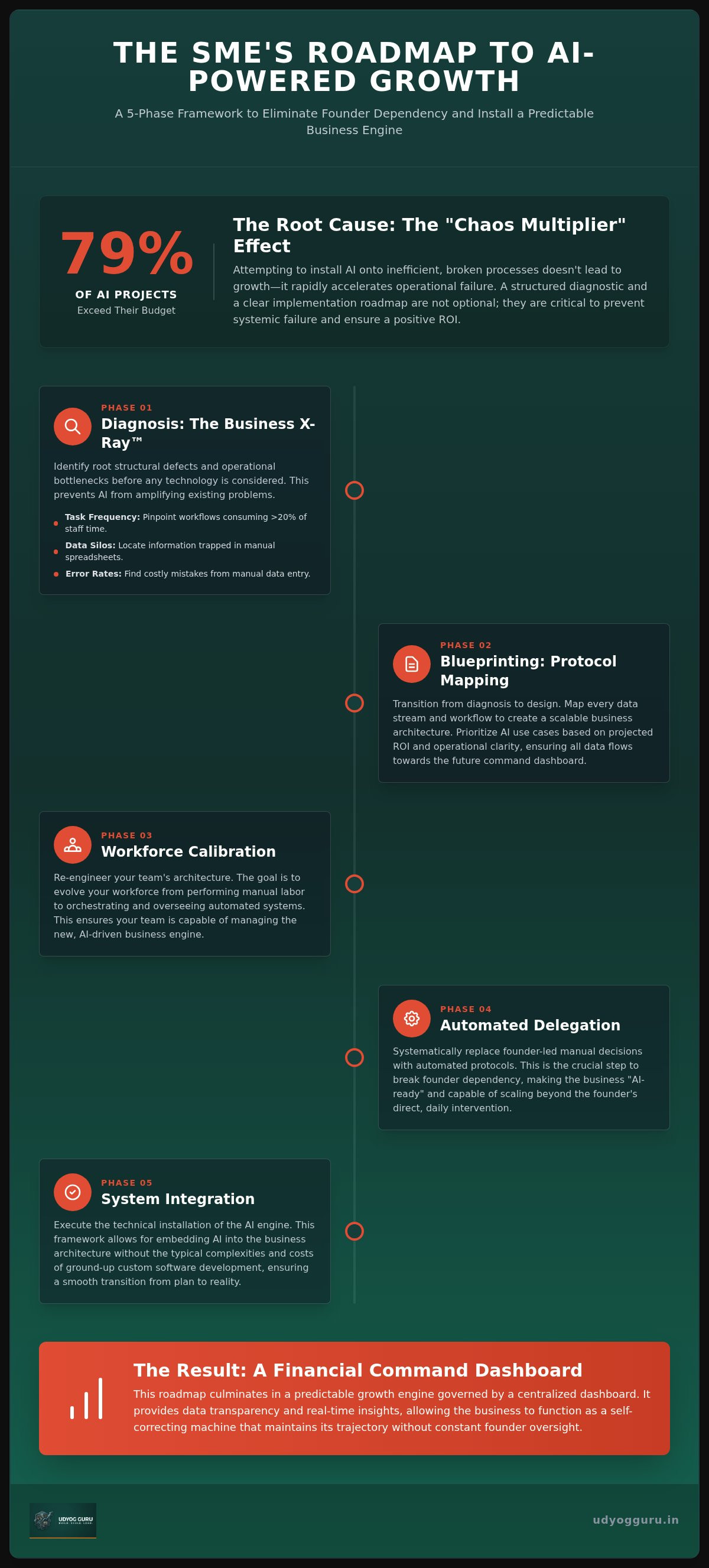
Moving from diagnostic theory to operational reality requires a strictly sequenced protocol. This ai implementation roadmap for smes is designed as a five-stage engineering process, ensuring that each layer of technology is anchored to a stable business foundation. By treating implementation as a series of calibrations rather than a singular event, leadership can mitigate the risk of project overruns. Recent data from February 2026 indicates that nearly 80% of enterprise AI projects exceeded their budgets due to poor structural planning; a phased approach eliminates this volatility by validating each component before full scale-up occurs.
Phase 1 & 2: Diagnosis and Blueprinting
The initial stages focus on constructing a Scalable Business Architecture that specifically accounts for the deployment of autonomous agents and automated workflows. During Phase 1, the Business X-Ray™ identifies structural gaps that would otherwise compromise the installation. Phase 2 involves Protocol Mapping, where leadership must prioritize AI use cases based on a rigorous assessment of projected ROI and operational clarity. It's a blueprinting exercise where every data stream is mapped to flow directly into the Financial Command Dashboard. This ensures that every automated action remains visible, measurable, and aligned with the organization's overarching financial objectives.
Phase 3 & 4: Pilot and Integration
Phase 3 initiates the Pilot Installation, where AI is injected into controlled, low-risk workflows to conduct an engine test without disrupting core operations. This stage is governed by the "Minimum Viable Data" requirement. If the underlying data architecture is fragmented or inconsistent, the AI output will be fundamentally unreliable, necessitating a data-cleansing protocol before proceeding. Successful pilots move into Phase 4, which focuses on Systematic Integration across the entire enterprise. This process refines the Scaling a Business framework by replacing manual execution tasks with automated components. This effectively upgrades the organization from a human-dependent entity into a high-precision machine capable of autonomic growth.
The final phase transitions the organization into Autonomic Operations, where the focus shifts to continuous optimization and maintenance. The system is monitored for algorithmic drift and recalibrated to maintain peak efficiency as market conditions evolve. For founders ready to move beyond conceptual planning, the Business Acceleration Engine™ provides the structural integrity needed to sustain this level of technological integration.
Engineering the Workforce Architecture: Aligning Teams with AI
Workforce alignment represents the most volatile component of the ai implementation roadmap for smes. Without a clinical diagnosis of human output, teams often view technology as a predatory threat rather than a structural enhancement. To mitigate this friction, leadership must redefine human capital as a high-output system that requires precise calibration. Engineering this alignment involves moving beyond motivational coaching and toward a "business-as-science" model where every role is audited for its contribution to the overall business machine.
The Workforce X-Ray™ Protocol
Before any technology is installed, leadership must execute a rigorous Workforce Performance Audit. This diagnostic measure identifies the specific output capacity of each department and differentiates between "Task-First" workers and "Systems-First" architects. Task-first individuals focus on manual execution, while systems-first architects possess the logical framework to manage automated protocols. By identifying these traits early, you can align AI tools with specific performance metrics, ensuring that the workforce architecture remains balanced during the transition.
Transitioning roles from "Manual Operators" to "AI Orchestrators" is a structural requirement for scaling. An orchestrator doesn't perform the work; they manage the AI agents that execute low-value tasks. This shift allows your team to focus on the high-value decision points that were identified during the initial Business X-Ray™ scan. It's a systematic repair of the labor model that prioritizes cognitive leverage over manual stamina.
Automated Accountability Systems
Accountability shouldn't depend on a founder's intuition or constant follow-ups. By utilizing automated triggers, the need for manual delegation is removed from the daily workflow. AI systems track team progress against the Financial Command Dashboard in real-time, providing immediate data-driven clarity on project status. This creates a culture of "Quantitative Transparency," where every team member's output is visible and measurable.
Building this culture of transparency reduces operational chaos and eliminates the over-dependency on the founder for manual oversight. When the workforce architecture is synchronized with the ai implementation roadmap for smes, the business engine operates with a level of predictability that manual management cannot replicate. This foundation is essential for the final installation phases, where human and machine protocols merge into a single, high-output ecosystem.
Protocols for Automated Delegation: Freeing the Founder
Founder dependency isn't a badge of honor; it's a structural bottleneck that limits the scalable potential of the business machine. When an organization relies on the founder's manual intervention for tactical decision-making, it remains fragile and resistant to growth. Artificial intelligence shouldn't be utilized merely to perform existing tasks faster. It must be used to delegate those tasks entirely. This shift from "firefighting" to "Strategic Architecting" represents a critical phase in the ai implementation roadmap for smes, ensuring the business engine operates with autonomic precision.
Installing the Business Acceleration Engine™ provides the necessary framework for this founder-independent growth. It transforms the business into a predictable system where acquisition, fulfillment, and reporting occur through automated protocols. By removing the founder from the tactical weeds, the organization can focus on high-level calibration and market expansion. This transition requires a move away from intuition-based management toward a model of rigorous, data-driven delegation.
Architecting the Automated SOP
Standard Operating Procedures (SOPs) often fail because they exist as static documents that humans eventually ignore. To leverage AI effectively, these procedures must be converted into machine-readable sequences. This involves breaking down complex business processes into binary decision trees and logical triggers that an AI agent can execute. Key components of this architecture include:
- Logical Sequencing: Defining the exact order of operations for every recurring task.
- Intervention Thresholds: Establishing the precise parameters where the system triggers a notification for human oversight.
- Metric Alignment: Ensuring every automated protocol links back to a core business performance metric to maintain structural integrity.
The Financial Command Center
Operational clarity is impossible without total data transparency. The Financial Command Dashboard eliminates the need for manual spreadsheet updates by aggregating real-time data from every automated workflow. This command center allows for absolute fiscal control, providing a high-level diagnostic view of the business machine's health. Automated reporting ensures that even as the organization scales, the architecture remains visible and manageable without the founder needing to engage in manual data entry.
Consider the transition of a mid-sized firm that replaced its manual reporting with these delegation protocols. Within six months, the leadership reduced their tactical workload by 40%, allowing them to focus on the structural engineering of new revenue streams. To begin this systemic repair of your own operations, you can implement the Business Acceleration Engine™ to drive founder-independent growth.
Installation and Next Steps: The AI Tech Business Integration Bootcamp™
The transition from architectural planning to technical installation marks the final stage of the ai implementation roadmap for smes. Many organizations fail at this juncture because they remain in a state of perpetual "explanation" rather than active "installation." The AI Tech Business Integration Bootcamp™ is designed to bridge this gap, moving beyond theory to embed functional protocols directly into the business engine. This isn't about conceptual learning; it's about the systematic deployment of the Tier 3 Protocol, which allows for the seamless integration of artificial intelligence without the prohibitive costs or timelines associated with custom software development.
The Bootcamp Methodology
The methodology focuses on "No-Code" and "Low-Code" technology stacks, allowing for rapid integration and immediate operational impact. This approach ensures that the Business Acceleration Engine™ is installed with surgical precision, minimizing downtime and maximizing structural integrity. During this process, the founder's role shifts from a manager of people to a "System Surgeon." In this capacity, you don't oversee manual tasks; you monitor the health of automated workflows and calibrate the engine for peak performance. This systematic approach ensures that the technology serves the business architecture, rather than the business becoming a slave to the technology.
Securing Your Competitive Advantage
A "wait and see" strategy in the 2026 economic landscape is a diagnostic failure. As AI adoption costs for small projects range between $25,000 and $75,000, those who delay installation risk falling into an "efficiency gap" that becomes impossible to close. By following a structured ai implementation roadmap for smes, you build a sustainable machine that scales without the traditional burden of linear costs. The first 90 days following a Business Diagnostic Scan are critical for establishing these foundations. This period focuses on data centralization and the activation of the Financial Command Dashboard, providing the transparency required to lead a founder-independent organization.
Calibrating your business engine for the challenges of 2026 requires a commitment to structural repair and technological innovation. The goal is to move from a state of operational chaos to one of autonomic growth. Enroll in the AI Tech Business Integration Bootcamp™ to install your roadmap today and ensure your business architecture is prepared for the next era of commerce.
Calibrating the Business Machine for Autonomic Growth
The transition into the 2026 economic landscape requires a shift from manual intervention to systematic precision. Establishing a robust ai implementation roadmap for smes isn't a speculative venture; it's a structural necessity for any organization aiming to eliminate operational chaos and founder dependency. By utilizing the proprietary Business X-Ray™ diagnostic tool, you identify the specific architectural gaps that hinder scalability. This ensures that every layer of technology added serves to strengthen the business engine rather than complicating a broken system.
Success is defined by the installation of the Business Acceleration Engine™, a framework that prioritizes no-code integration for rapid SME deployment. This methodology allows your team to move from manual execution to strategic orchestration, guided by the real-time transparency of the Financial Command Dashboard. The final step in this structural repair is moving from planning to active installation to secure your competitive advantage. You can Install your AI Roadmap with the AI Tech Business Integration Bootcamp™ to begin calibrating your organization for predictable, founder-independent growth. Your business is a machine; it's time to ensure it operates with surgical precision.
Frequently Asked Questions
How long does a typical AI implementation roadmap take for an SME?
A standard roadmap generally spans 12 to 24 months for full systemic integration, though initial diagnostic phases like the Business X-Ray™ are completed much sooner. The first 90 days are critical for establishing data readiness and pilot installations. This timeline accounts for structural recalibration, workforce alignment, and the deployment of automated protocols without disrupting core acquisition engines. It's a methodical progression that ensures the business architecture remains stable throughout the technological upgrade.
Do I need to hire a data scientist to start the AI integration process?
No, hiring a specialized data scientist is unnecessary for the initial stages of a systematic ai implementation roadmap for smes. Most small to mid-sized enterprises benefit more from a "Systems Architect" approach that focuses on no-code and low-code integrations. The priority should be on cleaning existing data and mapping business protocols rather than developing custom algorithms from scratch, which often results in excessive capital waste and operational delay.
What is the most common reason AI implementation fails in small businesses?
The primary cause of failure is a lack of structural clarity, often referred to as the "Chaos Multiplier" effect. When AI is layered onto a broken or manual business architecture, it simply accelerates existing inefficiencies. Without a preliminary Business X-Ray™ to diagnose operational gaps, technology becomes a superficial upgrade that fails to deliver a measurable return on investment. Successful implementation requires a clean diagnostic scan before any technical installation occurs.
How does AI help in reducing a founder’s daily firefighting?
AI reduces firefighting by converting manual decision-making into automated delegation protocols. By architecting machine-readable SOPs, the business engine can handle recurring tactical tasks without founder intervention. This shift allows the founder to move from a reactive role to a "Strategic Architect" who monitors the organization through a Financial Command Dashboard. This transition ensures operational transparency and reduces the emotional burden of constant crisis management by installing predictable, self-correcting systems.
What are the minimum data requirements for an AI-driven Business X-Ray™?
A diagnostic scan requires structured data regarding task frequency, employee output metrics, and financial performance history. While "big data" isn't necessary, you must have "minimum viable data" that is consistent and accessible. This includes digitized records of customer acquisition costs, fulfillment timelines, and operational error rates. These inputs allow the diagnostic framework to pinpoint exactly where the business machine requires calibration or systematic repair to support future automation.
Can AI be integrated into existing legacy systems without custom development?
Yes, modern AI tools are designed for seamless integration with legacy systems through low-code middleware and API connectors. This approach avoids the high costs and long lead times of custom software development. By focusing on "Systems Integration" rather than "Building," SMEs can upgrade analog workflows into automated engines rapidly. This maintains structural integrity while leveraging the specialized capabilities taught in the AI Tech Business Integration Bootcamp for maximum efficiency.
How do I measure the ROI of my AI implementation plan?
ROI should be measured through the lens of operational efficiency and founder-independent growth. Key metrics include the reduction in manual labor hours, the decrease in operational error rates, and the increase in high-value decision output. By monitoring these variables through a Financial Command Dashboard, you can quantitatively track how the ai implementation roadmap for smes translates into improved profit margins and a more scalable, reliable business architecture over time.
What is the difference between AI automation and a standard Business Acceleration Engine™?
AI automation is a specific technological toolset, whereas the Business Acceleration Engine™ is a comprehensive structural framework. Automation performs tasks, but the engine organizes those tasks into a predictable, high-output machine. While AI provides the execution power, the engine provides the architecture, ensuring that every automated protocol aligns with the organization's broader growth strategy and financial objectives rather than operating in an uncoordinated, fragmented vacuum.


