
The primary reason most scaling enterprises fail to reach their next revenue milestone is not a lack of capital, but a systemic rejection of structural autonomy. When your presence is the only thing preventing operational collapse, you haven't built a business; you've built a high-stress job that relies on your constant, manual calibration. You've likely experienced the friction of founder dependency, where every ₹10,000 decision or workflow adjustment requires your direct oversight. Successfully implementing team management systems requires moving beyond simple software adoption and into the realm of architectural repair.
You recognize that your current chaotic processes are causing high turnover and a dangerous lack of transparency in output. This article provides a rigorous diagnostic framework to identify these points of operational friction and install high-output systems that eliminate the need for your constant intervention. We'll examine the clinical steps to scan your organization for bottlenecks, diagnose the root causes of inefficiency, and deploy a Workforce Acceleration Engine™ that ensures predictable growth. By the end of this protocol, you'll have a blueprint for automated delegation and total financial control that transforms your business into a self-sustaining machine.
Key Takeaways
- Distinguish between raw workforce activity and optimized output to ensure every operational hour contributes to measurable enterprise growth.
- Use the Workforce X-Ray™ diagnostic protocol to identify hidden structural friction and bottlenecks before you've attempted to scale.
- Shift the burden of oversight from the founder to the architecture by implementing team management systems that allow the process to manage the team.
- Apply the "Zero-Ambiguity" rule to your workflow protocols to eliminate the operational chaos that's caused by vague task handoffs.
- Integrate the Financial Command Dashboard to translate raw workflow data into real-time financial transparency and total executive control.
Implementing Team Management Systems: A Clinical Definition
In the architecture of a scaling enterprise, team management is often misunderstood as a soft skill or a motivational exercise. From a diagnostic perspective, implementing team management systems is the systematic calibration of workforce inputs to produce predictable enterprise outcomes. It represents the transition from a person-dependent operation to a process-governed machine. For Indian SMEs, this distinction is critical. Most founders confuse raw activity, the visible effort of a busy team, with optimized output, which is the actual value created per unit of resource spent. High activity without a system is merely expensive noise.
By 2026, the primary inhibitor of scaling is "Operational Friction." This occurs when internal resistance, caused by vague protocols and manual intervention, slows down the business engine. Relying on manual, founder-led processes is no longer just inefficient; it's a structural risk to business continuity. If your direct oversight is required for a ₹50,000 project to reach completion, your business has a biological limit. It cannot grow beyond your personal bandwidth. The process of implementing team management systems involves installing a protocol where the system, not the individual, ensures the quality of the result.
The Anatomy of a High-Output Workflow
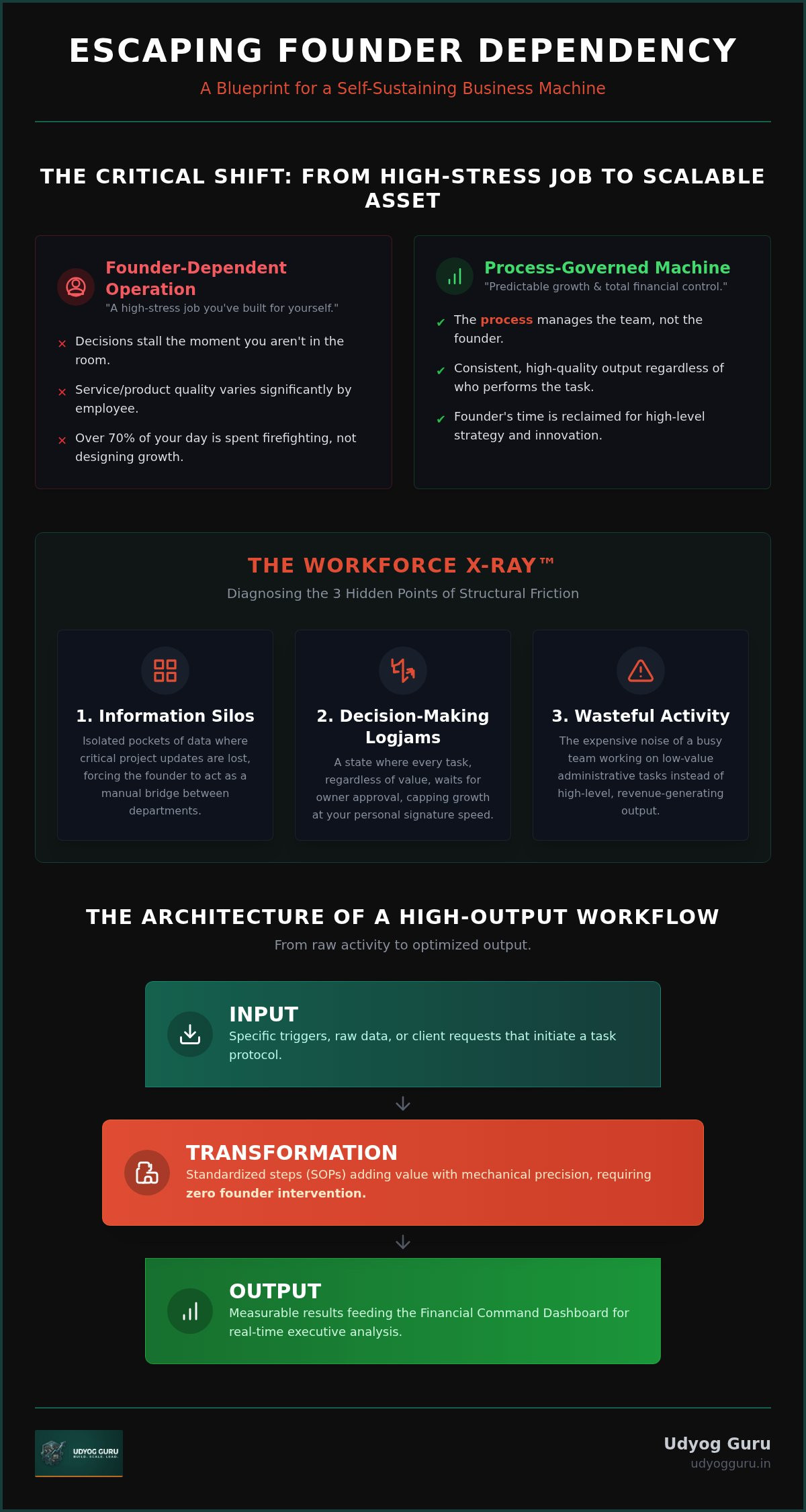
A functional system treats work as a mechanical sequence. To achieve structural integrity, every workflow must be broken down into three dimensional layers:
- Input: The specific triggers, raw data, or client requests that initiate a task protocol.
- Transformation: The standardized steps (SOPs) that add value through mechanical precision, requiring zero founder intervention to move to the next stage.
- Output: The measurable result that feeds directly into the Financial Command Dashboard for real-time executive analysis.
Why Leadership Styles Fail Without Structural Systems
Leadership is often a mask for a lack of architecture. While many founders rely on "Managerial Oversight," which involves constant check-ins and troubleshooting, true scaling requires "Systemic Accountability." Software alone can't fix a broken business architecture; it only digitizes existing chaos. You must first repair the logic of the workflow before you automate it.
There are three clear signs of a founder-dependent workflow that prevents scaling. First, decisions stall the moment you aren't in the room. Second, the quality of your service or product varies significantly based on which employee is performing the task. Third, you spend more than 70% of your day firefighting instead of designing growth. If these symptoms are present, your current leadership style is actually subsidizing a failing system.
The Workforce X-Ray™: Diagnosing Structural Friction
Before any structural repair can begin, a rigorous examination of the current organizational pathology is mandatory. This follows the "Diagnostic Before Prescription" rule. It's a fundamental principle that prevents the installation of expensive software onto a broken logic. Implementing team management systems effectively requires more than a new tool. It demands a deep-tissue scan of how your team actually functions. Without this initial calibration, you risk automating inefficiency and scaling your problems alongside your revenue.
This phase is anchored in a comprehensive workforce performance audit. By mapping the movement of information and the speed of decision-making, we identify where the business machine is leaking energy. We don't look for motivational issues; we look for structural cracks in the engine block.
Identifying Operational Bottlenecks
Structural friction usually manifests in three specific areas. First, we scan for "Information Silos." These are isolated pockets of data where critical project updates go to die. These silos force the founder to act as a manual bridge between departments, wasting high-level bandwidth on low-level coordination. Second, we identify the "Decision-Making Logjam." This is a state where every task, regardless of its value, waits for owner approval. If your team cannot move a ₹5,000 expense forward without your signature, your growth is capped by your own signature speed. Finally, the audit quantifies "Wasteful Activity." We distinguish between low-value administrative friction and high-leverage work that directly drives enterprise value.
Mapping the Invisible Workflow
The "Invisible Workflow" is the gap between your official manual and how the job actually gets done. Employees often develop workarounds to bypass broken processes. These workarounds are symptoms of a failing architecture. The Workforce X-Ray™ is a quantitative audit of human capital efficiency that captures these hidden interactions. Implementing team management systems requires a precise mapping of these invisible workflows to ensure the new architecture fits the reality of the workshop floor.
The Business X-Ray™ provides the macro-level scan required to see how these workforce failures impact your bottom line. It reveals the architectural flaws that prevent individual departments from syncing correctly. This level of scrutiny is essential for any leader who wants to move from a "firefighter" role to a "Systems Architect" position. If you're ready to see the true state of your operations, a Workforce X-Ray™ can reveal the structural cracks before they cause a total collapse.
Architecting the Workforce Acceleration Engine™
Once the Workforce X-Ray™ has identified the structural cracks in your operation, the business must transition from a diagnostic state to active installation. Implementing team management systems at this level isn't about choosing a task manager; it's about architecting the Workforce Acceleration Engine™. This engine acts as a mechanical governor for your team, ensuring that the process manages the people rather than the manager chasing the process. The goal is to build an "Architecture of Autonomy" where the business functions as a high-output machine, independent of the founder's daily manual input.
Installing the Accountability Framework
A high-performance machine requires precise monitoring of its internal components. To achieve this, we deploy a team performance metrics framework that tracks output with clinical accuracy. Every node in your workflow must have "Clear Ownership" assigned to a specific individual. This eliminates the ambiguity that leads to missed deadlines and finger-pointing. When every team member knows exactly what they're responsible for, and the data is captured in real-time, the need for time-wasting "check-in" meetings is purged from the system. Real-time reporting provides the transparency needed to maintain order without constant executive intervention.
Removing Founder Dependency
The most dangerous bottleneck in an Indian SME is often the founder's own bandwidth. To remove this dependency, we install automated delegation systems that utilize strict "Escalation Protocols." These protocols ensure that standard operational decisions are handled by the system or the team, while the founder is only alerted to Tier 1 exceptions. This shift requires you to abandon the role of "Chief Problem Solver" and embrace the identity of a "Systems Architect."
By delegating the logic of the business to the system itself, you ensure that the enterprise can scale without a linear increase in your personal working hours. The business machine should be able to process a 50% increase in volume without requiring a single extra hour of your time. This level of calibration is what separates a chaotic, founder-led startup from a professionalized, scalable corporation. Implementing team management systems is the final step in securing your time and your company's future.
The 2026 Implementation Checklist: Standardizing Workflow Protocols
Scaling an enterprise in 2026 requires a shift from intuitive management to mechanical standardization. Implementing team management systems without first defining your protocols is like installing a high-performance engine in a rusted chassis. You must prioritize structural integrity over temporary productivity gains. This checklist utilizes the "Zero-Ambiguity" rule, ensuring that every task handoff is clinically defined and leaves no room for human interpretation or error. By following this protocol, you align your operation with the broader workforce optimization strategies required for high-output scaling.
Phase 1: Protocol Standardization (SOPs)
The first phase focuses on the underlying logic of your business machine. You cannot automate what you haven't first standardized. This requires a three-step installation process:
- Step 1: Document the "Golden Thread." Identify the primary revenue-generating workflow that drives your enterprise. If you cannot map this thread from initial trigger to final delivery in a single, unbroken line, your architecture is fragmented and prone to failure.
- Step 2: Create "Zero-Ambiguity" SOPs. Standardizing manual labor is simple; standardizing repetitive cognitive tasks is where most Indian SMEs fail. Every decision-making node must have a binary logic that allows a team member to proceed without asking for your permission.
- Step 3: Install the Workforce Acceleration Engine™. Move your SOPs from static documents into active task triggers. The system must automatically initiate the next stage of the workflow the moment the previous node is completed, removing human memory as a point of failure.
Phase 2: AI and Automation Integration
Once your protocols are standardized, you can begin the process of technological calibration. This phase ensures that your human capital is only used for high-leverage work while the machine handles the administrative friction.
- Step 4: Audit for "Cognitive Waste." Scan your workflows for low-value tasks like data entry, meeting scheduling, or status reporting. If a manager is spending 30% of their time on these activities, you're subsidizing inefficiency.
- Step 5: Integrate AI via the AI Tech Business Integration Bootcamp methodology. Deploy AI as a structural component of your workflow rather than a separate tool. This ensures that automation is baked into the "Golden Thread" you defined in Phase 1.
- Step 6: Deploy "Agentic" Workflows. Use autonomous scripts to bridge the gaps between disparate software tools. These agents act as the connective tissue, ensuring data flows seamlessly from your CRM to your project management system without manual intervention.
If your team is currently trapped in a cycle of manual firefighting and vague task handoffs, your business architecture is leaking revenue. You can begin the process of systematic repair by joining our AI Tech Business Integration Bootcamp to learn how to install these high-output protocols today.
The Financial Command Dashboard: Quantifying the Machine
The ultimate objective of implementing team management systems is not merely to organize tasks, but to achieve total financial transparency through operational data. The Financial Command Dashboard serves as the cockpit of the enterprise, where raw workforce metrics are converted into actionable fiscal intelligence. In the Indian market, where operational costs can fluctuate rapidly, relying on intuition is a structural vulnerability. You must translate every workflow node into a financial value to understand the true health of your machine. Without this level of quantification, scaling is a blind exercise in risk rather than a controlled expansion.
Bridging Operations and Finance
A significant gap exists in most SMEs between how the team works and how the business earns. We bridge this by tracking the "Cost of Friction." This metric identifies the exact financial leak caused by redundant meetings, task re-runs, and manual handoffs. For instance, an unoptimized process that delays a ₹10,00,000 project delivery by just one week represents a tangible loss in revenue velocity. By optimizing team systems, you directly stabilize cash flow and improve quarterly profitability. We convert "Team Hours" into "Revenue Velocity" metrics, allowing you to see exactly how fast your internal engine turns human effort into liquid capital.
The Founder’s Command Center
As a Systems Architect, you no longer need to investigate departments to find problems. The Financial Command Dashboard allows you to open a single interface and see the entire organization's performance in real-time. This dashboard highlights which systems require "Re-Calibration" or immediate repair, allowing for surgical interventions rather than broad, ineffective changes. It removes the need for anecdotal evidence or "gut feelings" about team performance. Implementing team management systems ensures that every data point on your screen is rooted in standardized, verifiable output.
Achieving the "15-Minute CEO" lifestyle is the byproduct of this systemic control. It isn't about working less; it's about the machine working more effectively without your intervention. When your reporting is automated and your protocols are standardized, your primary role shifts to monitoring the dashboard for Tier 1 exceptions and strategic growth. You gain the financial control necessary to make bold scaling moves, backed by the data that your high-output systems provide every hour. This is the final stage of business transformation: moving from a founder-dependent struggle to a data-driven enterprise.
Securing Your Enterprise Through Systemic Calibration
Scaling an enterprise without a calibrated architecture is a high-risk gamble that often leads to operational collapse. You've seen how the path to 2026 growth requires a shift from manual oversight to systemic accountability. By using the Workforce X-Ray™ to diagnose friction and installing a tiered Acceleration Engine™, you move from a state of chaos to one of mechanical precision. Implementing team management systems is the definitive method for purging founder dependency and reclaiming your executive bandwidth.
True leadership in a scaling business means acting as a Systems Architect rather than a chief firefighter. With the Financial Command Dashboard, you gain the real-time visibility needed to make data-driven decisions that impact your bottom line. It's time to stop managing people and start managing the machine that manages the people. Schedule your Business X-Ray™ to diagnose your team’s operational friction today. Your business is a machine; let's ensure it's built for high-output growth.
Frequently Asked Questions
What is the first step in implementing team management systems for a scaling team?
The first step is performing a rigorous diagnostic scan of your current operational architecture to identify structural friction. At Udyog Guru, we utilize the Workforce X-Ray™ protocol to map how work actually moves through your organization. This data-driven assessment ensures that you aren't simply digitizing chaos. By scanning for bottlenecks first, you create the baseline necessary for successfully implementing team management systems that actually scale.
How do I identify bottlenecks without micro-managing my employees?
You identify bottlenecks by monitoring system data rather than individual behavior. When you have a standardized workflow, the Financial Command Dashboard reveals where tasks stall or where the "Cost of Friction" increases. This clinical approach allows you to see the "Decision-Making Logjam" without needing to hover over an employee's desk. It shifts the focus from managing people to managing the engine that drives your enterprise.
Can implementing team management systems really remove founder dependency?
Yes, it removes dependency by installing a process-led logic where the system governs the team. Through the Workforce Acceleration Engine™, you establish "Zero-Ambiguity" protocols that allow tasks to move forward without your direct intervention. This structural autonomy ensures the business continues to function at peak efficiency whether you're present or not. It effectively transforms you from a "Chief Firefighter" into a "Systems Architect."
What is the difference between a Workforce X-Ray™ and a standard performance review?
A standard performance review is a subjective assessment of an individual's behavior, whereas a Workforce X-Ray™ is a clinical diagnostic of your business architecture. The X-Ray focuses on how structural flaws, like information silos or vague handoffs, inhibit team output. It doesn't look at personality; it scans the workflow nodes for mechanical failure. This provides a quantitative baseline for implementing team management systems that fix the root cause of inefficiency.
How does AI integration improve team productivity in 2026?
AI integration improves productivity by purging "Cognitive Waste" from your high-level human capital. In 2026, agentic workflows bridge the gaps between disparate software tools, ensuring data flows without manual entry. Our AI Tech Business Integration Bootcamp teaches you how to embed these technologies into your "Golden Thread" workflow. This allows your team to focus on high-leverage work while the machine handles repetitive administrative friction.
Do I need custom software development to optimize my business workflows?
No, you don't need custom software development to achieve operational excellence. Most Indian SMEs can reach high-output status by correctly calibrating and integrating existing SaaS platforms and AI agents. Udyog Guru focuses on architectural repair and tool integration rather than building expensive, custom-coded solutions. This approach provides faster deployment and greater flexibility as your business systems evolve and scale.
How often should a business recalibrate its team management systems?
A business should monitor its systems daily via the Financial Command Dashboard and perform a deep recalibration whenever it hits a new revenue milestone. As volume increases, the friction points in your engine often shift. Regular diagnostic scans ensure your architecture remains robust enough to handle higher loads. If you notice a drop in revenue velocity or an increase in founder-led firefighting, it's a clear signal for immediate system calibration.
What metrics are essential for tracking team output and systemic accountability?
Essential metrics include Revenue Velocity, the Cost of Friction, and Output per Unit of Resource. You must track "Clear Ownership" at every workflow node to ensure systemic accountability. These metrics translate raw team activity into financial data that appears on your command center. By quantifying the performance of your business machine, you gain the data-driven control needed to drive predictable growth and maintain total financial oversight.


